Over 10 technical rounds, RTK GPS wins on precision (1–2 cm versus 10–30 cm in odometry), speed of installation (1 to 3 hours versus 8 to 15 hours) and mobility. It loses however on all-weather robustness, entry cost and performance under dense trees. The final score is 6 rounds to 4 in favour of RTK, but this figure does not designate an absolute better: the cable remains unbeatable on a wooded garden of less than 800 m² or with a budget capped at 800 €.
The two contestants in brief
The perimeter cable
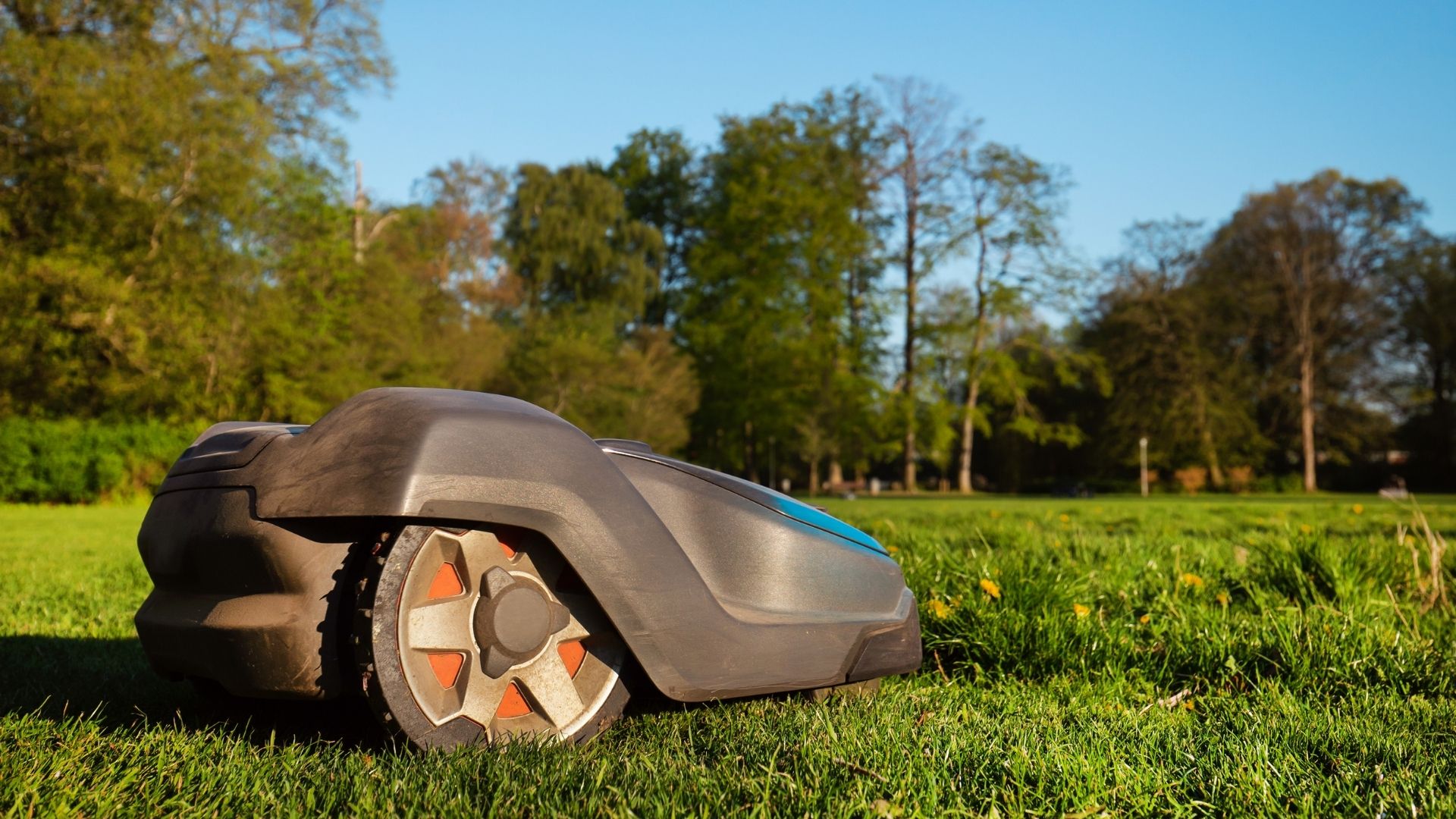
The perimeter cable is an inductive loop buried or stapled on the surface, powered by a base station that emits a signal at approximately 9 V. The robot continuously reads the magnetic field generated by this wire and adjusts its trajectory to stay inside the delimited zone. Its internal localisation relies on odometry: wheel sensors calculate the distance travelled and the angle of rotation. The trajectory is random, with rebound on the edges. This technology has been mature since 1995, the date on which Husqvarna commercialised the first consumer boundary-wire robot mower.
The RTK GPS
RTK (Real Time Kinematic) relies on a multi-constellation GNSS receiver that simultaneously captures GPS, Galileo, GLONASS and BeiDou signals. A local reference station or an NRTK network corrects measurement errors in real time, bringing theoretical precision to 1–2 cm. The robot plans trajectories in parallel strips and delimits its zones in a purely software manner. This technology appeared in the consumer market on robot mowers between 2021 and 2022, with models such as the Husqvarna Automower EPOS, the Mammotion LUBA and the Segway Navimow. For a complete presentation of the different navigation approaches, see our complete guide to robot mower navigation systems.
The match in 10 rounds
Round 1 : Positioning precision
Which technology knows best where it is in the garden?
The perimeter cable does not locate the robot: it only tells it that it is approaching a boundary. The internal position is calculated by odometry, with a cumulative drift of 10 to 30 cm over large surfaces. The larger the garden and the longer the trajectory, the more the error accumulates.
The RTK corrects its position every second thanks to differential corrections. Under clear sky, precision reaches 1–2 cm when static and remains below 5 cm while moving. The robot knows exactly where it is and can reproduce parallel strips with millimetre overlap.
Round winner: RTK.
Round 2 : Speed and complexity of installation
How long does it take to get the robot into service?
For a 500 to 800 m² garden with a few obstacles (beds, trees, paths), laying the perimeter cable takes 8 to 15 hours of work: tracing, stapling or burying, connection to the station, continuity test of the signal, then robot learning. The necessary equipment includes approximately 200 m of wire and several hundred nails or staples. Installation by an approved dealer costs an additional 200 to 500 €.
RTK requires positioning the reference station at height, connecting it to power, then calibrating the robot by walking it around the perimeter via the app. The operation takes 1 to 3 hours for the same surface, with no tools or cable to pull.
Round winner: RTK.
Round 3 : Weather robustness and all-weather performance
Which of the two technologies resists atmospheric conditions best?
The perimeter cable is insensitive to weather conditions. The inductive signal passes through rain, fog, melting snow and storms without measurable degradation. The robot can mow in overcast weather without any loss of navigation performance.
RTK depends on satellite signal quality. In ordinary overcast weather, degradation remains low (less than 5 cm additional). However, under an intense electromagnetic storm or during ionospheric disturbances, precision can drop by 30 to 60 %. Some models stop automatically to avoid leaving the virtual zone.
Round winner: perimeter cable.
Round 4 : Multi-zone management
Which of the two systems handles several separate zones most easily?
With the cable, each secondary zone requires either an additional guide wire or an independent loop connected to the station. Depending on the model, the number of manageable zones is limited to 3 to 5. Adding a zone requires pulling wire, connecting it and reconfiguring the station, which represents several hours of work.
With RTK, zones are purely software-based. Simply draw the new zone in the app in a few minutes. The number of zones is theoretically unlimited, and their modification (addition, deletion, resizing) requires no physical intervention on the ground.
Round winner: RTK.
Round 5 : Total entry cost (robot + accessories + installation)
Which technology requires the least initial investment to cover 500 m²?
A cable robot for 500 m² costs between 350 and 900 € depending on the model (Husqvarna 305, Gardena Sileno City, Worx Landroid M500). Add 80 to 150 € for wire, nails and accessories, for a total of 400 to 1 200 € excluding professional installation. Entry-level models such as the best robot mower under 1 000 € are almost exclusively wire models.
An RTK robot for the same surface costs between 800 and 1 800 €, reference station included or integrated. The entry gap is 400 to 600 € in favour of the cable, sometimes more on mid-range lines.
Round winner: perimeter cable.
Round 6 : Maintenance cost and common faults
Which of the two technologies generates the least expense over time?
The perimeter cable has a specific point of failure: wire breakage. It is estimated that 5 to 15 % of installations suffer a cut over 10 years, caused by rodents, a spade blow or soil compaction. Repair costs 30 to 80 € in parts and labour and requires locating the break with a detector.
RTK has no buried physical element liable to break. Navigation faults are virtually non-existent outside classic hardware failures (GNSS receiver, antenna). Regular firmware updates improve precision and obstacle management at no extra cost.
Round winner: RTK.
Round 7 : Mobility and moving
Which of the two systems moves most easily from one garden to another?
Moving a cable robot involves removing the entire wire, packing it, then reinstalling it in the new garden with a complete new layout. The operation takes 4 to 8 hours in both directions. Without reinstallation, the robot is unusable for the new owner.
With RTK, simply move the reference station, reposition it in the new garden and recalibrate the perimeter in the app. The operation takes approximately 1 hour. The robot is operational the same day.
Round winner: RTK.
Round 8 : Performance under dense trees or wooded borders
Which of the two technologies maintains its performance under vegetation cover?
The perimeter cable is totally insensitive to vegetation cover. The magnetic field passes through foliage, hedges and wooded structures without any attenuation. The robot mows just as well under a dense canopy as in full sun.
RTK loses precision as soon as satellite visibility drops below 70 %. Under dense trees or against a high wall, the robot may drift, slow down or stop automatically. Hybrid RTK + vision or RTK + LiDAR models partially compensate for this deficit, but do not eliminate it entirely.
Round winner: perimeter cable.
Round 9 : Security, anti-theft and identification
Which of the two systems best protects the robot against theft?
The perimeter cable offers no native anti-theft. A wired robot pulled from its station is immediately resalable or resettable by a third party. Some models integrate a PIN activation code, but it does not block resale of the machine.
RTK natively integrates several layers of protection: mandatory PIN code at start-up, geo-fence with alert if the robot leaves the zone, push notification in case of lifting. Some models such as the Mammotion LUBA 2 or the Segway Navimow integrate a 4G card allowing GPS location of the robot in case of theft.
Round winner: RTK.
Round 10 : Long-term scalability and zone extension
Which of the two systems adapts most easily to an evolving garden?
Expanding the zone of a cable robot requires pulling additional wire, reconfiguring the main loop and testing signal continuity. Each garden modification (new flower bed, added path) may require intervention on the layout.
With RTK, redrawing or expanding the zone is done in the app in approximately 10 minutes. No physical movement is necessary, unless the reference station must be repositioned to cover the new surface.
Round winner: RTK.
Final score and honest verdict
RTK wins 6 rounds out of 10: positioning precision (round 1), installation speed (round 2), multi-zone management (round 4), maintenance cost (round 6), mobility (round 7), anti-theft security (round 9) and scalability (round 10). The perimeter cable wins 4 rounds: weather robustness (round 3), entry cost (round 5) and performance under vegetation cover (round 8).
| Round | Criterion | Winner |
|---|---|---|
| 1 | Positioning precision | RTK |
| 2 | Speed and complexity of installation | RTK |
| 3 | Weather robustness and all-weather performance | Perimeter cable |
| 4 | Multi-zone management | RTK |
| 5 | Total entry cost | Perimeter cable |
| 6 | Maintenance cost and common faults | RTK |
| 7 | Mobility and moving | RTK |
| 8 | Performance under dense trees | Perimeter cable |
| 9 | Security, anti-theft and identification | RTK |
| 10 | Scalability and zone extension | RTK |
This 6–4 score does not designate an absolute better. Real weighting depends on the garden profile. For a 600 m² wooded garden, rounds 3, 5 and 8 (cable) weigh structurally more than the others: robustness under vegetation cover and entry cost are the determining criteria. For an open 2 000 m² garden with several distinct zones, rounds 1, 2, 4, 7 and 10 (RTK) take decisive importance. The raw score is a starting point, not a conclusion.
Decision grid: who should choose what
Profile 1 : small wooded garden under 800 €
Garden under 800 m², partially shaded by trees or high hedges, budget capped at 800 €. The perimeter cable is the logical choice: it is not affected by vegetation cover, its entry cost remains accessible and its reliability on small surfaces has been proven for thirty years. Suitable models: Stihl iMOW 4, Husqvarna Automower 305, Gardena Sileno City 250. These three models cover 250 to 600 m² for an investment of 400 to 750 €.
Profile 2 : medium open garden 800–2 000 m²
Garden of 800 to 2 000 m², mostly open with good satellite visibility, budget of 1 000 to 1 800 €. Pure RTK is relevant: 1–2 cm precision improves cut quality in parallel strips, installation is fast and scalability is an asset if the garden is likely to evolve. Suitable models: Segway Navimow i108E, Husqvarna Automower 520 NERA. See our Segway Navimow comparison for performance details.
Profile 3 : large multi-zone garden
Garden over 2 000 m², divided into several distinct zones (vegetable garden, orchard, main lawn), with possible seasonal mobility or a planned move. Hybrid RTK with all-wheel drive is the most suitable: it manages zones via software, supports uneven terrain and reconfigures without physical intervention. Suitable models: Mammotion LUBA 2 AWD, Segway Navimow X330. These models cover up to 5 000 m² with native multi-zone management.
Profile 4 : very shaded garden
Garden with very dense and continuous shade: urban forest, high hedges on three sides, closely spaced fruit trees. Pure RTK drops too frequently to be reliable. Two options: high-density cable (Husqvarna Automower 450X, designed for complex terrain up to 5 000 m²) or a hybrid RTK + vision model that switches to the camera when the satellite signal is insufficient. The cable remains the most predictable choice if the shade is structural and permanent.
FAQ
Is RTK really more precise than perimeter cable?
Yes on internal localisation: 1–2 cm versus 10–30 cm of odometry. But not on boundary delimitation. The cable offers a perfectly stable physical boundary, RTK a virtual boundary that can drift 5 to 10 cm in case of signal loss. On open ground, RTK wins clearly. Under trees, the cable remains more reliable for maintaining a precise and constant limit.
How long does it take to install a cable robot mower?
Allow 8 to 15 hours for a 500 to 800 m² garden with a few obstacles (beds, trees, paths). On a simple rectangular 300 m² garden, 4 to 6 hours suffice. Installation by an approved dealer costs 200 to 500 € depending on brand and surface, including installation guarantee. This labour cost is often underestimated in price comparisons.
Is a subscription required for an RTK robot mower?
No for models with a local reference station: Husqvarna EPOS local, Mammotion LUBA (station included), Segway Navimow. Yes, or strongly recommended, for models using a national NRTK network, at a rate of 5 to 15 € per month depending on the provider. The 4G anti-theft card of certain models may also require a subscription after an offered period of 12 to 24 months.
Does an RTK robot mower work under trees?
Only partially. Pure RTK loses precision as soon as satellite visibility drops below 70 %. Under dense cover, the robot slows, drifts or stops. Hybrid RTK + vision or RTK + LiDAR models compensate by switching to the camera when the signal drops. For very shaded gardens, the perimeter cable remains the most reliable and predictable choice on a daily basis.
Is perimeter cable obsolete in 2026?
No. On 800 m² or less, on wooded gardens, or with a budget capped at 800 €, the cable remains the best reliability-price compromise. Husqvarna, Stihl, Gardena, Worx and Kress continue to release wire models every year. Several of them obtain an Mowy Lab score above 8/10 against entry-level RTK models, particularly on robustness and cut regularity criteria.
Can a wired robot be converted into an RTK robot?
No. Navigation is integrated into the robot's motherboard and firmware. No manufacturer offers an RTK retrofit kit on an existing wired model. A new RTK robot must be purchased, or a new wired model compatible with the wire already in place must be installed, which remains a wired installation and not a conversion. The existing wire can sometimes be reused if its layout is compatible with the new model.
Updated on 2026-05-29.