A robot mower navigates using four main families: the buried perimeter wire (reliable, mature, economical), camera and onboard AI vision (no heavy installation, but sensitive to light), RTK GNSS (1 to 2 cm precision, but requires open sky) and hybrid RTK + vision (the most versatile, the most expensive). The right choice depends on the area, obstacle density and sky coverage of the garden, not an absolute performance ranking.
How Does a Robot Mower Find Its Way Around a Garden?
Every navigation system must answer three distinct questions, in order.
Delimitation: where is the robot not allowed to go? This involves defining the boundaries of the mowing area, lawn, flower beds, paths, pool. This step is logical or physical depending on the technology.
Localisation: where exactly is the robot at that precise moment within the authorised area? This is where the families diverge the most. A robot that knows its boundaries but not its exact position mows randomly; a robot that localises to within 2 cm can mow in parallel strips.
Trajectory Planning: how does the robot decide its next movement, random, systematic in strips, or adaptive based on detected obstacles?
The four families answer these three questions differently:
- Perimeter Wire: physical delimitation by inductive loop, relative localisation by signal counting, trajectory often random.
- Vision: delimitation by camera mapping, localisation by scene recognition, adaptive trajectory.
- RTK GNSS: software delimitation by GPS coordinates, centimetre localisation by satellite, planned strip trajectory.
- Hybrid RTK + Vision: combines the last two to address their respective shortcomings.
The Perimeter Wire: The Historical Reference
Principle of Operation
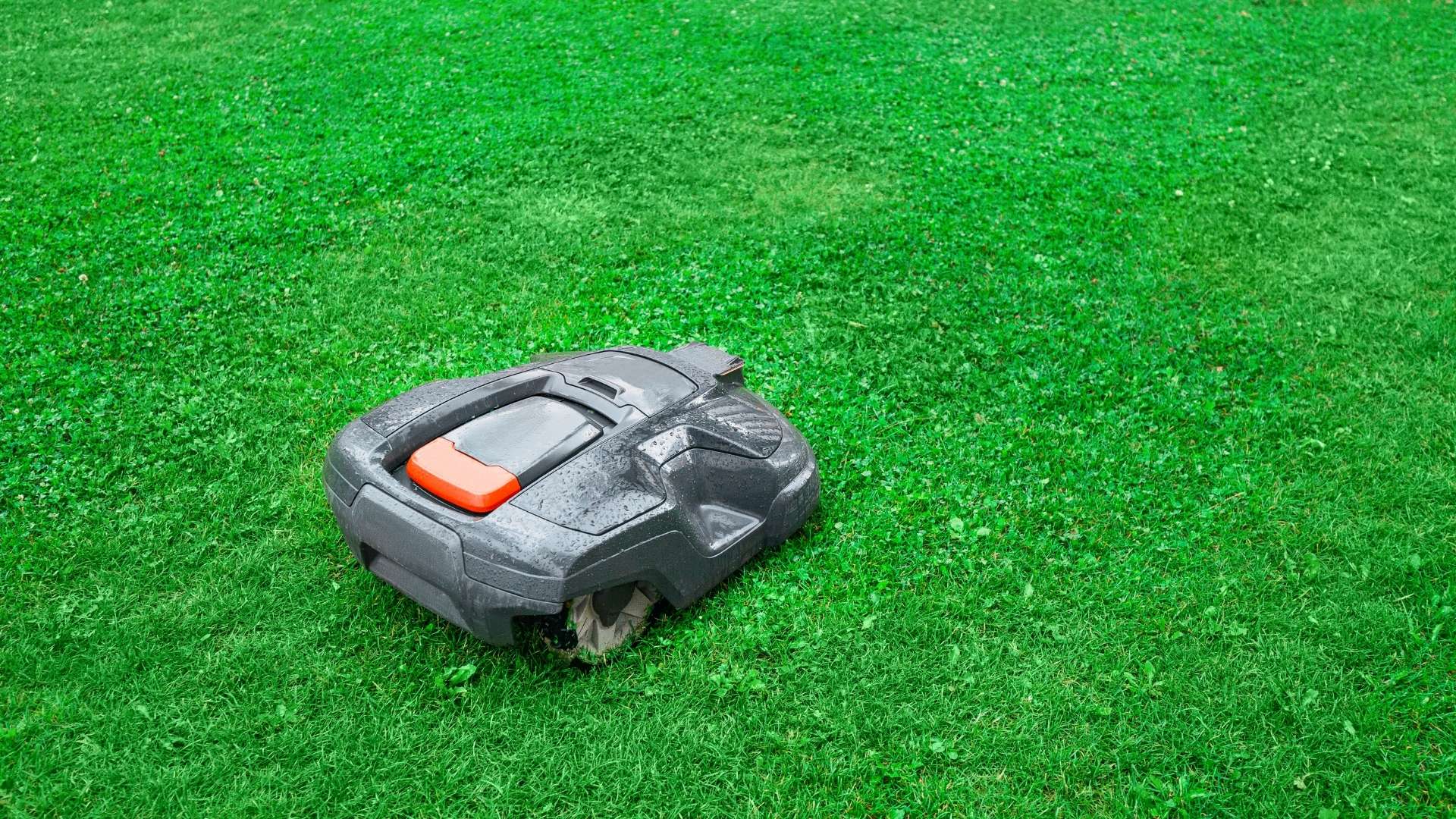
The perimeter wire is a loop of conductive cable carrying a low-voltage current (typically 9 V, signal encoded in frequency). The robot detects the emitted electromagnetic field and knows it is approaching the boundary. Inside the loop, it orients itself using wheel sensors (odometry) and bump or tilt sensors. The trajectory is most often random, with bouncing off the edges.
Installation
The cable is laid stapled on the surface (it disappears under the grass in a few weeks) or buried at 5–10 cm. Installing a simple 500 m² garden takes 8 to 12 hours. A garden with multiple separate zones, islands or narrow corridors may require 15 to 20 hours and additional guide cables.
Representative Models
The Husqvarna Automower 305 and 310 Mark II, the Worx Landroid M and the Gardena Sileno City are common examples in this family. In 2024, 80 to 95% of robot mowers sold in France still used the perimeter wire, according to distribution data from major specialist retailers.
Strengths
- All-weather reliability: rain, night, dense shade do not affect wire detection.
- Total independence from sky and network.
- Entry price among the lowest on the market.
- Proven technology for over twenty years.
Limitations
- Non-negligible installation work: trenches, joints, staples.
- After a storm or gardening work, the wire can break or shift.
- Extending to a new zone requires laying more cable and reconfiguring the base station.
- Relocation: the wire stays in the ground, residual value is zero.
Vision Navigation: Cameras and Onboard AI
Principle of Operation
Visually navigating robots carry one or more cameras (often stereoscopic to estimate depth) coupled with an AI processor. The algorithm distinguishes grass from hard borders, obstacles and non-mowable areas. The delimitation is defined during an initial mapping pass: the robot memorises the scene and builds a reference map.
Representative Models
The Eufy RoboVac E15 and E18 (V-FSD range), the Dreame A2 and the Worx Vision are the most widespread representatives. The Mova ViAX combines vision and RTK, it therefore belongs to the hybrid family, even if its marketing emphasises the camera.
Strengths
- Quick installation: 20 to 30 minutes for the initial mapping, no trenches.
- Dynamic obstacle detection (animals, toys, hose pipes).
- Software updates possible to improve scene recognition.
Limitations
- Night mowing degraded or impossible: without sufficient light, the camera loses its bearings. Some models carry auxiliary LEDs, but precision remains lower.
- Backlight and moving shadows (foliage stirred by the wind) generate false positives or untimely stops.
- Tall grass (> 8–10 cm): natural borders become hard to distinguish.
- Pure vision (without RTK) remains a minority in 2025–2026 sales. The majority of robots presented as "vision" actually integrate an RTK module, they are hybrid.
RTK GNSS: Centimetre Precision from Satellites
Principle of Operation
GNSS refers to the set of satellite navigation constellations: GPS (United States), Galileo (Europe), GLONASS (Russia) and BeiDou (China). A standard GNSS receiver achieves 2 to 5 metres precision, insufficient for neat strip mowing.
RTK (Real Time Kinematic) corrects this inaccuracy by comparing in real time the signal received by the robot with that of a fixed base station whose position is known exactly. The phase difference between the two receivers allows calculating the robot's position to within 1–2 cm. The base station can be local (box installed in the garden) or remote (NRTK network via internet).
Representative Models
Husqvarna offers EPOS technology on the Automower 450X NERA and 520 NERA. Mammotion launched the LUBA 1st generation as a pure RTK robot without wire. The Segway Navimow H series is another accessible reference in this family. For a detailed comparison of RTK models, see our RTK robot mower comparison.
Strengths
- Localisation precision: 1 to 2 cm in optimal conditions.
- Mowing in regular parallel strips, visual result close to a careful manual mowing.
- Software multi-zones: delimit as many zones as needed from the app, without laying extra cable.
- No wire to maintain or repair.
Limitations
The main limitation is structural: the satellite signal is weakened or blocked by anything interposing between the robot and the sky. Under dense tree cover, against a high wall or under a pergola, the robot loses precision, stops or drifts. The empirical rule: about 70% sky visibility is needed to maintain an exploitable RTK signal.
An 800 m² garden with several large trees may therefore be less well served by pure RTK than a fully clear 2 000 m² garden.
Cost is the other barrier: RTK models range from 1 800 € to 4 500 € depending on the covered area and brand. The base station must be installed in a fixed spot with a good sky view, and initial calibration takes 1 to 3 hours.
Hybrid RTK + Vision: The Versatile Path
Principle of Operation
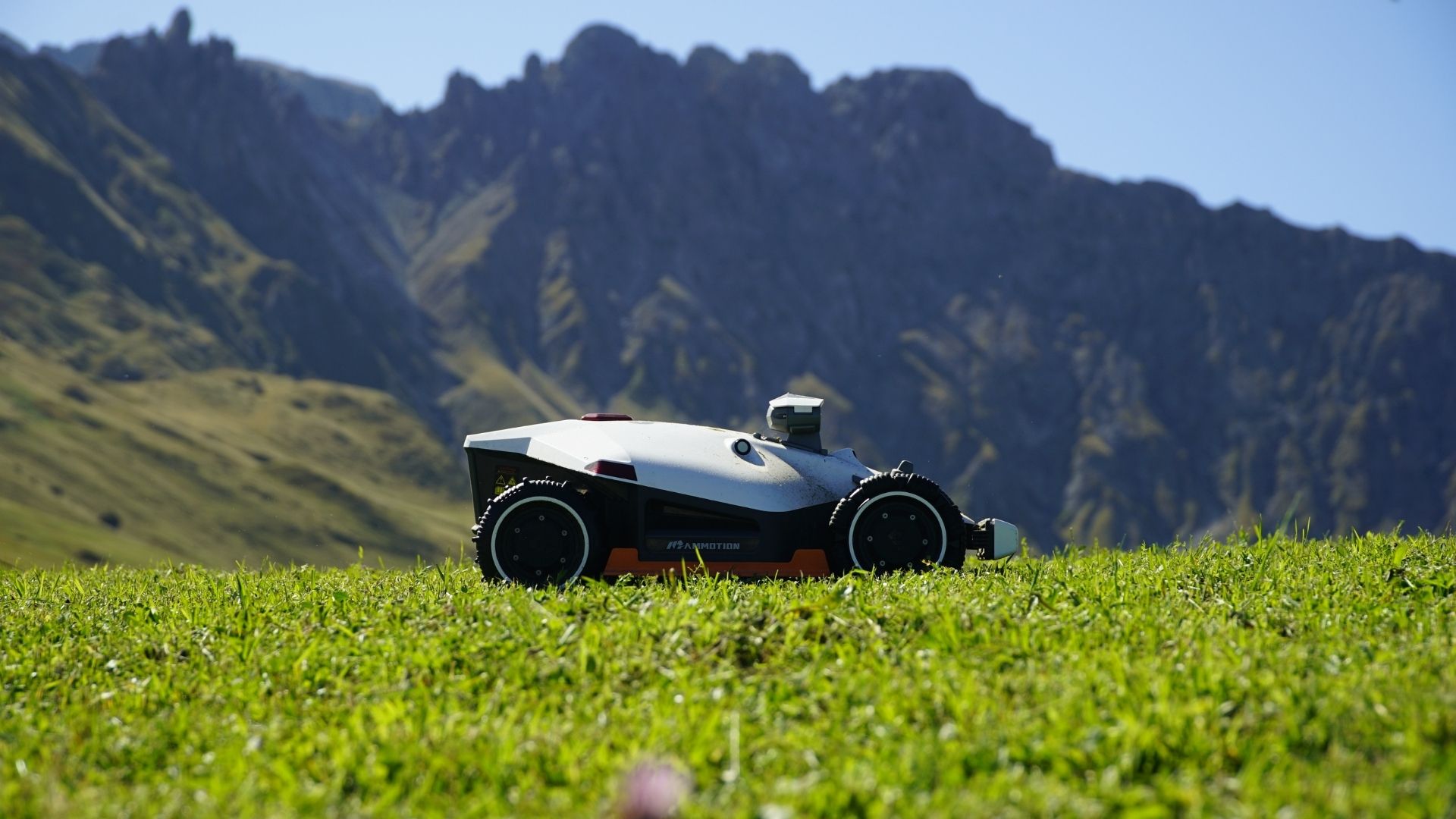
The hybrid architecture merges an RTK receiver and one or more cameras. When the satellite signal is strong (open air), RTK ensures centimetre localisation. When it drops (under trees, near a wall), the camera takes over to maintain approximate localisation and detect obstacles. The two data streams are fused in real time by an onboard processor.
Representative Models
The Mammotion LUBA 2 AWD and LUBA 3 AWD are the most cited references in this category. The Mova ViAX, Segway Navimow X3 and Dreame A3 AWD Pro also belong to this family. The Husqvarna Automower 450 V NERA integrates additional sensors to RTK for obstacle management.
Strengths
- Continuity of operation when RTK drops: the camera ensures handover.
- Dynamic obstacle detection: animals, toys, molehills, hose pipes.
- Planned strip mowing on clear areas, adaptive navigation under trees.
- Slope management thanks to AWD models (all-wheel drive).
Limitations
- Premium price: hybrid models start around 2 500 € and can exceed 6 000 € for large areas.
- Software complexity: firmware updates are frequent and sometimes critical. An unupdated robot may exhibit degraded behaviour.
- The camera remains sensitive to night and backlight, even if RTK partially compensates.
Comparison Table of the 4 Families
| Family | Precision | Installation | Typical Area | Sensitive To | Entry Price | Multi-Zones | Reference Model |
|---|---|---|---|---|---|---|---|
| Perimeter Wire | 10–30 cm (odometry) | 8–20 h (cable) | 200–5 000 m² | Wire breaks, storms | ~600 € | Guide cables required | Husqvarna 305, Gardena Sileno |
| Pure Vision | 5–15 cm | 20–30 min (mapping) | 200–1 500 m² | Night, backlight, tall grass | ~800 € | Software | Eufy E18, Dreame A2 |
| RTK GNSS | 1–2 cm | 1–3 h (station + calibration) | 500–10 000 m² | Tree cover, walls | ~1 800 € | Software, unlimited | Mammotion LUBA 1, Segway Navimow H |
| Hybrid RTK + Vision | 1–5 cm (depending on signal) | 1–3 h (station + mapping) | 500–15 000 m² | Price, critical updates | ~2 500 € | Software, unlimited | LUBA 2 AWD, Dreame A3 AWD Pro |
Which Navigation for Which Garden? The Mowy Lab Decision Grid
Sky coverage takes precedence over area. An 800 m² garden under dense trees calls for a different solution than a fully clear 800 m² garden. Here are four practical cases.
Compact Garden < 500 m²
Small area, often rectangular or simple. Obstacles are fixed (flower beds, terrace). Sky coverage varies but the area does not justify an RTK investment.
The perimeter wire covers this case with an excellent cost-reliability ratio. Pure vision is an alternative if cable installation is refused and the garden is well lit. RTK is financially oversized for this area.
Mowy Lab Reco: perimeter wire or vision, example: Gardena Sileno City or Eufy E18.
Medium Garden 500–1 500 m² with Trees
This is the most common case in France. The presence of mature trees creates satellite shadow zones and dynamic obstacles (leaves, low branches). Pure RTK will drop out regularly under the foliage.
Hybrid RTK + vision is the most coherent solution here: RTK handles clear areas, the camera takes over under trees. The wire remains relevant if budget is tight and topography is simple.
Mowy Lab Reco: hybrid RTK + vision, example: Mammotion LUBA 2 AWD.
Large Garden > 1 500 m² Clear Sky
Meadow, young orchard, private sports field: the area is large, the sky is open, obstacles are fixed and few. Pure RTK expresses its full potential here: neat parallel strips, software multi-zones, no cable to maintain.
Consult our purchase guide by area to refine the choice based on slope and terrain shape.
Mowy Lab Reco: RTK GNSS, example: Husqvarna Automower 520 NERA or Segway Navimow H series.
Sloped Terrain > 35 %
Beyond 35% slope, two criteria become priority: traction (AWD or high-grip studded wheels) and localisation stability. A pure vision robot can lose its visual bearings on a backlight slope. Pure RTK maintains precision uphill if the sky is clear, but drops if wooded.
Beyond 45%, only AWD hybrid models offer a robust enough combination of traction + localisation.
Mowy Lab Reco: hybrid RTK + vision with AWD, example: Mammotion LUBA 3 AWD or Dreame A3 AWD Pro.
Myths and Misconceptions About Navigation
"The wire is obsolete." False. More than fifteen wire models were launched or renewed in 2024–2025 by Husqvarna, Gardena, Worx and Stihl. On a garden under 800 m² with fixed obstacles, the wire offers a better reliability-price ratio than most wire-free alternatives. Obsolescence is commercial, not technical.
"GPS = RTK." False. A standard GPS receiver achieves 2 to 5 metres precision depending on atmospheric conditions. At this scale, a robot would mow in unpredictable zigzags. RTK adds real-time correction that reduces error to 1–2 cm, a 100 to 250 times gain. The two terms are not interchangeable.
"Wire-free = no installation." False. An RTK robot requires installing and precisely positioning a base station (with clear sky view), 1 to 3 hours calibration and mapping each zone from the app. It is less demanding than a trench, but not a ten-minute setup.
"The more expensive, the better it navigates." False. A well-installed Husqvarna Automower 305 with wire mows more regularly and reliably than a budget RTK on a wooded garden where the satellite signal drops every ten minutes. The most expensive technology only performs in the conditions it was designed for.
FAQ
What is the most precise navigation system for a robot mower?
RTK GNSS offers the best theoretical precision, 1 to 2 cm, provided there is a clear sky view. In a garden with trees, hybrid RTK + vision becomes more precise in practice: when the satellite signal drops under the foliage, the camera takes over and maintains usable localisation. Absolute precision thus depends as much on the garden as on the technology.
Is a wire robot mower outdated in 2026?
No. Under 800 m² and on wooded or complex gardens, the perimeter wire remains the most reliable and cheapest solution. Husqvarna, Gardena, Worx and Stihl continue releasing new wire models every year. The technology is mature, spare parts are available and the installer ecosystem is well established in France.
Does an RTK robot need a clear sky view?
Yes, largely. A pure RTK robot needs about 70% satellite visibility to maintain 1–2 cm precision. Under dense tree cover, the signal drops and the robot stops or drifts. Hybrid models (RTK + camera) partially compensate for this shortcoming, but do not eliminate it entirely: the camera has its own limits (night, backlight).
Which navigation to choose for a sloped terrain?
Beyond 35% slope, two criteria take precedence: traction (AWD or studded wheels) and localisation stability. A pure vision robot can lose its bearings on a backlight slope. RTK maintains precision uphill if the sky is clear. The hybrid with AWD remains the safe bet beyond 45% slope, combining robust localisation and sufficient grip.
Can you convert a wire robot to a wire-free one?
No. Navigation is integrated into the robot's motherboard and firmware. No manufacturer offers an RTK retrofit kit for an existing wire model. You must buy a new robot designed for wire-free navigation, or install a model from a compatible brand with an existing perimeter wire in place, which remains a wire installation, not a conversion.
What is the lifespan of a buried perimeter wire?
Well laid, stapled on the surface then colonised by the grass, or buried at 10–20 cm, a quality wire lasts 8 to 12 years. The main failure causes are spade strikes during gardening work, rodents gnawing the sheath and poorly crimped joints that oxidise. A break can be located in 15 to 30 minutes with a signal detection probe, available from most specialist retailers.
Last updated 2026-05-11.