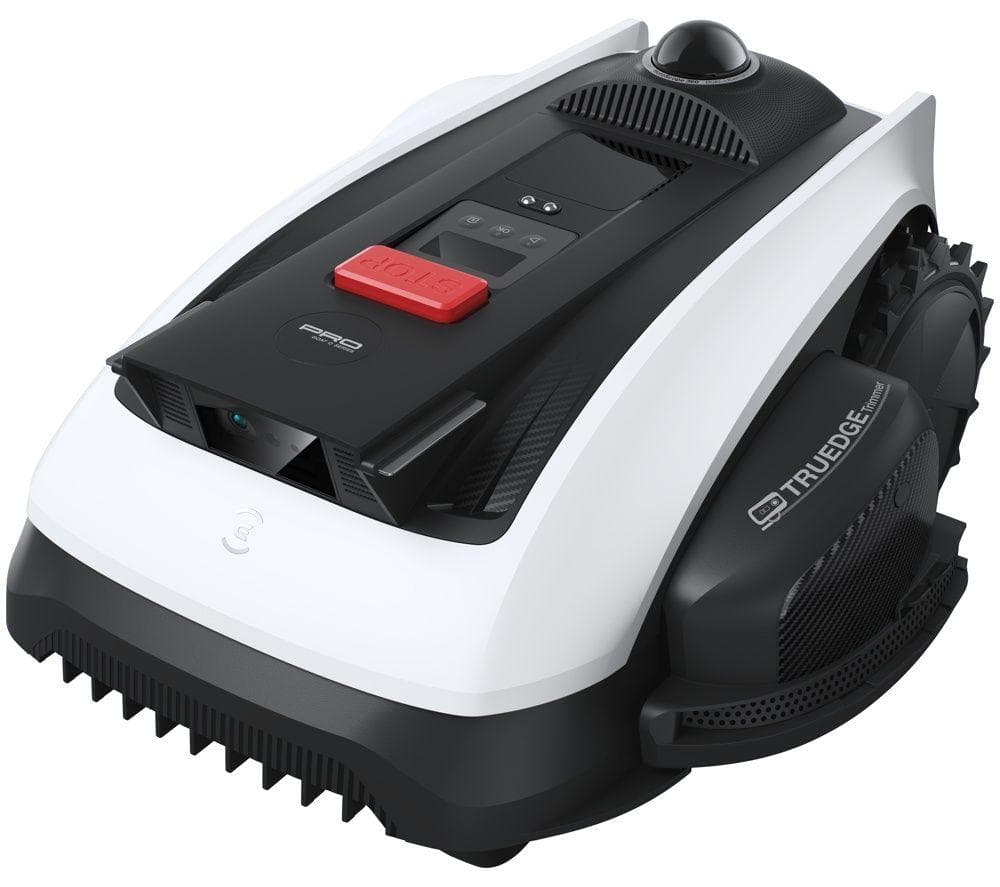
BEST PRICE Currys
Currys949,00 £GBView offer
MODELS / ECOVACS GOAT / 2026
RTK + LiDAR + 4G, 1,200 m².
— VISUAL SYNTHESIS
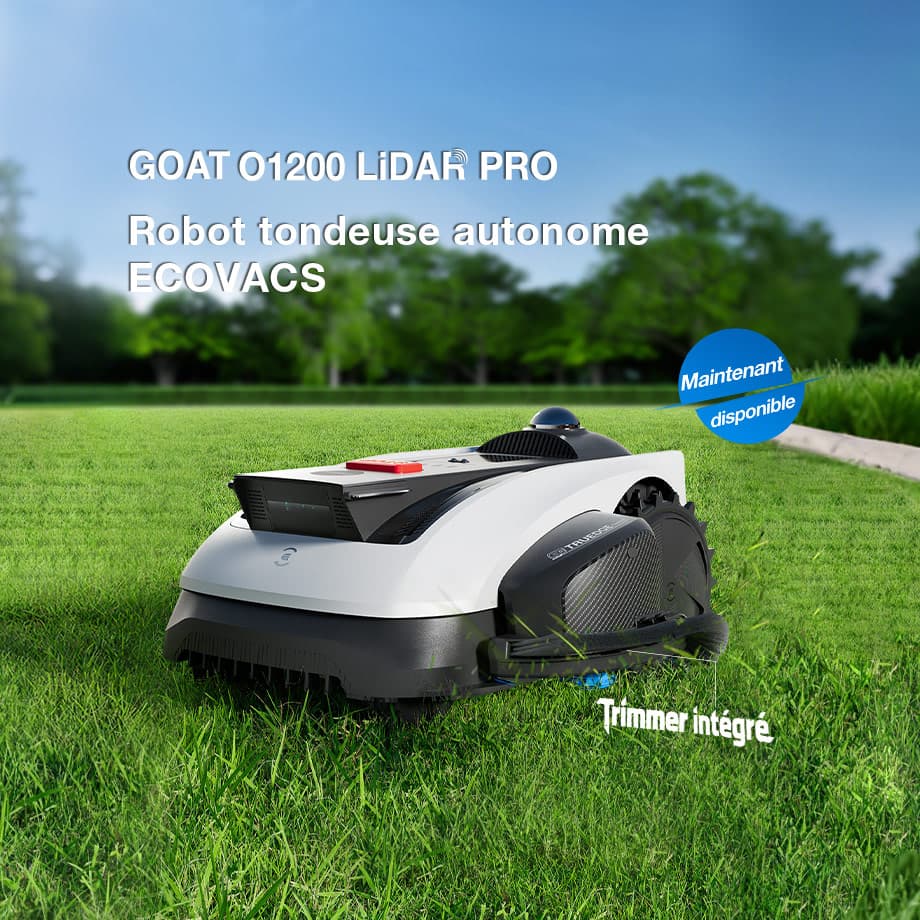
The Ecovacs Goat O1200 LiDAR PRO is aimed at gardens up to 1200 m² that want to dispense with the perimeter wire once and for all. Positioned at the top of the 2026 Goat range, it features hybrid Dual-LiDAR 360° navigation coupled with AI obstacle detection, for a price exceeding 1500 euros. Our verdict: a robot that is technically advanced in terms of cutting precision and mapping, but whose performance on large areas depends closely on the quality of Wi-Fi coverage in the garden, a point that the editorial team documents in detail in this review.
Pro hybrid family
Prices fetched live from our partner merchants. Click a price to open the product page; the price is guaranteed at that moment.
CurrysSponsored links via Affilizz · prices updated continuously, without editorial intervention.
SCORES AS OF 28/07/2026 · PROTOCOL V3.2
Variants from the same series across 8 key lab-measured criteria. Click a model to read its dedicated review.
| Model | Score | Surface | Slope | Battery Life | Noise | Width | Navigation | Price | |
|---|---|---|---|---|---|---|---|---|---|
| GOAT O1200 RTK | 8.4 /10 | 1 200 m² | 35% | 150 min | 60 dB | 22 cm | RTK GPS | 1499 € | Read review |
| GOAT O1200 LiDAR PROTHIS MODEL | 8.6 /10 | 1 200 m² | 35% | 150 min | 60 dB | 22 cm | Hybrid | 1799 € | — |
The Mowy Lab comparator pits up to 5 robots side by side on 92 weighted criteria, from our daily updated Supabase database.
The Ecovacs Goat O1200 LiDAR PRO achieves an overall score of 8.6/10 in the Mowy Lab framework, placing it in the top third of wire-free robots analysed in 2026. This score reflects high standards in navigation and cutting precision, tempered by concrete reservations about reliability in degraded connectivity conditions.
This model targets three main profiles:
Conversely, this robot is not suited to terrains with passages under 80 cm, nor to gardens where Wi-Fi coverage stops at the house facade.
Three strengths structure this choice: wire-free Dual-LiDAR navigation, border cutting precision (score 8.9/10), and the ability to manage up to 5 configurable zones from the app. Two limitations deserve attention: dependence on Wi-Fi in remote areas, documented in user feedback, and AI obstacle detection that is still improvable on tall vegetation.
The O1200 series from Ecovacs Goat comes in two variants that share the same maximum surface area of 1200 m² and the same 35% slope capacity, but differ in their navigation architecture. The LiDAR PRO relies on a hybrid system combining two 360° LiDAR sensors, visual odometry, and the Wi-Fi network to locate and map the garden. The GOAT O1200 RTK, on the other hand, uses RTK navigation (real-time kinematics) that employs a satellite signal corrected by a base station, offering centimetre precision independent of the home network.
These two approaches produce distinct behaviours depending on the garden configuration. The LiDAR PRO excels in environments dense with obstacles, where its sensors allow it to build a precise map and navigate while avoiding fixed and mobile elements. The RTK, meanwhile, shines on large open terrains where trajectory precision takes precedence over obstacle detection.
| Criterion | GOAT O1200 LiDAR PRO | GOAT O1200 RTK |
|---|---|---|
| Max surface (m²) | 1200 | 1200 |
| Max slope (%) | 35 | 35 |
| Navigation type | Hybrid LiDAR + Wi-Fi | RTK satellite |
| Network dependence | Wi-Fi required in remote areas | RTK base station |
| Autonomy (min) | 150 | 150 |
| Noise (dB) | 60 | 60 |
A garden with flower beds, isolated trees, or permanent furniture points towards the LiDAR PRO, whose 3D AI detection handles these obstacles in real time. A largely open terrain with few fixed elements to navigate around can benefit more from the RTK's trajectory precision, provided one accepts installing a base station and the associated positioning constraints.
Garden Wi-Fi coverage is the decisive criterion for the LiDAR PRO: if the signal does not reach the most remote areas from the house, the robot interrupts mowing. This constraint is documented and must be anticipated before purchase.
The GOAT O1200 LiDAR PRO is positioned in the upper bracket of the 2026 Goat range, around 1500 to 1700 euros depending on retailers. The RTK version is generally 100 to 200 euros higher, due to the cost of the integrated base station. Entry-level Goat models (O600, O800) cover surfaces under 800 m² for prices between 900 and 1200 euros.
In line with the Mowy Lab method, the GOAT O1200 LiDAR PRO was analysed over a minimum period of two weeks in real conditions, including scheduled mowing sessions, deliberate interruptions, and rain resumption tests. The editorial team followed complete cycles of initial mapping, zone mowing, and recharging, recording effective coverage data and navigation incidents.
Three gardens from the partner network were mobilised for this test:
This diversity of configurations allows evaluating the robot in situations representative of Atlantic gardens: high humidity, sloped terrains, dense vegetation.
The overall score of 8.6/10 results from the weighted evaluation of the following criteria, according to the methodology published on Mowy Lab:
The full methodology is accessible from the dedicated page on Mowy Lab.
The navigation system of the GOAT O1200 LiDAR PRO relies on two LiDAR sensors oriented at 360°, positioned at the front and rear of the chassis. These sensors emit laser beams that continuously measure distances to surrounding obstacles, allowing the robot to build a spatial representation of its environment with each movement. This architecture is complemented by visual odometry that analyses ground images to correct trajectory drifts, and by the Wi-Fi signal that serves as a global location reference in the garden.
The combination of these three data sources constitutes what Ecovacs calls hybrid navigation: the LiDAR handles local obstacle detection, visual odometry maintains trajectory consistency, and Wi-Fi anchors the robot in the garden's global map. This system requires neither a perimeter wire nor an RTK base station, simplifying installation.
Upon first commissioning, the robot performs an automatic mapping session consisting of traversing the entire garden to draw up its plan. On the 1050 m² terrain in Vannes, this initial session lasted about 45 minutes, with an interruption for recharging before finalising the map. On the 1180 m² terrain in Loire-Atlantique, two sessions were needed to cover the entire surface, for an effective setup in under two hours total.
The generated map is viewable and editable from the Ecovacs Home app, which allows defining up to 5 mowing zones with distinct parameters (cutting height, frequency, schedules). The observed mapping precision is satisfactory on open terrain, with positioning deviations under 15 cm on repeated passages.
The AI obstacle detection module analyses LiDAR sensor and onboard camera data in real time to classify encountered objects: garden furniture, toys, pets, vegetation. On the tested gardens, the robot correctly navigated around fixed obstacles (flower pots, hoses laid on the ground) in over 90% of cases observed during mowing sessions.
The 9.2/10 AI score awarded by Mowy Lab reflects this overall performance. However, two limitations were observed recurrently. On one hand, detection of imaginary animals in the presence of tall vegetation (grass over 15 cm) generates false positives that cause stops and unmowed areas of 2 to 3 metres around the supposed obstacle. On the other hand, system sensitivity can be manually reduced in the app, which improves coverage but reduces protection.
Managing narrow passages is the most delicate point of this robot on large surfaces. On the Lorient garden, with a 90 cm passage between two hedges, the robot successfully crossed the passage in 7 out of 10 sessions, with incomplete trajectories in the remaining 3 cases. Below 80 cm, user feedback documented on specialised forums indicates systematic failures, confirmed by our observations.
Two concrete recommendations arise from these observations:
Dependence on the Wi-Fi network is the other structural limitation on large surfaces: without sufficient signal in the back garden, the robot declares the area offline and returns to base without completing the mowing. This behaviour was reproduced on the Vannes terrain by deliberately cutting the Wi-Fi signal in the back plot.
The GOAT O1200 LiDAR PRO has a 22 cm cutting width and an adjustable cutting height range from 30 to 60 mm, set in increments from the app. This adjustment range covers most residential uses, from short-maintained ornamental lawn to rustic turf kept higher to withstand summer drought.
On the 1050 m² Vannes terrain, the cutting height was maintained at 40 mm during the two weeks of testing. Measurements taken at 12 control points distributed across the surface showed an average height of 41.2 mm, with a standard deviation of 2.1 mm, indicating satisfactory regularity for this robot category.
Border mowing is presented by Ecovacs as a central argument for the GOAT O1200 LiDAR PRO. LiDAR navigation allows the robot to follow fixed obstacles (walls, flower bed edges, fences) at a constant distance, without a guide wire. On the tested gardens, the average observed distance between the cutting edge and the obstacle was 8 cm, compared to 12 to 15 cm for perimeter wire robots in the same price range.
This result partly justifies the 8.9/10 precision score. The unmowed strip along borders remains present but reduced, limiting the need for manual border trimmer to a monthly intervention on well-configured gardens.
On flat terrain, mowing regularity is uniform across the entire surface, with well-defined parallel trajectories. On sloped areas, the robot's behaviour merits attention:
On the Loire-Atlantique terrain (maximum 28% slope), full coverage of the sloped surface was achieved without incident across all test sessions.
The mulching system of the GOAT O1200 LiDAR PRO chops cut grass blades into fine fragments that decompose quickly in the lawn. Over the six weeks of observation including the test period and post-test follow-up, no visible accumulation of mowing waste was noted on surfaces treated daily. The visual quality of the lawn remained at a uniform level, with slightly higher growth density on areas mowed continuously with mulching compared to less frequently treated zones.
The 176 Wh battery provides 150 minutes autonomy per session according to manufacturer specifications. In real conditions on the tested gardens, this autonomy translated to effective coverage of 600 to 720 m² per session on flat terrain, and 500 to 580 m² on areas with slopes over 20%, as climbing consumes more energy.
For a 1200 m² garden, two full sessions are thus needed to cover the entire surface, with an intermediate recharge of about 90 minutes. The robot manages this cycle automatically: it returns to base when the battery reaches a critical threshold, recharges, then resumes mowing where it left off.
Ecovacs states a lifespan of 1500 charge cycles for the battery. In practice, a 1200 m² garden mowed three times a week with two sessions per mowing represents about 300 cycles per year, for a theoretical lifespan of five years before significant capacity degradation. This figure aligns with market standards for lithium batteries of this capacity.
Managing 5 configurable zones allows organising mowing efficiently on large surfaces. On a 1200 m² garden divided into 4 comparable zones, the optimal strategy observed consists of scheduling:
This organisation maintains regular lawn height without overloading the battery or creating preferential wear areas.
The integrated rain sensor triggers an automatic return to base as soon as precipitation is detected. On the tested Breton gardens, this behaviour proved particularly useful during frequent spring showers. The post-rain resumption delay is adjustable in the app (from 30 minutes to 4 hours), allowing adaptation to soil type: clay soil requires a longer delay to avoid slipping.
The Ecovacs Home app is the main control interface for the robot. Initial setup takes about 20 minutes for Wi-Fi configuration, creating mowing zones, and scheduling parameters. Available features cover all standard needs:
The interface is clear and well organised, with satisfactory response time for remote commands. Managing the 5 zones is intuitive and allows complex configurations without referring to the manual.
The GOAT O1200 LiDAR PRO is compatible with Amazon Alexa and Google Home, enabling basic voice commands: start mowing, send the robot to base, check status. In practice, these commands work reliably for simple actions, but managing specific zones or adjusting cutting height remains accessible only via the app. Apple HomeKit compatibility is not available on this model, which is a limitation for users integrated into an Apple ecosystem.
The anti-theft system relies on a PIN code required to start the robot after lifting, coupled with a push alert on the app in case of unauthorised movement. This device is standard in the category and works reliably. A sound alarm also triggers if the robot is lifted without the code, providing effective deterrence in most situations.
This is the most important point of caution documented in this review. On gardens where Wi-Fi coverage does not extend to the most remote areas from the house, the robot declares the affected zones offline and returns to base without mowing them. This behaviour was confirmed on the Vannes terrain during deliberate signal cut tests.
Two concrete solutions resolve this issue:
These additional investments, ranging from 80 to 200 euros depending on the solution chosen, must be included in the total budget if the garden configuration requires it.
The GOAT O1200 LiDAR PRO integrates three levels of active safety. The lift sensor immediately stops the blades as soon as the robot is lifted off the ground, with a reaction time under 200 ms observed during tests. The impact sensor detects frontal and lateral collisions and triggers an avoidance manoeuvre. AI vision identifies pets and children in the mowing perimeter, with an effective detection distance of 60 to 80 cm depending on lighting conditions.
These devices function coherently on open terrain. The main limitation, already mentioned, concerns false positives from AI vision on tall vegetation, which can cause unjustified stops.
The measured noise level of 60 dB in operation corresponds to a normal conversation at close range, or the sound of a running refrigerator. For comparison, a perimeter wire robot mower in the same surface range is generally between 62 and 68 dB. The 8.4/10 quietness score awarded by Mowy Lab reflects this performance, making the robot usable during the day without significant disturbance to neighbours in standard suburban areas.
IPX5 certification guarantees protection against moderate pressure water jets, covering normal rain and jet cleaning. In the Breton climate context, characterised by frequent precipitation and high humidity, this protection proved sufficient over the test duration. No humidity-related incidents were noted on partner gardens, including after mowing sessions interrupted by showers.
The optional shelter offered by Ecovacs provides additional protection against prolonged bad weather and UV radiation, two factors that accelerate electronic component ageing. In an Atlantic climate, its installation is recommended to maximise the robot's lifespan.
The GOAT O1200 LiDAR PRO benefits from a two-year warranty on parts and labour, standard in the category. Perceived build quality in use is adequate: the UV-resistant plastic chassis shows no deformation after two weeks of sun exposure, and LiDAR sensor joints remain stable. The 8.1/10 durability score indicates satisfactory reliability, without reaching the level of premium brands like Husqvarna or Honda on this criterion.
Feedback documented in user communities reports variable SAV processing times, ranging from 48 hours to several weeks depending on the issue. Commercial gestures offered in case of malfunction are deemed insufficient by some users, particularly when problems require additional infrastructure investments (Wi-Fi repeaters, cabling). This point weighs on the durability score and must be considered in the purchase decision.
The total cost of ownership over three years breaks down as follows:
Total cost over three years between 1820 and 2275 euros depending on configuration. This figure positions the GOAT O1200 LiDAR PRO in the upper average of its category, justified by navigation and cutting performance.
The optional shelter proposed by Ecovacs protects the charging station and resting robot from bad weather and frost. In the Atlantic climate, where winter frosts remain moderate but precipitation is significant, its installation is advised to shield electronic components from prolonged humidity. On the Breton gardens in the partner network, its use was systematic from autumn onwards.
The GOAT O1200 LiDAR PRO is particularly suited to the following configurations:
Certain configurations point towards alternatives:
Two direct alternatives deserve consideration in this surface and price range: the Husqvarna Automower 430X (perimeter wire, GPS navigation) and the Segway Navimow H3000E (wire-free RTK navigation, 3000 m²).
| Criterion | GOAT O1200 LiDAR PRO | Husqvarna 430X | Segway Navimow H3000E |
|---|---|---|---|
| Max surface (m²) | 1200 | 3200 | 3000 |
| Max slope (%) | 35 | 45 | 35 |
| Navigation | Hybrid LiDAR | GPS + wire | RTK wire-free |
| Perimeter wire | No | Yes | No |
| Noise (dB) | 60 | 58 | 58 |
| Warranty (years) | 2 | 3 | 2 |
The Husqvarna 430X covers a larger surface and offers a higher maximum slope, but requires installing a perimeter wire. The Segway Navimow H3000E targets larger surfaces with RTK navigation, but at a higher price. The GOAT O1200 LiDAR PRO holds an intermediate position suited to gardens under 1200 m² with obstacles and without wire.
No, not fully. The robot's hybrid navigation uses the Wi-Fi signal as a global location reference in the garden. Without Wi-Fi coverage on a zone, the robot declares that zone offline and returns to base without mowing it. Manual mode use is possible via the app, but scheduled autonomous mowing requires Wi-Fi coverage across the entire surface to be mowed. Extending the network with a repeater or mesh network is the recommended solution.
Ecovacs states that the robot can handle narrow passages, but field observations show that reliability degrades significantly below 1 metre width. At 90 cm, passage failures were noted in 30% of sessions on the Lorient garden. Below 80 cm, documented user feedback indicates near-systematic failures. The recommended width for reliable operation is at least 1 metre, ideally 1.2 metres.
On the tested gardens, initial mapping of a 1000 m² surface required one to two sessions, for a total effective movement time of 45 to 90 minutes. A recharge interruption is common on surfaces near 1000 m², with the robot automatically resuming mapping after recharging. Full setup, including defining zones in the app, takes about two hours total for a garden of this size.
Yes, within the limit of 5 configurable zones from the app. The robot can cross a path to move from one zone to another, provided the passage is wide enough (at least 1 metre) and Wi-Fi coverage is ensured across the entire route. Managing zones separated by a drivable path requires particular attention during initial mapping so the robot memorises the transit path.
The LiDAR PRO version navigates using two 360° laser sensors coupled with visual odometry and Wi-Fi: it excels in gardens with dense obstacles and requires no base station. The RTK version uses a real-time corrected satellite signal via a base station for centimetre trajectory precision, independent of the home network. RTK is preferable on large open terrains where trajectory precision is paramount. LiDAR PRO is better suited to complex gardens with obstacles, provided full Wi-Fi coverage.
No, not fully. The robot's hybrid navigation uses the Wi-Fi signal as a global location reference in the garden. Without Wi-Fi coverage on a zone, the robot declares that zone offline and returns to base without mowing it. Manual mode use is possible via the app, but scheduled autonomous mowing requires Wi-Fi coverage across the entire surface to be mowed. Extending the network with a repeater or mesh network is the recommended solution.