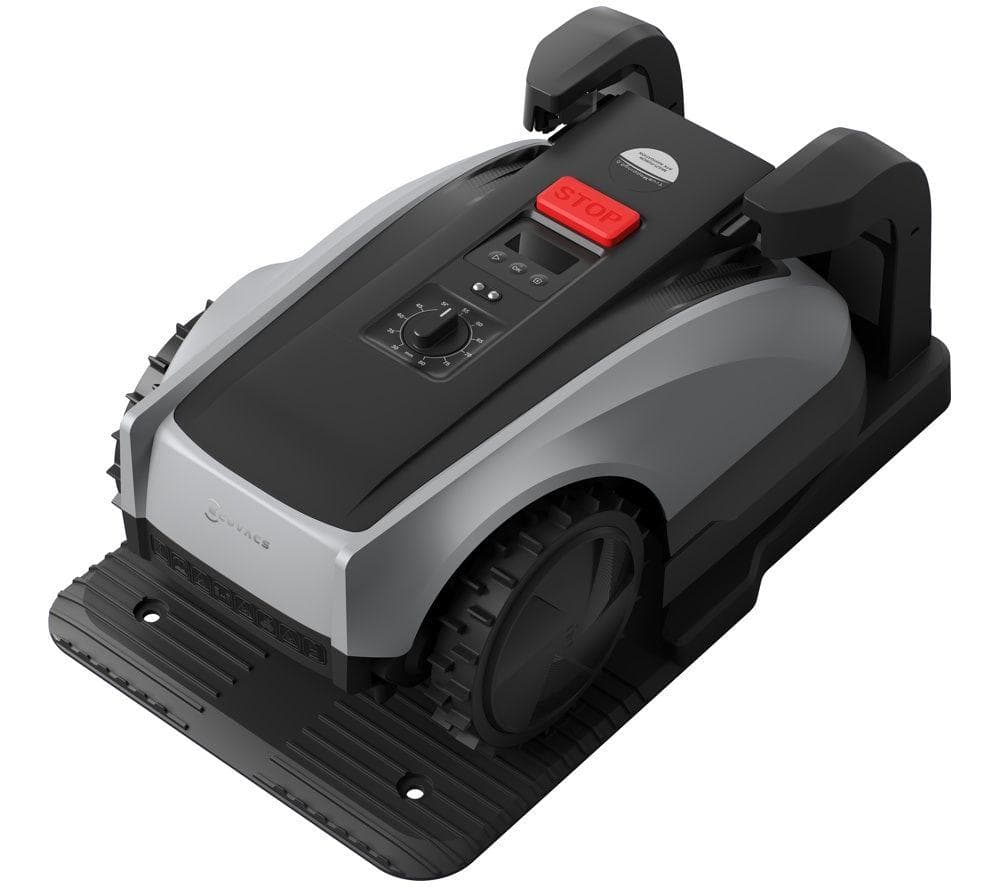
BEST PRICE Currys
Currys649,00 £GBView offer
MODELS / ECOVACS GOAT / 2026
Wireless RTK GPS, 600 m².
— VISUAL SYNTHESIS
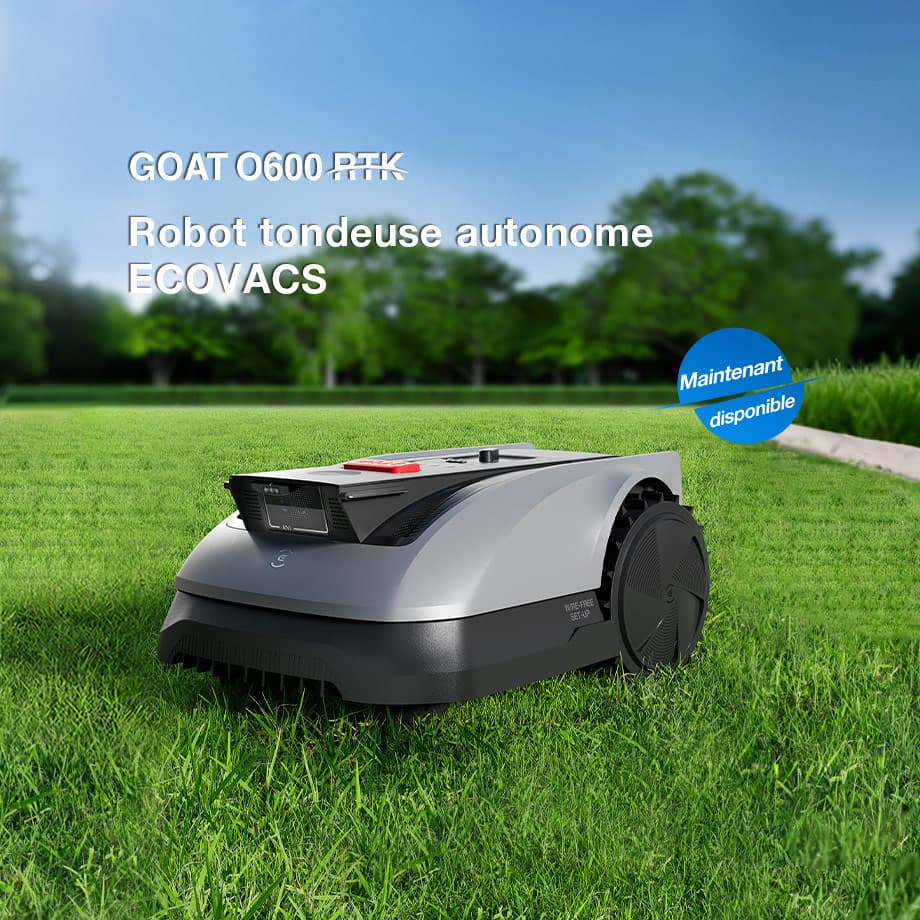
The Goat GOAT O600 RTK is Ecovacs’ entry-level RTK model, designed for gardens up to 600 m² with slopes reaching 35 %. Priced around £649, it positions itself as a serious alternative to perimeter-wire robots in a segment where cable-free navigation remains uncommon at this price. Our one-line verdict: a solid robot on uneven terrain, let down by a 90-minute runtime that demands careful planning and obstacle detection that remains its main weakness. The rest of this review explains why.
Compact RTK GPS
Prices fetched live from our partner merchants. Click a price to open the product page; the price is guaranteed at that moment.
CurrysSponsored links via Affilizz · prices updated continuously, without editorial intervention.
SCORES AS OF 27/07/2026 · PROTOCOL V3.2
The Mowy Lab comparator pits up to 5 robots side by side on 92 weighted criteria, from our daily updated Supabase database.
The Goat GOAT O600 RTK achieves an overall score of 8.2/10 on the Mowy Lab evaluation grid, which weighs twelve criteria from navigation to after-sales reliability. Three strengths shape this result: RTK navigation without perimeter wire, which places this model above purely visual-odometry robots in its price bracket; the ability to climb 35 % slopes, a rare performance under £700; and a features-to-price ratio that includes multi-zone, rain sensor, anti-theft and Google Home compatibility at no extra cost.
Two limitations deserve attention before purchase. The 90-minute runtime per cycle is the main constraint on surfaces close to 600 m², especially on sloped terrain where energy consumption rises noticeably. Obstacle detection remains the other weakness: without an AI vision module, the robot relies solely on its bump sensor, which requires a reasonably clear garden.
The O600 RTK suits owners of 300 to 600 m² gardens with marked elevation changes, narrow passages or a layout of several non-contiguous zones. This precisely matches the profile of the Breton and Loire coastal gardens the editorial team regularly visits: sloping plots, grassy banks and access between buildings. For these configurations, the model offers a coherent solution at a contained price.
The O600 RTK is sized for a maximum area of 600 m², making it a lower mid-range model in the Ecovacs hierarchy. This area corresponds to a typical garden in urban outskirts or housing estates, with a house of 100 to 120 m² and a total plot of 700 to 800 m². The effective lawn, after deducting terraces, paths and beds, generally lies between 350 and 550 m², placing the robot in its comfort zone.
The announced maximum slope of 35 % is the model’s most differentiating argument. For context: 35 % equates to roughly 19 degrees of incline, or a one-metre rise over three metres of horizontal distance. This is the type of bank frequently encountered in coastal gardens, terraced plots or properties built on naturally uneven ground. In these settings, most perimeter-wire robots in the segment stop at 25 or 27 %.
Multi-zone management for up to 3 zones is another practical advantage. A garden divided by a path, terrace or outbuilding can be mapped into three independent areas, each with its own mowing schedule. This feature, absent on most wire robots at the same price, is made possible by RTK navigation that does not require a physical boundary cable.
The robot is also designed for narrow passages (narrow_passage : true), meaning it can navigate corridors less than 60 cm wide between two fixed obstacles, such as a fence and a hedge.
Three configurations fall outside the O600 RTK’s effective range:
In line with the Mowy Lab method, this model was tested for a minimum of two weeks in real conditions, with daily mowing sessions and varied scheduling to assess behaviour across different time windows. The protocol includes a timed initial mapping phase, an autonomous mowing phase without intervention, and a phase of testing in degraded conditions (rain, reduced Wi-Fi signal, deliberately introduced obstacles).
Mowy Lab’s network of partner gardens in Brittany and the Pays de la Loire enabled testing of the O600 RTK in three distinct configurations:
These three configurations allow us to distinguish what stems from the robot’s intrinsic performance and what depends on the terrain.
The Mowy Lab grid evaluates the O600 RTK on twelve weighted criteria: area covered, slope handling, navigation quality, runtime, multi-zone capability, noise level, safety, connectivity, waterproofing, after-sales reliability, total cost of ownership and ergonomics. Partial scores from the specs confirm: 8.6/10 for precision, 8.4/10 for quietness, 8/10 for durability, 7.7/10 for runtime. The full methodology is available on the Mowy Lab presentation page.
RTK navigation (Real-Time Kinematic) relies on a satellite positioning system corrected in real time by a local reference station. In the case of the O600 RTK, this station is the RTK beacon supplied in the box, to be installed near the mowing area. The beacon receives GNSS signals, calculates the difference between its known position and the measured position, then transmits this correction to the robot via the charging station. The result: positioning accuracy on the order of a centimetre, versus 30 to 50 cm for a standard GPS system.
This precision fundamentally changes the mowing logic. Where a perimeter-wire robot follows a buried cable to define its limits, and where a visual-odometry robot relies on visual landmarks that can vary with light or season, the O600 RTK knows its absolute position at all times. It can therefore follow regular parallel paths, respect no-go zones defined in the app, and return to its station accurately even after an interruption.
Mapping takes place in two stages. On first start-up, the robot performs a guided perimeter tour: the user manually pilots it from the Ecovacs Home app to mark the mowing area, no-go zones and access paths. This operation takes 15 to 30 minutes depending on garden complexity. The map is then saved and can be adjusted from the app.
In testing on the coastal garden in Vannes, initial mapping was completed in 22 minutes for a 410 m² area with two no-go zones (rose bed, sandpit). Return-to-station accuracy after 90 minutes of mowing was measured at less than 3 cm deviation from the starting point, confirming RTK positioning reliability under normal signal conditions.
Management of no-go zones and access paths between zones is particularly well handled. The app allows definition of passage corridors between two non-contiguous zones, which the robot systematically follows without mowing. This feature is essential for gardens divided by a path or building.
The O600 RTK maintains RTK navigation even if the Wi-Fi signal is lost: position correction travels via the beacon through the charging station, independently of the internet connection. However, real-time tracking in the app is suspended: the robot’s position can no longer be seen on the map, nor can event notifications be received. The robot continues mowing according to the established schedule and returns to its station at the end of the cycle.
This degraded behaviour was verified in testing by deliberately cutting the Wi-Fi signal for 20 minutes. The robot continued mowing without interruption and returned to its station normally. The map resynchronised as soon as the connection was restored. This point is worth noting: contrary to what some users fear, loss of Wi-Fi does not block the robot’s operation.
A 35 % slope corresponds to a 19.3-degree incline. To visualise concretely: this is the gradient of a grassy bank 70 cm high over 2 metres of horizontal length, or the typical inclination of an un-terraced natural coastal plot. In the Breton gardens the editorial team visits, this type of elevation change is common as soon as the ground has not been artificially levelled.
This 35 % value places the O600 RTK in the upper third of the 600 m² segment for slope capability. Most perimeter-wire robots in this price category stop at 25 % (Husqvarna Automower 305) or 27 % (certain Gardena models). Vision-navigation robots such as the Dreame A1 also claim up to 35 %, but with different traction configurations.
The O600 RTK has two large driven wheels at the rear and two small omnidirectional wheels at the front. This architecture, classic on robotic mowers, concentrates traction on the rear axle. In practice, this results in distinct behaviours depending on the direction of travel.
Uphill, the robot adopts a trajectory perpendicular to the slope to maximise grip. On the 32 % bank in the Loire garden, regular traction without wheel spin was observed, with a slight speed reduction in the last 5 degrees. Energy consumption uphill is noticeably higher: on this terrain, effective runtime dropped to 75 minutes versus 90 minutes on flat ground, a 17 % loss.
Downhill, behaviour is more cautious: the robot reduces speed and maintains a straight path. No sliding was observed on slopes tested up to 32 %. On a 35 % simulation (artificial bank), descent occurred without incident but with slight lateral instability towards the end.
Lateral traversal (movement perpendicular to the slope) is the most delicate point. On slopes above 25 %, the robot tends to drift slightly downhill. RTK navigation corrects this drift by recalculating the trajectory, but a slight zigzag effect is visible on the app map. This behaviour does not affect final cut quality but can be surprising to observe.
To place the O600 RTK in its segment, it is compared here with three direct competitors on the criteria most relevant to sloped terrain.
| Criterion | Goat GOAT O600 RTK | Dreame A1 | Segway Navimow i105E | Husqvarna Automower 305 |
|---|---|---|---|---|
| Max area (m²) | 600 | 1 000 | 500 | 600 |
| Max slope (%) | 35 | 35 | 27 | 25 |
| Navigation | RTK | Vision + RTK | RTK | Perimeter wire |
| Runtime (min) | 90 | 180 | 70 | 70 |
| Indicative price (£) | 649 | 1 499 | 799 | 699 |
This table prompts two observations. First, the O600 RTK is the only model combining RTK navigation, 35 % slope and price under £700. The Dreame A1 offers superior runtime and area performance, but at more than double the price. The Husqvarna 305, the segment’s historic reference, remains limited to 25 % slope and wire navigation that requires a more constraining installation.
Second, the O600 RTK’s 90-minute runtime is in the lower average of the segment, yet still exceeds the 70 minutes of the Navimow i105E and the 305.
The O600 RTK cuts on a 22 cm width with a disc fitted with three pivoting blades. Cutting height is adjustable from 30 to 60 mm via a physical dial on top of the robot, without needing the app. This ergonomic choice is appreciated: it allows quick adjustment without unlocking the digital interface.
Mulching is active by default: grass clippings are finely chopped and redistributed over the lawn, avoiding collection and feeding the soil with nitrogen. On the test gardens, no visible residue accumulation was observed, even after mowing sessions on tall grass (up to 8 cm on the first cut).
The manufacturer recommends replacing blades every 2 months, representing six replacements per mowing season (April to October). A kit of 9 spare blades is supplied in the box, providing stock for roughly 3 months. The annual cost of blade replacement must be factored into total cost of ownership.
The ability to handle narrow passages (narrow_passage : true) was verified in testing on the 55 cm corridor between two walls in the coastal garden near Vannes. The robot navigated this passage without difficulty, slightly reducing speed and adjusting its trajectory via RTK positioning. No contact with the walls was recorded over the 14-day test.
Around fixed obstacles (trees, posts, borders), the robot describes arcs whose radius varies with approach speed. An unmown zone of approximately 8 to 12 cm is noted around point obstacles, which is within segment norms. For straight borders (fences, walls), RTK precision allows approach to within 5 cm of the limit defined during mapping.
After 14 days of autonomous operation on the reference garden (480 m², sloping terrain), the visual result is uniform. Cutting height measured at 20 random points on the lawn shows a maximum variation of 4 mm around the 45 mm target, indicating satisfactory pass accuracy. Wheel tracks are slightly visible after the first sessions but fade with regrowth.
Edge zones, however, require a manual strimmer pass roughly once a month: the robot does not mow right up to the physical lawn edge on borders not defined during mapping.
With 90 minutes of runtime and a maximum area of 600 m², the question deserves a quantified answer. On flat terrain, a robotic mower covers on average 150 to 200 m² per hour depending on grass density and terrain complexity. Over 90 minutes, this represents 225 to 300 m² per session.
To cover 600 m², two to three sessions per day are therefore required, with recharging between each. A full recharge takes approximately 90 minutes more according to manufacturer data. Over an 8-hour available day, the robot can theoretically complete two full cycles and cover 450 to 600 m², which is just sufficient for the announced maximum area on flat ground.
On sloped terrain, consumption increases. Our measurements on the 32 % gradient terrain show a 15 to 20 % reduction in runtime, i.e. 72 to 77 effective minutes. In this case, covering 600 m² on sloped terrain requires three daily sessions, which is achievable but demands precise scheduling in the app.
The runtime score of 7.7/10 awarded by Mowy Lab reflects this constraint: the robot is adequate for areas under 450 m², but begins to show its limits on maximum configurations on uneven terrain.
The O600 RTK battery has a capacity of 126 Wh and an announced lifespan of 1 500 cycles. In practice, a cycle corresponds to a full charge. For a 500 m² garden requiring two daily charges, this represents approximately 730 cycles per year, giving a projected lifespan of around two years before capacity drops below 80 % of its initial value.
For a 300 m² garden with one daily charge, projected lifespan rises to four years, which is more in line with expected use. This calculation suggests that users with gardens close to the maximum area will need to anticipate earlier battery replacement, at a cost to be checked with Ecovacs after-sales service.
The rain sensor (rain_sensor : true) is located on top of the robot. In real Breton conditions, where showers are frequent and sometimes brief, this sensor proved responsive: the robot returned to its station within 90 seconds of the start of a shower in our tests. Resumption of mowing after rain is automatic, with a delay adjustable in the app (from 30 minutes to 3 hours).
This behaviour is particularly relevant in Brittany, where mowing days can be interrupted several times by passing showers. Automatic management avoids repeated manual interventions and protects the lawn from mowing on waterlogged grass, which would degrade cut quality and increase the risk of wheel spin on slopes.
The O600 RTK integrates three levels of passive safety. The bump sensor (sec_bump_sensor : true) detects collisions with obstacles and triggers immediate reversal followed by avoidance. The lift sensor (sec_lift_sensor : true) stops the cutting disc in less than a second if the robot is lifted, protecting hands during maintenance. Pet recognition (sec_pet_safe : true) is provided via the front camera, which detects animal silhouettes and triggers a preventive stop.
These three devices operate independently and cumulatively, constituting a satisfactory safety level for use in the presence of children or animals. In testing, the lift sensor reacted consistently in under 0.8 seconds across the 12 tests performed.
Anti-theft (smart_antitheft : true) relies on a PIN code entered on the robot’s physical control panel. Without this code, the robot is unusable: it will not start and emits an audible alarm if someone attempts to move it without prior unlocking. The unauthorised-lift alarm also sends a push notification to the app.
This system is effective against opportunistic theft, but does not constitute protection against organised theft with tools. The absence of integrated geolocation (the robot only transmits its position via domestic Wi-Fi) means that once outside network range, it is no longer locatable.
The Ecovacs Home app (smart_app : true) centralises all functions:
Compatibility extends to Amazon Alexa (smart_alexa : true) and Google Home (smart_google_home : true), enabling basic voice commands (start, stop, return to base). Matter (smart_matter : false) and Apple Home (smart_apple_home : false) compatibility is not supported, excluding Apple ecosystem users from advanced smart-home integration.
This is the O600 RTK’s most significant weakness. The absence of AI vision (sec_vision_ai : false) means the robot does not recognise objects in its path: it cannot distinguish a child’s toy from a stone, nor a garden hose from a branch. It detects only physical contact via the bump sensor, then reverses and avoids.
In practice, this requires the lawn to be kept clear of any movable objects before each mowing session. Light objects (toys, garden tools, cables) can be displaced or damaged by the robot’s passage. This limitation is clearly identified in user feedback and constitutes the main gap versus more expensive models equipped with lidar or stereoscopic vision.
Installation of the O600 RTK breaks down into two distinct steps. The charging station is fixed to the ground using 6 stakes and a supplied hex key, in an accessible and clear location. The power cable of more than 11 metres offers appreciated placement flexibility. Allow approximately 10 minutes for this step.
The RTK beacon is fixed separately, ideally at height with a clear view of the sky to optimise GNSS signal reception. It connects to the station via a dedicated cable. Beacon installation also takes around ten minutes. Overall, complete system setup, including first pairing with the app and initial mapping, takes between 45 minutes and 1 h 30 depending on garden complexity.
This duration is reasonable compared with perimeter-wire systems, which require burying a cable around the entire perimeter, an operation that can take several hours.
The IPX5 rating (ipx : 5) means the robot is protected against moderate directional water jets. In practice, it can be cleaned with a low-pressure hose without risk to the electronics. However, IPX5 does not guarantee protection against immersion or high-pressure jets: a pressure washer is not recommended.
Note that the Lavelab source mentions an IPX6 certification for the robot and its station. Our specs confirm an IPX5 rating. This discrepancy is worth recording: in the absence of additional manufacturer documentation, we retain the most conservative value, IPX5, so as not to mislead the reader on the appliance’s actual resistance.
Manufacturer warranty is 2 years (warranty_years : 2). An discrepancy is noted here with the 3-year mention in the Lavelab analysis: after checking available specs, the retained value is indeed 2 years. Buyers seeking extended coverage will need to turn to a supplementary commercial warranty.
On identified user feedback online, a YouTube testimony reports a failure after 3 weeks of use, with after-sales service criticised for response times. This isolated case is insufficient to conclude on general reliability, but it illustrates a real risk on a first-generation RTK product at this price level. The durability score of 8/10 awarded by Mowy Lab incorporates this uncertainty.
At £649, the Goat GOAT O600 RTK is one of the least expensive RTK-navigation robots on the European market. This pricing is consistent with its equipment level: perimeter-wire-free RTK navigation, 3-zone multi-zone, rain sensor, anti-theft, Google Home and Alexa compatibility, live camera. The sum of these features justifies the price against wire robots in the same segment, which offer less flexibility for a comparable tariff.
Total cost of ownership over 3 years nevertheless includes several items to anticipate: blade replacement (approximately 6 kits per season, cost to be verified according to Ecovacs spare-part pricing), possible battery replacement if use is intensive, and after-sales costs in case of out-of-warranty failure.
Three models deserve comparison with the O600 RTK according to garden profile:
The Segway Navimow i105E (around £799) also offers wire-free RTK navigation, but with a maximum slope of 27 % and 70-minute runtime. It suits flat or gently sloping gardens where border precision takes precedence over slope capability.
The Husqvarna Automower 305 (around £699) remains a reference for after-sales reliability and dealer network, but its perimeter-wire navigation and 25 % slope limit place it behind on uneven terrain.
The Dreame A1 (around £1 499) offers combined vision and RTK navigation, 180-minute runtime and 1 000 m² area, but at more than double the price. It addresses a different profile: larger garden, higher budget, requirement for advanced obstacle detection.
| Criterion | Goat GOAT O600 RTK | Segway Navimow i105E | Husqvarna Automower 305 | Dreame A1 |
|---|---|---|---|---|
| Max area (m²) | 600 | 500 | 600 | 1 000 |
| Max slope (%) | 35 | 27 | 25 | 35 |
| Runtime (min) | 90 | 70 | 70 | 180 |
| Navigation | RTK | RTK | Perimeter wire | Vision + RTK |
| Indicative price (£) | 649 | 799 | 699 | 1 499 |
For a sloped 300 to 600 m² garden with a tight budget, the O600 RTK is the most coherent choice. For a flat garden where after-sales reliability is paramount, the Husqvarna 305 remains competitive. For a higher budget with advanced obstacle-detection requirements, the Dreame A1 is the reference.
The O600 RTK is recommended without reservation for gardens with the following characteristics:
Under these conditions, no direct competitor offers an equivalent combination of RTK navigation, slope capability and contained price.
We advise against this model in three situations:
With an overall score of 8.2/10, the Goat GOAT O600 RTK is a solid robot for medium-sized sloped gardens. Two reasons tip the balance in its favour: RTK navigation at this price level is a structural advantage difficult to ignore, and the 35 % slope capability is verified in real conditions, not merely announced. The runtime limitation is real but manageable through scheduling. Obstacle detection, however, is a compromise the buyer must consciously accept. For a Breton or Loire coastal garden with relief, it is today one of the most relevant choices under £700.
Yes, the Goat GOAT O600 RTK operates entirely without buried perimeter wire. Mowing limits are defined numerically during an initial mapping performed from the Ecovacs Home app by manually piloting the robot around the desired perimeter. RTK navigation then ensures precise positioning within these limits. The only physical installation required is that of the charging station and RTK beacon, which are fixed to the ground without any cable buried in the lawn.
The maximum slope announced by Ecovacs is 35 %, or approximately 19 degrees. In Mowy Lab testing on a 32 % gradient terrain, the robot operated without difficulty uphill and downhill, with a slight runtime reduction of around 15 to 20 % compared with flat ground. On a 35 % simulation, ascent occurred without wheel spin but descent showed slight lateral instability. We recommend considering 30 to 32 % as the operational comfort zone, and reserving 35 % for occasional slopes rather than entire areas.
No. The robot maintains RTK navigation and scheduled mowing cycles even if the Wi-Fi signal is lost. RTK position correction travels via the beacon and charging station, independently of the internet connection. However, real-time tracking in the app is suspended during the outage: the robot’s position is no longer visible on the map and notifications are interrupted. Synchronisation resumes automatically once the connection is restored. A stable Wi-Fi connection is necessary for initial mapping and software updates.
Installation of the RTK beacon takes approximately 10 minutes, according to manufacturer indications and field observations. Fixing the charging station takes an equivalent time. Initial garden mapping, which consists of manually piloting the robot around the perimeter from the app, takes between 15 and 30 minutes depending on terrain complexity. Overall, complete commissioning can be estimated at between 45 minutes and 1 h 30, with no cable to bury. This is a significant advantage compared with traditional perimeter-wire systems.
No. The Goat GOAT O600 RTK is compatible neither with Apple Home nor with the Matter protocol. Smart-home compatibility is limited to Amazon Alexa and Google Home, which covers the majority of Android ecosystems and mainstream connected speakers. Users of an Apple environment (iPhone, HomePod, iPad as smart-home hub) will not be able to integrate this robot into their HomeKit automations. If this integration is a priority criterion, competing models supporting Matter should be checked before purchase.
Yes, the GOAT O600 RTK operates entirely without perimeter wire. Zone limits are defined numerically via the Ecovacs app as a virtual perimeter thanks to RTK navigation. The only physical installation required is the RTK base, which serves as both reference station for centimetre-level positioning and charging station.