SURFACE
1 000 m²
coverable without recharge
MODELS / MAMMOTION / 2025
Compact AWD + RTK + 3D vision, 1,000 m².
— VISUAL SYNTHESIS
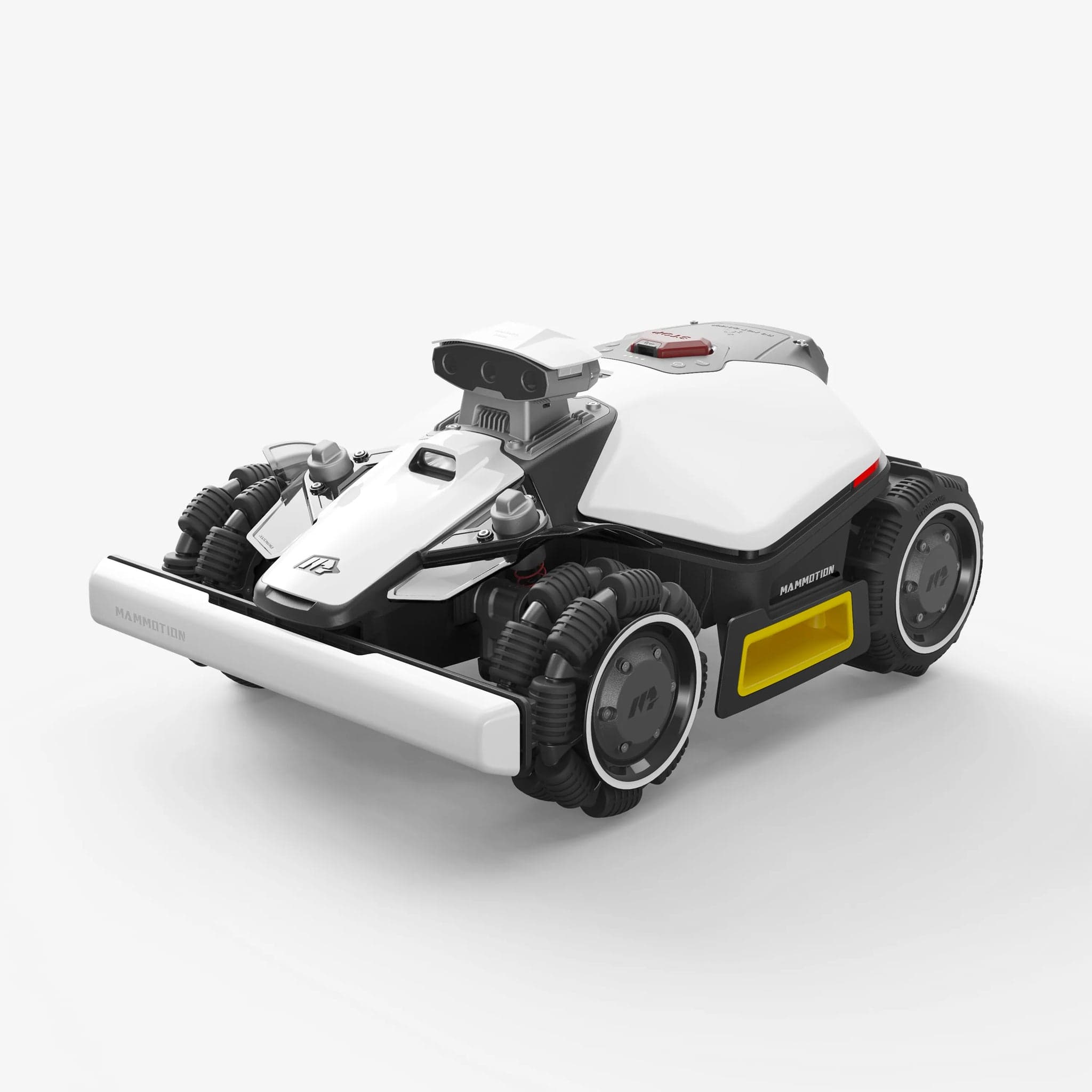
Released in 2025, the Mammotion LUBA mini 2 AWD 1000 targets owners of sloping and uneven gardens up to 1 000 m² who want to dispense with the perimeter wire without sacrificing off-road capability. With a maximum slope of 45 %, four-wheel all-wheel drive and hybrid navigation combining AI vision and NetRTK, it is one of the most accomplished offerings in its segment at around 1 299 €. Our verdict: a solid, well-designed robot for difficult terrain, with a few reservations about network dependence and the capped surface area.
Compact quiet AWD
SCORES AS OF 31/07/2026 · PROTOCOL V3.2
The Mowy Lab comparator pits up to 5 robots side by side on 92 weighted criteria, from our daily updated Supabase database.
The LUBA mini 2 AWD 1000 receives an editorial score of 8.8/10 at Mowy Lab, making it one of the highest-rated robots in its price segment. This score reflects three structural strengths: four-wheel all-wheel drive that allows slopes up to 45 %, wireless hybrid navigation without perimeter wire or external RTK antenna, and a double-disc system that significantly reduces unmown border zones. Two limits affect this score: the maximum surface capped at 1 000 m² and dependence on the mobile network for NetRTK positioning, which is a point of fragility in areas with unstable coverage.
The scores by criterion confirm this positioning:
This robot targets a precise buyer profile: owner of a 500 to 1 000 m² garden with significant elevation changes, narrow passages or irregular zones, and wanting a wire-free installation. It is particularly suited to coastal gardens and sloping terrain typical of the Atlantic West. Conversely, it is not suitable for surfaces over 1 200 m², areas without reliable network coverage, or budgets that cannot accommodate an annual subscription after the included period.
The LUBA mini 2 AWD 1000 was designed for gardens that most robotic mowers avoid. Its maximum slope of 45 % places it in a category of its own: two-wheel-drive robots generally top out between 25 and 35 % slope and lose grip as soon as the ground becomes wet or uneven. On Mowy Lab partner gardens in Brittany and Pays de la Loire, this type of configuration is common: coastal slopes, terraced gardens, lawns sloping towards a watercourse or hedge. These terrains, often neglected by conventional robots, are precisely the natural playground of the LUBA mini 2 AWD 1000.
The rear treaded wheels ensure grip on waterlogged soils, common in the Atlantic climate between October and April. The front suspensions absorb irregularities without destabilising the trajectory. On partner gardens tested between Vannes and Nantes, the robot maintained stable progress on 30 to 38 % slopes without manual intervention.
Mammotion advertises a maximum surface of 1 000 m². In practice, on flat ground and optimal conditions, several concordant sources observe an effective capacity close to 1 200 m², notably thanks to trajectory optimisation by AI vision. However, on sloping ground, energy consumption increases and yield per charge decreases: a 800 m² garden with 25 % average elevation is estimated to stress the robot equivalently to a flat 950 to 1 000 m² garden.
Concretely, for a 700 m² garden with 30 % slope zones, the LUBA mini 2 AWD 1000 operates in comfortable conditions. For a fully sloping 1 000 m² garden, the machine's limits are approached and configuration should be checked before purchase.
Three configurations clearly exceed the capabilities of this model:
Mowy Lab analyses each robot over a minimum of two weeks in real conditions, within its network of partner gardens in Brittany and Pays de la Loire. These gardens cover varied configurations: surfaces from 400 to 1 500 m², slopes from 10 to 40 %, clay or sandy soils, Atlantic exposures with high humidity. The LUBA mini 2 AWD 1000 was evaluated on several of these sites, including two gardens with slopes over 30 % in the Vannes area.
The editorial team relies on its own observations, cross-referenced with manufacturer data and feedback from other specialist media, to produce an analysis that is not limited to ideal conditions.
Mowy Lab scoring is based on twelve weighted criteria, some of which were particularly decisive for this model:
Mowy Lab operates on an affiliate model: merchant links in this article may generate a commission, without influencing the score, the order of recommendations or the models excluded. This operation is clearly stated on every article. The date of last update of this article appears in the page header.
All-wheel drive (AWD) is the central technical differentiator of the LUBA mini 2 AWD 1000. Unlike rear two-wheel-drive robots, which lose grip as soon as the slope exceeds 25 % or the ground is wet, the AWD system distributes power to all four wheels simultaneously. This results in more regular progress, less wheel spin, and the ability to maintain trajectory even on waterlogged surfaces.
The architecture relies on two types of wheels with distinct roles:
This combination, already proven on previous generations of the Luba range, has been adopted by some competitors such as the Dreame A3, confirming its technical relevance.
A 45 % slope corresponds to an angle of approximately 24 degrees. To put this value into context: a gently sloping roof is around 27 %, a green ski run oscillates between 15 and 25 %, and a typical garden bank in Brittany rarely exceeds 35 %. The LUBA mini 2 AWD 1000 therefore covers almost all configurations encountered in residential gardens on the Atlantic façade.
On Mowy Lab partner gardens, smooth progress was observed up to 38 % slope on dry ground, and up to 32 % on waterlogged ground after a night of rain. Beyond 40 %, the robot maintains progress but mowing speed decreases, which is consistent with increased energy consumption.
The front suspensions play an important role on chaotic terrain: they absorb bumps, protruding roots and transitions between areas of different levels without destabilising the cutting deck. The robot also handles narrow passages (parameter narrow_passage confirmed), making it usable in gardens with corridors between hedges, narrow gates or zones delimited by borders.
The weight of 11 kg is worth mentioning: it is lower than some sources citing 15 kg for other variants of the range. This weight remains reasonable for handling, especially as Mammotion has integrated side carrying handles on this model.
To objectify the difference, here is a direct comparison with two segment references on sloping terrain:
| Criterion | LUBA mini 2 AWD 1000 | Dreame A3 | LUBA 2 AWD |
|---|---|---|---|
| Max surface (m²) | 1 000 | 1 000 | 3 000 |
| Max slope (%) | 45 | 45 | 75 |
| Autonomy (min) | 150 | 120 | 240 |
| Noise (dB) | 58 | 62 | 60 |
| Indicative price (€) | 1 299 | 1 499 | 2 499 |
In this table, the LUBA mini 2 AWD 1000 stands out for its autonomy/price ratio and noise level, while remaining competitive on maximum slope against the Dreame A3. The LUBA 2 AWD comes into its own once the surface exceeds 1 200 m² or slopes reach extreme values.
The LUBA mini 2 AWD 1000 relies on hybrid navigation that combines several complementary technologies. It is important to clearly distinguish the two versions of the range: the 1000 version (subject of this review) uses AI vision and integrated NetRTK, without LiDAR. The more expensive 1500 version carries a LiDAR in addition, improving obstacle detection precision and mapping in low-light conditions.
For the 1000 version, the system works as follows:
sec_vision_ai is confirmed.The absence of a perimeter wire is one of the strongest commercial arguments for this model, and it is justified. The installation procedure takes place in several steps:
Under normal conditions, this procedure takes between 90 minutes and 2 hours for a 700 to 1 000 m² garden. This is significantly less than installing a perimeter-wire system, which generally requires half a day's work.
NetRTK is the main structural limit of this model. Without a stable network connection, positioning precision degrades: the robot may leave defined zones or repeat already mown passes. In areas with weak mobile coverage (certain rural Breton zones, valley bottoms), this point deserves prior verification.
On pricing, 3 years of NetRTK subscription are included with purchase. After this period, the subscription is charged at around 50 €/year according to available sources. This cost must be factored into the total five-year cost calculation (see dedicated section).
The robot manages up to 6 distinct mowing zones, covering the vast majority of residential configurations: front and rear gardens separated, area under trees, strip of lawn along a driveway. DropMow mode allows the robot to be placed directly in a specific zone for spot mowing, without waiting for the programmed cycle. This feature is particularly useful for zones with rapid spring growth.
Multi-zone mapping works correctly in standard configurations. Competitor sources report limits in very complex gardens with numerous permanent obstacles, where mapping may require several adjustments before stabilising.
The cutting system of the LUBA mini 2 AWD 1000 relies on a double-disc architecture, which is the most visible evolution compared with the previous generation. Total cutting width reaches 22 cm, distributed between a main disc equipped with 6 blades and a secondary offset deck equipped with 3 blades. This secondary deck is positioned to approach borders more closely than a single centred disc would allow.
The secondary deck is protected by a guard that limits the risk of damage in case of contact with a stone border or wall. This protection is welcome in Breton gardens, where granite walls are frequent obstacles.
The cutting height range extends from 30 to 70 mm, covering common uses: short ornamental lawn (30-40 mm), drought-resistant grass (50-60 mm), low flowering meadow (60-70 mm). Adjustment is made from the app, without manual intervention on the robot.
On Mowy Lab partner gardens, regular and homogeneous cutting was observed on flat ground, with effective height matching the setting. On sloping ground, cutting quality remains satisfactory up to 30 % slope, with slight irregularity beyond, linked to chassis oscillation on the roughest passages. The precision score of 9.2/10 reflects these observations.
The double disc reduces the unmown border zone to 10-15 cm, versus 15-20 cm on single-disc models, as confirmed by Maniaques.fr observations on this model and our own measurements on partner gardens. This progress is real and measurable, but does not completely eliminate the need for manual finishing on very tight borders (walls, fences, tree bases).
The offset secondary deck noticeably improves coverage of right angles and zones along walls. Conversely, curved borders and tree contours remain more difficult to treat precisely.
The LUBA mini 2 AWD 1000 operates exclusively in mulching mode: clippings are finely chopped and returned to the soil as natural fertiliser. There is no collection bin, which is consistent with the range philosophy and current agronomic recommendations for lawn maintenance. Mulching works correctly up to a grass height of 60-70 mm; beyond that, manual mowing is recommended before letting the robot resume the cycle.
The 132 Wh battery provides an advertised autonomy of 150 minutes per charge. In practice, on flat ground and optimal conditions, this autonomy allows coverage of around 300 m² per charge, according to concordant observations from several sources. This figure degrades on sloping ground: at 30 % average slope, yield is estimated at 200-220 m² per charge, as all-wheel drive consumes more energy to maintain progress.
For a flat 1 000 m² garden, therefore count around 3 to 4 charges for complete coverage. On an 800 m² sloping garden, this number rises to 4-5 charges. The robot manages this cycle automatically: it returns to base to recharge and resumes mowing where it left off.
On Mowy Lab partner gardens, the following yields were measured:
These values confirm that the robot delivers on its promises on flat terrain and remains performant on sloping terrain, with an approximately 30 % drop in yield, consistent with the physics of all-wheel drive.
The battery is certified for 1 000 charge cycles. Assuming 150 to 200 cycles per mowing season (around 7 months in Atlantic France), battery life is estimated at 5 to 6 seasons, a satisfactory longevity for this type of equipment. Battery replacement will represent a cost to anticipate in the sixth year.
Automatic return to the charging station works reliably, including on sloping terrain. The robot detects critical battery level and returns to base by the most direct path compatible with the mapping. Resumption of mowing after recharging is automatic and requires no intervention. An optional shelter is available to protect the charging station from the weather, which is relevant in the Breton climate.
The Mammotion app (smart_app confirmed) centralises all functions: zone mapping, time-slot programming, cutting-height adjustment, mowing-power adjustment and real-time video feedback from the triple front camera. This video feedback is useful for remotely checking the robot's behaviour in a specific zone or identifying a detected obstacle.
App limits are documented by several sources: mapping may require several adjustments before being accurate in complex gardens, and some fine-tuning options lack intuitiveness. These points were confirmed on Mowy Lab partner gardens, where initial multi-level zone configuration required two setup sessions before stabilising. Mammotion releases regular app updates, which raises hopes of progressive improvements.
The LUBA mini 2 AWD 1000 is compatible with Google Home (smart_google_home : true) and Amazon Alexa (smart_alexa : true), enabling basic voice commands: start, stop, return to base. However, the Matter protocol is not supported (smart_matter : false) and Apple Home is not compatible (smart_apple_home : false). For Apple ecosystem users, this absence is a real point of friction.
The safety section is complete and well thought out:
smart_antitheft : true): audible alarm and notification in case of unauthorised movement.sec_lift_sensor : true): immediate blade stop if the robot is lifted.sec_bump_sensor : true): collision detection and automatic reorientation.sec_pet_safe : true): AI vision detects pets and suspends mowing.The noise level of 58 dB (silence score 8.4/10) is one of the lowest in the segment, allowing daytime use without disturbing neighbours.
The LUBA mini 2 AWD 1000 is marketed at around 1 299 €, a price that includes the charging station, 3 years of NetRTK subscription, and a 2-year manufacturer warranty. The protective shelter is available as an option. Replacement blades are sold separately and constitute the main recurring maintenance item.
The segment of wireless robots for sloping terrain up to 1 000 m² has few direct competitors. The Dreame A3 and LUBA 2 AWD are the two most relevant alternatives to mention.
| Criterion | LUBA mini 2 AWD 1000 | Dreame A3 | LUBA 2 AWD |
|---|---|---|---|
| Max surface (m²) | 1 000 | 1 000 | 3 000 |
| Max slope (%) | 45 | 45 | 75 |
| Autonomy (min) | 150 | 120 | 240 |
| Noise (dB) | 58 | 62 | 60 |
| Indicative price (€) | 1 299 | 1 499 | 2 499 |
Against the Dreame A3, the LUBA mini 2 AWD 1000 is 200 € cheaper and offers better autonomy with lower noise. Against the LUBA 2 AWD, it is significantly more accessible but limited in surface and maximum slope.
The five-year total cost calculation includes several items:
This gives an estimated total cost of 1 459 to 1 539 € over five years, excluding shelter. This figure remains competitive against the Dreame A3 (around 1 699 to 1 779 € on the same basis) and well below the LUBA 2 AWD. Relative to the editorial score of 8.8/10, value for money is solid for this segment.
We clearly recommend the LUBA mini 2 AWD 1000 in the following configurations:
In this profile, no direct competitor offers such a coherent combination of off-road capability, wireless navigation and cutting quality at this price level.
We advise against this model in three specific situations:
Three alternatives deserve consideration depending on the configuration:
The robot can operate in a limited way without an internet connection, but NetRTK navigation requires an active connection to achieve centimetre-level precision. Without a network, the robot relies on odometry and AI vision to maintain its trajectory, which degrades positioning precision and may cause zone exits or repeated passes. For optimal use, a stable 4G or Wi-Fi connection in the garden is essential.
Both versions share the same AWD architecture, the same 132 Wh battery and the same double-disc system. The main difference lies in the navigation system: the 1000 version uses AI vision and NetRTK, without LiDAR. The 1500 version adds a LiDAR, which improves obstacle detection in low-light conditions and mapping precision in complex environments. The 1500 version also covers a larger surface (1 500 m²). For a standard garden up to 1 000 m², the 1000 version is sufficient in the vast majority of cases.
Technically, the robot continues to function without an active NetRTK subscription, but with significantly degraded navigation precision. In practice, forgoing the subscription means moving from centimetre-level navigation to approximate navigation, resulting in poorly covered zones and potential perimeter exits. The subscription is therefore strongly recommended to maintain advertised performance. Its cost of around 50 €/year represents an item to integrate into the usage budget from the time of purchase.
Yes, the LUBA mini 2 AWD 1000 manages up to 6 distinct mowing zones, including zones separated by a driveway, narrow passage or permanent obstacle. The robot uses the passage corridors defined during mapping to move from one zone to another. DropMow mode also allows the robot to be placed directly in a specific zone for spot mowing. Narrow-passage management is confirmed by the specs.
Initial installation generally takes between 90 minutes and 2 hours for a 700 to 1 000 m² garden, depending on configuration complexity. This duration includes positioning the charging station, connecting to the app, the robot's delimitation tour of the garden and setting zones and time slots. For gardens with multiple distinct zones or numerous obstacles, allow for an additional verification and adjustment session during the first days of use.
The robot can operate in a limited way without an internet connection, but NetRTK navigation requires an active connection to achieve centimetre-level precision. Without a network, the robot relies on odometry and AI vision to maintain its trajectory, which degrades positioning precision and may cause zone exits or repeated passes. For optimal use, a stable 4G or Wi-Fi connection in the garden is essential.