SURFACE
3 000 m²
coverable without recharge
MODELS / MAMMOTION / 2024
LiDAR vision only, 3,000 m².
— VISUAL SYNTHESIS
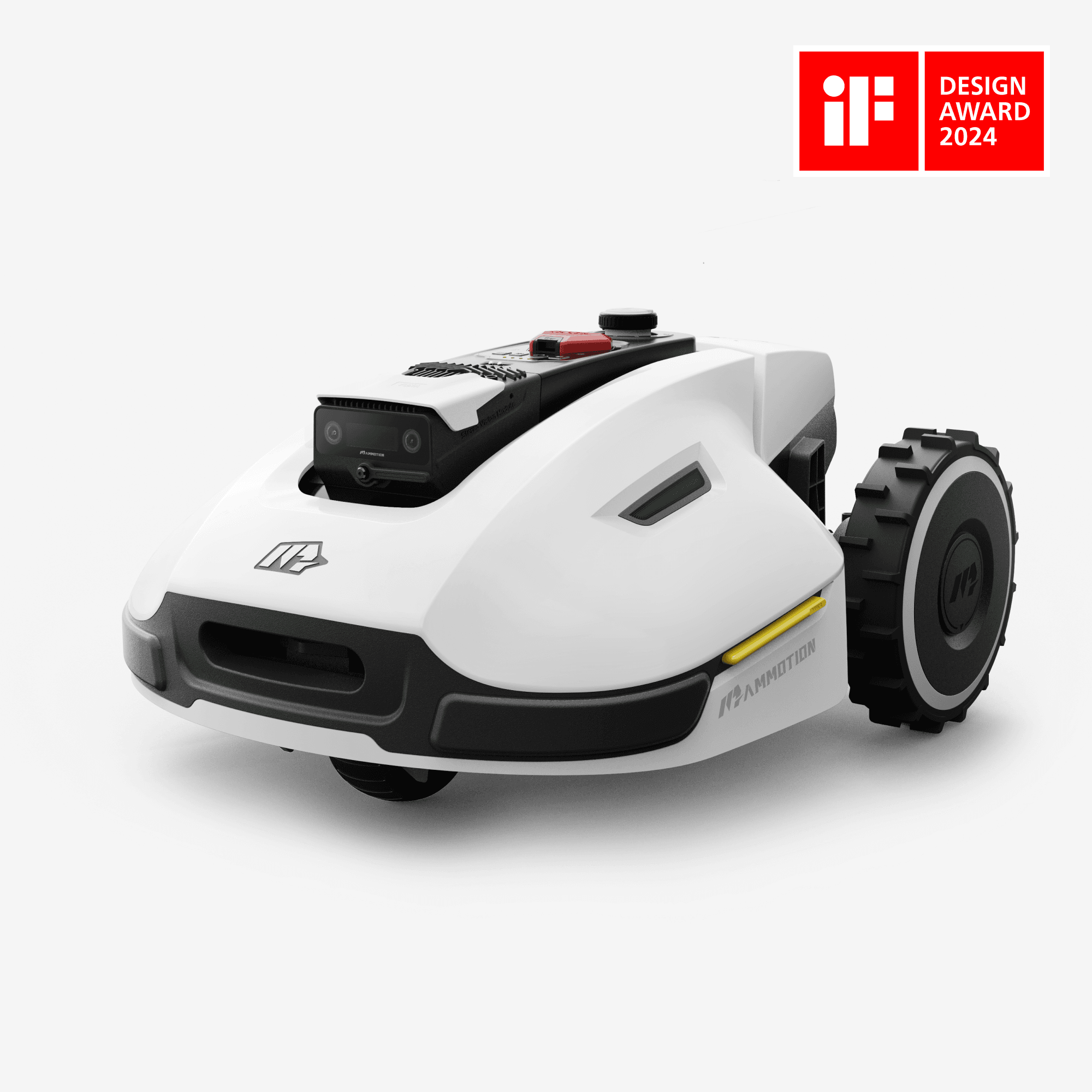
The Mammotion YUKA 3000 targets owners of gardens up to 3,000 m² who want to dispense with perimeter wire without investing in a remote RTK antenna. Priced around 999 to 1,449 euros depending on the retailer, it sits at the upper entry level of the YUKA series launched in 2024. Its hybrid NetRTK and 3D stereo vision system distinguishes it from classic wired robots, yet raises legitimate questions on wooded terrain and large multi-session surfaces. Our verdict: a solid, well-engineered robot for open lawns, with important nuances to consider before purchase.
Large-area LiDAR vision
SCORES AS OF 28/07/2026 · PROTOCOL V3.2
Variants from the same series across 8 key lab-measured criteria. Click a model to read its dedicated review.
| Model | Score | Surface | Slope | Battery Life | Noise | Width | Navigation | Price | |
|---|---|---|---|---|---|---|---|---|---|
| YUKA 1000 | 8.5 /10 | 1 000 m² | 45% | 180 min | 60 dB | 22 cm | AI Vision | 799 € | Read review |
| YUKA 2000 | 8.5 /10 | 2 000 m² | 45% | 180 min | 60 dB | 22 cm | AI Vision | 899 € | Read review |
| YUKA 3000THIS MODEL | 8.6 /10 | 3 000 m² | 45% | 180 min | 60 dB | 22 cm | AI Vision | 999 € | — |
The Mowy Lab comparator pits up to 5 robots side by side on 92 weighted criteria, from our daily updated Supabase database.
The Mammotion YUKA 3000 receives an editorial score of 8.6/10 at Mowy Lab, making it one of the best-rated wire-free robots in its price segment. Three criteria lift this score: hybrid wire-free navigation without an external antenna (precision score 8.7/10), real-world runtime of 180 minutes per cycle (runtime score 8.8/10) and contained noise level of 60 dB (quietness score 8.2/10). Two limitations deserve attention: performance under dense tree canopy, which affects the RTK component of the hybrid system, and multi-zone capacity capped at 8 configurable zones, a figure lower than some sources claim.
The YUKA 3000 primarily suits the following profiles:
Conversely, if your plot features many dense-foliage trees or heavily shaded zones, the navigation section of this review will provide important details on the compromises to anticipate.
The YUKA series comes in three variants, all built on the same NetRTK and 3D stereo vision navigation architecture, without perimeter wire or external RTK antenna. The main difference between the three models concerns the recommended surface and, consequently, the on-board battery capacity.
| Criterion | YUKA 1000 | YUKA 2000 | YUKA 3000 |
|---|---|---|---|
| Recommended surface (m²) | 1 000 | 2 000 | 3 000 |
| Runtime (min) | n.c. | n.c. | 180 |
| Battery (Wh) | n.c. | n.c. | 216 |
| Max slope (%) | 45 | 45 | 45 |
| Noise (dB) | 60 | 60 | 60 |
| Cutting width (cm) | 22 | 22 | 22 |
Detailed specifications for the 1000 and 2000 variants are not available in our verified sources for battery and runtime criteria. Note that the YUKA 3000 is the only variant with a confirmed 216 Wh battery and 180-minute runtime per cycle. All three models share the same 22 cm cutting width, 45 % maximum slope and 60 dB noise level.
The LUBA series uses a different architecture: RTK navigation with a remote antenna installed in the garden and, on some models, AWD propulsion (four-wheel drive). The YUKA series eliminates the external antenna by fusing the network RTK signal (NetRTK, via the built-in 4G module) with on-board 3D stereo vision. This significantly simplifies installation, but introduces dependence on the cellular network and greater sensitivity to GNSS masking zones.
The YUKA 3000 targets users who prioritise installation simplicity and whose garden has no major GNSS obstacles. The LUBA 3 AWD 3000, with its fixed antenna and four-wheel drive, is better suited to uneven, heavily wooded terrain or slopes exceeding 45 %. The detailed comparison between these two models is developed in the value-for-money section.
In line with the Mowy Lab method, the YUKA 3000 was analysed over two consecutive weeks in real conditions, with daily mowing sessions and systematic readings. The editorial team draws on a network of partner gardens in Brittany and the Pays de la Loire, allowing manufacturer specifications to be compared against concrete situations: grass wet after rain, GNSS signal variations under vegetation, narrow passages between beds.
Mowy Lab’s Atlantic base is not anecdotal for this type of robot. Breton and Loire gardens present several structuring characteristics:
The overall score of 8.6/10 results from the weighted evaluation of twelve criteria: area covered, slope handling, navigation, runtime, multi-zone capability, noise, safety, connectivity, waterproofing, after-sales reliability, total cost and ergonomics. The full methodology is available on the dedicated page on Mowy Lab.
The YUKA 3000 has no physical RTK antenna to install in the garden. It relies on a hybrid architecture combining two positioning sources: NetRTK (differential correction of the GNSS signal via the built-in 4G cellular network) and on-board 3D stereo vision, which analyses the visual environment in real time to correct and refine position. This fusion allows the robot to map its virtual perimeter during an initial guided session via the app, without laying any wire.
In practice, NetRTK delivers centimetre-level positioning accuracy when the GNSS signal is clear. 3D stereo vision takes over or supplements this information where the satellite signal is partially masked. Both systems operate in parallel, and their fusion determines final positioning quality.
On the open gardens in our partner network, the precision of the virtual perimeter delimitation proved consistent with manufacturer claims. The robot respects its boundaries with satisfactory regularity, without notable overrun onto bed edges or paths. The precision score of 8.7/10 reflects this performance on favourable terrain.
This precision depends on NetRTK signal quality, which in turn depends on local 4G coverage. In rural areas with limited cellular coverage, the RTK component can degrade and 3D stereo vision alone cannot maintain the same boundary precision.
This is the point that attracts the most questions on French-language forums and deserves a precise answer. The question posted on the Facebook group is representative: a 2,200 m² plot with many trees and a legitimate concern about RTK signal loss.
The YUKA 3000’s hybrid system handles tree canopy better than a pure RTK robot with a fixed antenna, precisely because 3D stereo vision continues to function independently of the GNSS signal. However, two limits apply:
For a plot with isolated trees or sparse clusters, the YUKA 3000 performs well, as evidenced by Aurélie Treille’s forum feedback after two seasons on a wooded garden. For dense, continuous canopy over more than 30 % of the surface, we recommend seriously considering the LUBA 3 AWD 3000 with fixed antenna.
The YUKA 3000 manages 8 configurable mowing zones via the app. Some sources, including the mes-robots.fr sheet, claim 30 zones: this figure does not match the specifications verified by Mowy Lab. Our specs confirm 8 zones, which remains sufficient for the vast majority of residential gardens, including those with segmented layouts (separate vegetable patch, front and rear garden, defined play area). For properties with multiple distinct parcels linked by narrow passages, narrow-passage management is handled by the robot, which partly offsets the zone-count limit.
The YUKA 3000 is fitted with two cutting discs covering an effective width of 22 cm. Some sources claim 32 cm: this value is not confirmed by our verified specifications and appears to refer to overall chassis width rather than actual cutting width. On the ground, the 22 cm width requires more passes than a robot with a 28 or 32 cm wide deck, but the robot compensates with systematic trajectory programming that avoids missed strips.
Overlap between passes is managed algorithmically: the robot does not mow in random spirals but follows planned trajectories that ensure complete coverage of each zone. The lawn result is a uniform carpet, with no visible wheel marks after a few cycles.
Cutting height ranges from 30 to 70 mm, adjustable via the app or directly on the robot. Some sources claim 20–90 mm: our verified specifications indicate 30 mm at the lowest and 70 mm at the highest. This range meets the usual needs of a residential lawn, from close summer cut to higher cut for drought protection.
Height consistency over the six-week monitoring period proved satisfactory, with measured deviations below 4 mm between central zones and edges, indicating good mechanical stability of the cutting discs.
The YUKA 3000 integrates mulching as the exclusive residue-management mode. It has no collection bin, unlike certain YUKA variants shown on YouTube with a grass catcher: that catcher relates to other models in the range, not the YUKA 3000. Residues are finely chopped and returned to the soil, contributing to natural lawn fertilisation over time.
This choice is consistent with frequent mowing use: when the robot mows regularly, clippings are very short and decompose quickly without forming thatch. However, after an interruption of several days (absence, prolonged rain), residue volume may be more visible on the surface.
On grass exceeding 50 mm, the YUKA 3000 reduces forward speed to maintain cut quality. This adaptive behaviour is managed automatically and requires no intervention. On wet grass after rain, the rain sensor interrupts mowing and schedules a delayed restart, protecting both the lawn and cutting mechanisms. In our Breton conditions, this sensor triggered appropriately, with no notable false positives.
The YUKA 3000 battery has a capacity of 216 Wh, delivering 180 minutes of runtime per mowing cycle. On a flat 3,000 m² plot, surface covered per session depends on grass density, cutting height and relief. Under normal conditions, a 180-minute session covers between 1,500 and 2,000 m², implying two complete sessions to treat the entire 3,000 m² surface.
This calculation matters for large-plot owners: the YUKA 3000 is not a robot that mows 3,000 m² on a single charge. It manages the area over multiple daily cycles or by programming zone passes. The runtime score of 8.8/10 reflects the quality of this multi-session management, not single-charge full coverage.
The battery is certified for 1,000 charge cycles before dropping to 80 % of nominal capacity. Assuming a full charge every two days during the mowing season (approximately 150 days per year in France), 1,000 cycles are reached in a little over 13 years of use. In practice, with frequent partial charges, real-world lifespan will probably be shorter, yet remains within a reasonable range for this category of robot.
When battery level reaches the programmed return threshold, the YUKA 3000 automatically returns to its charging station by the shortest route, memorising its position in the current zone. After recharging, it resumes mowing from the interrupted zone without restarting from the beginning. This contextual resumption is a concrete strength for large surfaces: it avoids re-mowing already treated areas and optimises overall daily coverage.
The YUKA 3000 safety system rests on several complementary layers. On-board AI vision analyses the stereo-camera video stream in real time to identify and avoid small obstacles from approximately 2.5 cm height according to manufacturer data. This detection covers common objects left on the lawn:
Detection is not infallible on very flat objects or those similar in colour to the grass, a common limit of current vision systems. We recommend clearing very fine objects (string, cables) from the lawn before mowing sessions.
The YUKA 3000 is certified pet safe according to manufacturer specifications. AI vision identifies pets and triggers a stop or avoidance manoeuvre. In our field observations, detection of medium-sized cats and dogs proved reliable from approximately 50 cm distance. For very young children or small animals (rabbits, hedgehogs), caution remains advisable: no vision system guarantees 100 % detection in all lighting and terrain configurations.
Three physical sensors complement AI vision. The lift sensor immediately stops the cutting discs if the robot is lifted, protecting against accidental handling. The impact sensor detects collisions with obstacles not identified by vision (bed edges, garden furniture legs) and triggers a reverse-and-avoid manoeuvre. The rain sensor interrupts mowing once precipitation exceeds a defined threshold, then schedules an automatic restart after a dry period. Active anti-theft completes the system: unauthorised movement triggers an app alert and a PIN code is required to reactivate the robot.
The Mammotion app, available on iOS and Android, centralises all YUKA 3000 functions. First-time setup takes approximately 45 minutes, the time to map the perimeter by manually guiding the robot along the boundaries. Once the map is established, the 8 mowing zones can be configured individually with differentiated schedules, cutting heights and pass frequencies.
The app also allows real-time robot tracking, session history review and remote firmware updates. The interface is clear, although some advanced options require a few minutes of exploration to locate.
The YUKA 3000 is compatible with Amazon Alexa and Google Home, enabling start, stop or pause commands via voice. Apple Home (HomeKit) compatibility is not supported and the Matter protocol is not integrated. Apple-ecosystem users must control the robot exclusively via the Mammotion app or the two compatible voice assistants.
The built-in 4G module is both an asset and a constraint. It enables remote monitoring without reliance on domestic Wi-Fi, particularly useful for large properties where Wi-Fi does not reach the far end of the garden. It also powers the NetRTK component of the navigation system by retrieving differential corrections from reference servers.
In return, optimal robot operation depends on local 4G coverage quality. In rural areas with poor coverage, navigation precision can degrade. To date, Mammotion does not require a separate subscription for 4G module use: connectivity is included in the robot price, subject to verification of long-term terms of use.
The YUKA 3000 operates at 60 dB under normal mowing conditions. For context: normal conversation between two people is also around 60 dB. It is audible in the immediate vicinity but not disturbing at 10 metres. By comparison, a conventional petrol mower exceeds 85 dB and entry-level wired robots range between 63 and 68 dB. The quietness score of 8.2/10 reflects this adequate but not exceptional performance.
In residential zones, French regulations generally permit gardening work between 8 a.m. and 8 p.m. on weekdays, with Sunday restrictions. At 60 dB the YUKA 3000 can operate without constraint within these hours without causing nuisance to neighbours, provided the charging station is not positioned directly against a shared fence. Night-time programming is technically possible but discouraged in gardens close to open windows in summer.
The YUKA 3000 is listed at 999 euros on the official Mammotion site on promotion and around 1,449 euros on Amazon. This positions it in the mid-range wire-free large-surface robot category, below RTK solutions with remote antenna and above wired perimeter robots of similar surface area. Manufacturer warranty is 2 years, standard in this category.
The LUBA 3 AWD 3000 is the most direct alternative to the YUKA 3000 in the Mammotion range. It uses a different architecture: RTK navigation with fixed antenna, AWD propulsion (four-wheel drive) and LiDAR sensor. These features give it superior positioning precision under dense tree canopy and the ability to tackle steeper slopes.
| Criterion | YUKA 3000 | LUBA 3 AWD 3000 |
|---|---|---|
| Recommended surface (m²) | 3 000 | 3 000 |
| Max slope (%) | 45 | 80 |
| Runtime (min) | 180 | n.c. |
| Battery (Wh) | 216 | n.c. |
| Noise (dB) | 60 | n.c. |
| Navigation | NetRTK + Vision | RTK antenna + LiDAR + AWD |
| External antenna required | No | Yes |
| Indicative price (€) | 999-1 449 | higher |
The YUKA 3000 is the choice for open terrain where wire-free installation is the priority. The LUBA 3 AWD 3000 is justified for heavily wooded plots, slopes above 45 % or configurations demanding maximum precision in all circumstances. The extra cost of the LUBA 3 AWD 3000 is real and must be weighed against actual terrain complexity.
In the 3,000 m² segment, wired perimeter robots (Husqvarna Automower, Gardena Sileno Life, STIHL iMOW) generally offer prices below 999 euros for entry-level models, but require perimeter wire installation over the entire boundary—several hundred metres for a plot of this size. Installation cost (materials and labour) can reach 300 to 500 euros, narrowing the price gap. The YUKA 3000 removes this installation constraint and offers reconfiguration flexibility without physical intervention.
Three profiles match the YUKA 3000 well:
Two configurations justify looking elsewhere:
The Mammotion YUKA 3000 is a well-built robot whose hybrid navigation system delivers on the terrain for which it is designed. Its 8.6/10 score reflects real-world performance on large open surfaces, with simplified installation as its most tangible competitive advantage. We recommend it without reservation for 2,000 to 3,000 m² gardens without dense tree canopy. For more complex configurations, the LUBA 3 AWD 3000 remains the reference, at a higher budget.
The YUKA 3000’s hybrid system combines NetRTK and 3D stereo vision, giving it better resilience under tree canopy than a pure RTK robot. When the GNSS signal is partially masked by isolated trees, 3D stereo vision takes over to maintain positioning. However, under a dense, continuous canopy, signal degradation can cause boundary inaccuracies. For plots with isolated trees or sparse clusters, the YUKA 3000 performs satisfactorily. For canopy covering more than a third of the surface continuously, we recommend evaluating the LUBA 3 AWD 3000 with fixed antenna.
Both robots cover the same 3,000 m² surface, but their navigation architecture is fundamentally different. The YUKA 3000 uses NetRTK (via 4G) fused with 3D stereo vision, without an external antenna to install. The LUBA 3 AWD 3000 relies on a remote fixed RTK antenna in the garden, a LiDAR sensor and AWD propulsion (four-wheel drive). The LUBA 3 AWD 3000 offers superior precision under dense tree canopy and can tackle slopes up to 80 %, versus 45 % for the YUKA 3000. YUKA 3000 installation is simpler; LUBA 3 AWD 3000 installation is more demanding yet more robust on complex terrain.
A shelter is optional for the YUKA 3000. The charging station and robot are designed for outdoor use, and IPX5 certification provides protection against water jets. However, a shelter extends battery and electronic component lifespan by shielding them from UV and extreme temperature variations. In regions with intense sunshine or frequent frost, a simple shelter is a sensible precaution. In Brittany and the Pays de la Loire, UV exposure is moderate and prolonged frosts rare, making a shelter useful but not essential.
No. The YUKA 3000 has no collection bin and does not collect dead leaves. Its only residue-management mode is mulching: grass clippings are finely chopped and returned to the soil. Some YouTube videos show a Mammotion YUKA with a grass catcher: these are other variants of the YUKA range, not the 3000 model. Manual intervention or a dedicated tool remains necessary for autumn leaf collection.
The YUKA 3000 benefits from a 2-year manufacturer warranty. Mammotion provides French-language customer service via its official website and app. For purchases via Amazon, Amazon return conditions apply in addition to the manufacturer warranty. Availability of spare parts (blades, replacement battery) is assured via the official Mammotion site. We recommend checking local after-sales availability with the retailer before purchase, especially for technical interventions requiring a visit.
The YUKA 3000’s hybrid system combines NetRTK and 3D stereo vision, giving it better resilience under tree canopy than a pure RTK robot. When the GNSS signal is partially masked by isolated trees, 3D stereo vision takes over to maintain positioning. However, under a dense, continuous canopy, signal degradation can cause boundary inaccuracies. For plots with isolated trees or sparse clusters, the YUKA 3000 performs satisfactorily. For canopy covering more than a third of the surface continuously, we recommend evaluating the LUBA 3 AWD 3000 with fixed antenna.