SURFACE
1 000 m²
coverable without recharge
MODELS / MAMMOTION / 2025
LiDAR vision only, 1,000 m².
— VISUAL SYNTHESIS
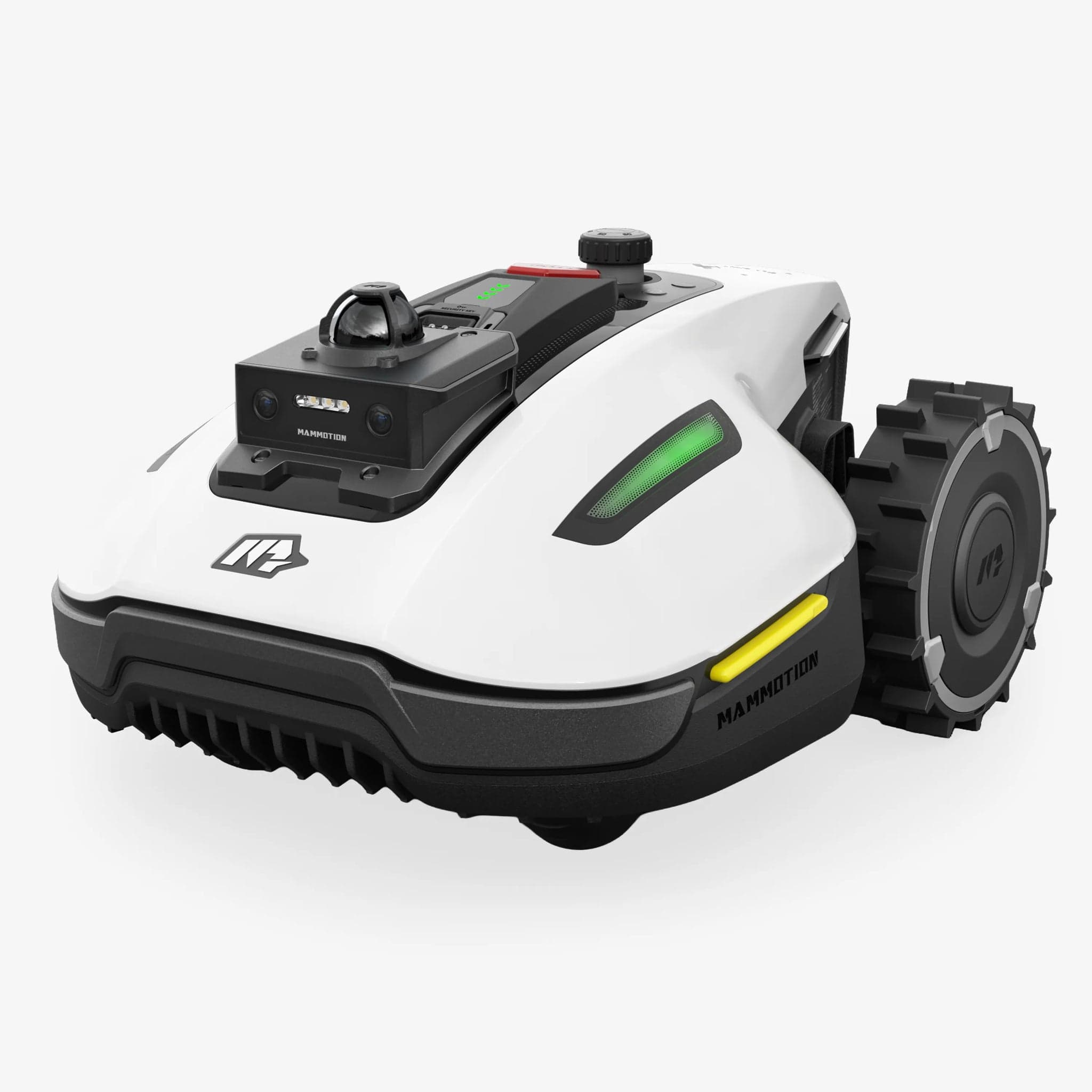
The Mammotion YUKA mini 2 1000 is aimed at gardens up to 1000 m² that do not resemble a golf course: steep slopes, narrow passages, shaded areas, everyday obstacles. Released in 2025, it represents the top of the YUKA mini 2 range thanks to its 360° LiDAR sensor coupled with a front camera featuring onboard AI. Its installation without a perimeter wire, completed in less than an hour, clearly distinguishes it from entry-level models. Mowy Lab editorial score: 8.5/10. The rest of this review details why this robot performs well on complex terrain, and in which cases it is better to look elsewhere.
Compact LiDAR vision 1,000 m²
SCORES AS OF 29/07/2026 · PROTOCOL V3.2
Variants from the same series across 8 key lab-measured criteria. Click a model to read its dedicated review.
| Model | Score | Surface | Slope | Battery Life | Noise | Width | Navigation | Price | |
|---|---|---|---|---|---|---|---|---|---|
| YUKA mini 2 800 | 8.4 /10 | 800 m² | 45% | 110 min | 60 dB | 19 cm | AI Vision | 899 € | Read review |
| YUKA mini 2 1000THIS MODEL | 8.5 /10 | 1 000 m² | 45% | 150 min | 57 dB | 19 cm | AI Vision | 1099 € | — |
The Mowy Lab comparator pits up to 5 robots side by side on 92 weighted criteria, from our daily updated Supabase database.
The Mammotion YUKA mini 2 1000 achieves an editorial score of 8.5/10 at Mowy Lab, making it one of the most solid references in the segment of wire-free robots for medium to large areas. Three strengths structure this positioning.
First, the 360° LiDAR navigation: the sensor rotates continuously and covers a stated range of 60 m with 2 cm precision, allowing the robot to build an accurate map of the environment without relying on a GPS signal or buried wire. Second, the obstacle detection by artificial intelligence: the front camera, coupled with LED lighting, recognises more than 300 categories of objects and adjusts the trajectory in real time. Third, the slope capacity: with two rear driven wheels with cleats, the robot handles inclines up to 45%, a threshold that few models in this price range actually reach.
The scores by criterion confirm this overall coherence: 8.7/10 in cutting precision, 8.4/10 in quietness (57 dB measured), 8.4/10 in durability, 8.3/10 in autonomy.
This robot targets a specific profile: owner of a garden between 600 and 1000 m², with at least one of the following constraints.
The pricing positioning is above the YUKA mini 2 800, which offers vision-only navigation without LiDAR. For gardens under 600 m² without relief constraints, the 800 m² variant is generally sufficient and represents a significant saving.
Mammotion offers three variants in the YUKA mini 2 range: the 500 m² model (available mainly on Amazon, without LiDAR, camera-only navigation), the 800 m² (without LiDAR, vision navigation), and the 1000 m² which is the subject of this review, the only one equipped with the 360° LiDAR sensor.
The difference between the 800 and the 1000 is not limited to the covered area. The LiDAR brings three concrete advantages compared to vision-only navigation. First, an active mapping that does not depend on ambient light: where the camera loses precision under dense shade or at the end of the day, the LiDAR continues to operate with the same reliability. Next, a superior positioning precision in narrow passages, where laser beam distance measurement is more robust than visual estimation. Finally, better management of complex geometry areas (re-entrant angles, corridors between hedges).
| Feature | YUKA mini 2 800 | YUKA mini 2 1000 |
|---|---|---|
| Max surface (m²) | 800 | 1000 |
| 360° LiDAR sensor | No | Yes |
| Max slope (%) | 45 | 45 |
| Mowing zones | 4 | 4 |
| Stated autonomy (min) | 150 | 150 |
| Noise (dB) | 57 | 57 |
In the Mammotion ecosystem, the YUKA mini 2 1000 occupies an intermediate positioning between the entry-level YUKA mini and the LUBA, which integrate RTK GPS navigation and target areas over 2000 m². The LUBA AWD add all-wheel drive and more advanced multi-zone management, but their installation is more complex and their price significantly higher.
For a garden up to 1000 m² with relief and obstacles, the YUKA mini 2 1000 therefore represents the optimal entry point in the Mammotion range with LiDAR, without paying the extra cost of RTK navigation whose advantages only really manifest beyond this area.
Mowy Lab analyses each model over a minimum of two weeks, in real conditions, via its network of partner gardens in Brittany and the Pays de la Loire. This network covers varied configurations: coastal lawns exposed to wind and saline humidity, sloped gardens on clay soil, properties with narrow passages between buildings, areas partially shaded by laurel or thuja hedges.
The scoring is based on twelve weighted criteria:
The YUKA mini 2 1000 was observed on terrains representative of the Atlantic context: dense grass after rain, 45 cm passages between two borders, shaded areas in mid-day. The editorial team maintains total independence from the brands. The affiliate links present in this article generate a commission that funds the editorial work, without influence on the scores or recommendations. The full methodology is accessible from each article.
Upon opening the carton, the contents are complete and well protected. It includes the robot, the charging station, installation accessories and a replacement blade kit. The quality of the materials is noticeable from the first handling: the chassis inspires confidence for regular outdoor use, and the finishes do not betray an entry-level product.
The charging station is compact and installs without complex anchoring. An optional shelter is available separately, which may prove relevant in regions with high rainfall like Brittany, even though the robot's IPX6 rating allows it to withstand powerful water jets without additional protection.
The installation without a perimeter wire is one of the central arguments of this model. In practice, the setup unfolds in three main steps:
The total estimated time for this sequence is about 45 minutes for a garden of 800 to 1000 m² without complex configuration. This figure can increase if the terrain has many obstacles to delimit manually. It is significantly faster than laying a perimeter wire, which requires several hours of work on an equivalent area.
The Mammotion app, available on iOS and Android, controls the entire process. Its interface is structured around the garden map, on which mowing zones (up to 4 independent zones), no-go areas and passage corridors are drawn.
The definition of virtual perimeters is done directly on the map generated by the LiDAR, without physical ground marking. Exclusion zones can be drawn around a flower bed, a sandpit or a terrace in a few seconds. This flexibility is real, but it has an important limitation: once the mapping is done, it cannot be modified without restarting a complete procedure. This friction point, identified by several users, deserves to be anticipated if the garden is likely to evolve.
Before each start-up, the robot requires activation of the safety handle on top of the chassis. This mechanism, common to the range's robots, prevents accidental starting and provides effective protection in the presence of children or pets.
The LiDAR fitted to the YUKA mini 2 1000 rotates continuously and covers a 360° angle with a stated range of 60 m and 2 cm precision. In practice, this sensor builds a map of the immediate environment at each pass, allowing the robot to locate itself precisely even in the absence of usable GPS signal.
This architecture has a decisive advantage on terrains where RTK GPS navigation shows its limits: under dense canopy, between high walls or in enclosed areas, the satellite signal degrades and robots that depend on it lose precision. The LiDAR, on the other hand, operates autonomously and does not suffer from these interferences. On Breton gardens bordered by thick hedges or stone walls, this advantage is concrete and measurable.
The counterpart to this architecture is the dependence on the physical environment: if garden elements move significantly (relocation of garden furniture, major hedge trimming), the robot may temporarily lose its bearings and require partial remapping.
The LiDAR alone is not enough to identify the nature of obstacles: that is the role of the front camera coupled with onboard AI. This system recognises more than 300 categories of objects, from children's toys to pets, including garden tools left on the ground. When an obstacle is detected, the robot adjusts its trajectory by going around the object rather than stopping systematically, which improves mowing continuity.
The LED lighting integrated into the camera extends the operating range in low light conditions. The DropMow function deserves specific mention: it detects sudden drops (steps, terrace edges, ditches) and stops the robot before it tips over, a safety feature appreciated on terrains with level breaks.
In narrow passages, the YUKA mini 2 1000 behaves satisfactorily thanks to the LiDAR and camera combination. The narrow_passage: true specification is confirmed by field observations: the robot negotiates corridors of about 45 cm without repeated blocking, which is notable for a 10 kg machine.
Under dense shade, the LiDAR maintains its precision where purely visual navigation degrades. On the other hand, night mowing raises two reservations. On one hand, cutting quality may be slightly reduced in the absence of natural light, the camera being less effective at detecting fine terrain irregularities. On the other hand, night mowing disturbs local wildlife, a point that the editorial team takes into account in its overall evaluation and which deserves consideration in gardens close to natural areas.
The cutting system relies on a 5-blade pivoting disc powered by an 88 W motor. The cutting width reaches 19 cm, which is consistent with the targeted area category. Mulching is active by default: the cut grass blades are finely chopped and returned to the ground, which nourishes the lawn without requiring collection.
The cutting height is adjusted manually between 20 and 60 mm, in mechanically defined increments on the chassis. This range covers the majority of common uses. The limit at 60 mm is however identified as a friction point by some users: during dry periods, it is advisable to leave the grass taller to protect the roots, and 60 mm may prove insufficient in these conditions. The cutting precision score reaches 8.7/10, which reflects satisfactory mowing regularity on flat and slightly undulating terrain.
The two rear driven wheels with cleats constitute one of the differentiating assets of this model. On the coastal slopes frequently encountered in Morbihan or Loire-Atlantique gardens, the robot maintains its trajectory without visible slippage up to inclines close to 40%. The manufacturer's 45% limit corresponds to about 24° inclination, a threshold that few residential gardens actually reach.
At the front, the two caster wheels (as opposed to the omni wheels on some competitors) offer a concrete advantage on wet terrain: they do not dig into the grass during direction changes, which preserves the lawn after the frequent rainy episodes on the Atlantic coast.
This is where the YUKA mini 2 1000 shows its main cutting limitation. The lateral blind spot of the disc leaves an unmown strip on the periphery of delimited areas, particularly along walls, fences and flower beds. This limitation is inherent to the robot's design and not a setup fault: the disc is centred under the chassis, without significant lateral overhang.
In practice, a manual trimmer pass remains necessary two to three times per season for users demanding on edge finishing. This is not a surprise for a robot in this category, but it is a criterion to weigh if finishing precision is an absolute priority.
The YUKA mini 2 1000 battery has a capacity of 132 Wh (or about 6100 mAh at nominal voltage). The autonomy stated by Mammotion is 150 minutes in optimal conditions, corresponding to coverage of about 250 m² per cycle on flat terrain with dry grass.
In real Breton conditions (dense grass after rain, regular slopes, frequent narrow passages), this autonomy is noticeably reduced. An effective coverage closer to 200 m² per cycle is observed in these configurations, which remains consistent for a 1000 m² garden managed over several daily cycles. The autonomy score of 8.3/10 reflects this slight depreciation compared to manufacturer data, without calling into question the robot's ability to cover its target area.
The full charging time is estimated at about 135 minutes, a duration comparable to operating autonomy. The robot manages its returns to base and mowing resumes itself, without user intervention. On a 1000 m² garden, automatic planning distributes the cycles over the day to cover the entire area according to the frequency defined in the app.
Mammotion states 1000 charge cycles before significant capacity degradation. In normal use (one full charge per day during the active mowing period, or about 7 months per year in France), this represents about 4 to 5 full seasons before the battery reaches 80% of its initial capacity. A battery replacement is therefore to be anticipated in the ownership budget from the fifth year of use.
The Mammotion app centralises all the robot's functions: mowing scheduling, real-time map visualisation, definition and modification of no-go areas, robot position tracking, session history and alerts. The interface is logically structured and requires no particular training for common functions.
Scheduling allows defining time slots per zone, with sufficient granularity to adapt mowing frequency according to the season. Real-time tracking is functional and responsive, which reassures during the first weeks of use.
The YUKA mini 2 1000 is compatible with Amazon Alexa and Google Home, allowing basic voice commands (start, stop, return to base). However, Apple Home compatibility is not provided, and the Matter protocol is not supported. For users integrated into an Apple ecosystem or wishing for advanced smart home integration, this limitation is concrete.
The connected anti-theft function (smart_antitheft: true) sends an alert to the smartphone in case of unauthorised lifting of the robot outside its operating zone. This system provides useful protection, even if it does not replace physical anchoring for gardens accessible from the public road.
The most frequently cited friction point by users concerns the non-modifiable mapping after the first installation. In concrete terms, if you move a flower bed, install a new fence or modify your garden configuration, you must restart a complete mapping procedure. This constraint is identified as a structural limitation of the system, and not as a bug fixable by update.
OTA firmware updates (over-the-air) are available and regularly deployed by Mammotion. They have notably improved obstacle detection precision and Wi-Fi connection stability since the model's launch in 2025.
Three levels of safety coexist on the YUKA mini 2 1000. The first is AI vision (sec_vision_ai: true): the front camera detects moving obstacles, including pets (sec_pet_safe: true), and adjusts the trajectory before any contact. The second is the physical bumper (sec_bump_sensor: true): in case of unanticipated contact, the robot stops immediately. The third is the lift sensor (sec_lift_sensor: true): any chassis lifting triggers blade stoppage in less than a second.
This redundancy of safety systems is appreciated, particularly in gardens frequented by young children or animals. AI detection does not replace human supervision, but it significantly reduces the risk of incidents compared to robots without onboard vision.
The measured noise level is 57 dB, which is slightly below a normal conversation at 60 dB. In practice, the robot is audible at close range but does not constitute a noise nuisance at 10 metres. The quietness score of 8.4/10 reflects this correct performance without being exceptional.
For adjacent gardens or residences with close neighbours, it is advisable to programme mowing outside rest hours. The app allows defining precise time slots to comply with local noise regulations.
The IPX6 rating means that the robot resists powerful water jets in all directions, which amply covers the conditions of a Breton shower. The rain sensor (rain_sensor: true) detects precipitation and automatically returns the robot to its charging station, without user intervention.
This behaviour is particularly relevant in the Atlantic context, where showers are frequent and unpredictable. The charging station, without integrated shelter by default, can be supplemented by an optional shelter (shelter: optional) to protect the entire system between sessions. On gardens exposed to sea winds laden with humidity, this accessory deserves consideration from purchase.
The YUKA mini 2 1000 positions itself in a price range that places it in direct competition with several notable models on the European market. The table below compares key features based on available specifications.
| Feature | YUKA mini 2 1000 | Worx Landroid Vision L1000 | Ecovacs Goat A3000 |
|---|---|---|---|
| Max surface (m²) | 1000 | 1000 | 3000 |
| Max slope (%) | 45 | 35 | 45 |
| Autonomy (min) | 150 | 120 | 240 |
| Noise (dB) | 57 | 63 | 62 |
| Perimeter wire | No | No | No |
| Warranty (years) | 2 | 2 | 2 |
In this comparative scope, the YUKA mini 2 1000 stands out with its 57 dB noise level, the lowest of the trio, and slope capacity superior to the Worx Landroid Vision. The Ecovacs Goat A3000 covers a larger area and offers superior autonomy, but at a significantly higher price.
The official warranty for the YUKA mini 2 1000 is 2 years, in accordance with manufacturer specifications. Some sources mention a 3-year warranty, but the editorial team could not confirm this point with certainty based on the official documents available at the time of publication. It is advisable to check the exact conditions at the time of purchase according to the retailer.
Mammotion SAV is accessible via the app and by email. User feedback is generally positive on responsiveness, with correct response times for a brand whose physical presence in France remains limited. The model's repairability index is deemed satisfactory, with spare parts (blades, wheels, battery) available on the official website and from certain retailers.
The total cost of ownership over 5 years integrates several items beyond the purchase price:
Over five years, the total cost remains competitive compared to perimeter wire solutions that require professional installation, and compared to RTK models whose purchase price is noticeably higher.
The YUKA mini 2 1000 precisely meets the needs of several user profiles.
In these configurations, the 360° LiDAR brings real and measurable value compared to robots without this sensor.
The YUKA mini 2 1000 is less suitable in several situations. If the area exceeds 1000 m², Mammotion's LUBA ranges or models with greater autonomy deserve study. If edges constitute an absolute priority for finishing, no robot in this category dispenses with regular manual passes, and some models with offset cutting offer better performance on this specific criterion. If the budget is tight, the YUKA mini 2 800 covers areas up to 800 m² without LiDAR at a lower price, which remains a solid option for terrains without major relief or shade constraints.
The overall editorial score of 8.5/10 positions the YUKA mini 2 1000 as one of the most advanced wire-free robots in its segment in 2025-2026, provided that its usage profile matches the system's real strengths.
The robot requires an internet connection during initial setup and for firmware updates. In normal operation, some basic functions (starting from the robot, return to base) remain accessible without an active connection, but app control and advanced scheduling depend on a stable Wi-Fi connection. Fully offline operation is not provided by the system.
No, and it is one of the most concrete limitations of the system. Once the mapping is done, it cannot be modified partially: any significant change in garden configuration (relocation of a permanent obstacle, addition of a fence, modification of a mowing zone) requires restarting a complete mapping procedure. No-go areas can be adjusted in the app, but the base map remains fixed. This point deserves anticipation before purchase if the garden is under development.
The main difference is the presence of the 360° LiDAR sensor on the 1000 model, absent on the 800. The LiDAR improves navigation precision under dense shade, in narrow passages and in areas where GPS is unreliable. The coverable area is also superior (1000 m² vs 800 m²). The other main features (autonomy, noise, maximum slope, number of zones) are identical between the two variants.
The YUKA mini 2 1000 is certified IPX6, meaning it resists powerful water jets. However, the integrated rain sensor detects precipitation and automatically returns the robot to its charging station. Mowing under active rain is therefore interrupted by the robot itself, which protects both the equipment and the lawn (mowing a waterlogged lawn can damage the grass and clog the cutting disc).
The complete installation, from unboxing to the first autonomous mowing, is estimated at about 45 minutes for a standard configuration garden. This time includes station positioning, guided garden mapping, definition of mowing zones and no-go areas in the app, and the first operation test. Gardens with many obstacles to delimit or complex configurations may require up to 90 minutes for careful setup.
The robot requires an internet connection during initial setup and for firmware updates. In normal operation, some basic functions (starting from the robot, return to base) remain accessible without an active connection, but app control and advanced scheduling depend on a stable Wi-Fi connection. Fully offline operation is not provided by the system.