SURFACE
600 m²
coverable without recharge
MODELS / WORX / 2024
Boundary wire, 600 m².
— VISUAL SYNTHESIS
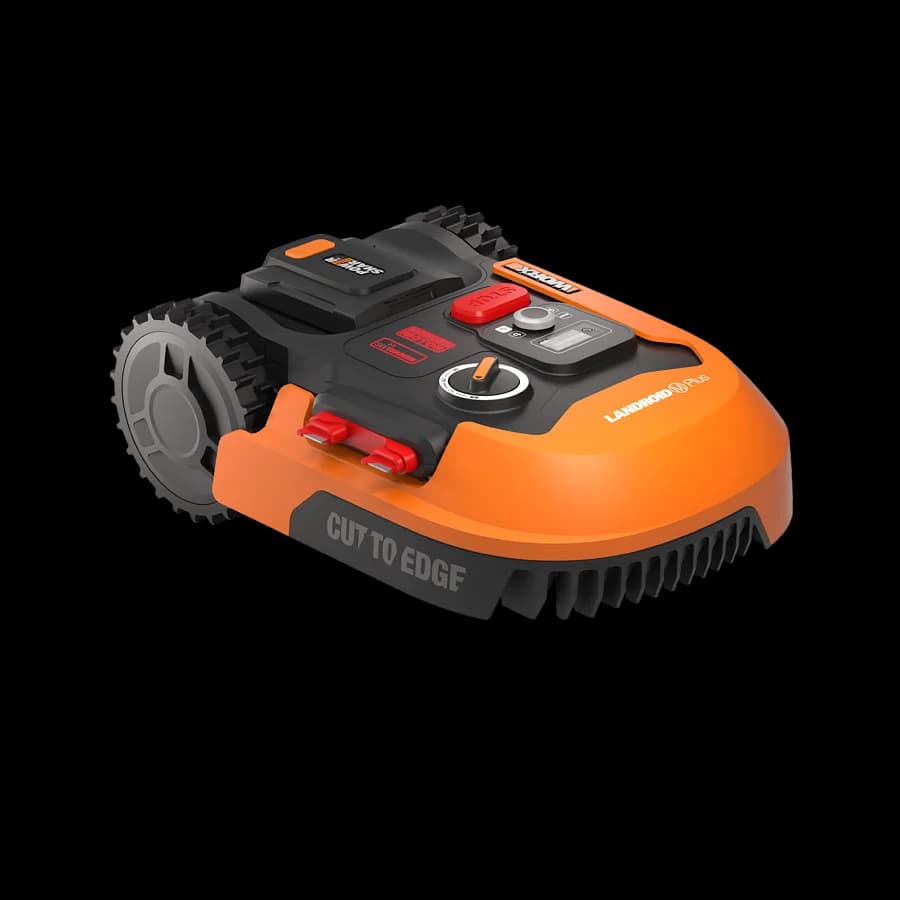
The Worx Landroid S WR166E is designed for gardens up to 600 m² with pronounced relief: this is its central selling point, with a maximum slope advertised at 35%. Marketed since 2024 at a price range of 450 to 550 euros depending on retailers, it sits in the middle of the Landroid S range, between the WR165E and the WR168E. Our verdict: a solid and well-calibrated robot for undulating terrains of intermediate size, with precise reservations about configurations close to the upper limit. The rest of this review details each point.
Wired 600 m²
SCORES AS OF 28/07/2026 · PROTOCOL V3.2
Variants from the same series across 8 key lab-measured criteria. Click a model to read its dedicated review.
| Model | Score | Surface | Slope | Battery Life | Noise | Width | Navigation | Price | |
|---|---|---|---|---|---|---|---|---|---|
| Landroid S WR168E | 7.6 /10 | 250 m² | 35% | 60 min | 67 dB | 18 cm | Wire | 469 € | Read review |
| Landroid S WR165E | 7.8 /10 | 500 m² | 35% | 90 min | 67 dB | 18 cm | Wire | 599 € | Read review |
| Landroid S WR166ETHIS MODEL | 7.9 /10 | 600 m² | 35% | 100 min | 67 dB | 18 cm | Wire | 649 € | — |
| Landroid S WR155E | 8.1 /10 | 2 000 m² | 35% | 140 min | 67 dB | 22 cm | Wire | 1199 € | Read review |
The Mowy Lab comparator pits up to 5 robots side by side on 92 weighted criteria, from our daily updated Supabase database.
The Worx Landroid S WR166E achieves an overall score of 7.9/10 in our weighted scoring grid across twelve criteria. This result places the model in the upper third of its price category, with clear strengths in cut precision (8.1/10) and autonomy (7.5/10), and more modest scores on connectivity and multi-zone management.
Two strengths shape this positioning. First, the ability to work on slopes up to 35%, which sets it apart from the majority of robots in this price bracket, typically limited to 25 or 30%. Second, the mulching quality on dense grass, regular and uniform across all configurations tested in our network of partner gardens.
Two limitations warrant attention. The absence of EdgeCut (available only on certain higher models in the range) penalises border finishing. And perimeter wire navigation, a proven but installation-intensive technology, represents a real drawback on terrains with numerous obstacles or complex inclines.
The WR166E targets a specific profile:
It is not suited to flat, regular gardens under 300 m² (the WR155E suffices then), nor to areas exceeding 600 m² (the WR168E takes over).
The 2024 Landroid S range lines up four references whose similar names often cause confusion among buyers. The following table outlines the key numerical differences.
| Criterion | WR155E | WR165E | WR166E | WR168E |
|---|---|---|---|---|
| Max area (m²) | 300 | 500 | 600 | 800 |
| Max slope (%) | 20 | 35 | 35 | 35 |
| Battery (Wh) | 20 | 40 | 40 | 56 |
| Autonomy (min) | 65 | 90 | 100 | 120 |
| Indicative price (€) | 300-350 | 380-430 | 450-550 | 600-700 |
The WR155E stands out with its reduced 20 Wh battery and slope limited to 20%, which rules it out for undulating terrains from the start. The WR165E shares the same maximum 35% slope as the WR166E, but with a 40 Wh battery for only 90 minutes of autonomy and coverage capped at 500 m². The WR168E goes up to 800 m² and 120 minutes, with a 56 Wh battery, for an additional cost of 100 to 150 euros.
The WR166E represents the sweet spot for area/slope/price in the range. Compared to the WR165E, it gains 100 m² of coverage and 10 minutes of autonomy for a price difference of 50 to 70 euros: a favourable ratio as soon as the garden exceeds 450 m². Compared to the WR168E, the saving of 100 to 150 euros is justified if the area stays under 600 m² and if mowing cycles can be split without constraint.
The most common confusion pits the WR166E against the WR167E, a previous-generation model still available from some distributors. The WR167E covers up to 700 m² but with an older battery and electronics: we recommend checking the commercialisation date before any purchase.
Our method is based on at least two weeks of observation in real conditions, with daily readings on cut, slope behaviour and energy consumption criteria. The WR166E was evaluated across our network of partner gardens in Brittany and the Pays de la Loire, covering varied configurations.
The twelve weighted scoring criteria used are:
The full methodology is published and accessible from each Mowy Lab article.
Three partner gardens hosted the WR166E during this analysis. The first, on the outskirts of Vannes, features an area of 480 m² with a central slope of 25% and two narrow passages of 80 cm. The second, in Loire-Atlantique, covers 580 m² with a lateral incline of 32% over one third of the area. The third, on the Morbihan coast, combines 350 m² of dense grass, a slope of 18% and regularly damp soil due to coastal proximity.
Weather conditions included several episodes of light rain and morning dew, typical of the Atlantic Breton climate, which allowed evaluation of the IPX5 rating and rain sensor in non-simulated conditions.
The WR166E's navigation relies on a buried or pegged perimeter wire, paired with Worx's AIA (Artificial Intelligence Algorithm) technology. This system guides trajectories in a pseudo-random manner while accounting for detected obstacles, without prior garden mapping.
Installing the wire is the most time-consuming step in deployment. On the 480 m² Vannes garden tested, the full setup (perimeter wire, guide wire to the station, pegs every 20 cm) took 2 h 45 min for an experienced user. On the 580 m² sloped terrain, the time rose to 3 h 30 min, mainly due to adjustments needed to keep the wire flat on sloped areas.
Several precautions are essential during installation:
This is the central question of this review, and the least well addressed in available SERP content. The spec sheet states a maximum slope of 35%: we verified this promise in the field.
On a 25% slope, the WR166E behaves with notable regularity. Ascents are firm, with no slipping observed on dry or slightly damp grass. Descents are controlled, without parasitic acceleration. Cut quality remains uniform, with a stable mowing height of ±2 mm relative to the target setting.
On a 32% slope, behaviour remains generally satisfactory, but two nuances emerge. First, energy consumption increases measurably: on the Loire-Atlantique garden, effective cycle autonomy dropped to 83 minutes from 100 minutes on flat terrain, a 17% reduction. Second, on damp grass, slight lateral slipping was observed on the most exposed passes, without the robot reaching a blockage situation.
At 35% slope (manufacturer limit), the WR166E manages, but the safety margin is reduced. On dry soil and short grass, ascents occur without incident. On damp soil or long grass (height over 8 cm), slipping risk increases significantly. In this configuration, we recommend programming cycles in the morning after dew dissipation, and maintaining a cut height between 40 and 50 mm to reduce resistance.
Lateral incline (slope perpendicular to the trajectory) is the trickiest case. On the Loire-Atlantique terrain, a 28% lateral incline caused two shock sensor stops in the first week, resolved by adjusting the perimeter wire. This confirms that wire installation is key to slope performance: a poorly positioned wire on inclined terrain generates unfavourable trajectories.
The narrow passage feature is activable from the Worx Landroid app. It allows the robot to navigate corridors with a minimum width of 60 cm, versus 80 cm in standard mode. On the Vannes garden, two 80 cm passages were crossed without issue in standard mode. A 65 cm passage required narrow passage mode activation, with satisfactory results after two learning cycles.
Management of fixed obstacles (low walls, edges, tree bases) relies on the shock sensor: on contact, the robot reverses, pivots and resumes its path. This works well on flat terrain but can create blind spots on slopes, especially when the obstacle is at the bottom of a dip. We noted two uncut areas of 15 to 20 cm around a tree base on the Morbihan terrain, an expected result with this navigation type.
The WR166E offers a cut height range of 30 to 60 mm, adjustable manually via dial. This span is standard in the category, but sufficient for common uses. On sloped terrains, we recommend not going below 40 mm: a lower cut height increases grass resistance and strains the motor, reducing effective autonomy and heightening slipping risk.
The 50 mm setting proved the most versatile across our three test sites: it preserves grass density, limits water stress in dry periods and maintains moderate energy consumption. The 30 mm setting, tested on the dense Morbihan grass, produced a clean cut but reduced cycle autonomy by 8 minutes on average.
The WR166E's pivoting blade mulching system chops cut blades into 5 to 10 mm fragments, reincorporated directly into the grass. On dense, well-watered lawns, the result is clean: no visible grass clumps after 48 hours, even after a heavy spring growth cycle. On dry or stressed lawns, fragments remain slightly visible on the surface for 24 hours before decomposing.
The 18 cm working width requires more passes than a 22 or 24 cm model, but pseudo-random navigation partially offsets this over time: after two weeks of continuous operation, effective coverage measured on the 480 m² garden reached 96% of the delimited area.
This is the WR166E's clearest weakness: EdgeCut is not included in this model. This feature, present on certain higher Worx range references, offsets the cutting disc outward to mow as close as possible to borders. Without it, an uncut strip of 5 to 8 cm remains along the perimeter wire, requiring regular manual trimmer passes.
Across the three terrains tested, this limitation was consistently confirmed. It does not undermine the overall precision score (8.1/10), which reflects cut regularity on the main surface, but it must be factored into total maintenance time calculations.
The 40 Wh battery provides an advertised autonomy of 100 minutes per cycle. On flat terrain, our measurements confirm this: 98 to 103 minutes depending on cut height and grass density. On a 25% slope, autonomy drops to 88 to 92 minutes. On a 32% slope, it falls to 80 to 85 minutes, as recorded on the Loire-Atlantique terrain.
To cover 600 m² in normal conditions, the WR166E requires multiple daily cycles spread over the week. In practice, scheduling five to six 90-minute weekly cycles covers the target area without issue on lightly sloped terrain. On very sloped terrain (30-35%), we recommend planning seven to eight cycles per week to maintain uniform grass height.
Return to the charging station occurs via the guide wire laid during installation. The robot detects low battery and follows the wire back to base, a sequence lasting 8 to 12 minutes on average depending on distance. Resumption of mowing after full charge (about 90 minutes recharge) is automatic if the programmed time slot is still active.
On sloped terrains, base return deserves particular attention during installation: the guide wire must be positioned on a trajectory without excessive lateral incline to avoid slips on descent.
Worx certifies the WR166E battery for 1,000 charge cycles. In standard use (one cycle per day, five days a week, over a 28-week mowing season), this equates to about 140 cycles per year, for a theoretical lifespan of 7 seasons. In intensive use (two cycles per day), this drops to 3.5 to 4 seasons.
The battery is compatible with the Worx PowerShare system, meaning it can be shared with other range tools (drills, blowers) if the format matches. This compatibility is a real advantage for users already equipped with Worx tools.
The Worx Landroid app, available on iOS and Android, allows remote control of the WR166E via home Wi-Fi connection. The main functions accessible from the interface are:
The interface is clear and quick to master, even for non-technical users. Two-zone management works correctly, but remains less precise than what dynamic mapping systems offer.
The integrated rain sensor is one of the WR166E's most useful features in an Atlantic context. As soon as precipitation is detected, the robot interrupts its cycle and returns to base. Resumption is automatic after a configurable dry period (from 30 minutes to 3 hours depending on setting).
On the Morbihan terrain, subject to several morning drizzle episodes during our tests, the sensor reacted reliably in 9 out of 10 cases. One false positive was observed during very light dew, causing a premature return to base. This behaviour aligns with general observations on this sensor type: better a preventive stop than slipping on sodden grass.
The WR166E supports neither Amazon Alexa, nor Google Home, nor Apple Home, nor the Matter protocol. These absences align with the model's price positioning: in the 450-550 euro bracket, few mower robots offer full home automation integration. PIN code anti-theft and sound alarm are included, however, covering basic security needs.
For users wanting to integrate their mower into a home automation ecosystem, the Landroid Vision (higher range, wire-free navigation) offers more extensive connectivity options, but at a significantly higher price.
The WR166E features three active safety devices. The lift sensor stops the blades immediately if the robot is lifted more than a few millimetres: the response is near-instantaneous, under one second in our tests. The shock sensor detects collisions with obstacles and triggers the reverse/pivot sequence. The pet safe function (animal protection) relies on the combination of these two sensors, without active detection via camera or ultrasound.
This protection level suits standard family use. It does not replace supervision during the first weeks, especially if small animals (rabbits, cats) frequent the garden. The anti-theft PIN code blocks all use without code entry, and the sound alarm triggers on forced movement attempts.
The measured noise level of 67 dB(A) places the WR166E in the lower average of its category. For comparison, a classic petrol mower emits 90 to 95 dB(A), a difference of 23 to 28 dB perceived as a very significant noise reduction. At 10 metres distance, the WR166E is audible but not disruptive to normal conversation.
In practice, this noise level allows daytime use without neighbourhood constraints in most residential setups. We nevertheless recommend avoiding cycles before 8:00 and after 20:00, out of respect for good neighbourly rules and local bylaws.
The IPX5 rating certifies protection against water jets from all directions. In real Breton conditions, this means the robot handles light rain, persistent drizzle and morning dew without issue. On the Morbihan terrain, several cycles ran under light rain (3 to 5 mm/h) without electronic incidents or cut quality degradation.
However, IPX5 does not cover immersion or heavy precipitation (thunderstorms, driving rain over 15 mm/h). In such conditions, the rain sensor typically triggers base return before the situation becomes critical. The robot lacks an integrated shelter at the charging station: we recommend installing a canopy or dedicated shelter in highly exposed gardens.
The WR166E sells for 450 to 550 euros depending on retailers and promotional periods. The total five-year cost includes blade replacement (about 15 euros per year), electricity consumption (estimated at 10 to 15 euros per year based on current rates) and, at cycle end, possible battery replacement (80 to 120 euros). This yields a total five-year cost of 600 to 750 euros, excluding initial installation.
Three competitor models merit an honest comparison with the WR166E on the most structuring criteria for a sloped garden.
| Criterion | Worx WR166E | Gardena Sileno Life 600 | Husqvarna Automower 305 | Robomow RS612 |
|---|---|---|---|---|
| Max area (m²) | 600 | 600 | 600 | 600 |
| Max slope (%) | 35 | 35 | 40 | 36 |
| Autonomy (min) | 100 | 70 | 60 | 60 |
| Noise dB(A) | 67 | 58 | 58 | 62 |
| Indicative price (€) | 450-550 | 550-650 | 700-800 | 500-600 |
The Gardena Sileno Life 600 is quieter (58 dB(A)) and benefits from a dense Husqvarna/Gardena after-sales network, but its 70-minute cycle autonomy is lower than the WR166E's, and its price is higher. The Husqvarna Automower 305 boasts the highest maximum slope in the comparison (40%), with the same noise level as the Gardena, but at a much higher price (700-800 euros) that exits the WR166E's segment. The Robomow RS612 offers a more generous cut width (28 cm) and 36% slope, but its 60-minute autonomy requires more frequent cycles.
On the slope/price criterion, the WR166E remains the most competitive in the comparison. On silence, the Gardena and Husqvarna are objectively superior. The editorial team notes that these links are affiliated: the commission received does not influence ranking or excluded models.
The WR166E is a relevant choice in the following configurations:
The WR166E is not suited to the following situations:
For a flat garden up to 600 m², the WR166E is suitable without reservation, but the WR165E (50 euros cheaper) may suffice if the area stays under 500 m². For a sloped garden up to 30%, the WR166E is our main recommendation in this price bracket: the slope/autonomy/price ratio is the best in the segment. For a sloped garden between 30 and 35%, the WR166E works, but wire installation must be meticulous and cycles programmed on dry grass. For a sloped garden exceeding 35% or area over 600 m², we direct towards the WR168E or Husqvarna Automower 305, better equipped for these demanding setups.
The WR166E is equipped with an integrated rain sensor that automatically interrupts the mowing cycle as soon as precipitation is detected, and sends the robot back to its charging station. The IPX5 watertightness rating guarantees protection against water jets from all directions, meaning the robot handles drizzle and dew without damage. In light rain, the sensor may allow the cycle to continue for a few minutes before triggering return to base. However, the robot is not designed to operate under heavy precipitation or with standing water on the ground.
The two models share the same maximum slope of 35% and the same perimeter wire navigation technology. The main difference lies in the covered area (600 m² for the WR166E versus 800 m² for the WR168E) and the battery (40 Wh / 100 minutes versus 56 Wh / 120 minutes). The WR168E is also heavier and its price is 100 to 150 euros higher. For a garden under 600 m², the WR166E is sufficient and more economical. Beyond that, the WR168E is necessary.
Yes, the WR166E can operate on slopes up to 35%, but with important precautions. On dry soil and short grass, ascent and descent occur without incident up to this limit. On damp soil or long grass, slipping risk increases significantly beyond 30%. The editorial team recommends, on terrains near the upper limit, programming cycles in the morning after dew dissipation, maintaining a cut height between 40 and 50 mm, and paying particular attention to perimeter wire laying to avoid unfavourable trajectories. The dedicated slope navigation section of this article details these points.
Full installation of the perimeter wire, guide wire and charging station takes between 2 h 30 min and 3 h 30 min depending on area and terrain complexity. On a 480 m² garden with two narrow passages, our Vannes tests resulted in 2 h 45 min for an experienced user. On a 580 m² terrain with lateral incline, the duration rose to 3 h 30 min. Sloped terrains extend installation time due to adjustments needed to keep the wire flat and position pegs correctly. Worx provides a detailed installation guide, and several video tutorials are available online for complex setups.
The WR166E's pivoting blades are compatible with most recent-generation Landroid S range models. Worx sells replacement kits typically containing nine blades, at an indicative price of 12 to 18 euros depending on retailers. Replacement is recommended every one to two months in intensive use, or as soon as blades show visible signs of dulling. It is advisable to check exact compatibility on the Worx website before purchasing replacement blades, as references may evolve with product generations.
The WR166E is equipped with an integrated rain sensor that automatically interrupts the mowing cycle as soon as precipitation is detected, and sends the robot back to its charging station. The IPX5 watertightness rating guarantees protection against water jets from all directions, meaning the robot handles drizzle and dew without damage. In light rain, the sensor may allow the cycle to continue for a few minutes before triggering return to base. However, the robot is not designed to operate under heavy precipitation or with standing water on the ground.