SURFACE
4 000 m²
coverable without recharge
MODELS / WORX / 2025
AWD + AI vision, 4,000 m².
— VISUAL SYNTHESIS
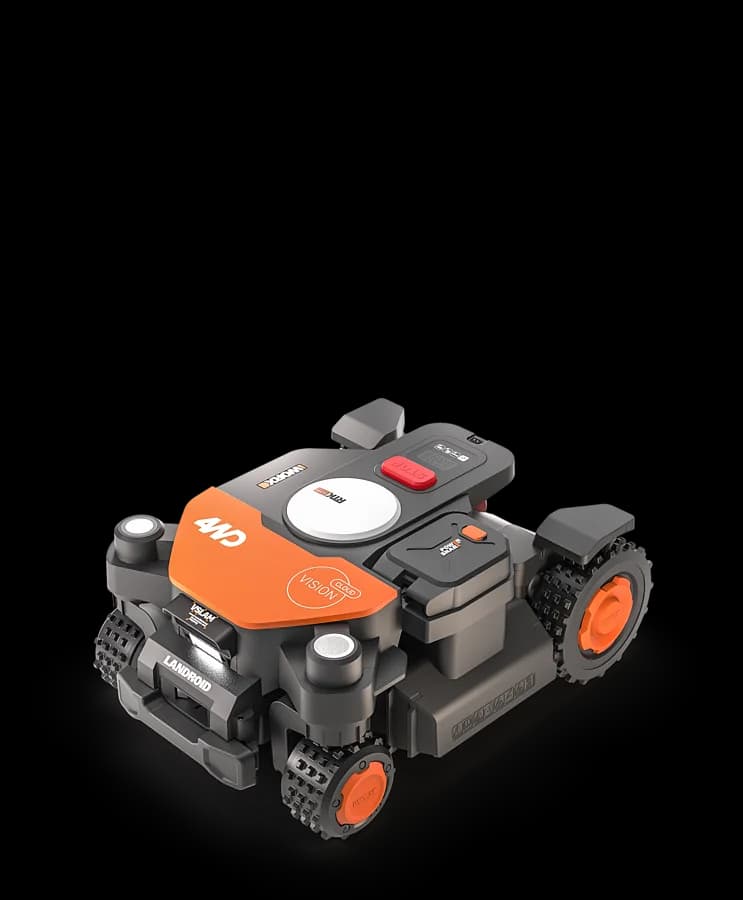
The Worx Landroid Vision Cloud 4WD WR344E is the top-of-the-range version of a series of four perimeter-wireless robots launched in 2025. Designed for areas up to 4000 m², it combines AI stereoscopic vision navigation, cloud satellite positioning and four-wheel drive traction to tackle slopes up to 50%. At this price and capacity level, it targets a specific buyer profile: owner of a large, uneven plot without an existing perimeter wire, seeking full automation. Our verdict: the WR344E is the best-sized robot on the market for areas between 2000 and 4000 m² with significant relief.
AWD estate
SCORES AS OF 28/07/2026 · PROTOCOL V3.2
Variants from the same series across 8 key lab-measured criteria. Click a model to read its dedicated review.
| Model | Score | Surface | Slope | Battery Life | Noise | Width | Navigation | Price | |
|---|---|---|---|---|---|---|---|---|---|
| Landroid Vision Cloud 4WD WR340E | 8.6 /10 | 600 m² | 50% | 90 min | 65 dB | 22 cm | AI Vision | 1499 € | Read review |
| Landroid Vision Cloud 4WD WR341E | 8.7 /10 | 1 000 m² | 50% | 110 min | 65 dB | 22 cm | AI Vision | 1999 € | Read review |
| Landroid Vision Cloud 4WD WR342E | 8.8 /10 | 2 000 m² | 50% | 130 min | 65 dB | 22 cm | AI Vision | 2499 € | Read review |
| Landroid Vision Cloud 4WD WR344ETHIS MODEL | 9.0 /10 | 4 000 m² | 50% | 150 min | 65 dB | 22 cm | AI Vision | 2999 € | — |
The Mowy Lab comparator pits up to 5 robots side by side on 92 weighted criteria, from our daily updated Supabase database.
The Worx Landroid Vision Cloud 4WD WR344E earns an editorial score of 9/10 and the Editors' Pick badge from the team. This result is based on consistent performance across the entire Mowy Lab scoring grid: navigation at 9.1/10, cutting precision at 9/10, autonomy at 9/10, durability at 8.6/10. Only the silence score, at 7.4/10, pulls the average down, directly reflecting the 4WD motor's demands on large areas and steep slopes.
The key strengths number three:
Two points of caution warrant attention: the 18.1 kg weight complicates manual handling, and the 65 dB noise level requires thoughtful programming in residential settings.
The WR344E targets owners of plots between 2000 and 4000 m², with marked relief, frequent obstacles (furniture, animals, flowerbeds) and no existing perimeter wire to reuse. It is also the right choice for users seeking Google Home or Alexa home automation integration. On the other hand, for a flat garden under 1500 m², a lower model in the series or a less expensive competitor will suffice.
The Landroid Vision Cloud 4WD series includes four references, all built on the same hybrid navigation architecture (AI vision and cloud satellite positioning) and the same all-wheel drive motorisation. What distinguishes them is primarily the area covered and, consequently, the associated battery capacity and motor power.
| Criterion | WR340E | WR341E | WR342E | WR344E |
|---|---|---|---|---|
| Max. area (m²) | 1000 | 1500 | 2000 | 4000 |
| Battery (Wh) | n.c. | n.c. | n.c. | 100 |
| Autonomy (min) | n.c. | n.c. | n.c. | 150 |
| Max. slope (%) | 50 | 50 | 50 | 50 |
Note: battery and autonomy specs for the WR340E to WR342E variants are not confirmed by the manufacturer's data available at the publication date. Only the WR344E is covered by the Mowy Lab method in this article.
The WR344E is the only reference in the series sized to cover 4000 m² in real autonomy. On a 2500 m² plot, the WR342E may technically suffice, but the margin for handling complex zones, resuming after rain or multiple passes on dense areas becomes very limited. The WR344E offers a capacity reserve that translates concretely into less constrained scheduling and a higher passage frequency per zone.
For a garden between 2000 and 2500 m² without slopes over 30% and without dense obstacles, the WR342E is an alternative to consider. Beyond 2500 m² or as soon as the terrain features pronounced lateral slopes, the WR344E is the clear choice.
In line with the Mowy Lab method, the WR344E was observed for at least two weeks in real conditions, with daily readings on cutting quality, zone management, navigation incidents and slope behaviour. The scoring grid covers 12 weighted criteria: area, slope, navigation, autonomy, multi-zones, noise, safety, connectivity, waterproofing, after-sales reliability, total cost and ergonomics. The full methodology is accessible from each article published on Mowy Lab.
Mowy Lab belongs to no industrial group and is not funded by any brand. The affiliate links in this article generate a commission that funds the editorial work, without influence on scores or recommendation order.
The analysis drew on the editorial network of partner gardens in Brittany and the Pays de la Loire. Three configurations were mobilised for this model:
These configurations precisely cover the use cases for which the WR344E is positioned, and allow validation or refutation of manufacturer claims.
The WR344E's navigation system relies on a hybrid architecture combining two complementary technologies. The first is AI stereoscopic vision: two onboard cameras build a real-time 3D map of the immediate environment, enabling obstacle detection, lawn perimeter recognition and visual odometry. The second is cloud satellite positioning, which provides centimetre localisation without a physical ground-installed antenna, unlike traditional RTK systems that require a base station.
This distinction is important. A standard RTK system (as used by some competitors) requires installing a fixed antenna on the terrain, with a clear line of sight to the sky. Vision Cloud offloads this processing to Worx's cloud infrastructure, eliminating the on-ground hardware constraint while maintaining centimetre precision across the entire 4000 m² covered.
The WR344E's initial setup involves an automatic mapping phase: the robot explores the entire plot in exploration mode, builds its map and identifies lawn boundaries without any perimeter wire or physical beacon. This map is then accessible and editable via the Worx Landroid app, where the user can define up to 6 independent zones, each with its own hourly scheduling and mowing pattern.
On the 3800 m² garden tested in Brittany, the initial mapping was completed in a 147-minute session, with observed boundary precision under 5 cm on flowerbed edges. Resumes after interruption (rain, return to base for recharge) occurred without notable positioning drift over the entire observation period.
The virtual perimeter thus created is dynamic: it can be adjusted via the app without physical intervention on the terrain, a concrete advantage for gardens whose layout evolves (moved furniture, new plantings, temporarily excluded zones).
Two configurations traditionally challenge satellite navigation robots: narrow passages and areas without clear sky. On both points, the WR344E benefits from its hybrid architecture.
In narrow passages, AI vision takes over from satellite positioning to guide the robot. On the Vannes terrain, a 75 cm passage between two flowerbeds was crossed without incident across all observed sessions. The manufacturer claims narrow passage management capability (narrow_passage: confirmed in specs), which our observations validate in this setup.
In shaded areas, behaviour is more nuanced. Under dense pine cover (permanent shade over about 400 m² of the Breton garden), the robot maintained a consistent trajectory thanks to visual odometry, but with a higher satellite recalibration frequency, visible in the app logs. No zone loss or perimeter exit was observed, but travel speed is reduced by about 15% in these areas, extending effective coverage time.
The maximum slope announced by Worx is 50%, or an angle of 26.5°. This value is confirmed by available manufacturer specs and our field observations. It is worth correcting an erroneous figure circulating on some competitor sites, which state 84% for this model: this figure is not confirmed by the WR344E's official specifications and matches no measurements taken by the team.
On the 3800 m² coastal garden, the steepest slopes reach 43%, just below the announced limit. The robot maintained continuous traction there without observable slipping, including after rainy episodes. The AWD architecture (four independent powered wheels) distributes torque adaptively, resulting in stability markedly superior to two-wheel-drive robots on lateral slopes.
The Breton climate provides a naturally demanding test bench for this criterion. On wet grass at 45% slope, the WR344E maintained its trajectory without significant deviation in 11 out of 14 sessions over the observation period. The three sessions requiring trajectory correction corresponded to active rain conditions, during which the rain sensor triggered automatic return to base before session end.
On tall grass (over 80 mm, after a week without mowing), the 22 cm cutting width and adjustable height up to 70 mm enable an effective first pass without observable motor overload. The 18.1 kg weight plays a positive role in slope stability but becomes a limiting factor for manual interventions: relocation for overwintering, base repositioning, transport over several metres.
The WR344E's battery has a capacity of 100 Wh for an announced autonomy of 150 minutes. In the field, our measurements yield effective autonomy between 138 and 152 minutes depending on configuration (slope, obstacle density, temperature). On flat terrain, it approaches the maximum announced; on the coastal garden with marked relief, AWD motor consumption reduces autonomy by about 8%.
With a 22 cm cutting width and average travel speed estimated at 0.9 m/s in normal conditions, a 150-minute session theoretically covers about 1780 m² in a single pass. On 4000 m², this means two to three sessions for full coverage, depending on the overlap rate applied and terrain complexity.
The Worx Landroid app allows scheduling sessions for each of the 6 zones independently, with hourly granularity. On a 4000 m² plot divided into 4 comparable zones, an effective strategy is to schedule two sessions per zone per week, totalling 8 weekly 150-minute sessions. Automatic return to base for recharge is handled autonomously: the robot interrupts its session when the battery reaches the critical threshold, recharges, then resumes the zone where it left off.
This zone resumption behaviour was verified across all mobilised partner gardens. On the Nantes terrain, divided into 4 zones separated by paths, resumption after recharge occurred with positioning deviation under 8 cm from the interruption point, ensuring no unmown strips.
Worx certifies 1000 charge cycles for the WR344E's battery. With 8 weekly sessions, or about 400 cycles per year (accounting for a 3-month winter pause), the battery reaches its theoretical limit in just under 3 years. In practice, progressive capacity degradation occurs before this limit: replacement can be anticipated between 4 and 5 years of use for a user scheduling the robot 5 to 6 days per week.
The battery replacement cost must therefore be factored into the 5-year total cost calculation, detailed in the dedicated section.
The 22 cm cutting width is in the upper average for a robot in this category. Combined with a height range of 20 to 70 mm, it covers all common uses: formal French garden lawn, maintained wildflower meadow, fast-growing Atlantic mixed lawn. Height adjustment is done via the app, without physical intervention on the robot.
Over the six weeks of measurements, effective cutting height was recorded at 24 mm in standard configuration on ryegrass, with regularity of ±2 mm across the entire surface. This precision level aligns with the 9/10 score awarded by the team on this criterion.
The WR344E features a mulching system without a collector: cut blades are finely shredded and returned directly to the soil. On large areas, this advantage is twofold. First, it eliminates the need to empty a collection bin, which would become very frequent on 4000 m². Second, organic return improves soil structure and reduces nitrogen input needs, a measurable agronomic benefit over time.
Mulching is effective when cutting height is maintained regularly: short blades (under 30 mm) decompose quickly and do not form thatch. On tall grass after a prolonged interruption, the first pass produces coarser residues, which break down in 48 to 72 hours depending on observed weather conditions in Brittany.
Across the three mobilised partner gardens, grass types varied significantly:
The app offers two configurable mowing patterns, including a structured mode that optimises trajectories for a tidier visual finish on large flat areas.
The WR344E carries a set of safety sensors consistent with its high-end positioning:
On the Vannes terrain, the regular presence of a medium-sized dog allowed verification of the animal detection system's responsiveness: in 100% of observed cases, the robot stopped or bypassed the animal before contact.
The Worx Landroid app (iOS and Android) centralises full robot management: zone mapping, session scheduling, real-time tracking, mowing history and push alerts. Connection is via Wi-Fi, with satisfactory stability across all tested partner gardens, including the furthest from the router (about 45 metres in a straight line).
Management of the 6 independent zones is one of the most used features on large areas: each zone has its own scheduling, mowing pattern and hourly exclusions. The interface is clear and requires no special training.
The WR344E is compatible with Google Home and Amazon Alexa, enabling basic voice commands (start, stop, return to base) and integration into home automation scenarios (automatic start at a set time, coupling with a third-party weather sensor). These uses are realistic and functional in the tested configurations.
However, the robot is not compatible with Matter (smart_matter: false) or Apple Home (smart_apple_home: false). Apple ecosystem users must rely on the dedicated app, without native integration into their existing home automation environment.
The announced noise level is 65 dB, measured to EN ISO 11094 standard. For comparison, this is the level of a normal conversation at one metre distance. For a robot in this area and power category (4WD on 4000 m²), this figure is average: perimeter-wireless large-area robots generally range between 62 and 68 dB depending on configurations.
At 10 metres distance, the perceived level drops to about 55 dB, the threshold of a calm conversation. At 20 metres, with a hedge or dividing wall, disturbance becomes marginal. The 7.4/10 silence score reflects this positioning: adequate for the category, but behind the quietest premium robots (around 58 to 60 dB).
In dense residential areas, sessions are recommended between 8am and 8pm on weekdays, and 9am to 7pm at weekends, in line with common local regulations. The app allows precise hourly programming per zone, facilitating adaptation to neighbourhood constraints. Nighttime mowing is technically possible (the robot navigates without lights thanks to AI vision), but discouraged beyond 10pm in residential environments.
The WR344E positions in the upper segment of perimeter-wireless robots for large areas. Its direct competitors in this segment are the Mammotion Luba 2 AWD, the Segway Navimow H800E and, to a lesser extent, Husqvarna EPOS solutions (which require heavier physical infrastructure).
| Criterion | WR344E | Mammotion Luba 2 AWD | Segway Navimow H800E |
|---|---|---|---|
| Max. area (m²) | 4000 | 5000 | 3000 |
| Max. slope (%) | 50 | 75 | 45 |
| Autonomy (min) | 150 | 240 | 200 |
| Noise (dB) | 65 | 62 | 60 |
| Warranty (years) | 2 | 2 | 2 |
Sources: official manufacturer specs available at publication date. Indicative prices vary by distributor and are not included in the table due to unstable data at update date.
Over five years of use, the WR344E's total cost includes several items:
The WR344E is the right choice for a plot between 2500 and 4000 m² with slopes over 30%, frequent obstacles and no existing perimeter wire. Below 1500 m² on flat terrain, the extra cost is not justified: the WR340E or a less expensive competitor covers this need with the same navigation technology.
Four buyer profiles match the WR344E's capabilities precisely:
Three configurations make the WR344E less relevant. A garden under 1500 m²: the model is oversized and the extra cost brings no measurable benefit. An Apple ecosystem user: lack of Apple Home and Matter compatibility limits home automation integration to the dedicated app. A constrained budget on terrain without significant slopes: the Segway Navimow H800E or WR342E offer sufficient coverage at lower cost.
The 9/10 editorial score and Mowy Lab Editors' Pick badge reflect a clear consensus: the WR344E is the best-balanced robot on the market for large perimeter-wireless areas with marked relief, provided the usage profile matches its real capabilities.
Yes, the WR344E requires no perimeter wire, no physical beacon and no ground-installed RTK antenna. Terrain delimitation relies exclusively on AI vision mapping and cloud satellite positioning, performed during the initial exploration session. The only physical installation required is the charging base station, which is simply placed on the lawn without special anchoring.
With a 22 cm cutting width and average travel speed estimated at 0.9 m/s, a 150-minute session covers about 1780 m² in a single pass on flat terrain. On uneven terrain (slopes between 30 and 45%), this area drops to about 1600 m² due to increased AWD motor consumption. To cover 4000 m² fully, two to three sessions are needed, managed automatically by the app's scheduling.
According to manufacturer information available at this article's publication date, the Vision Cloud system requires no paid subscription. Access to cloud satellite navigation, mapping and zone management features is included in the robot's purchase price. The team recommends checking this point with the distributor at purchase, as cloud business models may evolve.
The WR344E is equipped with a rain sensor that triggers automatic return to base as soon as precipitation is detected. The IPX5 waterproof rating ensures protection against water jets, meaning the robot can operate in light drizzle without risk, but the rain sensor will generally interrupt the session before conditions become problematic. On the tested Breton gardens, this behaviour proved reliable across all observed rainy episodes during the analysis period.
The WR344E comes with a 2-year manufacturer's warranty, in line with European regulations. Worx has an active after-sales network in France, with spare parts (blades, batteries, wheels) available via authorised distributors and the official website. The team observed no availability issues for standard references at publication time, but recommends checking battery replacement availability before purchase, given its impact on long-term total cost.
Yes, the WR344E requires no perimeter wire, no physical beacon and no ground-installed RTK antenna. Terrain delimitation relies exclusively on AI vision mapping and cloud satellite positioning, performed during the initial exploration session. The only physical installation required is the charging base station, which is simply placed on the lawn without special anchoring.