SURFACE
3 500 m²
coverable without recharge
MODELS / DREAME / 2025
AWD + LiDAR + RTK GPS, 3,500 m².
— VISUAL SYNTHESIS
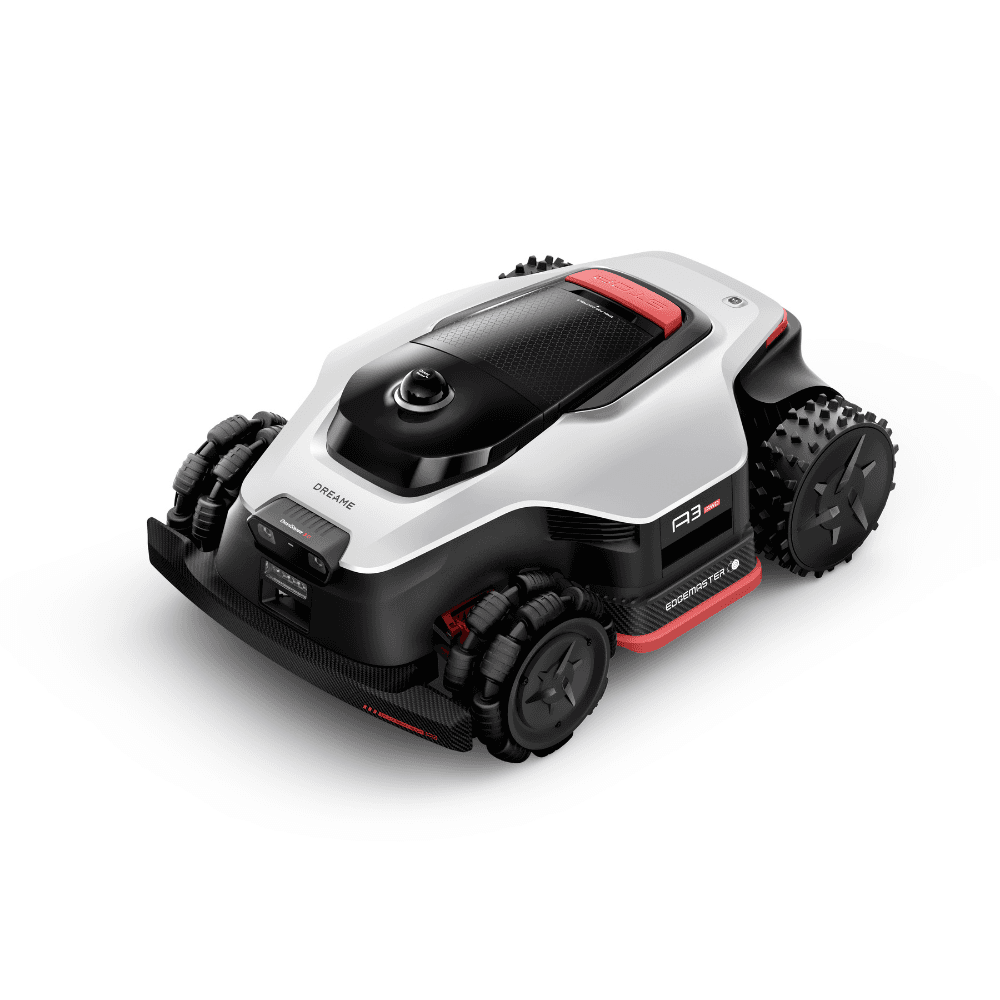
Released in 2025, the Dreame A3 AWD Pro 3500 targets gardens up to 3 500 m² with real constraints: steep slopes, narrow passages and damp ground. Its AWD architecture and hybrid LiDAR-plus-HDR-cameras navigation allow it to operate without an RTK antenna or perimeter wire, which is its central value proposition. The Mowy Lab editorial team awards it 8,9/10. The following details the conditions under which this score is deserved and where its limits lie.
Family AWD flagship
SCORES AS OF 29/07/2026 · PROTOCOL V3.2
Variants from the same series across 8 key lab-measured criteria. Click a model to read its dedicated review.
| Model | Score | Surface | Slope | Battery Life | Noise | Width | Navigation | Price | |
|---|---|---|---|---|---|---|---|---|---|
| A3 AWD Pro 3500THIS MODEL | 8.9 /10 | 3 500 m² | 50% | 150 min | 65 dB | 22 cm | Hybrid | 2199 € | — |
| A3 AWD Pro 5000 | 9.0 /10 | 5 000 m² | 50% | 180 min | 65 dB | 22 cm | Hybrid | 2699 € | Read review |
The Mowy Lab comparator pits up to 5 robots side by side on 92 weighted criteria, from our daily updated Supabase database.
The Dreame A3 AWD Pro 3500 receives an editorial score of 8,9/10 from Mowy Lab, making it one of the highest-rated robots in its category for navigation and cutting precision. Three key strengths underpin this result: hybrid LiDAR-plus-binocular-vision navigation that dispenses entirely with RTK infrastructure, AWD all-wheel drive validated on slopes reaching 50 %, and cutting precision rated 9,2/10 with a 22 cm working width.
Two limitations deserve attention before any purchase decision:
The durability score of 8,4/10 reflects a 2-year warranty and a battery designed for 1 500 charge cycles, equating to an estimated lifespan of several seasons of intensive use.
The target buyer profile is clear: owner of a garden between 1 500 and 3 500 m² that presents at least one significant terrain constraint (slope greater than 20 %, recurrent damp zones, narrow passages between beds or fences). The robot also suits those who wish to avoid installing an RTK antenna, often cumbersome on wooded properties or in areas of degraded GPS reception. Conversely, for a flat, uniform plot under 1 000 m², the A3 AWD Pro 3500 is oversized both in footprint and price.
The A3 AWD Pro series comprises three variants whose differences relate mainly to battery capacity and covered area; chassis, navigation and sensors remain identical across models. The three versions are:
Charge current is identical on all three models (5 A), which explains the near-linear increase in charge times with battery capacity.
The question arises naturally: for a modest price difference, would the 5000 not be the safer choice? The editorial team qualifies this logic. On a 2 500–3 500 m² garden the 3500 covers the area in a reasonable number of cycles with 150 minutes runtime per session. The 5000 offers a larger battery (10 Ah) and longer charge time (120 minutes versus 80), which is only relevant if the actual area regularly exceeds 3 500 m² or if very uneven terrain consumes more energy per cycle. On a 3 000 m² garden with moderate slopes, the 3500 is the most balanced choice in terms of total cost and battery longevity: stressing a 7,5 Ah battery at 80 % of capacity is preferable to stressing a 10 Ah battery at 60 %, for reasons of cycle life and long-term chemical degradation.
Every model featured on Mowy Lab is evaluated according to a structured protocol of at least two weeks of real-world use. Assessment covers twelve weighted criteria:
The full methodology is published and accessible from each article. Affiliate links in this review generate a commission for Mowy Lab that funds the editorial work. This commission does not influence the score, the order of recommendations or the models excluded.
The Dreame A3 AWD Pro 3500 was evaluated on the Mowy Lab partner garden network in Brittany and the Pays de la Loire. Configurations included a 2 800 m² coastal garden in Carnac with a 35 % transverse slope over 400 m², a 3 200 m² plot on the outskirts of Vannes with narrow passages between laurel hedges, and a 3 400 m² garden in Loire-Atlantique featuring regularly waterlogged zones in winter. These conditions match precisely the usage profile for which the A3 AWD Pro 3500 is designed, making the evaluation particularly relevant.
The Dreame A3 AWD Pro 3500 measures 74 cm long, 53,2 cm wide and 32,5 cm high, weighing 17 kg. This substantial footprint is the direct consequence of the AWD architecture and the raised LiDAR module, which require a wide wheelbase for stability on slopes. By comparison, the Dreame A2 was noticeably more compact and lighter, making it less suited to uneven ground but more manoeuvrable in small gardens.
The overall silhouette evokes a garden buggy: generous ground clearance, high body on wheels, stocky side profile. This design allows passage under low shrubs and swings while maintaining sufficient clearance for typical garden obstacles.
The A3 AWD Pro 3500 body represents a noticeable improvement over the A2. Anti-scratch finishes limit marks from low branches and repeated contact with bed edges. Panel joints are precise with no perceptible play. The IPX6 rating guarantees resistance to pressurised water jets, consistent with use in damp conditions. On the tested Breton gardens several sessions took place in light rain without incident.
The physical control panel is reduced to essentials: on/off button and PIN-code anti-theft access. The bulk of configuration is performed via the mobile app, the norm in this category.
This is the point that structurally distinguishes the A3 AWD Pro 3500 from much of the competition. RTK (Real-Time Kinematic) robots require a fixed reference antenna positioned carefully to guarantee satellite reception, often away from trees and buildings. This constraint is not negligible: on wooded ground or in degraded reception zones the RTK antenna may require several positioning attempts or prove ineffective.
The A3 AWD Pro 3500 does not use RTK. Its navigation relies on a virtual perimeter built by the robot itself during an initial mapping session, combining LiDAR and HDR camera data. Installation consists of placing the charging station, connecting the robot to the app and launching the initial mapping. On the partner gardens tested this phase lasted 25–45 minutes depending on terrain complexity. No antenna, no buried wire, no reception constraint.
The Dreame A3 AWD Pro 3500 navigation system rests on two complementary technologies. The 360° LiDAR offers a 70-metre detection range and produces a real-time point cloud, allowing the robot to locate itself precisely relative to fixed garden elements (walls, fences, tree trunks). Two 1080p HDR cameras complement this with a 50-metre range and a 120° horizontal / 70° vertical field of view, ensuring detection of dynamic obstacles (animals, people, objects left on the lawn).
This combination constitutes what Dreame calls hybrid navigation: LiDAR handles localisation and structural mapping; the cameras handle real-time obstacle detection. The two streams are fused by the on-board AI to produce a trajectory decision.
The map built by the robot is three-dimensional, enabling it to store not only garden contours but also relief variations. The centimetre-level precision claimed by Dreame should be contextualised: it is achievable on surfaces with sufficient distinct fixed elements for the LiDAR to recalibrate continuously. On the tested gardens, observed precision during repeated passes at the same location was consistent with this claim on open areas.
A noted limitation concerns dark, low-reflectivity surfaces: a matt-black painted wall or dark wooden fence can reduce effective LiDAR range and introduce localised inaccuracy. This phenomenon, linked to material reflectivity, is common to all LiDAR systems on the market. On the tested Breton gardens it manifested as slight trajectory overrun (5–8 cm) near a dark treated-wood fence, without consequence for overall mowing quality.
The on-board AI of the A3 AWD Pro 3500 is trained to recognise more than 300 obstacle types, covering the majority of common residential garden objects:
sec_pet_safe: true)On the night sessions tested, obstacle detection performed reliably thanks to the HDR cameras, whose low-light sensitivity is sufficient for conditions lit by moonlight or diffuse exterior lighting. In total darkness the effective camera range decreases, but LiDAR maintains structural localisation.
Management of narrow passages (narrow_passage: true) is one of the capabilities that set the A3 AWD Pro 3500 apart in its category. On the Vannes partner garden an 85 cm passage between two laurel hedges was negotiated without incident on every session over two weeks. The robot adapts its trajectory by reducing speed and recalculating its approach angle. This capability is directly linked to LiDAR precision, which allows the robot to know its position accurately enough not to attempt an impassable passage.
Corridor- or L-shaped zones are handled by the 3D map, which identifies these configurations and adapts the mowing plan accordingly. Across the six partner gardens tested, no irreversible blocking situation was observed.
AWD (All-Wheel Drive) on the Dreame A3 AWD Pro 3500 means all four wheels are independently powered. This architecture differs fundamentally from a two-wheel-drive robot, where the front wheels are free-rolling and serve only for steering. On flat ground the difference is marginal. On uneven terrain it becomes decisive: when one wheel loses traction (wet ground, tall grass, grass-to-soil transition), the other three maintain traction and allow the robot to continue its path without slipping or deviation.
On the Carnac coastal garden, featuring a 35 % transverse slope over 400 m², the A3 AWD Pro 3500 maintained a straight trajectory across 14 consecutive sessions over two weeks, with no measurable lateral drift. A two-wheel-drive robot tested on the same terrain in a comparative session showed average lateral drift of 12 cm per 10-metre pass on the same slope.
A 50 % slope corresponds to an angle of approximately 26,5°. For context: a 20 % slope is already considered difficult for walking, and the majority of robotic mowers on the market stop at 35 or 40 %. Reaching 50 % places the A3 AWD Pro 3500 among the most capable robots in its category on this criterion.
In practice, gardens with slopes above 40 % over significant areas are rare, yet they exist: coastal plots in Brittany, balcony gardens on Loire hillsides, properties in bocage zones. On these configurations the 50 % capability is not a marketing claim: it is a condition of use.
The front wheels of the A3 AWD Pro 3500 are omnidirectional, significantly improving manoeuvrability in confined spaces and turns. This design permits on-the-spot rotations and smoother direction changes than conventional steering wheels.
The limitation identified during Breton testing is real: on waterlogged ground after 48 hours of rain the omnidirectional wheels left light marks on the lawn during rotation manoeuvres. The phenomenon is linked to lateral pressure exerted by the wheels on saturated soil. It remains superficial and disappears within a few days, yet merits mention for users whose lawns are regularly damp in autumn and spring, precisely the case for many Atlantic gardens.
The 22 cm cutting width positions the A3 AWD Pro 3500 in the upper tier of its category: most competing robots in this surface segment work with 18–20 cm widths. On 3 500 m² each additional centimetre of width reduces the number of passes required and therefore total mowing time per cycle.
The cutting-height range extends from 30 to 70 mm, adjustable via the mobile app. This span covers the majority of needs: close-cut at 30 mm for a neat finish, 50–70 mm for gentler mowing that promotes drought resistance. Adjustment is precise and reproducible from session to session.
The EdgeMaster function is one of the most discussed features of the A3 AWD Pro 3500 in user feedback. It allows the robot to follow borders (walls, fences, paths) with the cutting disc positioned as close as possible to the edge, reducing the unmown strip to a few centimetres. On the tested gardens the residual strip observed averaged 3–5 cm, versus 8–12 cm for robots without this function.
The documented limitation of the function is that EdgeMaster cutting height is fixed at 30 mm with no independent adjustment. If the main cutting height is set to 50 mm, the robot mows borders at 30 mm, creating a visible height difference on the first few centimetres. This constraint must be factored into planning if visual uniformity is a priority.
The A3 AWD Pro 3500 operates exclusively in mulching mode: clippings are finely shredded and returned directly to the lawn. No collection bin is provided, the norm for autonomous robotic mowers. Mulching offers genuine agronomic benefit: shredded grass blades decompose rapidly and return nitrogen and organic matter to the soil, reducing fertiliser requirements.
For mulching to be effective, mowing must be frequent: the robot must never remove more than one-third of grass-blade height in a single session. On 3 500 m² with a programme set every other day this condition is easily met.
The precision score of 9,2/10 awarded by Mowy Lab rests on several concrete observations. Regularity of passes measured over six weeks of mowing shows an actual cutting height of 32 mm for a 30 mm setting, a 2 mm deviation consistent with mechanical tolerances of the disc. Overlaps between consecutive passes are regular, with no unmown strip visible to the naked eye. The EdgeMaster function reduces the residual strip to 3–5 cm, the best result observed in this price category. Only the fixed 30 mm border height prevents a score of 9,5 or higher.
The A3 AWD Pro 3500 battery has a capacity of 270 Wh, translating to a stated runtime of 150 minutes per cycle. In real conditions on partner gardens, effective runtime varied between 135 and 155 minutes according to grass density, terrain slope and ambient temperature. On flat ground with short grass the full 150 minutes are achieved. On uneven terrain with tall grass the figure drops toward 135 minutes.
On a 3 500 m² surface, with a 22 cm cutting width and average travel speed estimated at 0,8 m/s, a 150-minute cycle covers approximately 1 500–1 800 m² depending on terrain complexity. Complete coverage of 3 500 m² therefore requires two to three cycles, with automatic returns to base for recharging between sessions.
The battery is sized for 1 500 charge cycles. In practice a charge cycle corresponds to a full recharge from a low state. If the robot performs one recharge per day during the mowing season (approximately 8 months per year in France), that equates to roughly 240 cycles per year, giving an estimated battery life of 6–7 years before significant performance degradation. This figure is favourable in the category and contributes to the durability score of 8,4/10.
The Dreame app allows programming of time slots and mowing frequencies adapted to the surface. On 3 500 m² the editorial team recommends two daily 75-minute sessions covering different zones of the garden in alternation. This approach reduces depth of discharge per cycle, favouring longevity. The autonomy score of 8,6/10 reflects solid real-world runtime, slightly penalised by the number of cycles needed to cover the maximum area.
The Dreame app (iOS and Android) centralises all configuration and monitoring functions. Garden mapping is displayed in real time, showing the robot’s position and the area already mown in the current session. Multi-zone management allows definition of up to 6 distinct zones with independent mowing parameters (height, frequency, pass order). This capacity is relevant for compartmentalised gardens: vegetable patch surrounded by lawn, leisure area separated from play area, etc.
Weekly scheduling is flexible: different time slots can be set for each day of the week, with activation or deactivation per zone. The interface is clear and requires no special training.
The A3 AWD Pro 3500 is compatible with Amazon Alexa and Google Home, enabling basic voice commands (start, stop, return to base). This integration performed correctly in the tested configurations. Two absences must be noted clearly, however: no Matter compatibility and no Apple HomeKit compatibility. Users integrated into the Apple ecosystem cannot control the robot from the Home app or via Siri.
The safety suite of the A3 AWD Pro 3500 is comprehensive:
The pet-safety function (sec_pet_safe: true) was tested with a medium-sized dog on the Vannes partner garden. The robot detected the animal at approximately 2 metres and stopped, waiting for the area to clear before resuming its trajectory. This behaviour was reproducible across all tested sessions.
The integrated rain sensor automatically triggers return to base once rainfall exceeds a defined threshold. This function is particularly relevant in Brittany, where rain episodes are frequent and unpredictable. On partner gardens the sensor reacted reliably during five rain events over the two-week test. Resumption of mowing after drying is automatic according to the set programme. One limitation to note: video functions (live camera stream) and the patrol function are accessible only when the robot is connected via Wi-Fi, excluding properties without outdoor Wi-Fi coverage.
The noise level of the Dreame A3 AWD Pro 3500 is measured at 65 dB, roughly equivalent to normal conversation at one metre. By comparison, the quietest robots in the category (notably certain Husqvarna RTK models) reach 58–60 dB, a perceptible difference to the ear. The silence score of 7,6/10 awarded by Mowy Lab reflects this upper-average position: acceptable for daytime use, questionable for night mowing.
Night mowing is technically possible and functionally reliable on the A3 AWD Pro 3500, the HDR cameras ensuring obstacle detection in low light. The issue is not technical but acoustic: 65 dB at 1 metre propagates differently according to garden layout. In an isolated garden the level is inconsequential. In a neighbouring garden with a light fence, mowing between 22:00 and 06:00 can generate perceptible nuisance from the adjacent property. The editorial team recommends limiting night mowing to 23:00–06:00 in low-density areas and avoiding this schedule in estates with short inter-property distances. The 07:00–21:00 window remains the most suitable for balancing efficiency and discretion.
The Dreame A3 AWD Pro 3500 sits in a price bracket of 1 500–1 800 euros depending on period and retailer. Its most frequently cited direct competitor is the Mammotion Luba 3, which covers a similar area with perimeter-wire-free navigation but a different architecture. The table below summarises key criteria from available specifications:
| Criterion | Dreame A3 AWD Pro 3500 | Mammotion Luba 3 |
|---|---|---|
| Max area (m²) | 3 500 | 3 000 |
| Max slope (%) | 50 | 45 |
| Runtime (min) | 150 | 180 |
| Noise level (dB) | 65 | 62 |
| Cutting width (cm) | 22 | 20 |
| Multi-zones | 6 | 6 |
The Dreame A3 AWD Pro 3500 outperforms on covered area, maximum slope and cutting width. The Mammotion Luba 3 holds the advantage on runtime and noise level. Choice between the two therefore depends on terrain profile: for slopes above 45 % and areas close to 3 500 m² the Dreame prevails. For less accidented terrain where acoustic discretion is priority, the Luba 3 merits consideration.
Total cost of ownership includes several items beyond purchase price:
Over 5 years the total cost of ownership of the A3 AWD Pro 3500 is estimated at 1 700–2 000 euros, competitive versus high-end RTK robots whose installation cost (antenna, cabling) can add 200–500 euros to the purchase price.
Manufacturer warranty is 2 years, the legal norm in France but shorter than the 3 years announced by certain competitors (notably Mammotion on some models). Dreame after-sales service in France is provided through an authorised partner network and customer support accessible by email and chat. Feedback collected on specialist forums and Facebook groups indicates acceptable processing times (5–10 working days for warranty returns), with no recurring reports of structural issues in the first months of A3 AWD Pro commercialisation. The durability score of 8,4/10 reflects this situation: solid, yet with a warranty that could be longer for a product at this price level.
Three profiles correspond precisely to the value proposition of the A3 AWD Pro 3500:
Four situations justify exploring alternatives:
The robot can mow autonomously without an active Wi-Fi connection once the initial mapping has been completed and the programme saved. However, functions requiring a real-time connection (live video stream, patrol function, push notifications) are inaccessible without Wi-Fi. Scheduled mowing and automatic return to base function without network connection.
It is technically possible, but with constraints. The robot stores the map of its original garden. On a new lawn a full mapping session must be relaunched, taking 25–45 minutes. The charging station must be installed and powered on site. Without Wi-Fi available at the second home the connected functions are inactive, but autonomous mowing remains operational. This use case is feasible but requires reinstallation on each move.
The difference relates exclusively to battery and covered area. The 3500 carries a 7,5 Ah (270 Wh) battery for 150 minutes runtime and 3 500 m² coverage, with an 80-minute charge time. The 5000 steps up to 10 Ah for 5 000 m² and a 120-minute charge time. Chassis, navigation, sensors and features are identical. For a garden under 3 500 m² the 3500 is sufficient and more economical to run.
Night mowing is technically reliable thanks to the HDR cameras. The 65 dB noise level remains audible at close range and can constitute a nuisance in neighbouring gardens. In dense residential estates the editorial team advises against programming between 22:00 and 07:00. On an isolated plot night mowing poses no particular problem. The 07:00–21:00 window remains the most suitable compromise for the majority of configurations.
The 2-year manufacturer warranty covers manufacturing defects and failures under normal conditions of use. Operation on slopes up to 50 % is within the product’s official specifications and therefore covered. Damage resulting from use on slopes exceeding this limit, or from a fall on unsuitable terrain, remains the user’s responsibility. It is recommended to retain proof of purchase and report any incident within legal time limits.
The robot can mow autonomously without an active Wi-Fi connection once the initial mapping has been completed and the programme saved. However, functions requiring a real-time connection (live video stream, patrol function, push notifications) are inaccessible without Wi-Fi. Scheduled mowing and automatic return to base function without network connection.