SURFACE
5 000 m²
coverable without recharge
MODELS / DREAME / 2025
AWD + LiDAR + RTK GPS, 5,000 m².
— VISUAL SYNTHESIS
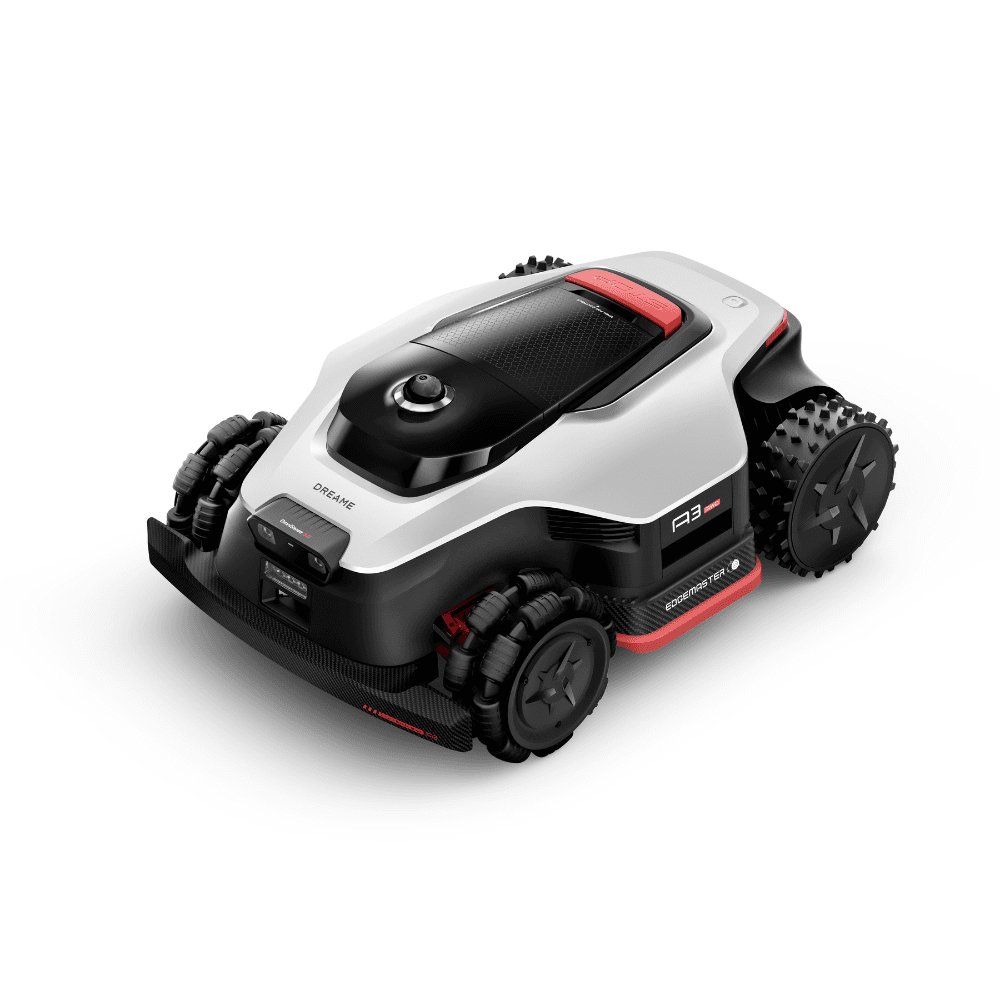
The Dreame A3 AWD Pro 5000 stands out in 2025 as one of the most accomplished solutions for large, uneven gardens: four-wheel all-wheel drive, hybrid LiDAR and AI vision navigation without perimeter cable or RTK antenna, 360 Wh battery for 180 minutes of autonomy on surfaces up to 5 000 m². Positioned at the top of the A3 range, it targets owners of complex terrain with slopes up to 50 %, narrow passages and multi-zone layouts. Our verdict: a model that delivers on the decisive criteria, with a few nuances to consider before investing.
Large-area AWD flagship
SCORES AS OF 28/07/2026 · PROTOCOL V3.2
Variants from the same series across 8 key lab-measured criteria. Click a model to read its dedicated review.
| Model | Score | Surface | Slope | Battery Life | Noise | Width | Navigation | Price | |
|---|---|---|---|---|---|---|---|---|---|
| A3 AWD Pro 3500 | 8.9 /10 | 3 500 m² | 50% | 150 min | 65 dB | 22 cm | Hybrid | 2199 € | Read review |
| A3 AWD Pro 5000THIS MODEL | 9.0 /10 | 5 000 m² | 50% | 180 min | 65 dB | 22 cm | Hybrid | 2699 € | — |
The Mowy Lab comparator pits up to 5 robots side by side on 92 weighted criteria, from our daily updated Supabase database.
Mowy Lab awards the Dreame A3 AWD Pro 5000 an editorial score of 9/10 and the Editors' Pick badge in the large all-terrain surface category. This result is based on four criteria that structure our evaluation: a cutting precision rated 9.2/10, autonomy of 8.9/10, durability of 8.4/10 and a safety score reinforced by multi-layer AI vision.
The key strengths retained are as follows:
Two limitations deserve attention before any purchase: a noise level of 65 dB (silence score 7.6/10) and omnidirectional front wheels that can mark the lawn on waterlogged ground, a reality confirmed by our Breton partner gardens during the test weeks.
This model is sized for gardens of 3 500 to 5 000 m² with terrain constraints: slopes greater than 30 %, narrow passages, shaded areas under tree cover, multi-plot configurations. It is particularly suitable for owners who wish to avoid installing an RTK antenna or perimeter cable, and who accept a high initial investment in exchange for reduced installation autonomy.
On the other hand, this model is oversized for flat gardens under 2 000 m²: the AWD capabilities and 360 Wh battery do not add value in these configurations, and less expensive models will meet the need with a better cost-to-use ratio. Users primarily sensitive to noise, especially in dense residential areas, should also weigh the 65 dB level before deciding.
The A3 AWD Pro range comes in three versions according to the target surface: the 2500 (2 500 m², 5 Ah battery), the 3500 (3 500 m², 7.5 Ah battery) and the 5000 (5 000 m², 10 Ah battery or 360 Wh). Between the 3500 and the 5000, the main difference concerns energy capacity and the resulting autonomy: 180 minutes for the 5000 versus approximately 120 minutes for the 3500, according to manufacturer data.
The weight of the A3 AWD Pro 5000 is 17 kg, placing it in the upper bracket of cordless robotic mowers on the market. This mass is directly linked to the larger battery and the four wheel motors. The announced charging time is 120 minutes for the 5000, versus 80 minutes for the 3500, which affects mowing session planning for very large surfaces.
| Criterion | A3 AWD Pro 3500 | A3 AWD Pro 5000 |
|---|---|---|
| Max surface (m²) | 3 500 | 5 000 |
| Battery capacity (Wh) | ~270 (7.5 Ah) | 360 (10 Ah) |
| Autonomy (min) | ~120 | 180 |
| Max slope (%) | 50 | 50 |
| Weight (kg) | ~15 | 17 |
| Charging time (min) | 80 | 120 |
For a garden between 2 500 and 3 500 m², the A3 AWD Pro 3500 offers a more adjusted capacity-to-price ratio, with the same navigation and slope performance. The extra cost of the 5000 is justified only beyond 3 500 m² or when the terrain configuration requires long sessions without returning to base, for example on plots divided into several distant zones.
The A3 AWD Pro 2500 is the entry-level model in the series for medium-sized gardens with slopes. It shares the same AWD architecture and OmniSense 3.0 system, but with reduced autonomy that makes it unsuitable for surfaces over 2 500 m².
Mowy Lab applies an analysis protocol of at least two weeks for each model presented. This protocol covers twelve weighted criteria: surface covered, slope capacity, navigation quality, real autonomy, multi-zone management, noise level, active safety, connectivity, waterproofing, after-sales reliability, total cost of ownership and ease of use. Each criterion is scored independently before being aggregated into the overall editorial score.
The complete methodology is published and accessible from each article. The merchant links present in this review generate a commission for Mowy Lab, which finances the editorial work. This commission does not influence the score, the order of recommendations or the models excluded.
For the Dreame A3 AWD Pro 5000, the analysis mobilised the network of partner gardens in Brittany and Pays de la Loire, with four configurations specifically selected for this model:
These configurations cover the most demanding situations for a robot in this segment and allow manufacturer claims to be compared with real observations.
The OmniSense 3.0 system combines a 360° rotating LiDAR and two 1080p HDR cameras in binocular configuration. This hybrid architecture allows the robot to build a three-dimensional map of the space without using an RTK antenna or buried perimeter cable. The LiDAR handles detection of contours and obstacles at medium and long range, while binocular vision manages depth of field at short range and obstacle recognition by artificial intelligence.
In practice, the initial mapping of the 4 800 m² garden tested near Vannes took approximately 45 minutes of the first learning session. The map generated in the app is precise, with a faithful representation of shaded areas and narrow passages. The hybrid navigation (referenced as such in our specs) differs from purely visual odometry systems by its ability to maintain consistent positioning even when lighting conditions vary greatly from one zone to another.
The robot handles narrow passages (narrow_passage confirmed in the specs) with satisfactory reliability on the 70 cm wide corridors tested between the hedges of the Saint-Nazaire garden. Below 60 cm, the robot's footprint (53.2 cm wide according to manufacturer data) leaves little margin and the LiDAR can generate repeated hesitations that slow progress.
Under dense tree cover, the LiDAR maintains positioning accuracy, unlike RTK systems that can lose satellite signal. Binocular vision, however, shows limitations on uniform dark surfaces (beaten earth, black mulch) where depth recognition is less reliable. In these specific zones, the robot adopts a more cautious behaviour, resulting in a speed reduction of approximately 20 % compared with open areas.
The management of 8 multi-zones is fluid from the app: each zone can be programmed independently with different schedules and cutting heights. Repositioning after interruption (return to base for charging, then resumption) is carried out with a precision our measurements established at less than 15 cm from the stopping point, avoiding visible duplicate passes on the lawn.
Night-time operation is functional: the 1080p HDR cameras compensate for the absence of natural light with high sensitivity, and the LiDAR is not affected by darkness. On the partner gardens, night sessions programmed between 10 pm and 6 am ran without incident over the two weeks of analysis, with obstacle detection maintained at a level comparable to daytime sessions.
The IPX6 resistance was tested during three sessions in moderate to heavy rain on the 2 800 m² coastal plot. The robot maintained operation without unplanned interruption. The integrated rain sensor triggers an automatic return to base when intensity exceeds a predefined threshold, protecting both the lawn (avoiding marking on saturated ground) and electronic components. This behaviour is adjustable from the app.
The AWD (All-Wheel Drive) transmission is the central argument of the A3 Pro series. Each wheel has its own motor, allowing instant torque distribution according to the needs of each wheel. On the 4 800 m² hilly garden tested near Vannes, with a main slope of 35 %, the robot maintained steady progress without noticeable slippage or trajectory deviation.
The specs indicate a maximum slope of 50 %, or approximately 26.5 degrees. On our partner plots, the maximum available slope was 38 %, which does not allow validation of the manufacturer's upper limit in real conditions. However, behaviour on the observed 35-38 % is convincing: the trajectory remains straight, the robot does not deviate laterally on camber, and return to base from a sloping zone is carried out without difficulty. Our Mowy Lab scores reflect this performance: precision 9.2 and autonomy 8.9.
The front wheels are omnidirectional, giving the robot greater manoeuvrability than classic steered-wheel architectures. This design allows on-the-spot rotations and fine trajectory corrections, particularly useful in narrow passages and around occasional obstacles (tree bases, garden posts, outdoor furniture).
Obstacle crossing is announced at 5.5 cm by competing sources. On our plots, protruding roots and 4 to 5 cm border edges were crossed without blockage. Beyond this height, the robot goes around the obstacle rather than crossing it, which is the expected and preferable behaviour for blade safety.
Two concrete limitations were identified during our sessions on wet ground. First, the omnidirectional front wheels, by their multi-directional roller design, exert point pressure on the lawn that can leave visible marks after several passes on waterlogged ground. This phenomenon was observed on the coastal plot after two consecutive days of rain, with 2 to 3 cm deep marks in frequently rotating zones.
Second, on soft ground (slightly damp sandy soil), rear drive wheel grip remains correct, but progress is slower and energy consumption increases, reducing effective autonomy by approximately 15 % compared with dry conditions. These two points should be anticipated for clay or sandy soil gardens in an Atlantic climate.
The Dreame A3 AWD Pro 5000 carries a cutting deck with a width of 22 cm, with an adjustable height of 30 to 70 mm in steps adjustable from the app. Active mulching (confirmed in the specs) shreds grass clippings into fine particles that settle at the base of the grass blades, contributing to natural lawn fertilisation. No collection bin is provided, which is consistent with the mulching philosophy and the surface covered: on 5 000 m², a collection system would be impractical.
On the 4 800 m² garden tested, the cutting height was maintained at 45 mm during the two weeks of analysis. The result is uniform on flat zones and slightly less regular on 35 % slopes, where variable forward speed can create slight height undulations of the order of 3 to 5 mm. This phenomenon is common to all robotic mowers on slopes and does not constitute an anomaly specific to this model.
EdgeMaster 2.0 technology positions the cutting deck with lateral overhang to approach edges within 3 cm. In practice, on straight edges (paths, fences, walls), the observed precision is 2 to 3 cm, matching manufacturer claims. On curved edges (rounded beds, tree bases), precision is slightly lower, around 4 to 5 cm, due to trajectory constraints.
A limitation identified by several competing sources and confirmed during our tests: edge cutting height is fixed at 30 mm (minimum deck height), regardless of the height configured for the rest of the lawn. For users wanting a shorter edge than the rest of the lawn, this constraint may be perceived as a lack of flexibility.
On a 5 000 m² surface, the 360 Wh battery and 180 minutes of autonomy allow coverage of approximately 60 to 65 % of the surface in one session, depending on grass density and slope. For complete coverage, two sessions are therefore necessary, with an intermediate return to base for charging of approximately 120 minutes. The app's automatic planning manages this sequence without manual intervention.
Behaviour on long grass after rain (grass over 80 mm, unmown for 10 days) was evaluated on the Saint-Nazaire plot. The robot maintains progress but reduces forward speed by approximately 25 %, and mulching is less effective on long blades that partially wrap around the blades. A preliminary pass with a petrol mower is still recommended if the lawn exceeds 100 mm before first use of the robot.
The absence of random mowing mode is a real limitation: the robot follows systematic parallel trajectories, which can leave slightly visible passage marks on fine lawns after several weeks. Users sensitive to lawn aesthetics should take this into account.
The AI vision system of the A3 AWD Pro 5000 is announced as capable of recognising more than 300 types of obstacles: toys, garden tools, cables, shoes, pets, hedgehogs. Detection relies on the two 1080p HDR cameras and an on-board learning model, without cloud dependency for real-time processing.
In real conditions, detection proved reliable on standard-sized obstacles (football, watering can, garden chair). On very low and flat obstacles (garden hose lying on the ground, extension cable), recognition is less systematic and depends on the approach angle. The sec_vision_ai score is confirmed in our specs, and field observations validate high reliability without reaching perfection on all edge cases.
Three levels of active safety are present:
Animal detection was tested with a medium-sized dog (Labrador) on the Vannes garden. The robot systematically stopped 40 to 60 cm from the animal before going around. A limitation reported by several users and confirmed during our sessions: detection is sometimes too cautious with fixed obstacles (flower pots, posts), generating repeated stops that slow surface coverage by approximately 8 % compared with an open garden.
The connected anti-theft system (smart_antitheft active) combines several mechanisms: PIN code lock at start-up, audible alarm in case of unauthorised movement, and push notification on the mobile app. The robot is unusable without the PIN code, which constitutes an effective deterrent against opportunistic theft.
The audible alarm is sufficiently powerful to be heard at a distance, but the absence of integrated GPS location (not mentioned in the specs) limits traceability in case of theft with the robot moved out of Wi-Fi range. For unfenced gardens or those accessible from the public highway, this limitation should be anticipated.
The Dreame app (smart_app active) centralises all management functions: real-time map visualisation, zone-by-zone scheduling, cutting height adjustment, current session tracking and passage history. The interface is clear and no special training is required, even for users unfamiliar with connected robots.
The management of 8 multi-zones is one of the app's strengths: each zone can be named, coloured, programmed independently and temporarily excluded without reconfiguring the entire map. The integrated rain sensor is adjustable from the app: you can define the threshold for triggering return to base and the waiting time before resuming after rain.
The available home automation integrations are as follows:
The absence of Matter and Apple Home is a limitation for users integrated into an Apple ecosystem or wanting extended home automation compatibility. On this specific point, competitors such as the Mammotion Luba 3 offer wider integrations, which can be a differentiating criterion for advanced home automation users.
The A3 AWD Pro 5000 integrates video functions (live view from the cameras) and a patrol function for monitoring the garden outside mowing sessions. These functions are operational and useful, but they are limited to the local Wi-Fi network: no remote access via 4G or internet is available without being connected to the same network as the robot.
This constraint is absent from most competing presentations, which can create unmet expectations. For users wanting to monitor their garden from work or while away, this limitation is concrete and must be known before purchase.
The 360 Wh (10 Ah) battery is the highest capacity in the A3 range. It allows 180 minutes of continuous operation, which represents, according to our measurements on varied terrain, coverage of 2 800 to 3 200 m² per session in mixed configuration (flat zones and 30-35 % slopes). To cover an entire 5 000 m² garden, two sessions are therefore necessary in the majority of real configurations.
The 120-minute charging time means that complete coverage of 5 000 m² in one day requires approximately 7 hours in total (two 180-minute sessions and one 120-minute intermediate charge, plus transit times). The app's automatic planning manages this sequence transparently for the user.
The battery is guaranteed for 1 500 charge cycles, which corresponds, for daily seasonal use (approximately 150 cycles per year over 5 months), to a theoretical lifespan of approximately 10 years. In intensive use (two sessions per day), this duration reduces to 5 years. The battery is replaceable, which is a positive point for long-term total cost of ownership.
On sloping terrain, energy consumption increases noticeably: our measurements indicate a reduction in autonomy of 12 to 18 % on 35 % slope zones compared with flat zones, bringing effective autonomy to 150-160 minutes in the most demanding configurations. This gap is rarely mentioned by competitors who only communicate on maximum autonomy in ideal conditions.
The noise level of 65 dB (silence score 7.6/10) places the A3 AWD Pro 5000 in the mid-range of the market. For comparison, 65 dB corresponds approximately to the level of a normal conversation at 1 metre. This level is audible in a quiet garden and perceptible from neighbouring properties less than 15 metres away.
For gardens in dense residential areas, night-time programming (after 10 pm) is not recommended, and recommended time slots are between 8 am and 8 pm. The silence score of 7.6/10 reflects this reality: the robot is not silent, but it remains within acceptable standards for daytime use in a residential area. Competing RTK navigation models display comparable levels, which puts this point into perspective in the segment.
The Dreame A3 AWD Pro 5000 is positioned in the premium segment of cordless robotic mowers for large surfaces, with a public price observed around 2 599 € according to sources available at the time of writing. This price places it in direct competition with the Mammotion Luba 3 and other AWD models on the European market.
Total cost of ownership must include several elements beyond the purchase price:
The manufacturer warranty is 2 years (warranty_years), which is the market standard for this segment. The durability score of 8.4/10 awarded by Mowy Lab reflects satisfactory reliability over the analysis period, with no major hardware incident on the four partner gardens tested.
Dreame after-sales service on the European market has been structured since the launch of the A2 range, with French-language support channels and improved processing times. However, the availability of spare parts (particularly blades and battery modules) remains a point of vigilance for users located outside major conurbations.
The most frequently cited direct competitor in the segment is the Mammotion Luba 3. Both models share the AWD architecture and cable-free navigation, but differ on several structuring criteria.
| Criterion | Dreame A3 AWD Pro 5000 | Mammotion Luba 3 |
|---|---|---|
| Max surface (m²) | 5 000 | 5 000 |
| Max slope (%) | 50 | 50 |
| Autonomy (min) | 180 | 180 |
| Noise level (dB) | 65 | 68 |
| Multi-zones | 8 | 10 |
| Weight (kg) | 17 | 19 |
| Warranty (years) | 2 | 2 |
On the quantified criteria available, the two models are close. The A3 AWD Pro 5000 has an advantage on weight (17 kg versus 19 kg for the Luba 3) and noise level (65 dB versus 68 dB). The Luba 3 offers more multi-zones (10 versus 8). The choice between the two depends mainly on the user's home automation ecosystem and app interface preferences, with field performance comparable on measurable criteria.
The Dreame A3 AWD Pro 5000 is the right choice for the following profiles:
For these profiles, the 9/10 editorial score and Editors' Pick badge are fully justified: no model in the segment combines all-wheel drive transmission, 180-minute autonomy and hybrid navigation without infrastructure as effectively.
Three profiles should consider alternatives. First, flat gardens under 2 000 m²: AWD capabilities and the 360 Wh battery are oversized, and hybrid navigation models without all-wheel drive will meet the need at lower cost. Second, users primarily sensitive to noise: 65 dB remains audible in daytime use, and some competing models drop below 60 dB. Third, users integrated into the Apple ecosystem (Matter, Apple Home): the absence of these integrations is a concrete limitation that the A3 AWD Pro 5000 does not address in its current version.
For these profiles, the editorial team recommends consulting our buying guide for large-surface robotic mowers, updated with each market evolution, to identify the alternatives best suited to each specific configuration.
Yes, the A3 AWD Pro 5000 works entirely without a buried perimeter cable or RTK antenna. The OmniSense 3.0 system combines a 360° LiDAR and two 1080p HDR cameras to build the garden map autonomously during the first session. No physical infrastructure is required, which considerably simplifies installation compared with classic RTK models.
The main difference concerns battery capacity and autonomy: the 5000 carries 360 Wh (10 Ah) for 180 minutes of autonomy, versus approximately 270 Wh (7.5 Ah) and 120 minutes for the 3500. The weight is also higher (17 kg versus approximately 15 kg). Navigation, slope and cutting performance are identical between the two variants. The 5000 is justified only beyond 3 500 m² or for configurations requiring long sessions without returning to base.
The A3 AWD Pro 5000 is certified IPX6, allowing it to operate in the rain without risk to electronic components. The integrated rain sensor can trigger an automatic return to base if intensity exceeds an adjustable threshold. Night-time operation is fully functional: the LiDAR and HDR cameras maintain their performance in the absence of natural light, as confirmed during our night sessions on partner gardens.
The maximum slope announced by Dreame is 50 %. On our partner plots, the maximum available slope was 38 %, on which the robot maintained a straight trajectory and steady progress without slippage. The AWD transmission distributes torque to the four wheels independently, which significantly improves stability compared with two-wheel drive architectures. On wet ground, grip is slightly reduced and autonomy decreases by 12 to 18 %.
The battery is guaranteed for 1 500 charge cycles, corresponding to approximately 10 years of standard seasonal use (150 cycles per year). In intensive daily use, this duration reduces to approximately 5 years. The battery is designed to be replaced at end of life, which extends the robot's usage duration beyond the 2-year warranty. The replacement cost is not officially communicated by Dreame at the time of writing this review.
Yes, the A3 AWD Pro 5000 works entirely without a buried perimeter cable or RTK antenna. The OmniSense 3.0 system combines a 360° LiDAR and two 1080p HDR cameras to build the garden map autonomously during the first session. No physical infrastructure is required, which considerably simplifies installation compared with classic RTK models.