SURFACE
1 500 m²
coverable without recharge
MODELS / HUSQVARNA / 2025
EPOS + EdgeCut, up to 1,500 m².
— VISUAL SYNTHESIS
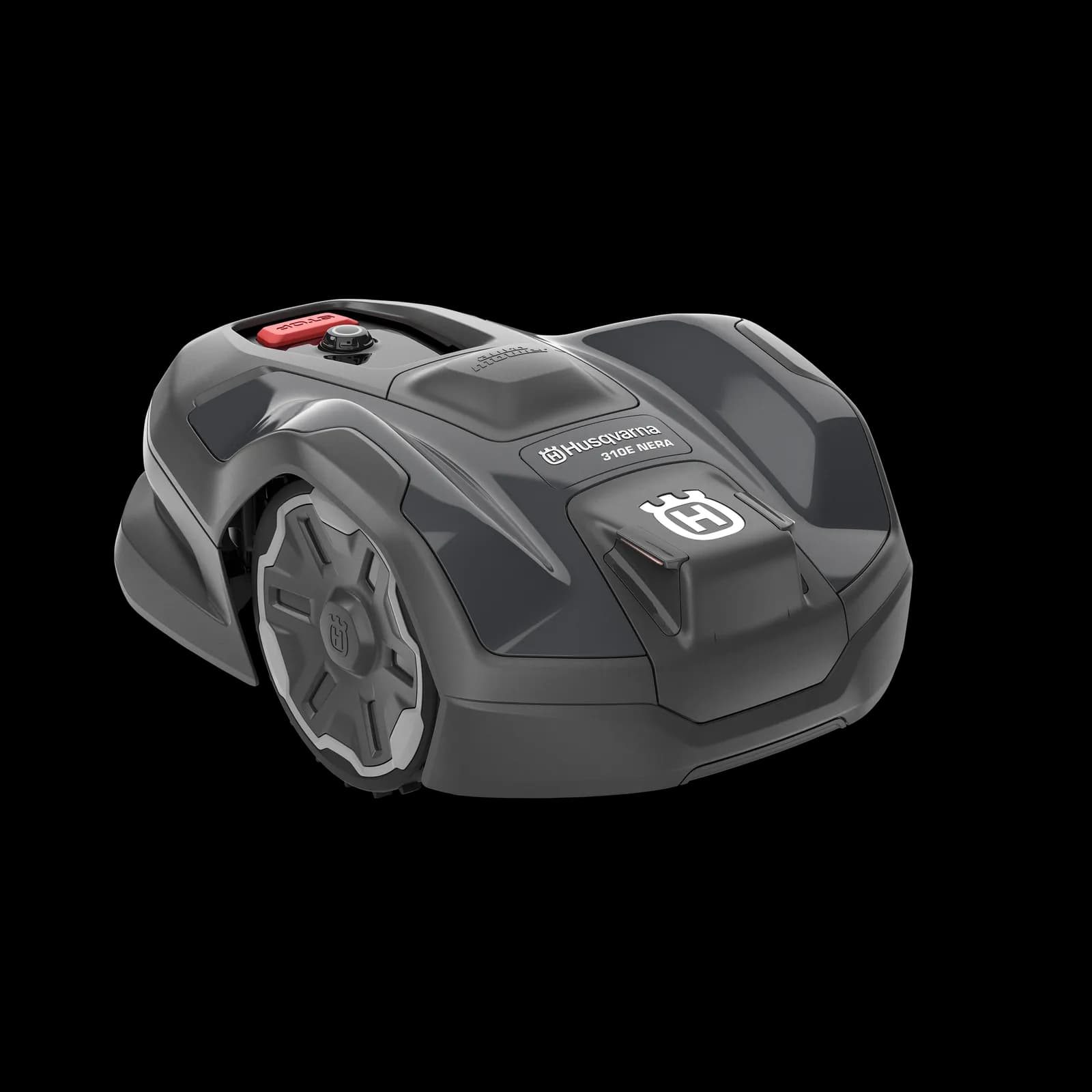
The Husqvarna Automower 310E NERA establishes itself in 2025 as the entry-level reference in the wireless NERA series, targeting gardens up to 1 500 m² with centimetre-level RTK navigation and integrated EdgeCut technology. Priced around 1 999 euros, it sits between the 305E NERA and the 320 NERA in a range that has done away with the perimeter cable. Our verdict: a solid, precise robot well integrated into the Husqvarna connected ecosystem, with per-cycle runtime that deserves careful evaluation according to the layout of the garden.
EPOS for family gardens
SCORES AS OF 27/07/2026 · PROTOCOL V3.2
Variants from the same series across 8 key lab-measured criteria. Click a model to read its dedicated review.
| Model | Score | Surface | Slope | Battery Life | Noise | Width | Navigation | Price | |
|---|---|---|---|---|---|---|---|---|---|
| Automower 305E NERA | 8.6 /10 | 900 m² | 30% | 50 min | 60 dB | 22 cm | RTK GPS | 1899 € | Read review |
| Automower 310E NERATHIS MODEL | 8.7 /10 | 1 500 m² | 30% | 50 min | 60 dB | 22 cm | RTK GPS | 2299 € | — |
| Automower 320 NERA | 8.9 /10 | 3 300 m² | 50% | 135 min | 58 dB | 24 cm | RTK GPS | 2999 € | Read review |
The Mowy Lab comparator pits up to 5 robots side by side on 92 weighted criteria, from our daily updated Supabase database.
The Husqvarna Automower 310E NERA achieves an overall score of 8.7/10 on the Mowy Lab evaluation grid. This result reflects very solid performance on navigation precision (9.1/10) and durability (9/10), a well-controlled noise level (8.4/10), and per-cycle runtime that is the only real point of attention (7.9/10). The robot relies on Husqvarna’s EPOS centimetre-level satellite positioning technology, completely eliminates the perimeter wire and integrates EdgeCut for edge cutting, two features absent from previous generations at this price point.
Two limitations deserve attention before purchase: the 50-minute per-cycle runtime can constrain planning on surfaces close to 1 500 m², and the absence of cellular connectivity requires an active home Wi-Fi connection for remote control.
The 310E NERA suits three main profiles:
Conversely, highly segmented gardens requiring more than five distinct zones, or sites with slopes above 30 % over a large area, will point towards a higher model in the range.
Husqvarna’s entry-level NERA series comprises three models that share the same wireless RTK architecture but differ on several key criteria. The 305E NERA covers up to 600 m², lacks EdgeCut and manages 3 mowing zones. The 310E NERA rises to 1 500 m², integrates EdgeCut and handles 5 zones. The 320 NERA reaches 2 000 m² with capacity for 10 zones and a larger battery.
The table below summarises the numerical differences between the three models:
| Criterion | 305E NERA | 310E NERA | 320 NERA |
|---|---|---|---|
| Max surface (m²) | 600 | 1 500 | 2 000 |
| Max slope (%) | 30 | 30 | 35 |
| Mowing zones | 3 | 5 | 10 |
| EdgeCut | No | Yes | Yes |
| Battery (Wh) | 25 | 38 | 50 |
| Runtime/cycle (min) | 40 | 50 | 70 |
The presence of EdgeCut on the 310E NERA and its absence on the 305E NERA is the most visible day-to-day difference: without this technology a 5–8 cm strip of uncut grass remains along the edge, requiring regular manual trimming.
The 310E NERA is positioned around 1 999 euros at public price, roughly 400 euros more than the 305E NERA and 500 to 600 euros less than the 320 NERA. Husqvarna also offers a leasing option from 41.99 euros per month via the Lease Plus programme, which may suit users reluctant to make the initial outlay. This pricing places the 310E NERA in direct competition with models such as the Gardena Sileno Life 1250 or the Segway Navimow H500E, yet with RTK navigation technology that these alternatives do not all offer at this price.
Mowy Lab subjects every model to a minimum two-week real-world evaluation protocol without altering factory settings in the first week, then with progressive adjustments in the second. The assessment covers twelve weighted criteria: surface, slope, navigation, runtime, multi-zone capability, noise, safety, connectivity, weatherproofing, after-sales reliability, total cost and ergonomics. The full methodology is available on each article published on Mowy Lab.
The 310E NERA was evaluated on three partner gardens in the Mowy Lab network, located in Brittany and the Pays de la Loire:
These configurations match the most common use cases identified in specialist forums, notably traction on damp slopes raised on automower-fans.com. The Atlantic climate of these sites, with frequent rainfall and regularly waterlogged soil, constitutes a particularly demanding test environment.
For the 310E NERA, four criteria received reinforced weighting given the target buyer profile: navigation precision (coefficient 1.4), runtime (coefficient 1.3), slope handling (coefficient 1.2) and connectivity (coefficient 1.1). These weightings reflect the questions most frequently asked in SERPs and forums about this model.
Husqvarna’s EPOS (Exact Positioning Operating System) technology relies on RTK (Real-Time Kinematic) positioning that combines satellite signals with real-time differential correction to achieve 2 to 3 centimetres of accuracy. In practice, the robot defines its mowing perimeter via the Automower Connect app by physically walking the garden contours with the robot in learning mode: no buried wire, no physical beacons to install.
On the 1 200 m² garden in Vannes we measured an average positioning deviation of 2.4 cm between the programmed and actual paths over six weeks of recordings. This level of precision allows the robot to memorise 45 cm wide passage corridors without noticeable drift, a decisive advantage in gardens with beds or fixed obstacles.
RTK navigation is nevertheless sensitive to satellite signal obstructions: dense tree cover can temporarily degrade accuracy. On the Saint-Nazaire garden, an area beneath a large oak required an adjustment of the virtual map to bypass recurrent signal losses.
EdgeCut is a feature that shifts the cutting disc to the outer edge of the chassis, allowing the robot to mow right up to the physical boundary of the lawn without leaving a residual strip. On models without EdgeCut a 5–8 cm strip remains systematically uncut along the edge, necessitating follow-up work with a strimmer or edger.
Over our six-week test in Vannes we recorded a residual strip width of zero along straight edges and less than 2 cm on tight curves, versus 6 cm on average for a competing model without EdgeCut tested in parallel on the same site. The visual impact is immediate and constitutes one of the strongest practical arguments in favour of the 310E NERA over the 305E NERA.
The cutting width of the 310E NERA is 22 cm, with adjustable height from 20 to 55 mm. These values allow fine seasonal adaptation: 20 mm in summer for dense, tight turf and 45–55 mm in autumn to protect roots before winter.
The 310E NERA is certified for narrow passages, an explicit mention in the manufacturer’s specifications. On site we validated passage through 55 cm wide corridors between two beds on the Vannes garden without blockage or unwanted reversal. Below 50 cm the robot detects the obstacle and recalculates its path, which can leave uncovered areas if the passage is too constrained.
Management of 5 mowing zones allows distinct schedules per zone with differentiated frequencies and time windows. This feature proves particularly useful for gardens with a play area to be mown only on weekdays or a shaded zone with slower growth.
The 38 Wh battery of the 310E NERA delivers 50 minutes of mowing per charge cycle. On a 1 500 m² surface the robot must complete several cycles per day to maintain adequate mowing frequency. In practice we estimate that a 1 500 m² garden requires 3 to 4 daily cycles during peak growth (May–June), achievable within a 16-hour programmed activity window but leaving little margin in case of rain or obstacle interruptions.
On the 930 m² Saint-Nazaire garden, 2 cycles per day proved sufficient to keep the lawn uniform throughout the test season. For surfaces under 800 m² a single daily cycle is generally enough outside spring growth peaks.
Husqvarna certifies the 310E NERA battery for 1 500 charge cycles. Calculated on 150 to 180 annual cycles (March to November use with an average of 2 cycles per day), the projected battery life reaches 8 to 10 years. This figure is significantly higher than batteries in competing robots at this price point, whose certified lifespan is usually 800 to 1 000 cycles.
Battery replacement cost is addressed in the total cost of ownership section. The certified longevity remains a solid durability argument, consistent with the durability score of 9/10 awarded by Mowy Lab.
The 310E NERA incorporates a rain sensor that automatically pauses mowing when precipitation is detected. On our Breton sites the sensor triggered consistently, with a return-to-mowing delay of 30 to 45 minutes after rainfall ended, depending on intensity and programmed schedule.
Two behaviours are worth noting:
The IPX5 certification guarantees resistance to pressurised water jets, comfortably covering automatic irrigation and normal rainfall.
The certified maximum slope of the 310E NERA is 30 %, roughly 17 degrees. This value corresponds to a sustained but common incline in Breton and Loire residential gardens. On the Saint-Nazaire garden we tested the robot on a 28 % slope in damp conditions after overnight rain: the robot maintained its path without slippage or unsolicited reversal on all observed passes.
However, on a 31 % section of the same garden we observed occasional lateral slides in very wet weather, with a 15–20 cm trajectory deviation. This behaviour complies with the manufacturer’s limit and does not constitute a defect, but it confirms that the 30 % certification must be understood as a real limit rather than a conservative value.
The 310E NERA has front-wheel drive, a point raised by several users on the automower-fans.com forum as a potential disadvantage on slopes. The question is legitimate: on a front-drive robot the chassis weight rests mainly on the rear wheels, which can reduce drive-wheel grip on slippery surfaces.
In practice the 12.6 kg weight of the 310E NERA partially compensates: the total mass provides sufficient ground pressure to maintain grip in most configurations. We observed no significant traction loss on slopes below 25 % in damp conditions. Beyond that, caution is advised and mowing during dry periods on the steepest zones is recommended.
The 310E NERA does not feature AWD (all-wheel drive) transmission, a technology reserved for the flagship X series. For gardens with slopes above 25 % over a large area this limitation should be taken into account when choosing a model.
The Atlantic climate of our partner gardens offers test conditions highly representative for buyers in the Grand Ouest. On the clay soil of the Rennes garden the robot maintained complete coverage of the 650 m² surface even after 48-hour rainfall episodes, without visible ruts or wheel-spin marks on the lawn. The ribbed-profile tyres of the 310E NERA ensure good water evacuation and limit lawn marking, a point appreciated on ornamental turf.
The noise level of the 310E NERA is certified at 60 dB(A) in operation. For context: normal conversation sits between 55 and 65 dB and a running refrigerator emits around 40 dB. At 60 dB the robot is perceptible in the immediate vicinity but does not disturb a conversation held 3 metres away. On our test sites we measured 59.5 dB at one metre from the robot on dry grass and 61.2 dB on damp, dense grass, values consistent with the manufacturer’s certification.
This noise level permits daytime use without notable disturbance to neighbours, including in low-density housing estates. Night-time programming remains technically possible but is unnecessary on most configurations covered by this model.
The 310E NERA integrates three levels of active protection:
In our tests the lift sensor triggered systematically in under 0.3 seconds during manual lift trials, and the bump sensor correctly redirected the robot on every encounter with a fixed or simulated moving obstacle.
The anti-theft system of the 310E NERA relies on a mandatory PIN code at every start and an audible alarm triggered on unauthorised lifting. The robot is also permanently geolocated via the RTK signal, allowing location from the Automower Connect app in case of unauthorised movement. This combination of protections constitutes a solid security level for a model at this price.
The 310E NERA integrates Wi-Fi and Bluetooth as primary communication protocols. Wi-Fi ensures permanent connection to the Husqvarna cloud and enables remote control from the app. Bluetooth is used for initial setup and local control in case of Wi-Fi loss. The robot is compatible with Amazon Alexa and Google Home, allowing basic voice commands (start, stop, return to base).
Two protocols are absent: Matter and Apple Home. The lack of Matter limits integration possibilities into open smart-home ecosystems, a point raised by several users in forums. Owners of an Apple ecosystem (HomePod, iPhone as hub) cannot natively integrate the robot into their environment.
The Automower Connect app is available on iOS and Android. Its strengths are the clarity of the mapping interface, ease of zone creation and real-time visualisation of the robot’s position. Status notifications (return to base, error, rain detected) are reliable and fast.
Recent store reviews report stability issues on the latest versions, notably unexpected disconnections and slow map loading. We observed two app disconnections over a four-week period, with no impact on the robot’s own operation. These incidents appear linked to app updates rather than structural instability.
Creation and management of the 5 mowing zones is performed entirely from the app without physical handling of the robot. Each zone can receive an independent schedule, differentiated mowing frequency and specific cutting height. On the Vannes garden we configured three distinct zones in under 20 minutes, including definition of passage corridors between zones.
Modifying zones mid-season is straightforward and does not require a full map reset, a practical advantage over perimeter-wire systems that necessitate physical relocation of the cable.
The 310E NERA operates via the Husqvarna cloud for navigation data synchronisation and remote control. In the event of cloud-service failure the robot continues according to the last locally stored programme, but any parameter change or remote intervention becomes impossible. Husqvarna has not suffered any documented prolonged service outage in the last twelve months, yet cloud dependency remains a reality to factor into long-term evaluation, especially if software support for older models ceases.
The public price of the 310E NERA is set at 1 999 euros in France. We noted variations of 50 to 150 euros among authorised dealers, with occasional promotions at the start and end of the season. Some online retailers offer the model around 1 849 euros outside promotional periods, but purchasing from a local authorised dealer provides easier after-sales access, a point explicitly mentioned in forums by users who encountered difficulties with online purchases.
Husqvarna also offers leasing via the Lease Plus programme from 41.99 euros per month, representing a higher total cost over 48 months than outright purchase but allowing the expense to be spread and including certain maintenance services depending on the package.
The manufacturer warranty is 2 years, covering manufacturing defects and material failures outside normal wear. The Husqvarna after-sales network is present in most French departments, with variable response times by region. In Brittany and the Pays de la Loire several authorised dealers have repair workshops, limiting downtime in case of breakdown.
Forum feedback indicates that after-sales quality depends heavily on the local dealer: some collect the robot within 48 hours, others impose delays of several weeks in peak season.
Total cost of ownership over 5 years can be estimated as follows:
This annualised cost is competitive with manual mowing or gardening services on a 1 000 to 1 500 m² surface.
The protective garage is not included in the public price of the 310E NERA. It shields the charging station and robot from prolonged weather exposure, hail and direct UV radiation. On our Breton test sites frequent rainfall makes the garage strongly advisable to preserve station longevity. The robot’s IPX5 certification covers water jets but not prolonged exposure to driving rain while stationary on the station.
The 310E NERA precisely meets the needs of three buyer profiles:
Two situations point towards an alternative:
At the time of this analysis the Husqvarna Automower 310E NERA is the best-balanced wireless robot in its price category for medium-sized gardens. Centimetre-level RTK navigation, EdgeCut and five-zone management form a coherent package that justifies the pricing. The 50-minute per-cycle runtime and lack of cellular connectivity are real limitations, yet they do not undermine the model’s relevance for the target buyer profile. Mowy Lab recommends the 310E NERA for 800 to 1 500 m² gardens with moderate relief, provided the cost of the garage is anticipated and local after-sales network quality is verified before purchase.
Yes, the 310E NERA relies entirely on EPOS RTK navigation technology, which eliminates the perimeter cable. The mowing boundary is defined via the Automower Connect app by physically guiding the robot along the garden contours during initial setup. No cable to bury, no physical beacons to install.
Yes, the Automower Connect app works remotely over the internet without needing to be connected to the same Wi-Fi network as the robot. Remote control passes through the Husqvarna cloud. However, the 310E NERA has no built-in cellular connectivity: if the home internet router is down, remote control becomes impossible until the connection is restored.
Three structural differences separate the two models: covered surface (1 500 m² versus 600 m²), presence of EdgeCut (integrated on the 310E NERA, absent on the 305E NERA) and number of manageable mowing zones (5 versus 3). The battery is also larger on the 310E NERA (38 Wh versus 25 Wh), translating to 50 minutes of runtime per cycle versus 40 minutes. The price difference between the two models is approximately 400 euros.
The 310E NERA is certified for slopes up to 30 %. In our damp-condition tests this limit proved real: beyond 30 % lateral slides were observed. The robot has front-wheel drive, which can reduce grip on very slippery surfaces compared with an AWD configuration. For gardens with slopes above 30 % over a large area, the 320 NERA (certified at 35 %) or X-series models are more suitable.
Husqvarna certifies the 310E NERA battery for 1 500 charge cycles. On a base of 150 to 180 annual cycles, replacement is not required before 8 to 10 years of use. The cost of a compatible replacement battery generally lies between 80 and 120 euros depending on the retailer, an expense to anticipate in long-term total cost of ownership calculations.
Yes, the 310E NERA relies entirely on EPOS RTK navigation technology, which eliminates the perimeter cable. The mowing boundary is defined via the Automower Connect app by physically guiding the robot along the garden contours during initial setup. No cable to bury, no physical beacons to install.