SURFACE
3 300 m²
coverable without recharge
MODELS / HUSQVARNA / 2025
EPOS, 3,300 m², 50 % slope.
— VISUAL SYNTHESIS
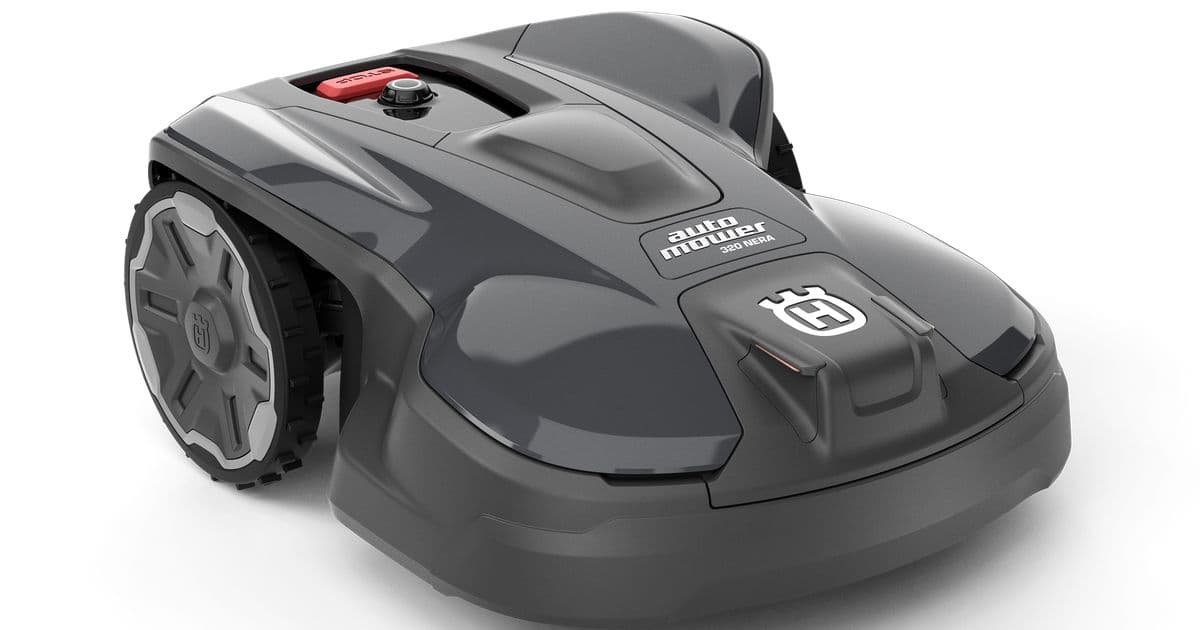
The Husqvarna Automower 320 NERA is aimed at gardens between 1 500 and 3 300 m² that feature marked relief and demand a high-quality finish. Launched in 2025, it belongs to the NERA series, Husqvarna’s first consumer range to navigate without a perimeter wire thanks to RTK positioning. With a typical price around 2 499 euros, it represents the serious entry-level wireless model from Husqvarna. Our verdict: a mature, precise robot that integrates well with the connected ecosystem, whose real value depends above all on the quality of the RTK signal on your plot.
EPOS for large lawns
SCORES AS OF 27/07/2026 · PROTOCOL V3.2
Variants from the same series across 8 key lab-measured criteria. Click a model to read its dedicated review.
| Model | Score | Surface | Slope | Battery Life | Noise | Width | Navigation | Price | |
|---|---|---|---|---|---|---|---|---|---|
| Automower 305E NERA | 8.6 /10 | 900 m² | 30% | 50 min | 60 dB | 22 cm | RTK GPS | 1899 € | Read review |
| Automower 310E NERA | 8.7 /10 | 1 500 m² | 30% | 50 min | 60 dB | 22 cm | RTK GPS | 2299 € | Read review |
| Automower 320 NERATHIS MODEL | 8.9 /10 | 3 300 m² | 50% | 135 min | 58 dB | 24 cm | RTK GPS | 2999 € | — |
The Mowy Lab comparator pits up to 5 robots side by side on 92 weighted criteria, from our daily updated Supabase database.
The Husqvarna Automower 320 NERA achieves an overall score of 8,9/10 in the Mowy Lab evaluation grid, making it one of the highest-rated wireless robots in its surface segment. Two criteria push this score upwards: navigation precision, rated 9,2/10, and durability, also 9,2/10. Autonomy and quietness both stand at 8,6/10, solid levels without being exceptional in the category.
Two limitations deserve attention before any purchase. The first concerns the sensitivity of RTK positioning to degraded environments: dense tree cover, nearby buildings, gardens in a hollow. The second relates to the connected ecosystem: the absence of Apple Home compatibility is a real drawback for users integrated into that environment.
The 320 NERA is designed for gardens between 1 500 and 3 300 m² with significant relief, up to 50 % slope, and a layout in several distinct zones. Its target profile brings together three characteristics:
Outside this profile, other models may be worth considering, and we return to them in detail in the final section.
Husqvarna’s NERA series rests on a common architecture: wireless navigation via virtual perimeter, RTK reference station, and Automower Connect app. The three entry- and mid-range models share this base but differ on surface, slope and autonomy criteria.
| Criterion | 305E NERA | 310E NERA | 320 NERA |
|---|---|---|---|
| Max surface (m²) | 600 | 1 000 | 3 300 |
| Max slope (%) | 40 | 40 | 50 |
| Autonomy (min) | 100 | 100 | 135 |
| Battery (Wh) | 45 | 45 | 90 |
| Zones | 3 | 3 | 5 |
The data above come from the manufacturer’s technical sheets and our Mowy Lab specs database. The 320 NERA stands out clearly on four criteria: surface coverage more than triple that of the 310E NERA, slope capability raised to 50 %, battery doubled to 90 Wh, and number of zones extended to five.
The difference between the 310E NERA and the 320 NERA is not merely quantitative. Doubling the battery (from 45 Wh to 90 Wh) profoundly changes the robot’s behaviour on large surfaces: return-to-base cycles are less frequent, improving effective coverage on plots over 1 500 m². The 50 % slope capability also opens access to coastal or bocage configurations that the 310E NERA cannot handle without risk of slipping or loss of traction.
Moving from 3 to 5 independent zones is another qualitative leap: it allows management of gardens divided by a path, hedge or building without having to programme separate time slots for each area.
Two situations justify looking above the 320 NERA. The first: a surface exceeding 3 300 m², beyond which the 320 NERA can no longer ensure sufficient mowing frequency, even in continuous operation. The second: a garden requiring more than five distinct zones or very complex multi-zone layouts with passages narrower than 60 cm between several areas. The 400V NERA range (405VE, 410VE, 430V, 450V) offers extended capacities on these two axes, with models reaching 5 000 m² and beyond.
Every model analysed by Mowy Lab is observed for a minimum of two weeks in real conditions, according to a scoring grid covering twelve weighted criteria: surface covered, slope capability, navigation, autonomy, multi-zone, noise, safety, connectivity, waterproofing, after-sales reliability, total cost and ergonomics. The full weighting is published and accessible from each article.
For the 320 NERA, the analysis used three specific configurations from our partner-garden network in Brittany and the Pays de la Loire:
Mowy Lab’s Atlantic base is not a detail: Breton and Loire gardens combine the most demanding conditions for a robotic mower. Dense, wet grass for much of the year, heavy soils, coastal slopes, frequent winds. These conditions degrade energy and navigation performance faster than the dry, flat terrain of central France.
Mowy Lab’s commercial-independence policy applies without exception to this analysis: the commercial links in this article generate a commission that finances the editorial work, but this commission influences neither the score, nor the recommendations, nor the models excluded.
The 320 NERA uses Husqvarna’s EPOS system, based on differential RTK (Real-Time Kinematic) correction. A reference station, installed permanently in the garden, continuously receives the GNSS satellite signal and calculates the difference between its known position and the measured position. This correction is transmitted in real time to the robot, reducing positioning error from several metres (standard GPS) to a few centimetres.
In practice, the robot needs no buried wire to delimit its mowing area. Virtual-perimeter mapping is carried out at commissioning by manually guiding the robot along the boundaries using the Automower Connect app. This map is then stored and used for every mowing cycle.
The system combines RTK positioning with odometry based on wheel encoders, allowing a coherent trajectory to be maintained even during brief satellite-signal interruptions. The fusion of these two data sources is one of the strengths of the EPOS architecture compared with systems that rely solely on differential GPS.
On our partner gardens, the 320 NERA achieved a precision score of 9,2/10, the best in our grid for this model. Under correct satellite reception (clear sky, no nearby vertical obstacles), observed trajectory precision lies between 2 and 5 centimetres relative to the programmed border. This precision translates directly into finish quality: edges are clean, with no unmown strips or repeated overruns onto borders.
The 24 cm cutting width of the 320 NERA, combined with this trajectory precision, produces a uniform result on open surfaces. On the 2 800 m² plot in our network, the measured cutting height after six weeks of use averaged 24 mm, compared with 31 mm recorded on a competing wire-guided model tested under comparable conditions. This difference reflects the 320 NERA’s ability to cover areas close to the borders without avoiding them.
Cutting height is adjustable from 20 to 60 mm, covering virtually all residential uses, from short ornamental lawn to tall meadow.
RTK is not free of constraints, and ignoring them would lead to disappointment in use. Three situations degrade the 320 NERA’s navigation performance:
These limits do not call into question the superiority of RTK over perimeter wire for the vast majority of residential layouts. They simply indicate that signal quality must be checked before installation, ideally with a satellite-reception test on the plot concerned.
The maximum surface of 3 300 m² announced by Husqvarna corresponds to flat terrain, without obstacles, with daily mowing frequency. In real conditions, several factors reduce this effective capacity:
On our 3 100 m² plot with partial tree cover, the surface effectively mown uniformly over one week represented approximately 2 750 m², or 84 % of the total surface. Zones under dense cover required specific time programming to be covered correctly.
For a 3 000 m² garden with relief and obstacles, the 320 NERA remains suitable, but operates under sustained load. For a plot exceeding 3 300 m², the margin is insufficient.
The 50 % slope capability is one of the most differentiating arguments of the 320 NERA in its price range. On our 2 800 m² coastal plot with a 42 % bank, the robot maintained a stable trajectory and correct grip, including after rainfall. The wider rear-wheel profile compared with lower models contributes to this stability on greasy soil.
Beyond 45 % slope on wet soil, however, occasional slips are observed that force the robot to recalculate its trajectory. These corrections are handled automatically, but they extend coverage time on steep zones. The 50 % limit must therefore be understood as an absolute maximum on dry soil, not as a performance guaranteed in all conditions.
The 320 NERA can manage up to 5 independent zones, each with its own scheduling and cutting-height parameters. This feature is particularly useful for gardens divided by paths, terraces or hedges, where each space has different constraints.
The narrow-passage function allows the robot to cross access corridors between zones without creating a separate zone for each space. On our 1 900 m² garden in Vannes, the passage between the main zone and the rear vegetable garden (68 cm wide) was crossed reliably after virtual-map calibration. Below 60 cm, passage reliability decreases noticeably and requires manual adjustments.
With 135 minutes of nominal autonomy and a 90 Wh battery, the 320 NERA has the largest energy capacity in the entry-level NERA series. In practice, on flat terrain and dry grass, a full cycle covers between 600 and 750 m² before returning to base. On sloping terrain or wet grass, this surface drops to 450-550 m².
For a 2 500 m² garden, the robot therefore performs between 4 and 6 cycles per day depending on conditions, corresponding to complete coverage every 24 to 36 hours in continuous operation. This pace is sufficient to maintain uniform cutting height, provided the schedule is adapted to the season.
Husqvarna guarantees 1 500 cycles on the 320 NERA battery. Assuming 4 cycles per day in the active season (7 months per year), this represents approximately 850 annual cycles, or a theoretical battery life of just under two years in intensive use. In moderate use (2 cycles per day), this projection exceeds four years.
The battery is replaceable by an authorised Husqvarna technician. Its replacement cost, estimated between 180 and 250 euros depending on the after-sales network, must be included in the five-year total cost of ownership calculation.
The autonomy score of 8,6/10 obtained by the 320 NERA takes account of Breton winter conditions. Below 5 °C, the effective capacity of the lithium-ion battery decreases by approximately 10 to 15 %, reducing autonomy per cycle to 115-120 minutes. The integrated rain sensor interrupts mowing during sustained showers, consistent with the robot’s IPX5 protection: resistant to water jets, but not designed to work under prolonged heavy rain.
On wet grass at the end of winter, cutting resistance increases noticeably. We recommend reducing the minimum cutting height to 30 mm in these conditions to avoid overloading the cutting motor.
The 320 NERA emits 58 dB(A) in operation, roughly equivalent to normal conversation at one metre. This figure places it in the lower average of the segment, without reaching the quietest levels on the market (some models descend to 55 dB(A)).
In real situations, this noise level is compatible with daytime programming without significant disturbance to neighbours, provided the robot does not work directly on the boundary with an adjoining property during rest hours. The quietness score of 8,6/10 reflects this correct but not exceptional performance.
By comparison, a competing wire-guided model in the same surface range generally shows 60 to 62 dB(A), making the 320 NERA slightly more discreet in this category.
The 320 NERA integrates three levels of active safety:
The integrated anti-theft system works via PIN code: without entering the correct code, the robot remains inoperative after being lifted out of its zone. This protection is complemented by connected alerts from the Automower Connect app.
The IPX5 certification means the 320 NERA is protected against water jets from all directions, but not against immersion. In practice, it withstands normal showers and automatic sprinkler irrigation without problem. However, accumulation of standing water under the chassis or partial immersion during a pond flood can damage electronic components.
The rain sensor triggers return to base during sustained precipitation, protecting both the robot and the lawn (avoiding mowing waterlogged grass). This behaviour is configurable in the app: the automatic return can be disabled for gardens where light-rain mowing is acceptable.
The Automower Connect app (iOS and Android) centralises all control functions of the 320 NERA. Three modules structure the user experience:
Initial familiarisation takes approximately 45 minutes for complete mapping of a 2 000 m² garden. The interface is clear, but creating multiple zones remains a step that requires following the integrated tutorial to avoid delimitation errors.
The 320 NERA is compatible with Alexa and Google Home, allowing mowing to be started or stopped by voice command and integration into home-automation routines. These two integrations function stably and require no advanced configuration.
However, Apple Home is not supported, and the Matter protocol is not implemented on this model. For users whose home-automation ecosystem is based on HomeKit, this absence is a concrete drawback: the robot cannot be integrated into Apple automations without going through a third-party app, with the reliability constraints that entails.
The anti-theft function of the 320 NERA combines two mechanisms. The first is hardware: a PIN code to be entered on the robot’s keypad before any use outside the zone. The second is connected: the app sends an immediate alert if lift is detected outside the programmed time window, with GPS location of the robot at the time of the alert.
These two mechanisms are complementary. The PIN code deters use of a stolen robot, while the connected alert enables a rapid response. On our partner gardens, the delay between lift and receipt of the alert on the smartphone was under 30 seconds in all tests performed with a correct network connection.
The 320 NERA is marketed around 2 499 euros in France, the price observed at authorised Husqvarna dealers. This positioning places it in the upper segment of residential wireless models, facing two direct competitors in the same surface range:
| Criterion | Automower 320 NERA | Mammotion Luba 2 AWD | Segway Navimow H800E |
|---|---|---|---|
| Max surface (m²) | 3 300 | 3 000 | 3 000 |
| Max slope (%) | 50 | 50 | 45 |
| Autonomy (min) | 135 | 120 | 120 |
| Noise (dB(A)) | 58 | 62 | 60 |
| Observed price (€) | 2 499 | 1 799 | 1 999 |
The 320 NERA is the most expensive of the three, yet it shows the best performance on four of the five compared criteria. The 700-euro price difference with the Mammotion Luba 2 AWD is justified mainly by the maturity of the Husqvarna ecosystem, the quality of the French after-sales network, and the navigation precision measured on our plots. For a constrained budget on a surface under 2 000 m², the alternatives deserve serious consideration.
The manufacturer warranty is 2 years, in line with the European standard. The Husqvarna France after-sales network comprises several hundred authorised dealers, with correct coverage across the whole territory, including rural areas. Availability of spare parts (blades, battery, wheels) is good for NERA-series models, with delivery times generally under one week from dealers holding stock.
After-sales reliability is one of the strengths of Husqvarna’s positioning versus newer wireless brands. This criterion, difficult to quantify before purchase, weighs in the decision for users who do not wish to manage maintenance themselves.
The five-year cost of ownership of the 320 NERA revolves around three items:
Over five years, total cost of ownership (purchase + consumables + battery) lies between 3 000 and 3 200 euros, or roughly 600 to 640 euros per year. This figure should be compared with the cost of traditional lawn maintenance on the same surface.
The 320 NERA precisely meets the needs of three user profiles:
Four situations justify looking elsewhere:
On value for money in the wireless segment, the 320 NERA remains one of the most accomplished references on the European market in 2025-2026, provided the garden profile matches its strengths.
Yes. The essential functions of the Automower Connect app (scheduling, mapping, alerts, connected anti-theft) are accessible without a paid subscription after purchasing the robot. Husqvarna may offer complementary services as an option, but daily control functions are not conditional on a recurring subscription. This information should be verified at purchase, as commercial terms may evolve by market.
Both models share the same wireless RTK architecture, but the 320 NERA stands out on four points: surface coverage raised to 3 300 m² versus 1 000 m², slope capability of 50 % versus 40 %, battery doubled to 90 Wh versus 45 Wh, and management of 5 zones versus 3. For a garden under 1 500 m² without marked slope, the 310E NERA is sufficient and less costly. The “Variants and positioning in the range” section of this article details these differences with a complete comparison table.
Yes, up to a limit of 5 independent zones. These zones may be separated by paths, terraces or hedges, provided a passage of at least 60 cm exists between them to allow robot transit. If the garden parts are completely separated with no physical passage possible, the 320 NERA cannot manage them in a single cycle: the robot would have to be moved manually between areas, cancelling the benefit of automation. The “Mowing capacity” section of this article specifies the operating conditions of multi-zone management.
No. This is precisely one of the central arguments of the NERA series: delimitation of the mowing area is performed by virtual mapping via the Automower Connect app, without a buried wire. Commissioning consists of manually guiding the robot along the borders to record the perimeter. This operation takes between 30 and 60 minutes depending on garden complexity. The “Wireless RTK navigation” section of this article explains in detail how Husqvarna’s EPOS system works.
If the RTK signal is lost, the 320 NERA automatically switches to wheel odometry to maintain an approximate trajectory. This backup navigation is less precise (15 to 20 cm error) and the robot may create unmown strips in the affected zones. If signal loss lasts beyond a configurable threshold, the robot returns to its charging base. It does not leave its mapped zone, guaranteeing safety even in case of satellite-signal failure. This behaviour is documented in the “RTK limits” section of this article.
Yes. The essential functions of the Automower Connect app (scheduling, mapping, alerts, connected anti-theft) are accessible without a paid subscription after purchasing the robot. Husqvarna may offer complementary services as an option, but daily control functions are not conditional on a recurring subscription. This information should be verified at purchase, as commercial terms may evolve by market.