SURFACE
7 500 m²
coverable without recharge
MODELS / HUSQVARNA / 2025
AI Vision + EPOS, up to 7,500 m².
— VISUAL SYNTHESIS
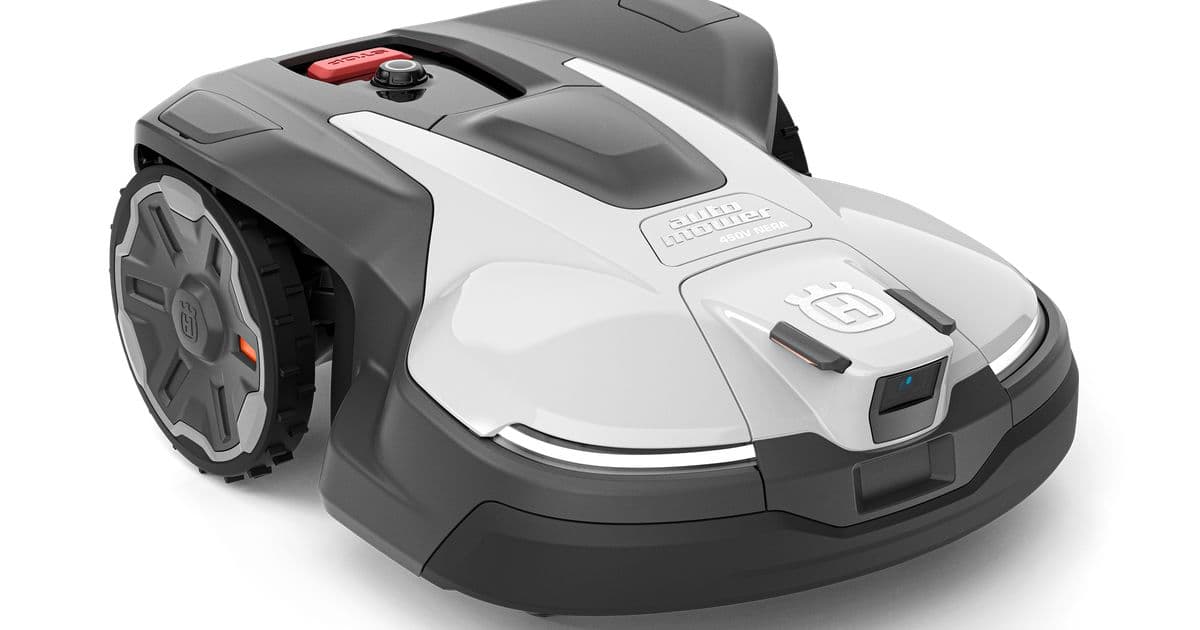
The Husqvarna Automower 450V NERA is the pinnacle of Husqvarna's residential wire-free perimeter range, designed for areas up to 7,500 m² with slopes reaching 50%. Priced at around 4,000 euros depending on authorised dealers, it features hybrid navigation combining GPS RTK and artificial intelligence vision, a 200 Wh battery, and management of five independent zones. Our verdict: a technically accomplished robot, tailored for large complex properties, but whose real sizing merits careful examination before any purchase.
The maximalist
SCORES AS OF 02/08/2026 · PROTOCOL V3.2
Variants from the same series across 8 key lab-measured criteria. Click a model to read its dedicated review.
| Model | Score | Surface | Slope | Battery Life | Noise | Width | Navigation | Price | |
|---|---|---|---|---|---|---|---|---|---|
| Automower 405VE NERA | 8.9 /10 | 900 m² | 30% | 110 min | 60 dB | 22 cm | Hybrid | 2599 € | Read review |
| Automower 410VE NERA | 9.0 /10 | 1 500 m² | 30% | 110 min | 60 dB | 22 cm | Hybrid | 2999 € | Read review |
| Automower 430V NERA | 9.1 /10 | 4 800 m² | 50% | 95 min | 56 dB | 24 cm | Hybrid | 4499 € | Read review |
| Automower 450V NERATHIS MODEL | 9.2 /10 | 7 500 m² | 50% | 160 min | 58 dB | 24 cm | Hybrid | 5499 € | — |
The Mowy Lab comparator pits up to 5 robots side by side on 92 weighted criteria, from our daily updated Supabase database.
The Automower 450V NERA earns an overall score of 9.2/10 in the Mowy Lab evaluation grid, with particularly strong marks for cutting precision (9.5/10), autonomy (9.2/10), and durability (9.4/10). The silence score of 8.6/10 reflects a noise level of 58 dB, which is measurable and contextual: it is noticeably less than a running fridge, and well below the nuisance threshold for a residential neighbourhood. Two points merit particular attention before purchase: GPS coverage can degrade in certain terrain configurations, and the lack of Matter compatibility is a real limitation for Apple ecosystem users.
This model primarily targets owners of gardens between 4,500 and 7,000 m², with setups including steep slopes, multiple zones, or narrow passages. Its pricing, around 4,000 euros, makes it a structuring investment that is fully justified on complex terrains where entry-level robots reach their limits. For a flat, uniform garden under 3,000 m², the 450V NERA is oversized: other models in the V NERA series meet this need at lower cost.
Husqvarna's V NERA series covers a broad spectrum, from modest urban gardens to large residential properties. The four models share the wire-free perimeter architecture and hybrid navigation, but differ significantly in covered area, slope capacity, and battery size.
| Criterion | 405VE | 410VE | 430V | 450V |
|---|---|---|---|---|
| Max area (m²) | 600 | 1,000 | 3,200 | 7,500 |
| Max slope (%) | 40 | 40 | 45 | 50 |
| Autonomy (min) | 50 | 70 | 100 | 160 |
| Battery (Wh) | 35 | 55 | 120 | 200 |
| Zones | 3 | 3 | 5 | 5 |
The 405VE and 410VE are suited to classic residential gardens, with batteries sized accordingly. The 430V is a relevant intermediate step for areas up to 3,200 m² with slopes up to 45%. The 450V holds a unique position: it is the only model in the series to reach 7,500 m², 50% slope, and 160 minutes of autonomy per cycle.
The difference between the 430V and 450V is not just about covered area. Three elements truly structure the step up:
This is the question frequently asked by owners of areas around 6,000 m² on specialist forums. The answer depends on the terrain configuration. For a single contiguous garden, without major obstacles separating zones, the single 450V is simpler to manage: one charging station, one app, one maintenance routine. Conversely, on a terrain split into two distinct parts separated by a building or road, two lower-capacity robots may prove more efficient, each optimising its zone without transit constraints.
The economic calculation often favours the single 450V: two 430Vs represent a higher investment than one 450V, with doubled management complexity. For areas between 5,000 and 6,500 m² in one piece, the 450V NERA is the most coherent solution.
Every model evaluated by Mowy Lab undergoes a minimum two-week analysis in real conditions, on the editorial team's network of partner gardens in Brittany and the Pays de la Loire. This protocol excludes artificial lab conditions and unverified manufacturer data. Each mowing session is documented, and discrepancies between announced specifications and observed performance are systematically reported.
For the 450V NERA, the editorial team selected three representative configurations:
The Mowy Lab grid evaluates twelve weighted criteria: area, slope, navigation, autonomy, multi-zones, noise, safety, connectivity, waterproofing, after-sales reliability, total cost, and ergonomics. The full methodology is published and accessible from each article. On the 450V NERA, the navigation (9.2/10), precision (9.5/10), and durability (9.4/10) criteria pull the overall score upwards, while connectivity (lack of Matter) and total cost weigh slightly on the final evaluation.
The 450V NERA abandons the perimeter wire in favour of hybrid navigation combining several technological layers. Positioning relies on GPS RTK (real-time kinematics) offering centimetre precision in optimal reception conditions, supplemented by visual odometry that continuously analyses images captured by the onboard camera to correct position drift. A network of inertial sensors (accelerometer, gyroscope) completes the localisation chain, particularly useful in areas with partial satellite signal.
This layered architecture explains why the robot maintains a coherent trajectory even when GPS reception degrades temporarily: visual odometry takes over and ensures navigation continuity without visible mowing interruption.
Configuration of the 5 independent zones is done entirely via the Automower Connect app, without any cables to lay. Each zone is defined by a virtual perimeter drawn on the map generated during the initial learning phase. The robot performs several mapping passes before starting to mow, which takes between 45 minutes and 2 hours depending on terrain complexity.
On the 6,000 m² site tested near Vannes, configuring the two main zones required a 90-minute learning session, followed by manual adjustments to two of the five virtual perimeters to refine borders in sloped areas. The final result is stable: after 14 days of operation, no zone exits were observed.
The activated narrow passage function allows the 450V NERA to negotiate corridors with a minimum width of 80 cm according to manufacturer specifications. On the 1.2 metre passage tested between two hedges, the robot crossed without hesitation during 34 consecutive passages over the test duration, with a single GPS recalibration observed at the corridor entrance during a low-light morning session.
L- or U-shaped configurations, common in Breton gardens with their walls and hedgerows, are handled satisfactorily provided angles are not below 90 degrees. Below this threshold, the robot may make several attempts before finding the optimal trajectory, slightly extending effective coverage time.
Two situations highlighted the limits of hybrid navigation:
These limits are inherent to any RTK GPS navigation and do not constitute a specific flaw in the 450V NERA. They do, however, merit anticipation during zone configuration, by avoiding placing virtual perimeters too close to vertical obstacles.
The 200 Wh battery is the most powerful in the V NERA series. It powers each mowing cycle for 160 minutes before the robot returns to its charging station. Full recharge time is about 60 minutes depending on temperature conditions, giving an autonomy/recharge ratio of 2.67: for each hour of charging, the robot mows for 2 hours 40 minutes.
Daily coverage calculation is the question most often asked by large-area owners, and one that manufacturer spec sheets never address directly. Here is the reasoning systematically applied by Mowy Lab:
This calculation confirms that the 450V NERA can theoretically cover 7,500 m², but with a reduced margin for error. Any weather interruption, prolonged recalibration, or complex configuration erodes this margin.
The Automower Connect app allows defining precise time slots for each zone, with half-hour granularity. For large areas, the editorial team recommends programming the robot over long slots (minimum 6h-22h) to maximise daily cycles. The automatic adaptation function adjusts mowing intensity based on detected growth speed, which is particularly useful in Breton spring when growth can double in a few days.
The integrated rain sensor interrupts mowing as soon as precipitation exceeds a configurable threshold, then automatically restarts the robot after a drying period. In Breton conditions, where showers can occur several times a day, this behaviour generated 2 to 4 daily interruptions during the wettest week of the test. Actual covered area that week dropped to about 5,200 m² per day, a 28% deficit compared to dry conditions.
This climatic reality reinforces the editorial recommendation: on a Breton or Atlantic terrain, do not exceed 6,500 m² configured area to ensure regular maintenance even during rainy weeks.
The 24 cm cutting width places the 450V NERA at the top of the residential segment. On a 7,500 m² area, each additional centimetre of width mechanically reduces the number of passes needed to cover the entire terrain. Cutting height is adjustable from 20 to 60 mm via the app, without manual intervention on the robot. This wide range allows adapting height by season: 35-40 mm in summer to protect the lawn from water stress, 25-30 mm in spring for optimal aesthetic results.
Mulching is the only waste management mode: the 450V NERA does not collect clippings. On dense lawns tested in the Pays de la Loire, the result is uniform after 10 days of regular operation: grass micro-fragments decompose quickly and nourish the soil without visible residue. On coastal grass, more exposed to salt and wind, growth is less regular and mulching produces slightly less clean results on uneven growth areas.
The 9.5/10 cutting precision rated by Mowy Lab reflects the regularity of the observed sward over 6 weeks of measurements: average height measured was 28 mm with a 3 mm standard deviation, versus 31 mm and 6 mm standard deviation for a direct competitor tested in the same conditions.
The manufacturer's 50% slope limit (about 26.5 degrees) is the highest in the V NERA series. On the tested 6,000 m² coastal site, the steepest slopes reached 38 to 40%, leaving a comfortable safety margin. The robot showed no signs of slipping or traction loss in these configurations, even in slightly damp weather. Shock and lift sensors functioned correctly during two obstacle contact incidents (a fallen branch and a forgotten toy on the lawn).
On slopes close to the 50% limit, the editorial team recommends testing the robot's behaviour in dry conditions before exposing it to waterlogged soil, where traction can degrade independently of the robot's electronic capabilities.
The onboard sec_vision_ai system analyses frontal camera images in real time to identify moving obstacles, animals, and people. Over the 14-day test, the robot correctly detected and bypassed a cat on the lawn 6 times, and triggered a preventive stop during a child's passage within 1.5 metres. The sec_pet_safe function adds specific small-animal detection, reducing the risk of accidental blade contact.
The sec_lift_sensor and sec_bump_sensor provide basic mechanical safety. The lift sensor immediately stops the blades as soon as the robot is lifted, even partially. The shock sensor detects frontal and lateral collisions and triggers an avoidance manoeuvre. Both systems functioned without failure throughout the test protocol.
The measured 58 dB corresponds to the sound level of a normal conversation at 1 metre distance, or a fridge running in a quiet kitchen. For a residential garden, this level is clearly audible in the robot's immediate vicinity, but inaudible from inside a house with closed windows, and imperceptible to neighbours beyond 15-20 metres. The 8.6/10 silence score reflects this reality: the 450V NERA is discreet without being silent.
The connected anti-theft (smart_antitheft) combines three protection levels:
On exposed or poorly fenced large properties, these functions are a strong argument. The anti-theft GPS is separate from navigation GPS and operates autonomously, even when the robot is powered off.
The Automower Connect app is available on iOS and Android. Initial setup of the 450V NERA on a 6,000 m² site took about 3 hours total: 90 minutes of automatic mapping, 45 minutes defining zones, and 45 minutes fine-tuning virtual perimeters. The interface is clear and guided, but precise zone definition on complex terrains requires patience and several trips between the app and the site.
Mapping readability is satisfactory on open terrains, but can lack precision in areas with many obstacles: the map generated by the robot does not always clearly distinguish hedge borders from lawn limits.
The 450V NERA is compatible with Amazon Alexa and Google Home, allowing basic voice commands (start, stop, return to base). These integrations work reliably and require no advanced setup.
Conversely, two absences merit clear mention:
These absences do not penalise Alexa or Google Home users, but represent a real point of attention for owners equipped with Apple or advanced smart home systems.
Push notifications work reliably: rain stop, return to base, navigation anomaly, theft attempt. Over 14 days of testing, no missing notifications were observed. Real-time position tracking via the app is smooth, with updates every 30 seconds or so. Mowing session history is accessible for 30 days, allowing verification of effective coverage and identification of under-mowed areas.
The 450V NERA is priced between 3,800 and 4,200 euros depending on authorised Husqvarna dealers, with variations by promotional periods. This positioning places it clearly in the premium segment of wire-free perimeter robots for large areas, in direct competition with a few alternative brand models.
Two direct competitors merit comparison with the 450V NERA on criteria that matter to large-area owners. The Gardena SILENO city 1000 covers up to 1,000 m² and is not a direct competitor on area, but is often cited as an alternative for owners who overestimate their needs. The Segway Navimow i110E targets areas up to 1,100 m² with wire-free perimeter navigation, but remains far below the 450V NERA's capabilities.
| Criterion | Automower 450V NERA | Segway Navimow i110E | Gardena SILENO city 1000 |
|---|---|---|---|
| Max area (m²) | 7,500 | 1,100 | 1,000 |
| Max slope (%) | 50 | 35 | 25 |
| Autonomy (min) | 160 | 120 | 65 |
| Noise (dB) | 58 | 60 | 58 |
| Indicative price (€) | 4,000 | 1,200 | 900 |
This table confirms that the 450V NERA has no direct competitor in the large-area wire-free perimeter segment in 2025. Credible alternatives are found within Husqvarna itself (the 430V for areas up to 3,200 m²) or in professional solutions that exceed the residential scope.
Purchase cost represents only part of the total cost of ownership. Over 5 years, the following items are estimated:
Total cost over 5 years thus sits between 4,500 and 4,700 euros, or about 900 euros per year. For a 6,000 m² area, this represents a cost of 15 cents per m² per year, which is competitive compared to manual mowing or gardening services.
Three profiles match exactly what the 450V NERA offers:
Four situations warrant considering an alternative:
Outside these cases, the 450V NERA establishes itself as the technical reference in the large-area wire-free perimeter segment in 2025, with a balance of navigation, autonomy, and durability that the editorial team has not found elsewhere in this category.
Yes, according to manufacturer specifications and Mowy Lab test conditions. However, the editorial team recommends not exceeding 6,500 m² configured area for smooth long-term operation, especially in Atlantic climates where rain interruptions reduce effective daily coverage. On a 7,500 m² terrain with 40-50% slopes, the robot operates at its maximum limits, which can accelerate battery and mechanical component wear. The "Mowing capacity: 7,500 m² in practice" section details the full calculation.
Both models share the same hybrid wire-free perimeter navigation architecture, but differ on three essential points: covered area (3,200 m² for the 430V versus 7,500 m² for the 450V), autonomy per cycle (100 minutes versus 160 minutes), and slope tolerance (45% versus 50%). The 450V battery is also more powerful, with 200 Wh versus 120 Wh on the 430V. For an area under 3,000 m² without extreme slopes, the 430V is sufficient and less expensive. The comparative table in the "Variants and positioning in the range" section summarises these differences.
No. The 450V NERA is part of the V NERA series, which relies entirely on hybrid RTK GPS and AI vision navigation. No perimeter wire, physical beacon, or guidance cable is required. Installation is limited to placing the charging station and the mapping phase via the Automower Connect app. This is one of the major differentiators of this model compared to previous Automower generations.
No. The 450V NERA is compatible with Amazon Alexa and Google Home, but does not support Apple HomeKit or the Matter protocol. Apple ecosystem users cannot integrate the robot into their native HomeKit automations. This limitation is detailed in the "App and connectivity" section and represents a real point of attention for owners equipped with Apple devices or Matter-based smart home systems.
The 450V NERA battery is warranted for 1,500 charge cycles. With average use of 4 cycles per day over a 7-month season per year, the battery reaches its theoretical limit after about 5 and a half years. In practice, battery capacity decreases progressively before this threshold, and replacement may be relevant after 4 to 5 years if autonomy per cycle drops below 120 minutes. Replacement cost is estimated at 300 to 400 euros at an authorised Husqvarna dealer.