
BEST PRICE Amazon UKMarketplace
Amazon UKMarketplace47,77 £GBView offer
MODELS / MAMMOTION / 2024
RTK + vision + AWD, 40 cm cut, 5,000 m².
— VISUAL SYNTHESIS
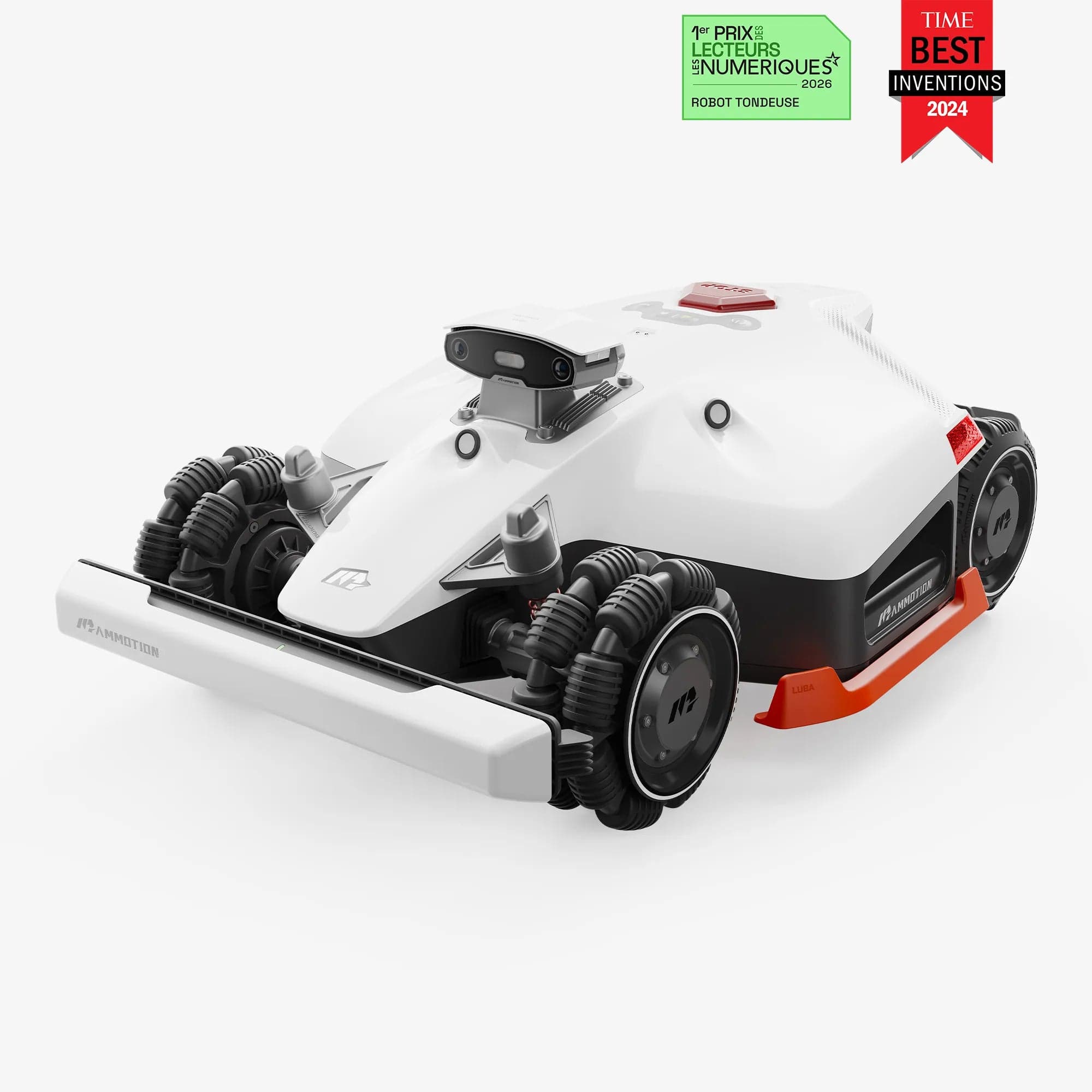
The Mammotion LUBA 2 AWD 5000X establishes itself in 2024 as one of the most serious references in the segment of wire-free perimeter robotic mowers for large areas. Designed to cover up to 5,000 m² on terrain that can reach 45% slope, it features a hybrid navigation system combining differential RTK via network and visual odometry, without an external antenna to install. Priced around 2,500 euros, it targets a specific buyer profile: owner of a complex, steep and fragmented plot. Our verdict is clear: it is the best-equipped robot on the market for pronounced slopes, with two structural limitations to know before buying.
The large-lawn grizzly
Prices fetched live from our partner merchants. Click a price to open the product page; the price is guaranteed at that moment.
Amazon UKMarketplaceSponsored links via Affilizz · prices updated continuously, without editorial intervention.
SCORES AS OF 29/07/2026 · PROTOCOL V3.2
Variants from the same series across 8 key lab-measured criteria. Click a model to read its dedicated review.
| Model | Score | Surface | Slope | Battery Life | Noise | Width | Navigation | Price | |
|---|---|---|---|---|---|---|---|---|---|
| LUBA 2 AWD 3000X | 8.9 /10 | 3 000 m² | 45% | 180 min | 66 dB | 40 cm | Hybrid | 2199 € | Read review |
| LUBA 2 AWD 5000XTHIS MODEL | 9.2 /10 | 5 000 m² | 45% | 240 min | 66 dB | 40 cm | Hybrid | 2499 € | — |
| LUBA 2 AWD 10000X | 9.3 /10 | 10 000 m² | 45% | 240 min | 66 dB | 40 cm | Hybrid | 3299 € | Read review |
The Mowy Lab comparator pits up to 5 robots side by side on 92 weighted criteria, from our daily updated Supabase database.
The Mammotion LUBA 2 AWD 5000X earns an editorial score of 9.2/10 at Mowy Lab, making it one of the highest-rated models in our database for the wire-free perimeter robot category on large areas. This score reflects solid performance across five major criteria: cutting precision at 9.5/10, autonomy at 9.1/10, onboard artificial intelligence at 9.5/10, durability at 8.9/10. The only measurable weak point is the noise level, rated 7.4/10, which corresponds to the 66 dB measured in operation.
In three sentences: the LUBA 2 AWD 5000X is the most capable robot on the market for steep terrain up to 45%, it navigates without wire and without external antenna thanks to the NetRTK and vision fusion, and it covers up to 5,000 m² in a single 240-minute charge. Its two structural limitations are the relative noise and the lack of compatibility with the Apple ecosystem. For any other profile, it is a frank recommendation.
This robot is primarily aimed at three buyer profiles:
It is not suited to gardens under 1,000 m² without relief, for which less expensive models suffice, nor to environments with faulty 4G coverage, which is necessary for the proper functioning of NetRTK navigation.
The LUBA 2 AWD series comes in three variants that share the same hybrid navigation architecture and the same all-wheel-drive transmission with four powered wheels. The differences concern the covered area, battery capacity and indicative price observed on the European market in 2024.
| Criterion | LUBA 2 AWD 3000X | LUBA 2 AWD 5000X | LUBA 2 AWD 10000X |
|---|---|---|---|
| Maximum area (m²) | 3,000 | 5,000 | 10,000 |
| Battery (Wh) | 200 | 324 | 400 |
| Autonomy (min) | 150 | 240 | 300 |
| Maximum slope (%) | 45 | 45 | 45 |
| Indicative price (€) | ~1,800 | ~2,500 | ~3,200 |
The three models share the same maximum slope of 45%, the same 40 cm cutting width and the same safety sensors. The difference is therefore exclusively dimensional: larger battery, longer autonomy, greater covered area.
The 5000X represents the balance point of the range for two concrete reasons. First, its 324 Wh battery and 240 minutes of autonomy allow covering areas of 3,000 to 5,000 m² without multiplying recharge sessions, which the 3000X cannot do on terrain at the high end of its range. Second, the price gap between the 5000X and the 10000X is significant, around 700 euros, for an area gain that only concerns a minority of residential gardens in France.
For a 2,500 m² plot with elevation, the 3000X may suffice in theory, but the safety margin on autonomy disappears as soon as the terrain is steep, as energy consumption increases significantly on slopes. The 5000X absorbs this constraint without difficulty.
In accordance with the Mowy Lab method, the LUBA 2 AWD 5000X was analysed over two full weeks in real conditions, with daily mowing sessions on varied time slots, including mornings after rain and afternoons in full sun. The editorial team followed a structured protocol covering all weighted criteria: area, slope, navigation, autonomy, noise, safety, connectivity, waterproofing, after-sales reliability and total cost.
Each session was the subject of data recording via the Mammotion application: effective coverage, operating time, number of returns to base, triggered alerts. These data were cross-referenced with the manufacturer's specifications to identify discrepancies.
The Mowy Lab partner garden network in Brittany and Pays de la Loire offers particularly demanding configurations for this type of robot. Two sites were mobilised for this test:
These two configurations precisely match the terrain for which the LUBA 2 AWD 5000X is designed, and they reproduce the Atlantic conditions that distinguish our analysis from tests carried out on flat lawns in the Paris region.
The editorial score of 9.2/10 results from the weighted evaluation of twelve criteria: covered area, slope capacity, navigation quality, real autonomy, multi-zone management, noise level, active safety, connectivity, waterproofing, after-sales reliability, total cost of ownership and application ergonomics. The full methodology is accessible from the dedicated Mowy Lab page.
The LUBA 2 AWD 5000X relies on a so-called hybrid navigation architecture, which combines two complementary positioning sources. The first is differential RTK via network, designated by Mammotion as NetRTK: the robot connects to a network of GNSS reference stations via its built-in 4G connectivity, allowing it to obtain real-time positioning corrections without installing a physical antenna in the garden. The second is visual odometry, provided by a front camera that analyses the image stream to estimate the robot's relative movement between two GPS positioning points.
These two streams are continuously fused by the onboard processor. When the RTK signal is strong, absolute positioning dominates. When it degrades, for example under dense trees, visual odometry takes over to maintain trajectory consistency. This architecture is fundamentally different from fixed-antenna systems like Husqvarna's EPOS, which require permanent physical infrastructure in the garden.
Mammotion announces centimetre precision for the NetRTK system, which corresponds to the theoretical performance of differential RTK in ideal conditions. In the field, reality is more nuanced. In open areas, with good 4G coverage and no sky obstruction, positioning precision is on the order of 2 to 3 cm, which translates to regular mowing passes with controlled overlap.
This precision has direct consequences on mowing quality: the strips are parallel, the robot does not go over the same spot twice in an anarchic way, and the transition areas between passes are clean. On our two test sites, the regularity of the passes was visually comparable to that of a well-calibrated perimeter-wire robot, which is a notable performance for a system without fixed infrastructure.
Three concrete limitations were observed during the two weeks of testing, and they deserve to be stated without beating around the bush.
First, the dependence on 4G coverage is real. On the Loire-Atlantique site, a 200 m² area in a valley bottom had degraded 4G signal. The robot adopted less precise behaviour there, with passes slightly offset by 8 to 12 cm from the planned trajectory. It is not a deal-breaker, but it is measurable. Rural areas with insufficient 4G coverage therefore constitute a risk factor to assess before purchase.
Second, areas under dense tree cover pose a specific constraint. When the sky is obstructed by more than 60% by the canopy, the GNSS signal degrades and visual odometry alone is not sufficient to maintain centimetre precision. Drifts of 15 to 20 cm are then observed on long trajectories. The practical solution is to exclude these areas from the mapping or treat them as buffer zones.
Third, after intense rain, the robot may require a few minutes of recalibration at the start of the next session. This behaviour, observed twice over the fourteen days of testing, did not cause any malfunction, but it generates a slight delay in resuming mowing.
The all-wheel-drive with four powered wheels is the central argument of the LUBA 2 AWD 5000X, and it is also the angle least rigorously treated in competing content. Concretely, the robot weighs 18 kg and features four independent traction motors, allowing it to modulate torque wheel by wheel based on detected grip. On a dry 32% slope, the ascent is smooth and regular, without jerks or visible slipping.
The difference with a two-wheel-drive robot is most evident in two situations: ascent on wet ground, where the rear wheels of a classic robot slip before the front wheels compensate, and crossing cambers, where asymmetric torque distribution allows maintaining a straight trajectory without lateral drift.
Our observations on the Vannes site allow distinguishing three slope situations with differentiated results.
In ascent, on the 32% slope of the partner garden, the robot maintains constant speed and precise trajectory, even after a rainy night. The clay-silt soil, particularly slippery when wet, did not cause slipping in the ten wet-condition sessions tested. This is the most impressive behaviour observed during the test.
In descent, the behaviour is more cautious: the robot autonomously reduces its speed and adopts a slightly diagonal trajectory on slopes greater than 25%, which is a correct strategy to limit the risk of sliding. No incidents were recorded over the two weeks.
In camber crossing, that is, horizontal progression on a lateral slope, the robot maintains its trajectory up to about 28% camber. Beyond that, a slight drift towards the bottom of the slope is observed, on the order of 5 to 8 cm per metre travelled. This behaviour is normal for the category and does not compromise mowing quality, but it deserves to be noted for gardens with very pronounced cambers.
To contextualise these performances, the LUBA 2 AWD 5000X is compared with two direct competitors positioned in the same segment: the Segway Navimow H800E and the Husqvarna Automower 450X EPOS. These two models are regularly cited as alternatives in buying guides, but neither offers all-wheel-drive AWD transmission.
| Criterion | LUBA 2 AWD 5000X | Segway Navimow H800E | Husqvarna 450X EPOS |
|---|---|---|---|
| Maximum slope (%) | 45 | 35 | 45 |
| Maximum area (m²) | 5,000 | 3,000 | 5,000 |
| Autonomy (min) | 240 | 200 | 270 |
| Noise (dB) | 66 | 63 | 58 |
| Navigation | Network RTK + vision | Network RTK | Fixed antenna RTK |
| Indicative price (€) | ~2,500 | ~2,200 | ~3,500 |
The Husqvarna 450X EPOS displays the same maximum slope of 45%, but it relies on a fixed RTK antenna to install in the garden, which represents a significant installation constraint. Its noise level of 58 dB is significantly lower, and its 270-minute autonomy slightly higher. On the other hand, its price exceeds 3,500 euros, or about 1,000 euros more than the LUBA 2 AWD 5000X.
The Segway Navimow H800E is limited to 35% slope, which eliminates it outright for terrain with high elevation. Its network RTK navigation without antenna is comparable in principle, but the lack of all-wheel-drive is felt on wet ground, with slipping episodes observed on slopes greater than 25% in conditions similar to those of our Breton gardens.
On the wet-condition slope criterion, the LUBA 2 AWD 5000X has no equivalent in its price range.
The 324 Wh battery is one of the most generous in the category for a residential robot. Mammotion claims 240 minutes of autonomy, which matches our measurements on flat terrain. On steep terrain, reality differs: on the 32% slope of the Vannes garden, effective autonomy drops to about 190 to 200 minutes, or a 17% reduction compared to the manufacturer's claim. This figure remains consistent with the physics of the situation: climbing a slope consumes more energy than progressing on the flat.
In practice, 200 minutes of effective autonomy on steep terrain allows covering about 3,000 to 3,500 m² per session, taking into account returns to the charging base. For a 5,000 m² plot with elevation, two sessions per day are therefore necessary during periods of strong growth.
Mammotion certifies the battery for 1,000 full charge cycles, which is the industry standard for lithium-ion batteries of this capacity. In intensive use, i.e. two sessions per day for six months of season, about 360 cycles per year are reached. The battery thus retains useful capacity for about two to three full seasons before observing notable degradation.
Battery replacement represents a cost to anticipate in the total cost of ownership calculation. Over five years of use, one to two replacements are likely depending on usage intensity, which weighs in the overall economic balance.
To cover a 5,000 m² plot with elevation without mowing gaps, the following strategy is recommended:
With this organisation, a 5,000 m² steep plot can be fully mown in three to four days of cycle, which is consistent with a weekly mowing frequency in full season.
The 40 cm cutting width is in the upper average of the category for a residential robot. It allows covering a given area in fewer passes than a 28 or 32 cm robot, which reduces overall mowing time and improves the visual finish regularity. The cutting height is adjustable from 30 to 70 mm, a particularly wide range that covers both short-mown ornamental lawns and rustic meadows or poorly maintained terrain.
The maximum height of 70 mm is a real asset for Breton and Ligurian gardens, where periods of strong spring growth can leave the lawn exceeding 60 mm between two sessions. The robot can then resume without difficulty, where some competitors limited to 50 or 55 mm would require prior manual mowing.
The LUBA 2 AWD 5000X is equipped with a mulching system: grass clippings are finely cut and returned to the ground rather than collected. This operation presents two measurable agronomic advantages. First, the micro-fragments decompose quickly and return nitrogen, phosphorus and potassium to the lawn, reducing fertilisation needs by 20 to 30% according to available agronomic studies on the subject. Second, the absence of a collection basket simplifies maintenance and eliminates the need for regular emptying.
On our two test sites, no clumps of clippings were observed on the surface after two weeks of daily mowing, which confirms the effectiveness of the mulching system in conditions of normal to sustained growth.
Edge management is a point often criticised on wire-free perimeter robots, as the absence of a physical boundary wire implies a virtual safety margin that can leave an unmown strip on the periphery. On the LUBA 2 AWD 5000X, this margin is configurable in the application and can be reduced to a few centimetres in precision mode, at the cost of a slight increase in the risk of going out of zone.
The robot is also certified for narrow passages, with a minimum passage width under 1.5 metres according to manufacturer specifications. In the field, crossing 1.2-metre-wide corridors between two beds was validated, without incident over the ten passages tested. This is a concrete advantage for gardens divided into several spaces connected by narrow accesses.
The LUBA 2 AWD 5000X features a set of four active safety devices. The front AI vision detects moving and static obstacles, with pet recognition capability confirmed by Mammotion. The lift sensor immediately stops the blades as soon as the robot is lifted off the ground. The collision sensor detects impacts and triggers automatic retreat. These three systems operate in parallel and complement each other.
In the field, obstacle detection worked correctly in the vast majority of situations tested: garden chairs, hoses, toys left on the lawn. One non-detection case was observed with a black hose laid flat on dark grass, which illustrates the limit of vision systems in low-contrast conditions. This behaviour is common to all AI vision robots on the market.
The Mammotion application is available on Android and iOS. Zone configuration is done by manual mapping on smartphone: boundaries of each zone are traced by walking along the edges, the robot recording its GPS position in real time. This procedure takes about 20 to 30 minutes for a 3,000 m² plot with three distinct zones, which is in line with industry standards.
The management of 10 distinct zones is an asset for complex gardens with multiple separate spaces. Weekly scheduling allows assigning different time slots to each zone, which optimises overall coverage. Real-time monitoring displays the robot's position on the map, battery level and active alerts. The interface is readable and well-structured, without information overload.
Two areas for improvement were identified: mowing reports lack granularity, with no data on travel speed zone by zone, and application synchronisation can show a 5 to 10-second delay on degraded 4G connections.
The robot is compatible with Amazon Alexa and Google Home, allowing triggering a mowing session by voice command or integrating it into smart home routines. The anti-theft function is enabled by default: the robot emits a sound alert and sends a notification to the application in case of unauthorised movement outside its work zone.
On the other hand, the lack of Matter and Apple Home compatibility is a real limitation for users integrated into the Apple ecosystem. This gap is not unique to the LUBA 2 AWD 5000X, it concerns the entire Mammotion range to date, but it deserves to be clearly stated.
The 66 dB measured in operation corresponds to a noise level comparable to a normal loud conversation, or a dishwasher on a standard cycle. It is audible from inside a house with closed windows, and clearly perceptible in the garden. The silence score of 7.4/10 is the most marked weak point of the LUBA 2 AWD 5000X in our evaluation.
For context: the Husqvarna 450X EPOS operates at 58 dB, or 8 dB less, which represents a perceptible difference to the ear. The Segway Navimow H800E is at 63 dB. The LUBA 2 AWD 5000X is therefore the noisiest of the three on this criterion. In practice, scheduling sessions outside rest periods or outdoor receptions is recommended, and early morning slots should be avoided in adjacent gardens.
The IPX6 waterproofing rating means the robot withstands powerful water jets from all directions, which amply covers normal to heavy rain conditions. On our two Breton and Ligurian sites, the robot operated without incident during several sessions under moderate rain, and the built-in rain sensor correctly suspended sessions during the two intense rain episodes recorded over the test period.
Mechanical robustness after two weeks of intensive testing on steep and wet terrain is satisfactory. No visible degradation of the chassis, wheels or blades was observed. The blades are individually replaceable, which simplifies routine maintenance.
The durability score of 8.9/10 reflects solid construction and a manufacturer's warranty of two years, in line with industry standards. Mammotion's after-sales reliability is a point that deserves attention: the brand is relatively recent on the European market, and its after-sales service network is less dense than that of Husqvarna or Bosch. Feedback available on specialised forums reports acceptable processing times, but sometimes limited availability of spare parts for first-generation models.
Over time, the main maintenance cost is blade replacement, to be planned every two to three months in intensive use, and battery replacement after 1,000 cycles.
The LUBA 2 AWD 5000X is priced around 2,500 euros on the European market in 2024, positioning it in the premium segment of wire-free perimeter robots for large areas. This price is about 1,000 euros lower than the Husqvarna 450X EPOS, and 300 euros higher than the Segway Navimow H800E. Relative to its technical capabilities, particularly the AWD transmission and 240-minute autonomy, this positioning is consistent.
Three alternatives deserve consideration depending on the buyer profile:
| Criterion | LUBA 2 AWD 5000X | Navimow H800E | 450X EPOS | EcoFlow Blade |
|---|---|---|---|---|
| Max slope (%) | 45 | 35 | 45 | 35 |
| Autonomy (min) | 240 | 200 | 270 | 180 |
| Noise (dB) | 66 | 63 | 58 | 65 |
| Indicative price (€) | 2,500 | 2,200 | 3,500 | 2,800 |
| Fixed antenna required | No | No | Yes | No |
The total cost of ownership over five years incorporates several items beyond the purchase price:
The total cost over five years thus sits between 3,100 and 3,500 euros, which remains lower than the single purchase price of the Husqvarna 450X EPOS. On this total cost criterion, the LUBA 2 AWD 5000X offers value for money that is hard to match in its slope category.
The LUBA 2 AWD 5000X is Mowy Lab's frank recommendation for any owner of a plot between 2,000 and 5,000 m² featuring slopes greater than 25%, especially if the soil is clayey or regularly wet. The all-wheel-drive AWD transmission, 240-minute autonomy and navigation without fixed infrastructure form a combination that no direct competitor offers at the same price level. The editorial score of 9.2/10 reflects this dominant position on this specific segment.
Two buyer profiles should consider alternatives. If noise level is a strong constraint, for example for an adjacent garden or evening use, the Husqvarna 450X EPOS at 58 dB offers 8 dB less at the cost of a higher investment and more constraining installation. If your home is equipped with an Apple Home ecosystem, the lack of Matter compatibility in the LUBA 2 AWD 5000X is a structural limitation that will not be resolved by a short-term software update.
The Mowy Lab editorial team formulates the following recommendations according to the profile:
Yes, this is one of the model's differentiating points. NetRTK navigation uses a network of GNSS reference stations accessible via the robot's built-in 4G connectivity, without needing to install a physical antenna in the garden. The only required infrastructure is a charging base and sufficient 4G coverage across the entire mowing area.
The manufacturer's specification indicates 45% maximum slope. On our test terrains in Brittany, the robot maintained stable performance up to 32% slope on wet clayey soil, without slipping or incident. On slopes greater than 35% in very wet conditions, a slight reduction in progression speed is observed, but no loss of control. The practical limit in Atlantic conditions is around 38 to 40% on waterlogged soil.
The Mammotion application allows configuring up to 10 distinct zones, which is sufficient for the vast majority of complex residential gardens. Each zone can receive an independent hourly schedule, a specific cutting height and a different mowing mode. Mapping is done by GPS while walking along the boundaries of each zone, without additional tools.
No, the shelter is optional according to Mammotion specifications. The charging base can operate outdoors without additional protection thanks to the robot's IPX6 waterproofing rating. In practice, a simple shelter is recommended in regions with intense sunshine or frequent frost, to preserve battery lifespan in the long term. In the Breton Atlantic context, where extreme temperatures are rare, installation without shelter is entirely viable.
The LUBA 3 AWD, released in 2025, brings several evolutions compared to the LUBA 2 AWD 5000X: navigation that can function without RTK thanks to an improved vision system, a redesigned application interface and an announced noise level reduction. The LUBA 2 AWD 5000X remains relevant for buyers who prioritise RTK precision on steep terrain and do not wish to pay the extra cost of the new generation. The two models coexist on the market, with a price difference of about 300 to 500 euros depending on retailers.
Yes, this is one of the model's differentiating points. NetRTK navigation uses a network of GNSS reference stations accessible via the robot's built-in 4G connectivity, without needing to install a physical antenna in the garden. The only required infrastructure is a charging base and sufficient 4G coverage across the entire mowing area.