BEST PRICE Amazon UKMarketplace
Amazon UKMarketplace22,27 £GBView offer
MODELS / MAMMOTION / 2025
RTK + LiDAR + AI vision + AWD, 5,000 m².
— VISUAL SYNTHESIS
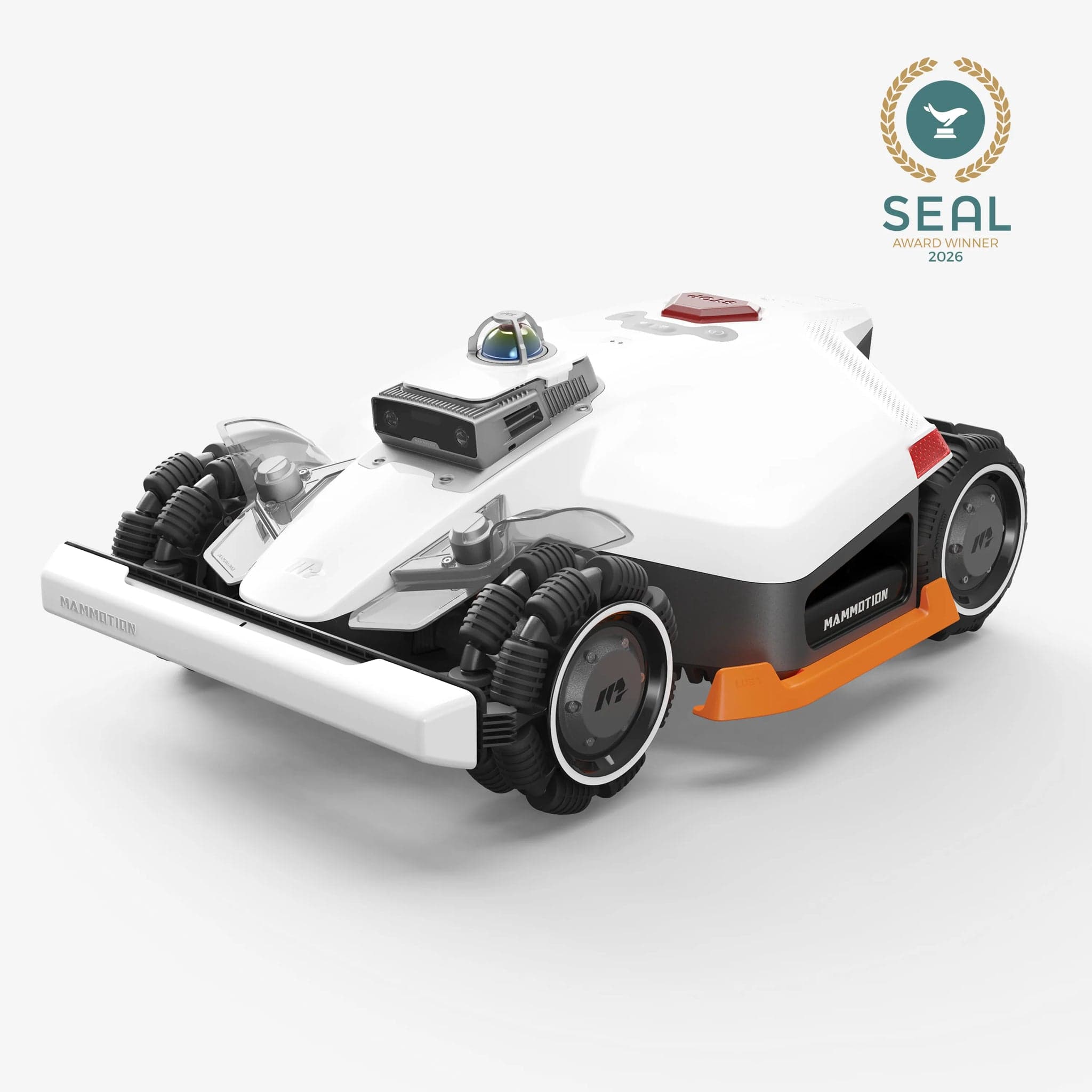
Launched in 2025, the Mammotion LUBA 3 AWD 5000 is the reference model in the LUBA 3 series: it targets gardens up to 5 000 m², integrates Tri-Fusion navigation combining 360° LiDAR, centimetre-accurate RTK and AI stereoscopic vision, and features all-wheel drive with front suspension. Positioned as a high-end model, it goes head-to-head with the Dreame A3 and the Segway Navimow H3000. Our verdict is clear: it is currently the best-equipped robot for complex large areas, provided you accept a total cost over five years that far exceeds the listed purchase price. The rest of this review quantifies what other tests have not measured.
Triple-nav large lawn
Prices fetched live from our partner merchants. Click a price to open the product page; the price is guaranteed at that moment.
Amazon UKMarketplaceSponsored links via Affilizz · prices updated continuously, without editorial intervention.
SCORES AS OF 29/07/2026 · PROTOCOL V3.2
Variants from the same series across 8 key lab-measured criteria. Click a model to read its dedicated review.
| Model | Score | Surface | Slope | Battery Life | Noise | Width | Navigation | Price | |
|---|---|---|---|---|---|---|---|---|---|
| LUBA 3 AWD 1500 | 9.2 /10 | 1 500 m² | 45% | 215 min | 70 dB | 20 cm | Hybrid | 2299 € | Read review |
| LUBA 3 AWD 3000 | 9.3 /10 | 3 000 m² | 45% | 215 min | 70 dB | 20 cm | Hybrid | 2699 € | Read review |
| LUBA 3 AWD 5000THIS MODEL | 9.4 /10 | 5 000 m² | 45% | 215 min | 70 dB | 20 cm | Hybrid | 3199 € | — |
The Mowy Lab comparator pits up to 5 robots side by side on 92 weighted criteria, from our daily updated Supabase database.
The Mammotion LUBA 3 AWD 5000 earns an editorial score of 9.4/10 at Mowy Lab, earning it the Editors' Pick badge for the large areas category in 2026. This score reflects navigation and terrain-crossing performance without direct equivalent in this price segment, tempered by two measurable weaknesses: a noise level of 70 dB and edge quality inferior to the best specialists.
The criteria that boost the score are clear:
This model is designed for three specific profiles. First, owners of gardens between 3 000 and 5 000 m² with relief, slopes or constrained passages, for whom perimeter wire or simple GPS navigation robots reach their limits. Next, users managing multiple separate zones (vegetable garden, orchard, main lawn) who want independent scheduling per zone. Finally, demanding profiles on connectivity, who want to control their robot from a comprehensive app with real-time mapping, home automation integration and built-in 4G tracking.
The LUBA 3 AWD series comes in three variants, with the main difference in battery capacity and area covered. The Tri-Fusion navigation, AWD transmission, front suspension and all sensors are identical across the three versions: it is not a matter of onboard technology, but of energy sizing.
| Criterion | LUBA 3 AWD 1500 | LUBA 3 AWD 3000 | LUBA 3 AWD 5000 |
|---|---|---|---|
| Max area (m²) | 1 500 | 3 000 | 5 000 |
| Autonomy (min) | n.c. | 175 | 215 |
| Battery (Wh) | n.c. | n.c. | 196 |
| Max slope (%) | 45 | 45 | 45 |
| Independent zones | 10 | 10 | 10 |
For a garden under 2 000 m², the LUBA 3 AWD 1500 covers the need without overpaying for battery capacity. Between 2 000 and 3 500 m², the 3000 model offers the most coherent balance. Beyond that, the 5000 is the only option in the range capable of covering the area without multiplying recharge cycles to the point of degrading mowing frequency.
The LUBA 2 AWD already covered 5 000 m² with all-wheel drive, making the comparison legitimate. The break between the two generations hinges on three key points. First, navigation: the LUBA 2 AWD relies on classic GPS RTK requiring a physical antenna installed in the garden, whereas the LUBA 3 AWD 5000 uses NetRTK (differential correction via network, no antenna), which radically simplifies installation. Second, the 360° LiDAR with integrated protective cage, absent on the LUBA 2, provides real-time mapping and active obstacle detection. Third, the front suspension improves performance on uneven terrain, a weak point identified on the previous generation during our observations in Brittany.
Mowy Lab applies a structured protocol over at least two weeks for each model analysed. The LUBA 3 AWD 5000 was observed on our network of partner gardens in Brittany and Pays de la Loire, covering varied configurations: flat coastal terrain, 35-40 % coastal slopes, multi-zone garden with narrow passages, and total area close to 4 800 m². Each criterion is evaluated on a weighted basis according to the Mowy Lab grid:
The Breton climate, with its alternations of rain and persistent humidity, provides a particularly demanding evaluation ground for lawnmower robots. The partner gardens mobilised for this analysis featured conditions not reproduced in Parisian or Mediterranean tests: dense grass laden with water, clay surface soil, narrow passages between hedges and walls. These conditions allowed us to identify behaviours not documented by competing sources, notably the omni wheels' performance on wet grass.
The LiDAR onboard the LUBA 3 AWD 5000 operates in full 360° rotation, with a stated range of 70 metres on standard reflective surfaces. On dark or absorbent surfaces (black mulch, tarps, certain coatings), the effective range drops to around 40 metres, which remains sufficient for the vast majority of private gardens. This LiDAR serves two distinct functions: initial garden mapping on first setup, and real-time obstacle detection during mowing. The integrated protective cage around the LiDAR turret is an important design detail: it prevents damage in case of contact with low branches or unforeseen obstacles, a fragility point identified on other market models.
RTK (Real-Time Kinematic) positioning achieves localisation precision on the order of a centimetre, compared to several decimetres for standard GPS. On a 5 000 m² area, this precision translates directly into regular parallel trajectories without excessive overlap or missed zones. The practical benefit of NetRTK is that instead of installing a physical reference antenna in the garden (installation constraint, wiring, exposure to weather), the robot connects to a network of reference stations via the internet for differential correction. Mammotion includes 3 years of NetRTK subscription in the purchase price. Beyond that, the service is charged at 50 €/year, a cost to factor into total ownership calculations. The built-in 4G connectivity ensures this connection without relying on home Wi-Fi, a concrete advantage for gardens far from the router.
The third pillar of the Tri-Fusion system is stereoscopic vision coupled with artificial intelligence processing. This module provides two functions complementary to the LiDAR: detection of small obstacles (toys, forgotten tools, animals) that the laser beam may miss depending on the angle of incidence, and recognition of pets for the pet-safe function. In practice, the AI vision shows its limits in two specific configurations. First, in low light: the integrated LED partially compensates for nighttime mowing, but detection of fine obstacles remains less reliable than in full daylight. Second, in narrow passages (narrow_passage mode activated in the app): the robot slows down and recalculates its trajectory, but obstacle avoidance at zone edges is less responsive than on the main surface, a point confirmed by Maniaques' observations on their 3000 version.
With a 196 Wh battery and 215 minutes autonomy per cycle, the LUBA 3 AWD 5000 covers around 1 500 m² per charge in normal conditions (flat terrain, dry grass, standard cutting height). This figure is the one used by Mammotion for the 3000 version of the previous range; on the 5000, the higher-capacity battery achieves this on slightly hilly terrain. On 30-35 % slopes, energy consumption increases and the area covered per cycle drops to 1 100 to 1 200 m², according to our observations.
The Mammotion app allows defining up to 10 independent zones, each with its own schedule, cutting height and passage frequency. This granularity is particularly useful for complex gardens combining a main lawn, an orchard, a bordered vegetable garden and a play area. Each zone can be scheduled independently, avoiding sending the robot to already treated or non-priority areas. The Drop & Mow mode allows manually placing the robot in a zone far from the charging base, useful when the area to treat is separated from the rest of the garden by an impassable obstacle (driveway, terrace). The robot memorises its position and automatically returns to the base once the zone is complete.
The question other tests do not ask is the number of cycles required to fully cover 5 000 m². With 1 500 m² covered per charge in favourable conditions, it takes at least 4 full cycles to treat the maximum area. Each cycle includes mowing (215 min), return to base and recharge (around 90 to 120 min depending on discharge level). A full cycle thus represents around 5 to 5.5 hours. To cover 5 000 m² in one day, the robot must operate for 20 to 22 consecutive hours, possible with nighttime scheduling but requiring rigorous organisation of time slots. In practice, for a 5 000 m² garden with weekly mowing frequency, the robot must operate 4 to 5 days per week in continuous rotation, covering a different portion of the garden each day. This performance aligns with the stated capacity, but assumes the user correctly configures zones and time slots in the app.
The AWD (All-Wheel Drive) transmission of the LUBA 3 AWD 5000 distributes torque to the four wheels independently, improving grip on irregular surfaces and reducing slippage risk on wet grass. The front suspension, absent on the LUBA 2 AWD, absorbs ground irregularities and maintains the cutting deck at constant height on bumpy terrain. On our partner gardens in Brittany, where clay soils create ruts and bumps after rain, this suspension makes a measurable difference in cutting regularity. The robot weighs 19 kg, giving it favourable inertia on slopes but making manual handling less easy than lighter models.
The stated slope capacity is 45 %, or about 24°. This value matches coastal slopes commonly found in Breton and Ligurian gardens. In dry conditions, the robot handles these slopes without notable difficulty, with stable trajectory and controlled return to base. On wet grass, the practical limit drops to around 35-38 %: the omni wheels, optimised for manoeuvrability, show reduced grip on waterlogged lawn. This point was identified by Maniaques on their 3000 version and confirmed in our own observations: in rainy weather, the robot manages moderate slopes well but may mark the grass on the steepest ones.
The LUBA 3 AWD 5000 crosses obstacles up to 8 cm high, covering most thresholds, borders and small steps encountered in residential gardens. The narrow_passage mode, activatable in the app, adapts the robot's trajectory to pass through widths under 60 cm. In this configuration, the robot reduces speed and recalculates its trajectory in real time, but lateral obstacle avoidance is less responsive than in open areas. For passages under 40 cm, the robot's dimensions (20 cm cutting width, wider body) become a limiting factor in themselves.
The 20 cm cutting width is on the lower average for a robot of this size and target area. On 5 000 m², this width implies more passes than a 28 or 32 cm model, mechanically extending coverage time per cycle. In compensation, the trajectory precision enabled by centimetre-accurate RTK partially offsets this drawback: passes are regular, without excessive overlap or forgotten zones. The cutting height range extends from 20 to 65 mm, covering common uses (ornamental lawn at 25-30 mm, rustic grass at 45-50 mm) and allowing management of regrowth after extended growth periods.
This is the most documented weak point of the LUBA 3 AWD 5000. The cutting deck design, centred under the chassis, does not allow reaching edges with the same precision as offset deck models like the Dreame A3 or those with integrated edge trimming like the Ecovacs O1200. In practice, a 5 to 8 cm strip on the periphery of zones remains less well treated, requiring occasional manual passes or acceptance of imperfect edge finishing. For gardens with many straight borders or beds to navigate around, this limit is concrete and must be anticipated.
The LUBA 3 AWD 5000 operates exclusively in mulching mode: mowing waste is finely chopped and returned to the ground as natural fertiliser. This mode suits frequent mowing on short grass, where cut blades are fine enough to decompose quickly. On tall grass (beyond 80-100 mm), mulching becomes less effective and may leave visible clumps on the lawn. In such cases, the maximum 65 mm cutting height allows progressively reducing height over multiple passes, the procedure recommended by Mammotion for regrowth after prolonged absence.
The LUBA 3 AWD 5000 integrates five complementary safety levels:
This safety architecture is comprehensive and well documented. The IPX6 certification ensures resistance to water jets and hose cleaning, an important criterion in high-rainfall regions like Brittany.
The Mammotion app is one of the most complete on the market for mapping: it displays the robot's real-time position on the garden map, allows defining and editing the 10 independent zones, and offers scheduling by time slot and day of the week. Strengths include map readability, zone drawing precision and real-time tracking responsiveness via built-in 4G. Limitations reported by several users concern the lack of fine adjustments for certain parameters (mulching intensity, edge behaviour, known obstacle management) and an interface that may seem dense for users unfamiliar with such tools.
The LUBA 3 AWD 5000's active anti-theft combines 4G geolocation and app alerts in case of unauthorised movement. The built-in 4G connectivity is a key advantage: it makes the robot independent of the home Wi-Fi network, particularly useful for gardens far from the house or properties with limited outdoor Wi-Fi coverage. The robot is compatible with Amazon Alexa and Google Home, allowing basic voice commands (start, stop, return to base). Apple Home compatibility is not available, which may be a friction point for users in the Apple ecosystem. The 70 dB noise level deserves context: it is equivalent to an animated conversation nearby, noticeable at 10-15 metres. For daytime use in a non-neighbouring garden, it is acceptable; for nighttime mowing in a dense housing estate, it may pose a problem.
The purchase price of the LUBA 3 AWD 5000 is around 2 499 € at launch. This figure does not represent the real five-year cost. Items to include are as follows:
Over five years, the total cost of ownership thus stands between 2 750 and 2 900 €, excluding electricity and shelter.
Three models compete in the large-area segment with wire-free navigation in 2026. The table below compares key criteria based on available manufacturer data.
| Criterion | LUBA 3 AWD 5000 | Dreame A3 | Segway Navimow H3000 |
|---|---|---|---|
| Max area (m²) | 5 000 | 5 000 | 3 000 |
| Max slope (%) | 45 | 45 | 35 |
| Autonomy (min) | 215 | n.c. | n.c. |
| Noise (dB) | 70 | 68 | 72 |
| Independent zones | 10 | 10 | 5 |
| Warranty (years) | 2 | 2 | 2 |
The Dreame A3 is the most direct competitor: it shares the same maximum area and slope capacity, with an advantage in edge quality thanks to its offset deck. The Segway Navimow H3000 covers a smaller area and has more limited slope capacity, but its app ecosystem is appreciated for its simplicity. On total cost criteria, the three models are comparable at purchase, with similar recurring subscriptions.
The manufacturer's warranty for the LUBA 3 AWD 5000 is 2 years per official specifications. Several sources, including Maniaques, mention a 3-year warranty: this information warrants direct verification with Mammotion France, as conditions may vary by purchase channel (official store vs third-party distributor). The repairability index is high, with confirmed availability of spare parts on the Mammotion France website. After-sales service is handled from France, reducing processing times compared to brands without local presence. The battery, less easily accessible on the LUBA 3 than on the LUBA 2 according to user feedback, remains replaceable but requires more technical intervention.
The LUBA 3 AWD 5000 clearly stands out for the following configurations:
In these configurations, no direct competitor offers an equivalent combination of navigation, slope capacity and multi-zone management in 2026.
The LUBA 3 AWD 5000 is not the optimal choice in three specific situations. For a flat garden under 2 000 m², the LUBA 3 AWD 1500 or a less expensive competitor covers the need without justifying the extra cost. For users prioritising quietness (neighbouring garden, nighttime mowing in a housing estate), 70 dB is a real drawback and models at 58-62 dB exist on the market. Finally, for a garden with many straight borders and high demands on peripheral finishing, the Dreame A3 and its offset deck offer superior results on this specific criterion.
With an editorial score of 9.4/10 and the Mowy Lab Editors' Pick badge, the LUBA 3 AWD 5000 is the 2026 reference for complex large areas. The value/performance ratio is solid, provided the five-year total cost has been anticipated and its two documented limitations are accepted.
The robot continues to function after the 3-year free period, but certain features depend on the NetRTK subscription. Without an active subscription, centimetre-accurate RTK navigation precision is no longer guaranteed: the robot may switch to standard GPS positioning, which is less precise. The NetRTK subscription is charged at 50 €/year after the included period. The 4G connectivity, which ensures real-time tracking and anti-theft, may also be subject to separate subscription conditions depending on Mammotion's pricing evolutions.
No. This is precisely one of the major advances of the LUBA 3 AWD 5000 over the previous generation. The NetRTK system obtains differential correction via an internet connection (built-in 4G), without requiring a physical antenna in the garden. Installation is limited to placing the charging base and configuring the app. This simplification is significant for users deterred by the installation of a wired outdoor antenna.
Yes. The robot integrates a front LED that allows it to navigate and mow in low light or darkness. Nighttime scheduling is possible from the app, by defined time slots. Two points deserve attention: AI vision obstacle detection is less effective at night than during the day, even with the LED active, and the 70 dB noise level may be problematic in dense residential environments during nighttime hours.
Both models share the same technical architecture: Tri-Fusion navigation, AWD transmission, front suspension, identical app and same safety sensors. The main difference lies in battery capacity and area covered: the 5000 has a 196 Wh battery and 215 minutes autonomy, compared to around 175 minutes for the 3000. For a garden under 3 500 m², the 3000 model covers the need at a lower purchase price. Beyond that, the 5000 reduces the number of cycles needed to cover the area and improves effective mowing frequency.
Yes. Mammotion offers an optional shelter compatible with the LUBA 3 AWD 5000, not included in the base purchase price. This shelter protects the robot and its charging base from weather and prolonged UV exposure, contributing to overall durability. Its installation is recommended for robots exposed outdoors year-round, particularly in high-rainfall regions like Brittany or Pays de la Loire.
The robot continues to function after the 3-year free period, but certain features depend on the NetRTK subscription. Without an active subscription, centimetre-accurate RTK navigation precision is no longer guaranteed: the robot may switch to standard GPS positioning, which is less precise. The NetRTK subscription is charged at 50 €/year after the included period. The 4G connectivity, which ensures real-time tracking and anti-theft, may also be subject to separate subscription conditions depending on Mammotion's pricing evolutions.