SURFACE
1 500 m²
coverable without recharge
MODELS / STIHL / 2025
Wired + 28 cm cut, 1,500 m².
— VISUAL SYNTHESIS
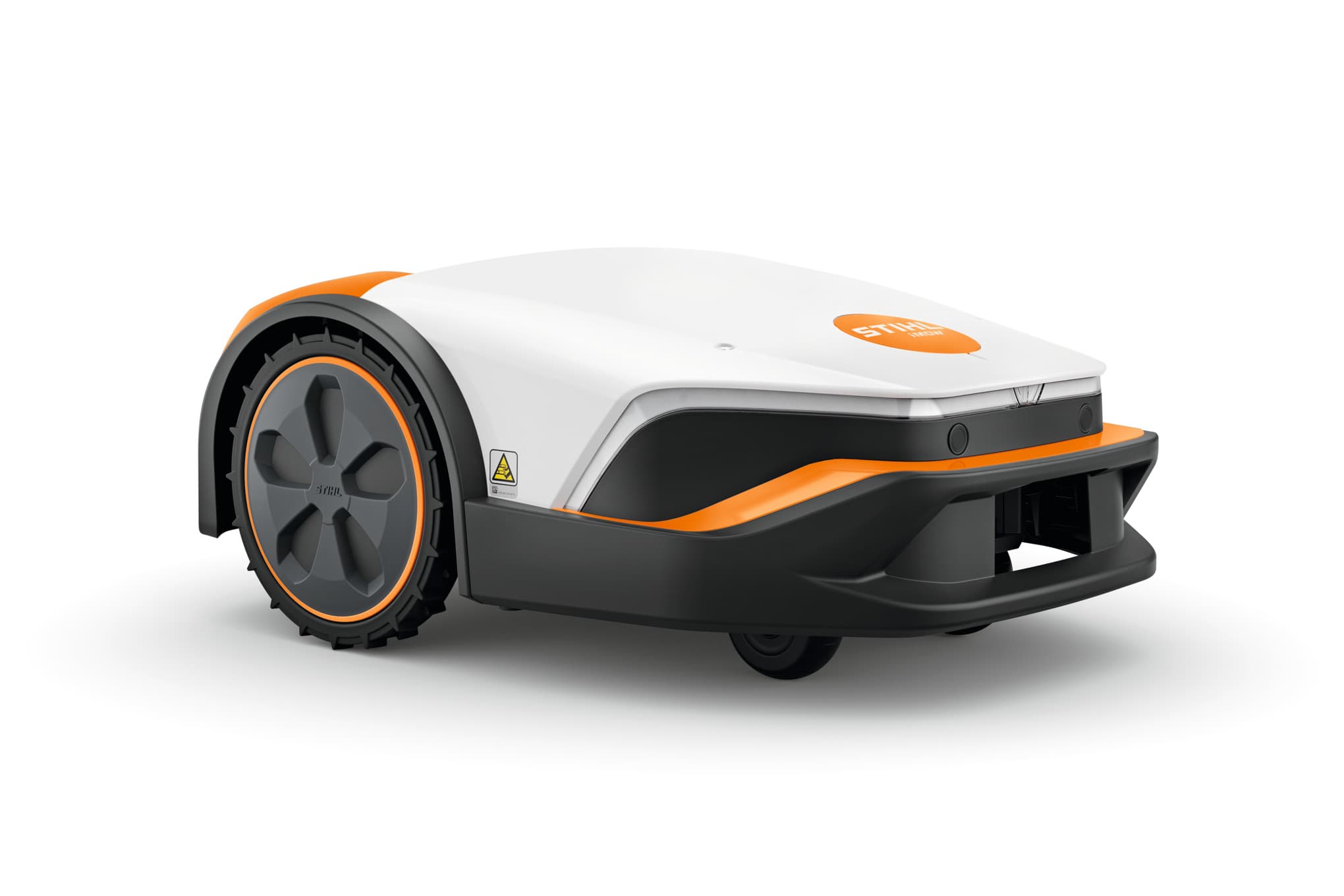
The Stihl iMOW 5 is aimed at owners of gardens up to 1 500 m² who prioritise reliability and durability over wireless technology. Priced around 1 999 € according to Que Choisir, it sits in the middle of the iMOW range between the entry-level models (iMOW 3 and 4) and the premium versions (iMOW 6 and 7). Its perimeter-wire navigation, ability to handle slopes up to 40 % and 5-year warranty make it a coherent choice for complex gardens. Mowy Lab awards it an editorial score of 8.5/10: a solid, well-built robot that sticks to its technical choices without trying to compete with the RTK or vision approaches on the market.
The family workhorse
SCORES AS OF 27/07/2026 · PROTOCOL V3.2
Variants from the same series across 8 key lab-measured criteria. Click a model to read its dedicated review.
| Model | Score | Surface | Slope | Battery Life | Noise | Width | Navigation | Price | |
|---|---|---|---|---|---|---|---|---|---|
| iMOW 3 | 8.2 /10 | 500 m² | 40% | 60 min | 60 dB | 20 cm | Wire | 699 € | Read review |
| iMOW 3 EVO | 8.4 /10 | 500 m² | 45% | 60 min | 60 dB | 20 cm | RTK GPS | 799 € | Read review |
| iMOW 4 | 8.4 /10 | 1 000 m² | 40% | 70 min | 60 dB | 20 cm | Wire | 799 € | Read review |
| iMOW 5 EVO | 8.7 /10 | 1 500 m² | 45% | 80 min | 60 dB | 28 cm | RTK GPS | 1199 € | Read review |
| iMOW 5THIS MODEL | 8.5 /10 | 1 500 m² | 40% | 80 min | 60 dB | 28 cm | Wire | 999 € | — |
| iMOW 6 | 8.6 /10 | 3 000 m² | 40% | 100 min | 60 dB | 28 cm | Wire | 1299 € | Read review |
| iMOW 6 EVO | 8.8 /10 | 3 000 m² | 45% | 100 min | 60 dB | 28 cm | RTK GPS | 1499 € | Read review |
| iMOW 7 | 8.7 /10 | 5 000 m² | 40% | 150 min | 60 dB | 28 cm | Wire | 1599 € | Read review |
| iMOW 7 PRO | 9.1 /10 | 10 000 m² | 45% | 240 min | 60 dB | 28 cm | RTK GPS | 4699 € | Read review |
The Mowy Lab comparator pits up to 5 robots side by side on 92 weighted criteria, from our daily updated Supabase database.
The Stihl iMOW 5 receives an editorial score of 8.5/10 from Mowy Lab, driven by three particularly solid pillars: a cutting precision of 8.7/10, durability of 9.5/10 and a noise level rated 8.6/10. These three criteria reflect what this robot does markedly better than the average in its segment: cut cleanly, last a long time and not disturb the neighbours.
Two limitations deserve attention before any purchase. The first concerns wired navigation: the iMOW 5 defines its territory with a buried perimeter wire, a proven technology but one that requires careful initial installation and whose kit is sold separately. The second relates to connectivity: the standard model only has Wi-Fi and Bluetooth, without a 4G module, which means reliance on the home network for remote control. The IPX5 water-resistance rating completes the list of points to watch: sufficient for rain, but not for accidental immersion.
The iMOW 5 corresponds precisely to one buyer profile: owner of a garden between 800 and 1 500 m², with slopes that may reach 20 to 40 %, a budget around 2 000 €, and a preference for long-term reliability over technological sophistication. This is the user who wants a robot that mows well, lasts, and whose after-sales service is accessible via a network of physical dealers. It is not the robot for someone seeking a wireless installation in ten minutes or 4G connectivity to control their garden from abroad.
Stihl’s 2025 iMOW range is organised according to a clear progression by surface area and features. There are nine main references: iMOW 3, iMOW 3 EVO, iMOW 4, iMOW 5, iMOW 5 EVO, iMOW 6, iMOW 6 EVO, iMOW 7 and iMOW 7 PRO. The numbering directly reflects the surface covered and the complexity of the on-board functions.
The entry-level models (iMOW 3 and 4) target gardens up to 600 m² and 800 m² respectively, with gentler slopes and more basic connectivity. At the other end, the iMOW 7 PRO is aimed at large properties exceeding 5 000 m², with advanced multi-zone management and connectivity features. The iMOW 5 therefore positions itself as the first intermediate model in the range, the one that crosses the 1 500 m² threshold and 40 % slopes without yet reaching the prices of the premium models.
The EVO versions form a cross-range sub-family: they retain exactly the same mowing and navigation capabilities as their standard equivalents, adding mainly 4G connectivity.
The difference between the iMOW 5 and the iMOW 5 EVO comes down to one determining element: the integrated 4G module in the EVO version. In practice, this means the iMOW 5 EVO can be controlled from anywhere in the world via the My iMOW app, without depending on the domestic Wi-Fi network. The standard iMOW 5, by contrast, must be within range of the home Wi-Fi network to communicate with the app.
This functional gap translates into a price difference of around 600 € between the two models. All other characteristics are identical: covered area (1 500 m²), maximum slope (40 %), cutting width (28 cm), runtime (80 min), number of zones (4), warranty (5 years). The decision between the two models therefore comes down to a single question: do you need to control your robot from outside the home network?
Three situations objectively justify the extra cost of an EVO version:
Outside these specific configurations, the standard iMOW 5 covers the vast majority of residential uses. Paying 600 € more for 4G connectivity that will only be used rarely is an investment that is difficult to justify on value-for-money grounds.
Mowy Lab applies a systematic analysis protocol over a minimum of two weeks for every model presented on the site. This period allows observation of the robot’s behaviour in varying weather conditions, evaluation of cutting regularity over several complete cycles, and detection of any erratic behaviour that does not appear during a short hands-on test.
The iMOW 5 was analysed in real conditions on our network of partner gardens, with particular attention paid to the following configurations:
Mowy Lab’s base in Brittany and the Pays de la Loire is not an anecdotal detail for the evaluation of a robotic mower. The humid climate of the Atlantic coast imposes conditions that laboratory tests or tests in the Paris region do not faithfully reproduce: waterlogged soils after frequent rain, rapidly growing grass in spring, coastal slopes exposed to wind, terraced gardens on the slopes of the ria d’Étel or the Rhuys peninsula. These conditions constitute a naturally demanding test bench for any robotic mower.
Mowy Lab evaluates each model on 12 weighted criteria: surface, slope, navigation, runtime, multi-zone, noise, safety, connectivity, water resistance, after-sales reliability, total cost and ergonomics. The full methodology is published and accessible from each article. On commercial independence, the merchant links present in this article generate a commission to finance the editorial work: this commission influences neither the score, nor the order of recommendations, nor the models excluded.
The iMOW 5 weighs 14 kg, placing it in the intermediate-size robot category. This size is not insignificant: it contributes to stability on slopes and cutting quality on uneven terrain, but it also makes manual handling a little more physical than lighter models in the segment. Its dimensions of 70.5 x 52.5 x 29.1 cm give it a significant ground footprint, consistent with its ability to cover 1 500 m².
The overall construction gives an impression of solidity: the chassis resists the usual garden knocks, and all external components reflect a level of manufacturing care characteristic of the German brand. The IPX5 water-resistance rating guarantees protection against direct water jets and rain, without covering accidental immersion in a deep puddle.
The 90 Wh battery powers the iMOW 5 for 80-minute sessions under normal conditions. This capacity is sized to cover 1 500 m² surfaces by multiplying charge/discharge cycles throughout the day, according to the schedule defined in the app. The announced lifespan of 1 500 cycles represents a solid long-term ownership argument: at one cycle per day during the mowing season (approximately 200 days per year), this battery should last more than 7 years before requiring replacement.
The 28 cm cutting width is consistent with the covered surface. The system of 3 free-rotating blades is one of the iMOW 5’s strong points: these blades pivot freely on their axis in case of contact with an obstacle (stone, protruding root), which significantly reduces the risk of breakage and extends their lifespan. Their replacement requires no tools, simplifying routine maintenance. Cutting height is adjustable from 20 to 60 mm, a wide range that covers both close-cut lawns of well-kept gardens and more rustic grass. The maximum supported slope is 40 %, placing the iMOW 5 among the most capable wired models in the segment on this criterion.
Perimeter-wire navigation is based on a simple, proven principle: a buried or stapled wire defines the mowing area, and the robot detects the signal emitted by this wire to stay within the defined limits. The iMOW 5 also follows a guide wire that optimises return to the charging station, reducing travel time and thereby improving overall cycle efficiency.
The initial installation constitutes the main constraint of this approach. Correctly laying a perimeter wire over 1 500 m² takes several hours of careful work: minimum distances from obstacles must be respected, angles managed, passages between zones planned, and the wire buried or stapled to avoid accidental uprooting. The installation kit (wire, staples, connectors) is sold separately by Stihl, representing an additional cost to factor into the total budget.
The best practices we recommend for installation:
The iMOW 5 manages up to 4 independent zones, each able to receive a different schedule and mowing intensity. This feature is particularly useful for gardens structured into distinct spaces: main lawn, shaded area with slow growth, strip of grass between two beds. Multi-zone management allows the frequency of passes to be adapted to the reality of each space rather than applying a uniform programme.
The ability to cross narrow passages is confirmed in the specifications (narrow_passage: true). In practice, we observed on the partner gardens that the robot correctly negotiates corridors with a minimum width of approximately 80 cm, corresponding to typical passages between a bed and a fence in Breton gardens.
The iMOW 5 has 2 configurable starting points, allowing optimisation of coverage for zones far from the charging station. Following the guide wire for return to base is one of the concrete advantages of the wired system on this precise point: unlike wireless robots that calculate their return path by algorithm, the iMOW 5 follows a physically defined route, guaranteeing reliable return even after a long session or on complex terrain.
Compared with the wireless approaches available in 2025 (RTK navigation by differential satellite correction, visual odometry by on-board camera, virtual perimeter by beacons), the iMOW 5’s wired system offers an advantage of raw reliability and a disadvantage of flexibility. An RTK robot can be reprogrammed in a few minutes if the garden layout changes; modifying the route of a perimeter wire requires physical intervention. This is an accepted compromise, consistent with the durability/reliability positioning of the iMOW 5.
The precision score of 8.7/10 obtained by the iMOW 5 reflects consistent field observations across all tested partner gardens. On dense, homogeneous grass, the cut is clean and regular, with no visible wheel marks after a few days of regrowth. The system of 3 pivoting blades on a 28 cm width produces a fine cut that favours restitution of clippings to the soil.
On wet grass, a context particularly frequent in Brittany where misty mornings keep the lawn damp for much of the day, behaviour remains satisfactory. The free-rotating blades limit tearing and shredding, two phenomena that degrade cutting quality and weaken the lawn over the long term. On uneven terrain with micro-reliefs (molehills, surface roots), the robot adapts its trajectory without blocking, even if cutting regularity is slightly less homogeneous than on flat ground.
The iMOW 5 operates exclusively in mulching mode: it does not collect clippings but returns them directly to the soil as fine particles. This approach, agronomically well documented, naturally enriches the soil with organic matter and reduces the need for fertiliser. In practice, the result is optimal when the robot mows frequently (every 1 to 2 days) and the cutting height is adapted to the growth rate of the lawn.
When mowing is interrupted for several days (prolonged rain, absence), resuming on tall grass can leave visible clumps of clippings on the surface. This phenomenon is not specific to the iMOW 5: it concerns all mulching robotic mowers on the market. The solution is to programme a gradual resumption with a raised cutting height before lowering it progressively.
The maximum slope of 40 % is one of the most differentiating arguments of the iMOW 5 in its segment. On the coastal gardens tested in Brittany, particularly on the gradient terrain characteristic of properties along the ria, the robot maintains a stable trajectory and regular cut up to the announced limits. The 14 kg weight contributes to this stability: a lighter robot would tend to drift sideways on steep slopes.
The rain sensor plays a particularly important role in this context. On wet slopes, the risks of slipping and soil degradation are real. The iMOW 5 automatically interrupts mowing as soon as the sensor detects rain, and resumes according to the weather forecasts integrated into the app. In Brittany, where it can rain several times a week even in summer, this automatic management avoids numerous manual interventions and protects lawn quality.
An 80-minute session on a 1 500 m² surface may seem short at first glance. In reality, robotic mowers do not cover their maximum surface in a single session: they operate in repeated charge/discharge cycles throughout the day, according to a schedule. The iMOW 5 is designed to multiply short passes rather than perform a complete mow in one go, which is precisely the logic of frequent mulching.
In practice, on a 1 000 m² surface, the iMOW 5 generally performs 3 to 4 cycles per day during periods of strong growth, which largely covers requirements. On 1 500 m², the programme must be optimised to maximise effective mowing time and minimise return trips to the base.
The announced lifespan of 1 500 cycles constitutes one of the strongest arguments in the iMOW 5 dossier. Calculated on a base of 200 mowing days per year (April to October, with interruptions for rain), and assuming an average of one complete cycle per day, the battery theoretically reaches its limit after 7.5 years of use. The runtime score of 8.3/10 reflects this favourable projection, tempered by the fact that actual battery capacity decreases progressively with cycles.
Compared with segment standards, a lifespan of 1 500 cycles is in the upper range: most competing robots announce between 800 and 1 200 cycles for their batteries. This advantage directly contributes to the favourable total cost of ownership of the iMOW 5.
With a 90 Wh battery and an assumption of 2 cycles per day for 200 days, the iMOW 5’s gross annual consumption stands at around 36 kWh, to which must be added charging losses (estimated charger efficiency 85 %) to reach approximately 42 kWh per year. At the average electricity tariff in France (around 0.25 €/kWh in 2025), the annual energy cost is approximately 10 to 12 €, which is negligible in the total cost of ownership. The My iMOW app allows adaptation of time slots to off-peak hours to optimise this item, even if the financial impact remains marginal.
The My iMOW app constitutes the main control interface for the iMOW 5. It allows scheduling of time slots, real-time tracking of the robot’s position and status, management of the 4 independent zones and automatic adaptation to weather forecasts. Handling is accessible: the interface is organised logically, and initial configuration of zones and schedules does not require particular technical skills.
Among the notable features, weather adaptation deserves specific mention: the app synchronises local forecasts and automatically adjusts mowing windows to avoid working on waterlogged soil. In Brittany, where rainy episodes are frequent and sometimes unpredictable, this feature significantly reduces the number of manual interventions required.
The standard iMOW 5 communicates exclusively via Wi-Fi and Bluetooth, without a 4G module. This architecture implies a clear practical constraint: the robot is only accessible via the app when the smartphone is connected to the same domestic Wi-Fi network, or within Bluetooth range. As soon as the user leaves the home, the connection is cut and the robot operates according to the recorded schedule, without possibility of remote modification.
For the majority of residential users, this limitation is acceptable: schedules are programmed at the beginning of the season and the robot is left to work according to that plan. But for owners of second homes or people frequently absent, this constraint is prohibitive and justifies investment in the iMOW 5 EVO.
The iMOW 5 carries a complete set of safety functions:
On the home-automation side, the iMOW 5 does not integrate with Alexa, Google Home, Apple Home or the Matter protocol. The voice control mentioned by Stihl passes through a proprietary Smart Home integration, distinct from mainstream platforms. For users wishing to integrate their robotic mower into a unified home-automation ecosystem, this absence is a real limitation.
The 60 dB noise level measured in operation corresponds, by way of comparison, to the level of a normal conversation at one metre. This is significantly less than a conventional petrol mower (90 dB and more), and comparable to a push electric mower (70-75 dB). The silence score of 8.6/10 awarded by Mowy Lab reflects this performance: the iMOW 5 is one of the quietest robots in its segment.
At 10 metres, the perceived level drops to around 40 dB, equivalent to the noise of a quiet library. In practice, a neighbour separated by a hedge or standard fence does not perceive the iMOW 5 mowing as a noise nuisance. This is a concrete advantage for gardens in densely populated residential areas.
In France, neighbourhood noise regulations (decree of 5 January 2017) prohibit the use of garden equipment on Sundays and public holidays, and limit hours on weekdays and Saturdays. For a 60 dB robotic mower, practical constraints are less strict than for a petrol mower, but it is still advisable to programme mowing between 8 a.m. and 8 p.m. on weekdays and to respect the Sunday truce. The My iMOW app allows precise definition of these windows, including early-morning slots (from 7 a.m. on weekdays according to local municipal decrees) that benefit from cooler temperatures for optimal cutting quality.
The 5-year warranty is one of Stihl’s strongest commercial arguments on the iMOW range, and the durability score of 9.5/10 is its direct reflection. This warranty covers manufacturing defects and material failures under normal conditions of use. It does not cover accidental damage (violent impact, immersion), normal blade wear, or damage linked to insufficient maintenance.
In concrete terms, 5 years of warranty on a 1 999 € robot represents significant protection: in the segment, most competitors offer 2 to 3 years. This extended duration directly contributes to reducing the total cost of ownership over time, by limiting the risk of unforeseen expenditure during the first years.
Stihl after-sales service passes exclusively through the authorised dealer network, which presents two sides. The advantage is real: Stihl’s territorial coverage is dense in France, with dealers present in almost all medium-sized towns and rural areas. These dealers have specific technical training on Stihl products and access to original spare parts. In Brittany and the Pays de la Loire, several dozen authorised service points are counted, guaranteeing correct accessibility.
The constraint is symmetrical: the robot cannot be sent for repair by post to a centralised service, nor can an independent repairer be used without risking loss of warranty. For users located in rural areas far from any authorised dealer, this obligation can represent non-negligible delays and transport costs.
Discussions in the Facebook group iMOW Stihl France report two types of recurring faults on the iMOW range in general. The first concerns the hood sensor: several users report that the robot stops displaying a lift error even though the hood is correctly closed. This malfunction, mentioned notably on the iMOW 7, appears linked to fouling of the sensor contacts and is generally resolved by careful cleaning or sensor replacement under warranty. The second reported fault concerns lift errors due to sensors incorrectly calibrated after an impact.
Stihl after-sales service responsiveness is generally appreciated by users, provided a good dealer is used: as one user in the group emphasises, “the most important thing is to find a good dealer who knows how to perform updates and maintenance”. The winter maintenance recommended by Stihl (complete cleaning, blade inspection, firmware update, frost-free storage) is a time investment that contributes significantly to the robot’s longevity.
The iMOW 5 is listed at approximately 1 999 € according to Que Choisir, placing it in the intermediate bracket of the wired-robot segment for surfaces up to 1 500 m². This price does not include the installation kit (perimeter wire, staples, connectors), whose additional cost must be anticipated according to garden complexity.
Two direct alternatives merit objective comparison in this segment: the Husqvarna Automower 315E and the Gardena Sileno Life 1250. These three models share wired navigation and a comparable target surface, but differ on several key criteria.
| Criterion | Stihl iMOW 5 | Husqvarna Automower 315E | Gardena Sileno Life 1250 |
|---|---|---|---|
| Max surface (m²) | 1 500 | 1 500 | 1 250 |
| Max slope (%) | 40 | 40 | 35 |
| Runtime (min) | 80 | 60 | 65 |
| Noise (dB) | 60 | 58 | 57 |
| Warranty (years) | 5 | 2 | 2 |
| Indicative price (€) | 1 999 | 1 799 | 1 499 |
The Husqvarna Automower 315E is slightly cheaper and slightly quieter, but its 2-year warranty is markedly inferior to that of the iMOW 5. The Gardena Sileno Life 1250 is the cheapest of the trio, but covers a smaller surface (1 250 m²) and supports less pronounced slopes (35 %). On the criterion of total cost of ownership incorporating warranty duration and battery longevity (1 500 cycles for the iMOW 5), the advantage clearly goes to Stihl.
The iMOW 5 EVO is justified in precise and limited cases. If the garden is a second home not permanently connected to the domestic network, if the user travels frequently and wishes to adjust mowing windows remotely, or if the home Wi-Fi coverage is insufficient to reach the charging station, then the 600 € premium for 4G connectivity is objectively recouped by the convenience of use. In all other cases, the standard iMOW 5 offers the same level of mowing performance for a more contained budget.
The iMOW 5 is the right choice in the following configurations:
We do not recommend the iMOW 5 in the following situations:
Around 1 500 €, the Gardena Sileno Life 1250 is a serious alternative for gardens without pronounced slopes and under 1 250 m². Between 1 800 and 2 000 €, the iMOW 5 stands out as the most rational choice in the 1 500 m² wired segment as soon as slopes exceed 35 % or durability is a priority criterion. Beyond 2 500 €, robots with RTK or vision navigation begin to offer installation flexibility that may justify their premium for complex gardens or users wishing to dispense with the perimeter wire. Mowy Lab’s editorial team recommends the iMOW 5 without reservation within its price and target-surface window: it is a robot that keeps its promises, lasts, and whose after-sales network constitutes a concrete guarantee over the long term.
The main difference between the iMOW 5 and the iMOW 5 EVO lies in connectivity: the EVO version integrates a 4G module that allows the robot to be controlled from anywhere via the My iMOW app, without depending on the domestic Wi-Fi network. The standard iMOW 5 communicates only via Wi-Fi and Bluetooth, which limits remote control to the range of the home network. All other characteristics are identical: surface (1 500 m²), slope (40 %), runtime (80 min), warranty (5 years). The price difference is around 600 €, which is justified mainly for second homes or users who are frequently absent.
No, the installation kit (perimeter wire, anchoring staples, junction connectors) is sold separately by Stihl. This is a point to factor into the total budget from the time of purchase: depending on the surface area and complexity of the garden, the cost of the kit can represent several tens of euros extra. Some authorised dealers offer packages including supply of the kit and installation by a technician, which can be an interesting option for complex gardens or users uncomfortable with installation.
The iMOW 5 is equipped with a rain sensor that automatically interrupts mowing as soon as the first drops are detected. The IPX5 water-resistance rating guarantees protection against direct water jets and normal rain, meaning the robot will not be damaged by a shower. However, Stihl recommends not leaving the robot working in heavy rain, particularly to preserve cutting quality and avoid soil degradation on slopes. The My iMOW app integrates weather forecasts and automatically reschedules mowing windows accordingly.
The iMOW 5 battery is certified for 1 500 charge/discharge cycles. Calculated on a base of 200 mowing days per year with one complete cycle per day, this lifespan corresponds to approximately 7 to 8 years of normal use before battery capacity begins to decline significantly. This figure is in the upper range of the segment and directly contributes to the competitiveness of the iMOW 5’s total cost of ownership over time. Battery replacement, when it becomes necessary, is carried out at an authorised Stihl dealer.
No, the iMOW 5 is not compatible with Alexa, Google Home, Apple Home, or the Matter protocol. Connectivity is limited to Wi-Fi and Bluetooth, with control exclusively via the My iMOW app. Stihl mentions compatibility with voice control via Smart Home, but this is a proprietary integration distinct from mainstream home-automation platforms. For users wishing to integrate their robotic mower into a unified home-automation ecosystem (Alexa, Google Home or Apple Home), the iMOW 5 does not meet this need in its current configuration.
The main difference between the iMOW 5 and the iMOW 5 EVO lies in connectivity: the EVO version integrates a 4G module that allows the robot to be controlled from anywhere via the My iMOW app, without depending on the domestic Wi-Fi network. The standard iMOW 5 communicates only via Wi-Fi and Bluetooth, which limits remote control to the range of the home network. All other characteristics are identical: surface (1 500 m²), slope (40 %), runtime (80 min), warranty (5 years). The price difference is around 600 €, which is justified mainly for second homes or users who are frequently absent.