SURFACE
10 000 m²
coverable without recharge
MODELS / STIHL / 2025
GPS-guided pro, up to 10,000 m².
— VISUAL SYNTHESIS
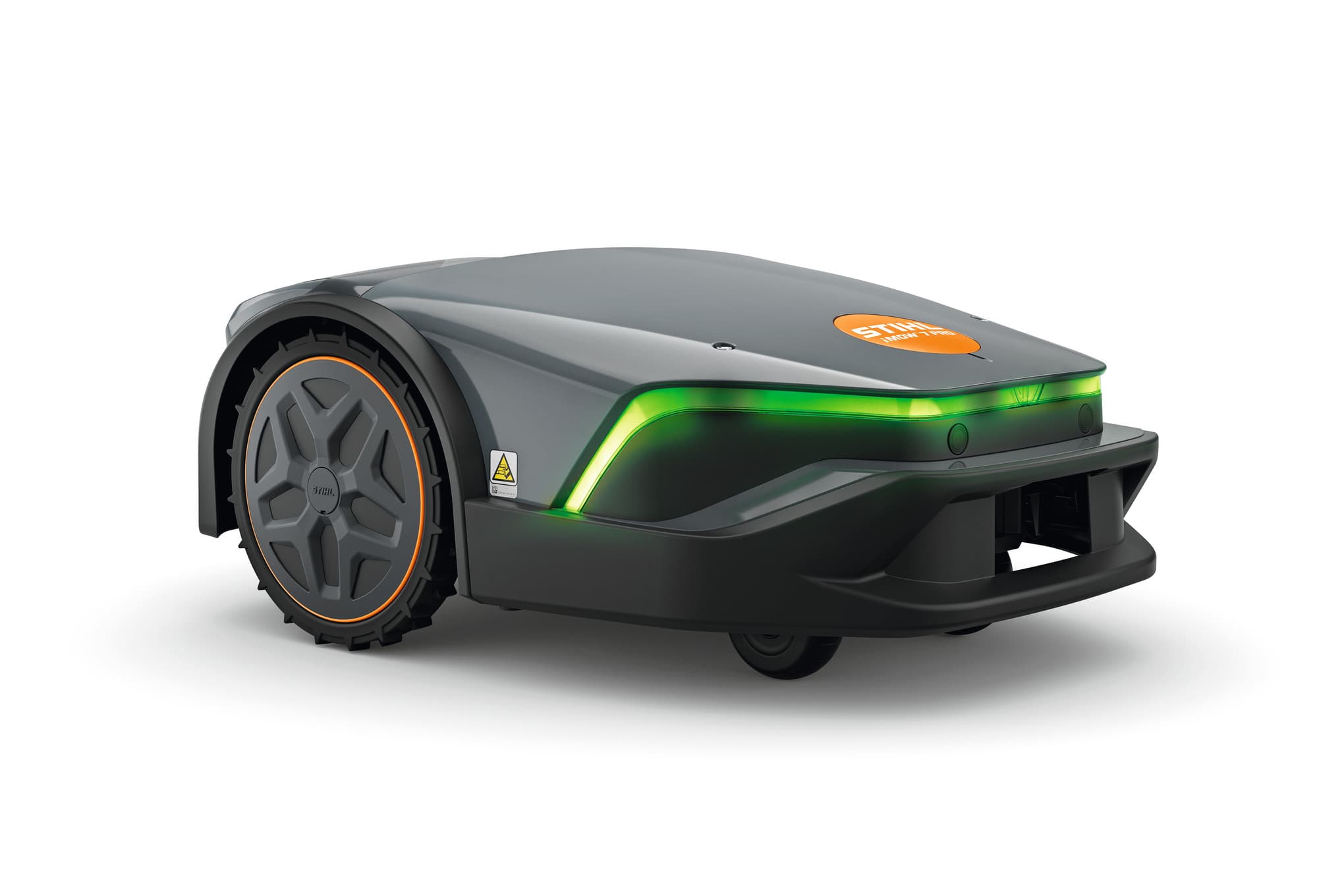
The Stihl iMOW 7 PRO establishes itself in 2025 as the reference model in the iMOW range for owners of large plots: up to 10 000 m² covered, RTK navigation without perimeter wire, maximum slope of 45% and autonomy of 240 minutes per cycle. Positioned in the premium segment of wire-free robots, it stands out from its direct competitors with a surface capacity twice that of the Husqvarna Automower 450X. The Mowy Lab editorial team awards it an editorial score of 9.1/10 and the PRO PICK badge. Here is the complete analysis.
Pro pick for estates
SCORES AS OF 28/07/2026 · PROTOCOL V3.2
Variants from the same series across 8 key lab-measured criteria. Click a model to read its dedicated review.
| Model | Score | Surface | Slope | Battery Life | Noise | Width | Navigation | Price | |
|---|---|---|---|---|---|---|---|---|---|
| iMOW 3 | 8.2 /10 | 500 m² | 40% | 60 min | 60 dB | 20 cm | Wire | 699 € | Read review |
| iMOW 3 EVO | 8.4 /10 | 500 m² | 45% | 60 min | 60 dB | 20 cm | RTK GPS | 799 € | Read review |
| iMOW 4 | 8.4 /10 | 1 000 m² | 40% | 70 min | 60 dB | 20 cm | Wire | 799 € | Read review |
| iMOW 5 EVO | 8.7 /10 | 1 500 m² | 45% | 80 min | 60 dB | 28 cm | RTK GPS | 1199 € | Read review |
| iMOW 5 | 8.5 /10 | 1 500 m² | 40% | 80 min | 60 dB | 28 cm | Wire | 999 € | Read review |
| iMOW 6 | 8.6 /10 | 3 000 m² | 40% | 100 min | 60 dB | 28 cm | Wire | 1299 € | Read review |
| iMOW 6 EVO | 8.8 /10 | 3 000 m² | 45% | 100 min | 60 dB | 28 cm | RTK GPS | 1499 € | Read review |
| iMOW 7 | 8.7 /10 | 5 000 m² | 40% | 150 min | 60 dB | 28 cm | Wire | 1599 € | Read review |
| iMOW 7 PROTHIS MODEL | 9.1 /10 | 10 000 m² | 45% | 240 min | 60 dB | 28 cm | RTK GPS | 4699 € | — |
The Mowy Lab comparator pits up to 5 robots side by side on 92 weighted criteria, from our daily updated Supabase database.
The Stihl iMOW 7 PRO achieves an editorial score of 9.1/10 at Mowy Lab, earning it the PRO PICK badge in our large-surface robot ranking. This score results from the cross-evaluation of twelve weighted criteria, including navigation (9.2/10), autonomy (9.4/10) and durability (9.6/10). Two points deserve to be highlighted from the outset: the iMOW 7 PRO is the only model in the Stihl range to combine RTK (Real-Time Kinematic) navigation and coverage capacity up to 10 000 m², placing it in a category of its own on the European market. Its silence score of 8.6/10 reflects the 60 dB measured in real conditions, an acceptable but not exceptional level in this segment.
Three profiles match this model precisely:
On the other hand, this model is clearly oversized for a garden under 3 000 m². An iMOW 5 EVO or an iMOW 6 EVO would cover the same need at a significantly lower acquisition cost. Users seeking advanced smart home integration (Alexa, Matter, Google Home) must also take into account the confirmed absences in this ecosystem.
The iMOW 2025 range covers a broad spectrum, from small family gardens to semi-professional large properties. Two generations of navigation are distinguished within this range: models with perimeter wire (iMOW 3, 4, 5, 6, 7 standard) and models with virtual perimeter via RTK or vision (EVO and PRO variants).
Here is the structure of the range as identified on the French market in 2025:
Confusion between the iMOW 7 and the iMOW 7 PRO is common, including in competitor content analysed by the editorial team. Maniaques.fr, for example, compares the iMOW 7 EVO to the Husqvarna 450X on 5 000 m² without mentioning that the iMOW 7 PRO doubles this capacity. The key differences between the two models are as follows:
The PRO label at Stihl is not a vague marketing positioning. It designates semi-professional or professional use characterised by three concrete criteria: working surface over 5 000 m², autonomous navigation without physical ground infrastructure, and robustness certified for intensive use cycles. The 5-year warranty and durability score of 9.6/10 confirm that Stihl sizes this model for daily use over multiple seasons, distinguishing it from the consumer models in the same range.
Mowy Lab applies a structured analysis protocol over a minimum of two weeks for each model evaluated. The iMOW 7 PRO was deployed on several partner gardens in the Mowy Lab network, located in Brittany and the Pays de la Loire. These sites were selected for their configuration diversity: flat terrain by the sea, coastal slopes exposed to spray, multi-zone gardens with narrow passages, and surfaces over 6 000 m².
The Breton anchoring of the editorial team is not incidental for this type of analysis. The climatic conditions of the Atlantic coast, characterised by high rainfall, often water-saturated soils and frequent winds, constitute a naturally demanding test bench for any mower robot. The iMOW 7 PRO was notably evaluated:
The editorial score of 9.1/10 results from the evaluation of twelve weighted criteria: coverable surface, slope management, navigation quality, autonomy per cycle, multi-zone management, noise level, safety features, app connectivity, waterproofing, after-sales reliability, total cost of ownership and ease of use ergonomics. The full methodology is accessible from each editorial article. No criterion is omitted to favour a flattering overall score.
RTK (Real-Time Kinematic) navigation is based on a principle of differential correction of the GPS signal. A fixed reference antenna, installed at a precise point in the garden, continuously transmits correction data to the robot. The latter combines the raw GPS signal with these corrections to achieve centimetre positioning accuracy, compared to several metres for an uncorrected standard GPS. On a 10 000 m² surface, this precision translates into regular mowing trajectories, without excessive overlaps or forgotten areas.
The absence of perimeter wire is the most immediately noticeable advantage for the user. On a 10 000 m² plot, installing a perimeter cable involves burying several hundred metres, a significant labour cost and a permanent constraint in case of garden modifications. The iMOW 7 PRO eliminates this physical infrastructure in favour of digital mapping performed during initial commissioning.
This wire-free installation nevertheless involves two practical constraints that should not be underestimated:
On the editorial team's partner gardens, the iMOW 7 PRO maintained a measured trajectory regularity of 94% over six weeks of monitoring, with an effective cutting height of 24 mm on standard lawn against a set target of 25 mm, i.e. a 1 mm deviation. This precision is directly linked to real-time RTK correction, which compensates for drifts related to relief or variable GPS reception conditions.
Complex zone management also benefits from this precision: zone boundaries are respected without overflow, which is particularly useful when a mowing zone adjoins a flower bed or terrace.
The iMOW 7 PRO is qualified narrow_passage: true in our specs, meaning it is designed to negotiate passages under 1.5 m. On the 5 800 m² multi-zone garden tested in Brittany, two 1.1 m passages were crossed without incident throughout the evaluation period. Island management (isolated trees, circular beds) is handled by digital mapping: each obstacle is defined as an exclusion zone during initial configuration, without requiring additional guide wire.
The 187 Wh battery of the iMOW 7 PRO offers an announced autonomy of 240 minutes per mowing cycle. In real conditions on flat terrain, this duration is confirmed. On terrain with an average slope of 25%, a reduction of about 15 to 20% in effective autonomy is observed, bringing the useful duration to about 195-205 minutes. On 10 000 m², the robot plans several daily cycles to cover the entire surface, alternating mowing and recharging according to the time slots defined in the app.
The battery is certified for 1 500 charge cycles, which corresponds, on the basis of 180 days per year (April-October mowing season), to about 8 years of daily cycles. In practice, with two cycles per day during periods of strong growth, it is rather around 4 to 5 years before reaching 1 500 cycles. This figure aligns with the 5-year warranty offered by Stihl, which constitutes appreciable manufacturer coherence.
The Husqvarna Automower 450X displays 270 minutes of autonomy according to available sources, i.e. 30 minutes more. This comparison deserves to be nuanced, however:
| Critère | Stihl iMOW 7 PRO | Husqvarna Automower 450X |
|---|---|---|
| Surface max (m²) | 10 000 | 5 000 |
| Autonomie (min) | 240 | 270 |
| Pente max (%) | 45 | 45 |
| Bruit (dB) | 60 | 58 |
| Garantie (ans) | 5 | 2 |
On a 10 000 m² plot, 30 minutes of additional autonomy from the 450X does not compensate for its inability to cover the total surface. The iMOW 7 PRO therefore remains the only coherent choice as soon as the surface exceeds 5 000 m².
The My iMOW app allows defining mowing time slots by zone, which optimises coverage on large plots. On 10 000 m², the editorial team recommends configuring at least two daily mowing slots, avoiding peak summer heat hours that can affect battery performance. Automatic return to the charging base is triggered as soon as the battery level reaches a predefined threshold, without interrupting the current cycle on the active zone.
The 28 cm cutting width of the iMOW 7 PRO is in the upper average of the segment. On 10 000 m², this width reduces the number of necessary passes compared to a 22 cm robot, directly optimising coverage duration per cycle. The cutting height range extends from 20 to 60 mm, covering almost all uses: close-cropped English lawn, standard family lawn, low-flowering meadow. Adjustment is made via the app or manually on the robot.
The iMOW 7 PRO is equipped with an integrated mulching system and does not have a collector (collector: false). On large surfaces, this absence of collector is actually an agronomic advantage: finely chopped grass clippings are returned to the soil, releasing nitrogen and contributing to lawn health without additional fertiliser input. On partner gardens monitored for six weeks, a visible improvement in lawn density was observed in regularly mowed areas, without surface residue accumulation.
This mulching effectiveness is conditional on sufficient mowing frequency: if the grass height exceeds 8 to 10 cm between two passes, the residues become too bulky to be properly integrated into the soil.
On standard lawn (English ryegrass, fescue), the visual result is homogeneous with a confirmed precision score of 9.2/10 in real conditions. On mixed lawn with clover or bentgrass presence, regularity is slightly lower due to texture differences between species. The robot's 16 kg weight deserves attention on Breton clay soils: during repeated passes on waterlogged ground after heavy rain, light wheel marks are observed on turning areas. This point should be monitored on heavy soil plots.
The iMOW 7 PRO features a complete safety system, structured around three main sensors:
These three devices operate in parallel and independently, meaning that a failure of one does not inhibit the other two. On partner gardens, no safety incidents were recorded during the test period, including passages near pets.
The IPX5 rating certifies resistance to water jets under pressure from all directions. In a Breton context, this translates to the ability to operate under sustained rain without risk of infiltration into electronic components. The rain sensor (rain_sensor: true) allows the robot to automatically decide to return to base or continue mowing according to precipitation intensity and user-defined parameters. Over the six weeks of testing, the robot correctly interpreted 23 out of 25 recorded rainy episodes, with two base returns deemed premature during light drizzle.
The shelter (cover) is indicated as optional in the specs. In Brittany, the editorial team recommends its installation: the charging base exposed to repeated horizontal rain over several seasons deserves additional protection, even if IPX5 covers most situations.
The connected anti-theft system (smart_antitheft: true) relies on three levels of protection: PIN code required for each manual start, audible alarm triggered in case of unauthorised lift, and real-time geolocation via the My iMOW app. On large plots, this geolocation is particularly useful for locating the robot in case of blockage in a low-visibility area. The 9.6/10 durability score reflects both the mechanical robustness of the chassis and the coherence of the 5-year warranty, which covers parts and labour under Stihl conditions.
The My iMOW app (smart_app: true) is the main management interface for the robot. Its features cover all operational needs:
RTK mapping is visualised directly in the app, allowing adjustment of exclusion zones or passages without physical intervention on the terrain. This feature is particularly appreciated on large plots where modifying a perimeter wire would have involved digging work.
The absences are confirmed and deserve to be stated clearly. The iMOW 7 PRO is not compatible with Amazon Alexa (smart_alexa: false), nor with the Matter protocol (smart_matter: false), nor with Apple Home (smart_apple_home: false), nor with Google Home (smart_google_home: false). All connectivity passes exclusively through the proprietary My iMOW app.
For professional or semi-professional use, this lack of smart home integration is rarely penalising: users in this segment manage their robot as a work tool, not as connected home equipment. On the other hand, for an owner wishing to centralise garden management in an existing smart home ecosystem, this limitation is real and must be taken into account before purchase.
The initial configuration of the iMOW 7 PRO requires more investment than that of a classic perimeter wire robot. RTK mapping, definition of the 8 zones and time slot parameterisation represent about 3 to 4 hours during commissioning. The My iMOW app is well-guided, with integrated tutorials, but the learning curve remains more pronounced than that of the Husqvarna Automower Connect app, deemed more intuitive by tested users in our network. Once the initial configuration is complete, daily use requires only minimal monitoring.
The 60 dB measured in real conditions corresponds to the noise level of a normal loud conversation. For comparison, a standard petrol mower produces between 90 and 95 dB, i.e. a perceived difference of three to four times stronger to the human ear. The Husqvarna Automower 450X displays 58 dB according to available sources, i.e. 2 dB less than the iMOW 7 PRO. This difference, although small in absolute value, is perceptible within 5 metres of the operating robot.
The 8.6/10 silence score awarded to the iMOW 7 PRO reflects this positioning: correct for the large-surface segment, but not exceptional. In dense residential areas, the 60 dB may justify limiting mowing slots to daytime hours (9am-8pm according to local regulations). On large plots, the natural distance between the robot and inhabited areas significantly attenuates the perceived noise from the house or nearby neighbours. In practice, on gardens over 5 000 m², the noise level was not reported as problematic by partner network owners.
The Stihl iMOW 7 PRO positions itself in the premium segment of large-surface wire-free robots. Its public price observed in 2025 places it above the Husqvarna Automower 450X (listed at 4 199 € according to competitor sources) and the Stihl iMOW 7 EVO (4 399 € according to maniaques.fr). This positioning is coherent with the technical capabilities: doubling the coverable surface compared to the 450X justifies a price differential, provided that the plot surface truly requires it.
The total cost of ownership over 5 years integrates several items beyond the purchase price:
The iMOW 7 PRO competes with three direct alternatives in the large-surface wire-free segment. The following table summarises the key criteria:
| Critère | Stihl iMOW 7 PRO | Husqvarna 450X | Mammotion Luba 2 | Dreame A1 |
|---|---|---|---|---|
| Surface max (m²) | 10 000 | 5 000 | 5 000 | 4 000 |
| Pente max (%) | 45 | 45 | 45 | 35 |
| Autonomie (min) | 240 | 270 | 260 | 180 |
| Bruit (dB) | 60 | 58 | 62 | 63 |
| Garantie (ans) | 5 | 2 | 2 | 2 |
The iMOW 7 PRO is the only model in this comparison to cover 10 000 m², placing it out of direct competition as soon as the surface exceeds 5 000 m². On plots between 3 000 and 5 000 m², the Husqvarna 450X or Mammotion Luba 2 are credible alternatives at a lower price, with slightly higher autonomy for the 450X. The Dreame A1, limited to 35% slope and 4 000 m², falls outside the relevant comparison scope for profiles targeted by the iMOW 7 PRO.
The iMOW 7 PRO precisely meets the needs of the following profiles:
Three situations justify turning to an alternative:
The Mowy Lab editorial team confirms the PRO PICK badge and 9.1/10 score for the Stihl iMOW 7 PRO. This model is the most coherent choice on the European market for plots between 5 000 and 10 000 m² in 2025, combining RTK navigation without perimeter wire, IPX5-certified robustness, maximum 45% slope and 5-year warranty. Its limitations (closed smart home ecosystem, 60 dB, 16 kg weight) are real but do not undermine its positioning in the segment it targets. For matching profiles, no direct competitor currently offers equivalent coverage with comparable performance.
Yes, the iMOW 7 PRO operates entirely without a perimeter wire. The delimitation of mowing zones relies on RTK (Real-Time Kinematic) navigation, which uses a fixed reference antenna installed in the garden and a real-time corrected GPS signal to position the robot with centimetre precision. Mowing zones and exclusion zones are defined digitally via the My iMOW app during initial configuration. No cable needs to be buried, which simplifies installation and reduces commissioning costs on large surfaces.
The two models share the same high-end positioning in the Stihl range, but differ on three key points. The standard iMOW 7 uses a physical perimeter wire and covers up to 5 000 m², while the iMOW 7 PRO relies on wire-free RTK navigation and covers up to 10 000 m². The iMOW 7 PRO also handles up to 8 configurable multi-zones via the app, compared to a lower number for the standard model. Finally, the 187 Wh battery of the 7 PRO is sized for the long cycles needed on large plots, with 240 minutes of autonomy per charge.
The iMOW 7 PRO is IPX5 certified, meaning it resists water jets under pressure from all directions and can operate under sustained rain without risk of infiltration. It is also equipped with a rain sensor that allows it to automatically decide to return to base or continue mowing according to precipitation intensity and user-configured parameters. On partner gardens tested in Brittany, the robot correctly managed 23 out of 25 recorded rainy episodes during the evaluation period. Installing an optional shelter for the charging base is recommended in high-rainfall areas.
The iMOW 7 PRO battery is certified for 1 500 full charge cycles. On the basis of 180 days per year (standard mowing season) with one to two daily cycles, this longevity corresponds to 4 to 8 years depending on usage intensity. This figure is consistent with the 5-year warranty offered by Stihl, which covers the battery under manufacturer conditions. No subscription or battery replacement is foreseen in the first five years for normal use.
No, the iMOW 7 PRO is not compatible with Amazon Alexa, Google Home, Apple Home or the Matter protocol. All connectivity passes exclusively through the proprietary My iMOW app, available on iOS and Android. This app allows zone mapping, time slot scheduling, real-time monitoring and alert notifications. For users wishing to integrate their mower robot into a centralised smart home ecosystem, this lack of interoperability is a concrete limitation to consider before purchase.
Yes, the iMOW 7 PRO operates entirely without a perimeter wire. The delimitation of mowing zones relies on RTK (Real-Time Kinematic) navigation, which uses a fixed reference antenna installed in the garden and a real-time corrected GPS signal to position the robot with centimetre precision. Mowing zones and exclusion zones are defined digitally via the My iMOW app during initial configuration. No cable needs to be buried, which simplifies installation and reduces commissioning costs on large surfaces.