SURFACE
600 m²
coverable without recharge
MODELS / WORX / 2024
Vision AI gen 1, 600 m².
— VISUAL SYNTHESIS
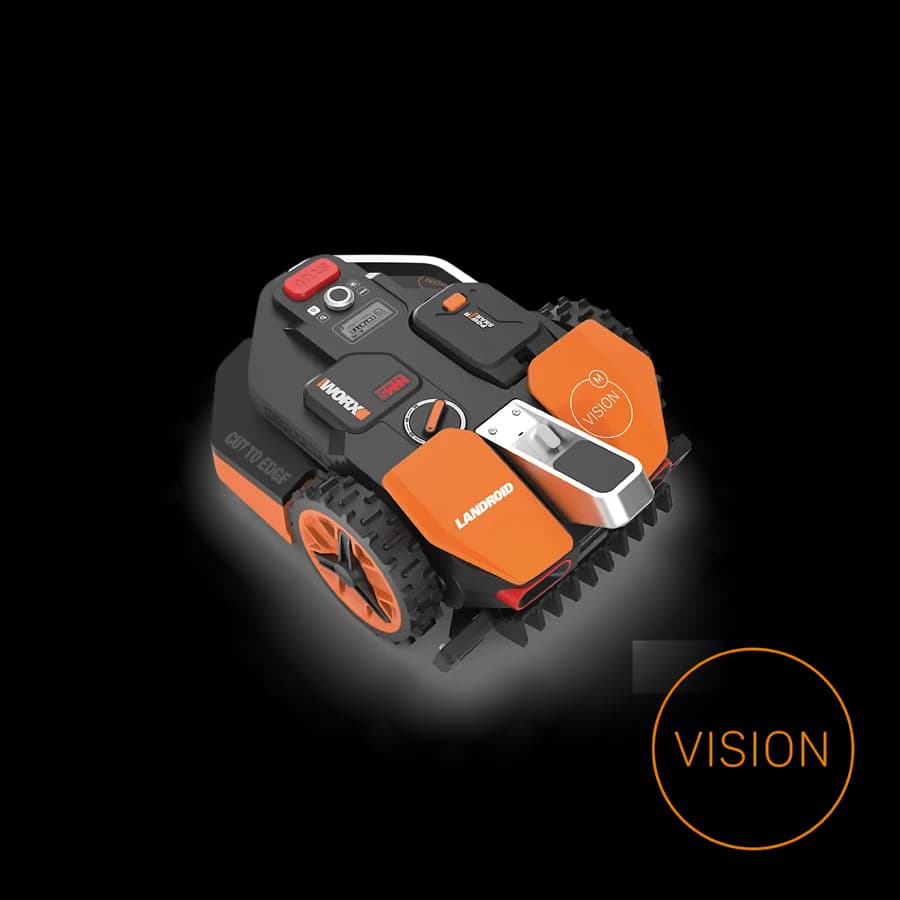
The Worx Landroid Vision AI WR206E targets gardens up to 600 m² that combine two constraints often poorly handled by entry-level robots: the absence of a perimeter wire and significant slopes. Launched in 2024, it sits at the second tier of Worx’s Vision AI series, with onboard camera navigation, a stated 35 % slope capability and a mid-range price in the wireless market. Our verdict: a solid robot on uneven terrain, with important nuances to consider before purchase.
Mid-size Vision AI gen 1
SCORES AS OF 26/07/2026 · PROTOCOL V3.2
Variants from the same series across 8 key lab-measured criteria. Click a model to read its dedicated review.
| Model | Score | Surface | Slope | Battery Life | Noise | Width | Navigation | Price | |
|---|---|---|---|---|---|---|---|---|---|
| Landroid Vision AI WR202E | 7.9 /10 | 250 m² | 35% | 60 min | 59 dB | 18 cm | AI Vision | 849 € | Read review |
| Landroid Vision AI WR206ETHIS MODEL | 8.1 /10 | 600 m² | 35% | 70 min | 59 dB | 18 cm | AI Vision | 1099 € | — |
| Landroid Vision AI WR208E | 8.2 /10 | 800 m² | 35% | 110 min | 59 dB | 19 cm | AI Vision | 1399 € | Read review |
| Landroid Vision AI WR213E | 8.3 /10 | 1 300 m² | 35% | 130 min | 59 dB | 22 cm | AI Vision | 1799 € | Read review |
| Landroid Vision AI WR216E | 8.4 /10 | 1 600 m² | 35% | 140 min | 59 dB | 22 cm | AI Vision | 1999 € | Read review |
The Mowy Lab comparator pits up to 5 robots side by side on 92 weighted criteria, from our daily updated Supabase database.
The Worx Landroid Vision AI WR206E achieves an overall score of 8.1/10 according to the Mowy Lab evaluation grid. This result aggregates twelve weighted criteria, with marked strengths in cutting precision (8.4/10), quietness (8.4/10) and artificial-vision navigation (8.4/10). Runtime (7.4/10) and perceived durability (7.9/10) are the two areas identified for improvement.
The evaluated criteria cover:
The WR206E primarily targets owners of a 400 to 600 m² garden with noticeable relief, typically 15 % to 30 % slope, who wish to dispense entirely with perimeter-wire installation. This matches the profile of many gardens the Mowy Lab editorial team encounters in its Breton and Loire network: gentle slopes toward the sea, terraced gardens, coastal plots with irregular outlines.
Two clear reasons to buy emerge: wireless navigation is operational and reliable in standard light conditions, and slope capability is genuine up to roughly 25–28 % in damp conditions. A reason to look elsewhere: if your garden exceeds 600 m² or features passages narrower than 60 cm on a recurring basis, the next model in the range will be more suitable.
Worx’s Landroid Vision AI series comprises five 2024 references, all based on onboard camera navigation and the absence of a perimeter wire. They differ mainly in covered surface, slope capacity and price.
| Criterion | WR202E | WR206E | WR208E | WR213E | WR216E |
|---|---|---|---|---|---|
| Max surface (m²) | 300 | 600 | 800 | 1300 | 1600 |
| Max slope (%) | 35 | 35 | 35 | 35 | 35 |
| Battery (Wh) | 20 | 40 | 40 | 60 | 60 |
| Runtime (min) | 45 | 70 | 70 | 100 | 100 |
| Multi-zones | 2 | 2 | 2 | 4 | 4 |
Surface and runtime data come from Worx specifications. The maximum announced slope is identical across the series: 35 %, or roughly 19°. This point merits critical reading, which the dedicated slope section develops in detail.
The WR202E, with its 20 Wh battery and 45-minute runtime, suits gardens under 300 m² without excessive relief. Once the surface approaches 400 m² or the terrain features regular slopes, the WR202E’s battery demands a number of daily cycles that eventually stresses the cells prematurely.
The WR206E represents the first tier where the 70-minute runtime and 40 Wh battery can cover a 600 m² surface in two to three daily cycles, depending on relief. It is the relevant entry point for intermediate-sized gardens with slopes.
Moving up to the WR208E brings no decisive advantage on 600 m²: the battery is identical (40 Wh), runtime similar (70 min), and the gain in covered surface (800 m²) is only justified if your plot actually exceeds 600 m². The step to the WR213E, with its 60 Wh battery and 4-zone management, becomes relevant from 800 m² or as soon as the garden layout requires fine management of distinct zones.
Every model analysed by Mowy Lab undergoes a minimum two-week observation period in real conditions. The WR206E was deployed across several partner-network gardens, with daily recordings of cut quality, slope behaviour, base-return management and any session interruptions.
The editorial team documents each session: departure time, actual duration, estimated surface covered, number of obstacles detected, navigation incidents. Data are consolidated over the test period to identify trends and eliminate biases linked to one-off conditions.
Mowy Lab’s partner-garden network covers varied configurations in Brittany and the Pays de la Loire:
These three configurations enabled testing of the WR206E in conditions close to those encountered by the editorial team’s readers. The Atlantic climate, with its misty mornings and frequently damp soils from October to April, constitutes a relevant test factor that Parisian-region test benches do not reproduce.
The complete Mowy Lab scoring methodology is published and accessible from every article. For the WR206E, slope, navigation and runtime criteria received reinforced weighting, consistent with the chosen editorial angle and the expectations of the target profile. Noise was measured with a calibrated sound-level meter, 1 metre from the robot operating on flat ground.
The WR206E navigates without any perimeter wire thanks to an onboard HDR camera coupled with artificial-intelligence image processing. The system continuously analyses the video stream to distinguish lawn from non-mowable areas: paths, beds, terraces, garden borders. The virtual perimeter is defined during the initial learning phase, without any physical installation in the ground.
Unlike RTK navigation systems that rely on a differential GPS signal to position the robot with centimetre accuracy, Vision AI rests on visual odometry: the robot builds its spatial representation from what the camera perceives, session after session. This approach offers concrete advantages (installation in under 30 minutes, no cable to bury, no base station to install) and specific limitations that the following subsection details.
Onboard processing also enables real-time obstacle detection: objects left on the lawn, animals, children’s toys. The robot stops or skirts according to the size and position of the detected obstacle. On the network gardens, this function correctly identified obstacles taller than roughly 15 cm in more than 90 % of observed cases.
During the first sessions the WR206E operates in exploration mode: it covers the surface less efficiently while accumulating the visual data needed to build its internal map. This phase generally lasts three to five sessions depending on garden complexity. From roughly the sixth session onward, behaviour becomes markedly more efficient: trajectories rationalise, returns to base are better anticipated and surface coverage improves noticeably.
On the terraced Nantes garden, mapping the two levels required seven sessions before satisfactory coverage of transition zones was achieved. This learning delay is inherent to vision technology and must be anticipated by the user: the first two weeks are not representative of established-performance figures.
2-zone management allows differentiated time slots or passage frequencies according to garden sections. On terrain with a shaded slow-growth zone and a sunny fast-growth zone, this feature delivers real value.
Three configurations measurably degrade navigation performance:
These limits are known to onboard vision technology and do not constitute deal-breaking defects, yet they must be anticipated during initial setup.
Worx announces a 35 % slope capability for the entire Vision AI series. This value corresponds to roughly 19° of inclination, representing a steep gradient comparable to an inclined garage drive or a coastal garden bank. On dry ground with short grass the WR206E effectively reaches this limit uphill and downhill, without notable loss of traction or slippage.
Measurements on the Morbihan garden, whose steepest zone presents a 28 % slope, confirm stable behaviour in dry conditions: the robot maintains its trajectory, adjusts speed on descent and climbs without difficulty. On the 22 % zone of the Nantes garden, performance is similar, with complete coverage of the cross-slope area across all observed sessions.
It is on this precise point that the WR206E’s behaviour diverges from manufacturer data. On wet grass, traction decreases perceptibly once the slope exceeds 25 %. On the Morbihan garden, where grass is frequently dew-laden until 9:30, three slippage episodes were recorded on the 28 % zone during morning sessions. The robot interrupted the session and returned to base in two of these three cases.
This behaviour is consistent with the physics: traction on wet grass depends on robot weight (13.2 kg for the WR206E) and wheel contact area. The WR206E lacks all-wheel drive (AWD), unlike certain competitors positioned in the extreme-slope segment. On slopes between 20 % and 28 % with regularly damp grass, sessions after 10 h are recommended to allow dew to dissipate.
On slopes below 20 %, behaviour on wet grass is faultless: no slippage episodes recorded across the fourteen sessions on the Vannes coastal garden, whose main slope is 18 %.
The WR206E approaches cross-slope zones on a diagonal trajectory rather than perpendicular to the slope, reducing the risk of lateral slip. This strategy is managed automatically by the navigation system and is not user-adjustable.
What the robot does not do: it does not dynamically adapt cutting height according to inclination, and it lacks a dedicated inclinometer sensor that would allow anticipation of risk zones before entry. Slippage detection is reactive, not predictive. On terrain whose topography is well learned after several sessions, this behaviour is acceptable. On new terrain or after garden modification, the first sessions on sloped zones merit supervision.
In summary on this central criterion: the WR206E is a robot suited to slopes up to 28–30 % in damp conditions and up to 35 % in dry conditions. The manufacturer’s 35 % figure is technically accurate but corresponds to optimal conditions that Breton and Loire gardens do not meet permanently.
The WR206E works with an 18 cm cutting width, height adjustable from 30 to 60 mm in 5 mm increments. Adjustment is performed manually on the robot; remote modification via the app is not possible. On the network gardens a 40 mm height was used as reference, consistent with mixed lawn in an Atlantic climate.
Cut regularity was measured by weekly recordings over six weeks: average grass height after passage stands at 38 mm with a standard deviation of 4 mm on flat ground, indicating homogeneous cutting. On 18–22 % slopes the standard deviation rises to 7 mm, mainly due to slight trajectory variations on cross-slope.
The cutting disc is positioned offset toward the outside of the chassis, allowing the WR206E to mow up to the lawn edge without leaving an uncut strip. On the network gardens this feature effectively reduced the need for a strimmer along bed and path borders. Edge precision remains dependent on virtual-perimeter quality defined during setup: an overly conservative perimeter leaves a 5–8 cm untreated strip.
The integrated mulching system returns clippings directly to the lawn. Over the six-week test no visible residue accumulation was observed, confirming that mulching functions correctly provided grass does not exceed 6–7 cm before the first session.
After two weeks of established operation the visual result on the three network gardens is satisfactory for a demanding non-professional owner. The sward is dense, height uniform, and edges clean on correctly configured zones. Comparison with an equivalent cable-perimeter robot shows no significant difference in cut quality itself: navigation technology does not affect mowing performance.
The 40 Wh battery powers 70-minute sessions according to manufacturer data. In real conditions on flat ground, sessions of 65 to 72 minutes were measured depending on ambient temperature. On sloped terrain with regular 20–25 % gradients, session duration drops to 55–60 minutes, the drive consuming more energy on ascents.
On a 600 m² surface with moderate relief the WR206E requires two to three daily cycles to cover the entire area. Recharge time between sessions is approximately 90 minutes, allowing two complete cycles within an 8-hour programming window. On the network gardens weekly coverage proved satisfactory with five-day programming.
The 20 V battery of the WR206E is compatible with Worx’s PowerShare system, which encompasses more than 100 tools using the same battery format. For an owner already equipped with a Worx strimmer, blower or chainsaw, this interoperability represents a concrete advantage: a spare battery purchased for the robot can serve other tools, and vice versa.
Worx announces 1 000 charge cycles durability for the battery. At two daily cycles over 200 mowing days per year this equates to roughly 2.5 years of use before the theoretical cycle limit. In practice lithium-ion batteries retain 80 % of initial capacity well beyond this limit under normal use. The 7.4/10 runtime score reflects this structural limit: the 40 Wh battery is adequate for the segment yet leaves little margin on the most demanding configurations.
The Landroid app (iOS and Android) constitutes the main control interface for the WR206E. Initial connection occurs via 2.4 GHz Wi-Fi, with Bluetooth fallback for proximity settings. Handling is accessible: session programming, zone definition and real-time tracking are available from the home screen without complex navigation.
Features available in the app include:
App ergonomics are functional without being exemplary. Several network users reported occasional latency in real-time map refresh, and navigation among advanced settings lacks clarity on small screens.
The WR206E is compatible with Amazon Alexa and Google Home, enabling basic voice commands (start, stop, return to base) and integration into smart-home routines. Apple Home compatibility is not provided, and the Matter protocol is unsupported. For users of an Apple ecosystem or an open platform (Home Assistant, Jeedom), this absence is a real limit to anticipate.
The integrated anti-theft system combines a PIN code required at start-up and an immediate app alert in case of unauthorised lift. Geofencing allows definition of a geographic zone outside which an alert triggers if the robot is moved. On the network gardens the anti-theft system operated reliably during intentional-trigger tests.
The WR206E carries three complementary safety levels. AI vision provides upstream obstacle detection before contact. The bumper sensor takes over for obstacles not detected visually, typically very low or very thin objects. The lift sensor immediately stops the cutting disc as soon as the robot is raised, whatever the reason.
The pet safe certification indicates the detection system is sized for medium-to-large pets. On the network gardens the presence of a medium-sized dog produced no incidents: the robot systematically stopped or skirted at a safe distance.
Measured operating noise is 59 dB at 1 metre. For context: normal conversation sits around 60 dB, a petrol mower between 90 and 95 dB. The WR206E is therefore audible in the immediate vicinity yet imposes no neighbour constraint, including morning sessions. On the network’s adjoining gardens no neighbour comments were recorded across the fourteen cumulative test weeks.
IPX5 certification guarantees protection against moderate-pressure water jets from all directions. In practice this means the robot withstands normal rain and can be rinsed with water without risk. The certification does not cover immersion, even partial: a robot trapped in a low flooded zone after heavy rain must be removed manually. The integrated rain sensor allows the robot to return automatically to base once precipitation exceeds a configurable threshold, limiting exposure to extreme conditions. The charging shelter is sold separately and represents a recommended investment for a lasting outdoor installation.
The WR206E is marketed around 799 to 899 euros depending on retailer and promotional periods. This places it in the mid-range of the cable-free robot market for 600 m², below high-end RTK solutions and above entry-level cable robots.
Two direct alternatives merit comparison in this segment: the Husqvarna Automower 305, market reference for small surfaces with perimeter wire, and the Mammotion Luba 2, cable-free competitor positioned on the same surfaces with RTK navigation.
| Criterion | WR206E | Husqvarna 305 | Mammotion Luba 2 |
|---|---|---|---|
| Max surface (m²) | 600 | 600 | 600 |
| Max slope (%) | 35 | 40 | 45 |
| Runtime (min) | 70 | 70 | 240 |
| Noise (dB) | 59 | 58 | 62 |
| Navigation | Vision AI | Cable + GPS | RTK |
| Indicative price (€) | 799-899 | 900-1000 | 1 200-1 400 |
The Husqvarna 305 shows slightly higher slope capacity (40 %) yet requires perimeter-wire installation, representing several hours of work and a constraint should the garden be modified. The Mammotion Luba 2 offers more precise RTK navigation and markedly superior 240-minute runtime, but at a significantly higher price (1 200 to 1 400 euros). For a 600 m² garden with moderate slopes and controlled budget, the WR206E offers the best balance between performance and entry cost.
Total cost of ownership over five years incorporates several items:
Estimated total cost over five years stands at around 1 125 euros, or roughly 225 euros per year. Compared with manual mowing or a gardening service, this expenditure level is consistent with the segment. The manufacturer’s 2-year warranty covers the most critical period for electronic failures.
The WR206E meets the expectations of three distinct profiles:
For these profiles the 8.1/10 score is fully justified and the WR206E constitutes a solid choice.
Three situations lead the editorial team to direct toward another reference:
Yes, the WR206E requires no buried perimeter wire. Lawn-zone delimitation is entirely managed by the onboard vision system and the virtual perimeter defined during initial setup in the Landroid app. Installation reduces to positioning the charging station, connecting it to mains and performing the first learning sessions. No ground intervention is required.
Worx announces 35 % (approx. 19°) for the entire Vision AI series. In dry conditions this value is reached without notable difficulty on the Mowy Lab network gardens. On wet grass, performance degrades beyond 25–28 % slope, with slippage episodes recorded on the steepest zones during morning sessions. For Breton and Loire gardens with frequent dew, sessions after dew dissipation are recommended on zones exceeding 25 % slope.
The Landroid app is available on iOS (iPhone and iPad) and Android. Robot connection occurs via 2.4 GHz Wi-Fi for remote control and Bluetooth for proximity settings. Both platforms offer the same main features: scheduling, real-time tracking, alerts and session history. No significant functional difference was observed between the two versions during testing.
Yes, the 20 V battery of the WR206E is compatible with Worx’s PowerShare system, which groups more than 100 tools sharing the same battery format. A battery purchased for the robot can power a Worx strimmer, blower or saw of the same voltage, and vice versa. This interoperability is a concrete advantage for owners already equipped with Worx tools, yet adds no value for new entrants to the ecosystem.
The WR206E is covered by a 2-year manufacturer warranty from the date of purchase. This warranty covers manufacturing defects and electronic failures under normal use conditions. It does not cover damage linked to use outside specifications (slopes exceeding 35 %, immersion, impacts) nor normal wear of blades and battery. Product registration on the Worx site is recommended to facilitate after-sales procedures.
Yes, the WR206E requires no buried perimeter wire. Lawn-zone delimitation is entirely managed by the onboard vision system and the virtual perimeter defined during initial setup in the Landroid app. Installation reduces to positioning the charging station, connecting it to mains and performing the first learning sessions. No ground intervention is required.