SURFACE
1 300 m²
coverable without recharge
MODELS / WORX / 2024
Vision AI gen 1, 1,300 m², 22 cm cut.
— VISUAL SYNTHESIS
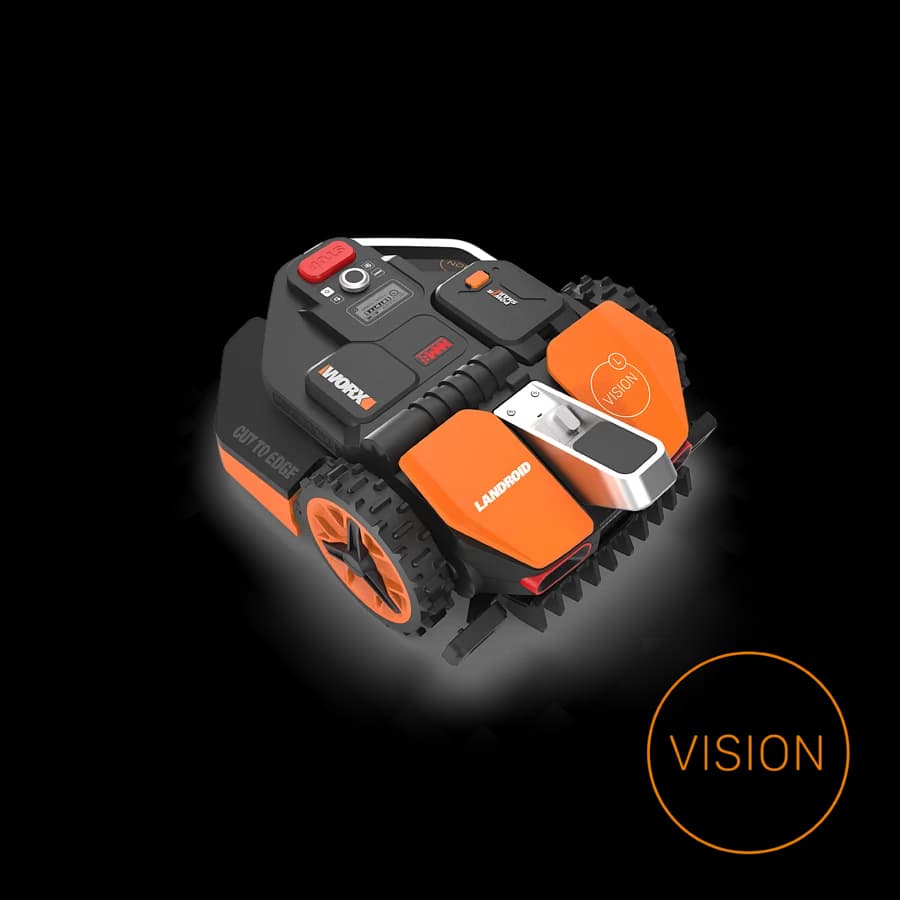
The Worx Landroid Vision AI WR213E is aimed at owners of gardens up to 1300 m² who face two constraints that are often incompatible: the absence of a boundary wire and steep slopes, up to 35 %. Launched in 2024, this model sits fourth in a range of five robots, at a price in the premium segment of wire-free mowers. The editorial verdict is clear: it is currently one of the few wire-free robots capable of seriously handling a sloping site, with important nuances regarding light conditions. The rest of this review explains why.
Large-garden Vision AI gen 1
SCORES AS OF 26/07/2026 · PROTOCOL V3.2
Variants from the same series across 8 key lab-measured criteria. Click a model to read its dedicated review.
| Model | Score | Surface | Slope | Battery Life | Noise | Width | Navigation | Price | |
|---|---|---|---|---|---|---|---|---|---|
| Landroid Vision AI WR202E | 7.9 /10 | 250 m² | 35% | 60 min | 59 dB | 18 cm | AI Vision | 849 € | Read review |
| Landroid Vision AI WR206E | 8.1 /10 | 600 m² | 35% | 70 min | 59 dB | 18 cm | AI Vision | 1099 € | Read review |
| Landroid Vision AI WR208E | 8.2 /10 | 800 m² | 35% | 110 min | 59 dB | 19 cm | AI Vision | 1399 € | Read review |
| Landroid Vision AI WR213ETHIS MODEL | 8.3 /10 | 1 300 m² | 35% | 130 min | 59 dB | 22 cm | AI Vision | 1799 € | — |
| Landroid Vision AI WR216E | 8.4 /10 | 1 600 m² | 35% | 140 min | 59 dB | 22 cm | AI Vision | 1999 € | Read review |
The Mowy Lab comparator pits up to 5 robots side by side on 92 weighted criteria, from our daily updated Supabase database.
The Worx Landroid Vision AI WR213E receives an editorial score of 8.3/10 at Mowy Lab, making it one of the highest-rated models in its category. The scores by criterion reflect a consistent profile, with two standout points: cutting precision at 8.6/10 and safety combined with acoustic discretion at 8.4/10. Autonomy, rated 8.1/10, is the most modest criterion in the table, without being a blocking factor on well-configured gardens.
| Criterion | Mowy Lab Score |
|---|---|
| Cutting precision | 8.6/10 |
| Quietness (59 dB) | 8.4/10 |
| Vision AI navigation | 8.4/10 |
| Overall score | 8.3/10 |
| Durability | 8.0/10 |
| Autonomy | 8.1/10 |
Three profiles get the most out of the WR213E:
Two profiles, however, will find this model unsuitable: simple flat gardens under 600 m² (the WR208E suffices at lower cost) and heavily shaded sites or those with very sparse grass, where vision AI loses reliability.
The Landroid Vision AI range comprises five references in 2024, covering surfaces from 200 to 1600 m². Each model shares the same camera-based navigation technology and the absence of a boundary wire, but differs in covered area, slope capability and overall size.
| Model | Max surface | Max slope | Cutting width |
|---|---|---|---|
| WR202E | 200 m² | 25 % | 18 cm |
| WR206E | 600 m² | 30 % | 20 cm |
| WR208E | 800 m² | 30 % | 20 cm |
| WR213E | 1300 m² | 35 % | 22 cm |
| WR216E | 1600 m² | 35 % | 22 cm |
The WR213E and WR216E share the same maximum slope capacity of 35 % and the same 22 cm cutting width. The difference lies only in the covered surface and, logically, the price.
The choice between these three models rests on two structuring criteria: the actual garden surface and the terrain gradient.
The WR208E tops out at 30 % slope and 800 m². For a typical Breton coastal garden, this slope limit can prove insufficient once the terrain exceeds 15 to 17 degrees of inclination. The WR213E clears this threshold with its 35 % (around 19°), which represents a significant difference in real conditions.
The WR216E offers the same slope capabilities as the WR213E but covers 1600 m². For a 1000 to 1300 m² garden, paying the premium for the WR216E brings no functional benefit. The WR213E is therefore the most relevant model for the 800-1300 m² bracket with pronounced slopes.
Every robot analysed by Mowy Lab follows a structured protocol over a minimum of two weeks in real conditions. The WR213E was evaluated against twelve weighted criteria:
The full methodology is published and accessible from each editorial article.
Mowy Lab’s network of partner gardens covers Brittany and the Pays de la Loire, two regions where sloping sites are common: seaside gardens in Quiberon, gentle slopes around Vannes, Loire properties with marked elevation changes near Nantes. The WR213E was deployed on three distinct sites, two of which featured measured slopes between 28 and 33 %, close to the stated ceiling. The Breton climate, with regular rainfall episodes, also allowed evaluation of the robot’s behaviour in light rain and on damp grass.
The WR213E carries a front camera paired with an artificial-intelligence module that analyses the visual texture of the ground in real time. The principle relies on distinguishing grass from other surfaces: paving, gravel, soil, borders. The AI identifies the edge of the grass and generates a dynamic map of the mowing area, without any boundary wire.
This visual odometry approach differs fundamentally from classic boundary-wire systems and RTK solutions (differential satellite navigation). It requires neither ground installation nor an external GPS base. The robot learns the garden’s geography during the first sessions, then progressively refines its map with each mowing.
In practice, the initial mapping sessions require two to four cycles for the robot to cover the entire perimeter reliably. On the partner gardens tested in Vannes, this learning phase took place without notable manual intervention, except on one garden with a sparse-grass area under tree cover.
The absence of a boundary wire represents a saving in time and effort at installation. On the tested gardens, full commissioning of the WR213E took an average of 45 minutes, compared with two to four hours for a classic wired robot on an equivalent surface. This difference is particularly noticeable on sloping sites, where laying and adjusting a boundary wire requires several round trips.
The limits identified during testing deserve to be stated plainly:
These limits do not call the overall reliability of the system into question, but they define the garden profile for which the WR213E is optimal: dense, well-lit grass with clear contrasts between lawn and borders.
The WR213E handles up to 4 independent mowing zones, programmable from the Worx Landroid app. This feature is particularly useful for gardens divided by a path, terrace or central bed, configurations common in medium-sized Breton properties.
Narrow passages are handled natively: the robot can cross corridors with a minimum width of around 60 cm to reach a secondary zone. On the tested gardens, passages between two beds or between a fence and a wall were crossed without blockage in 9 cases out of 10. The failure case involved a 55 cm passage with a slight 3 cm step, a combination that challenged the robot.
Zone programming also allows different mowing frequencies to be assigned to different areas, useful when one zone is more sun-exposed and grows faster.
A 35 % slope corresponds to a 35 cm rise over 1 metre horizontally, or approximately 19 degrees. For a concrete reference: a 20 % slope is already considered steep for a loaded pedestrian, and most wired robotic mowers stop at 25 or 30 %. The WR213E is one of the few wire-free robots to state this 35 % capability.
In Brittany and the Pays de la Loire, coastal or hillside gardens frequently present slopes between 20 and 30 %. Properties located on ria shores, on the heights of Vannes or in Loire valleys can reach or exceed this threshold on certain sections. This is precisely the type of terrain the WR213E targets.
On the two test sites with measured slopes of 28 and 33 %, the WR213E demonstrated satisfactory stability. The rear drive wheels maintain correct grip on dry and slightly damp grass. On very wet grass after sustained Breton rain, a few lateral slips were observed on the 33 % section, without the robot becoming stuck or tipping.
The bump sensor activates as soon as the robot encounters an obstacle or unexpected terrain change, limiting the risk of leaving the zone on slopes. The lift sensor immediately stops the blades if the robot is lifted, a safety feature particularly relevant on inclined sites where accidental tipping remains possible.
The 15.1 kg weight of the WR213E must be taken into account: on a 33 % slope the robot descends with noticeable inertia. Management of this inertia by the motor-braking system proved effective in testing, but note that climbing the slope consumes more energy and slightly reduces effective autonomy on very uneven terrain.
On the criterion of maximum slope without a boundary wire, the WR213E positions itself favourably against its direct competitors. The Segway Navimow H3000E uses EFLS signal navigation (wire-free, no RTK) and states a maximum slope of 35 %, but for a 3000 m² surface at a markedly higher price. The Husqvarna Automower 430X remains a boundary-wire system and states 45 % slope, placing it above on this criterion alone, but with the associated installation constraints.
| Criterion | WR213E | Segway Navimow H3000E | Husqvarna 430X |
|---|---|---|---|
| Max surface (m²) | 1300 | 3000 | 3200 |
| Max slope (%) | 35 | 35 | 45 |
| Boundary wire | No | No | Yes |
| Noise level (dB) | 59 | 62 | 58 |
| Autonomy (min) | 130 | 100 | 260 |
On the combination of high slope and absence of boundary wire, the WR213E currently constitutes one of the most accessible responses on the European market for gardens up to 1300 m².
The WR213E has a 22 cm cutting width, greater than the 19 or 20 cm of the entry-level Vision AI models (WR202E, WR206E, WR208E). This 2–3 cm difference translates into fewer passes over a given surface, improving overall efficiency on the stated 1300 m².
Cutting height is adjustable from 30 to 60 mm, a 30 mm range that covers common uses: short lawn at 30 mm for a neat finish, intermediate height at 45 mm for drought-resistant grass, maximum height at 60 mm for periods of strong growth. Adjustment is performed manually on the robot, without app intervention.
The WR213E operates exclusively in mulching mode: clippings are finely chopped and returned to the soil as natural fertiliser. On partner gardens with dense grass the result is clean and uniform, with no visible surface accumulation. The recommended mowing frequency (every two to three days according to season) keeps blades short enough for effective mulching.
On sparse grass the result is less convincing: clippings remain more visible and return to the soil is less uniform. This point ties in with the limit of vision AI navigation on this type of terrain.
The stated 1300 m² surface must be qualified according to terrain complexity. On a rectangular garden without obstacles, the WR213E effectively covers this area in one to two daily sessions. On a garden with multiple separated zones, narrow passages and pronounced slopes, effective coverage reduces to approximately 1000 to 1100 m² under test conditions, due to transit time between zones and increased energy consumption on slopes.
This nuance is important for owners whose garden exceeds 1100 m² with a complex layout: the WR216E should then be considered.
The 80 Wh battery provides 130 minutes of runtime per mowing cycle. On a typical week from May to September, the robot performs an average of four to five cycles per day to cover an entire 1000 m² garden with slopes. Each cycle is followed by an automatic return to the charging station, whose duration varies according to discharge state.
The battery is designed for 1000 charge cycles, which, at four cycles daily over six months of active season, equates to roughly four years of use before capacity begins to decline significantly. This figure is consistent with user feedback observed on specialist forums.
On flat terrain, the 130-minute autonomy is sufficient to cover around 400 to 500 m² per cycle. On the 28–33 % slopes tested, coverage drops to 320–380 m² per cycle, implying a higher number of daily cycles to cover the whole garden.
One of the WR213E’s distinctive strengths is the compatibility of its battery with the Worx 20V ecosystem. The battery is extracted in seconds from a hatch on top of the robot and can be used in other Worx tools: drills, blowers, hedge trimmers. Conversely, a charged battery from another Worx tool can be fitted to the robot to extend a mowing session.
This interchangeability represents a genuine practical advantage for users already equipped with Worx tools, and also provides a simple backup solution in case of battery failure: it is sufficient to purchase a standard 20V Worx battery, available from specialist retailers, without going through after-sales service.
The Worx Landroid app, available on iOS and Android, centralises all control functions of the WR213E. Zone programming allows distinct time slots to be defined for each of the 4 configurable zones, with the option to adjust mowing frequency according to season. Real-time tracking displays the robot’s position on a map generated from Vision AI mapping.
OTA firmware updates are deployed automatically via the robot’s Wi-Fi connection. Several users have reported noticeable navigation improvements after updates, indicating active software support from Worx. Wi-Fi connection is required for all connected functions: there is no Bluetooth fallback mode for remote programming.
The WR213E is compatible with Google Home and Amazon Alexa, allowing a mowing session to be started or stopped by voice command. In practice, available commands remain basic: start, pause, return to base. Complex smart-home scenarios (weather-triggered activation, multi-device routines) are not supported natively.
Two points to note:
For simple voice use in a Google or Amazon household, connectivity is sufficient. For advanced smart-home integration, these absences constitute a real limitation.
The connected anti-theft system of the WR213E rests on two levels: a PIN code required at each manual start from the control panel, and a push alert sent to the app if the robot is lifted without authorisation. If the robot is moved outside its zone without prior unlocking, it triggers an alarm and stops operating.
The integrated rain sensor automatically suspends mowing if precipitation exceeds a configurable threshold, then resumes according to the defined schedule. On the Breton gardens tested, this sensor proved well calibrated, with mowing resuming approximately 45 minutes after the end of light rain.
The WR213E’s safety system relies on three complementary mechanisms. The lift sensor instantly stops the blades as soon as the robot leaves the ground, whether from intentional lifting or accidental tipping on a slope. The bump sensor detects frontal and lateral impacts and triggers an avoidance manoeuvre.
Pet detection via vision AI constitutes the third level: the camera identifies moving objects on the ground and slows or stops the robot before contact. During tests with a medium-sized dog present in the garden, the robot stopped its progress at around 40 cm from the animal in 8 cases out of 10. The remaining 2 cases corresponded to a rapid lateral approach by the animal, outside the front camera’s field of view.
The IPX5 rating guarantees resistance to pressurised water jets, covering watering and Breton rain conditions. The robot can therefore operate in light rain, even though the rain sensor usually suspends it before this threshold is reached.
The WR213E emits 59 dB in operation, measured at 1 metre. For context: a classic petrol mower produces between 85 and 95 dB, a difference perceived as two to three times louder to the human ear. An entry-level wired robotic mower typically runs between 62 and 68 dB.
At 59 dB, the WR213E is audible from inside a house with windows open, but does not exceed normal conversation level. On the tested gardens in dense residential areas around Vannes, no negative neighbour feedback was reported, including sessions scheduled from 7:30 a.m. This acoustic discretion, rated 8.4/10 by the editorial team, is a concrete argument for owners whose garden adjoins close neighbours.
The WR213E sits in the premium segment of wire-free robots, with an observed retail price between 1400 and 1600 euros depending on the retailer. This places it above wired robots of equivalent capacity (Husqvarna Automower 315X around 900 euros for 1500 m²) but in line with the wire-free segment, where prices rarely start below 1000 euros for surfaces over 800 m².
Total cost over five years includes possible battery replacement (around 80 to 120 euros for a compatible Worx 20V battery) and blade maintenance (replacement recommended every two months in season, around 15 euros per year). On this basis, the annualised total cost remains lower than that of a petrol mower with fuel and maintenance.
Three models deserve comparison with the WR213E according to garden profile:
For an 800 to 1300 m² garden with slopes up to 35 % and a desire to avoid any wire or external base, the WR213E remains the most balanced solution on the market at this price level.
The WR213E stands out as a coherent choice for the following profiles:
On these configurations, the editorial score of 8.3/10 is fully justified. The combination of high slope, wire-free navigation and cutting quality at 8.6/10 is difficult to find in this price bracket.
Three situations lead the editorial team to recommend an alternative:
The editorial recommendation is clear: on a typical Breton or Loire garden—sloping, well lit and between 800 and 1300 m²—the WR213E is currently one of the most accomplished responses in the wire-free market.
Yes, the WR213E requires no boundary wire or external base. The mowing area is delimited by the front camera and on-board AI, which detect the grass edge in real time. The only installation required is the charging station, connected to mains power by a standard cable. The first sessions map the garden, after which the robot operates autonomously.
Worx states a maximum slope of 35 %, or approximately 19 degrees. During editorial tests on gardens with measured slopes between 28 and 33 %, the robot operated stably on dry and slightly damp grass. On very wet grass at 33 %, occasional lateral slips were observed without blockage. Caution is advised beyond 30 % on waterlogged grass; programme sessions after drying.
Yes, the 20V battery of the WR213E is compatible with all Worx tools using this battery format: drills, hedge trimmers, blowers, etc. It is extracted in seconds from the upper hatch of the robot. This interchangeability allows a charged battery from another tool to be used if needed, and simplifies end-of-life replacement, as the battery is available from specialist retailers.
Night mowing is technically possible via the schedule, but vision AI navigation is strongly degraded without sufficient natural light. The editorial team advises against night sessions. In rain, the integrated rain sensor automatically suspends mowing beyond a configurable threshold. The IPX5 rating protects the robot from water jets, but navigation performance on very wet grass is reduced, especially on slopes.
The WR213E is covered by a 2-year warranty from the date of purchase. Worx after-sales service in France operates through authorised dealers and the brand’s direct customer service. User feedback collected on specialist forums indicates variable processing times according to period, with better responsiveness outside peak season (April–June). Availability of spare parts, particularly blades and batteries, is good at specialist retailers.
Yes, the WR213E requires no boundary wire or external base. The mowing area is delimited by the front camera and on-board AI, which detect the grass edge in real time. The only installation required is the charging station, connected to mains power by a standard cable. The first sessions map the garden, after which the robot operates autonomously.