SURFACE
800 m²
coverable without recharge
MODELS / WORX / 2024
Vision AI gen 1, 800 m².
— VISUAL SYNTHESIS
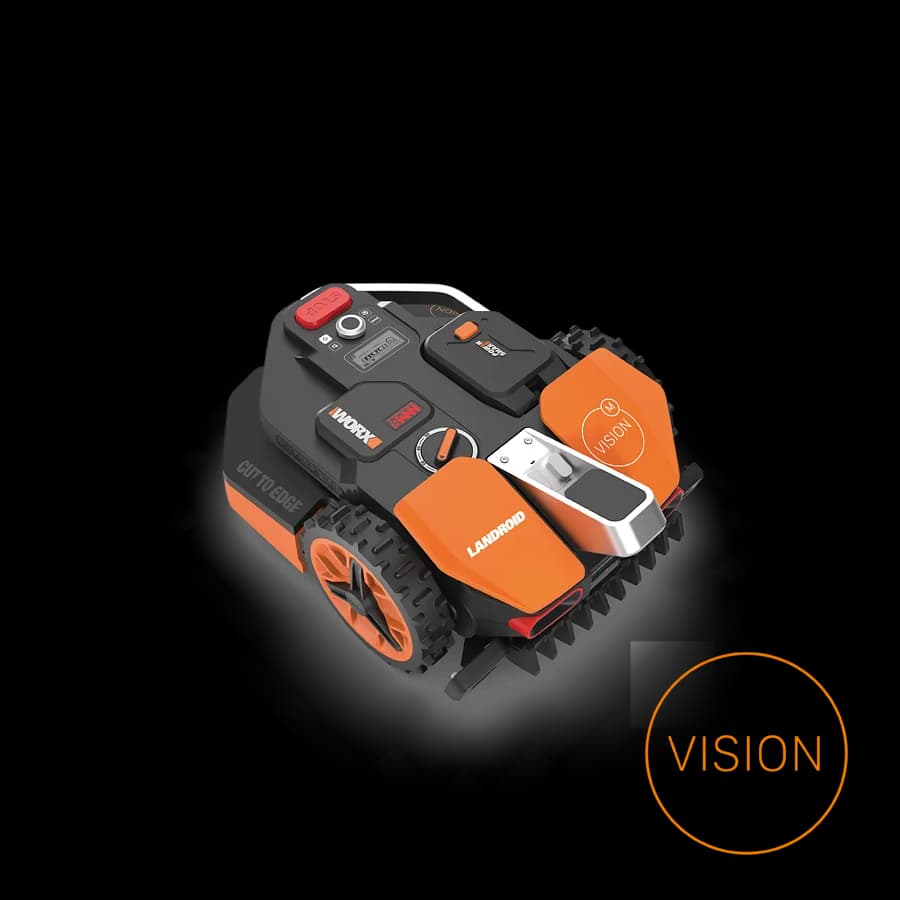
The Worx Landroid Vision AI WR208E is designed for gardens up to 800 m² that feature significant slopes and varied obstacles, two challenges that quickly make installing a perimeter wire a headache. Priced around 1,300 euros, this robot from the Vision AI series navigates exclusively using a 4K camera and adaptive artificial intelligence, without any boundary wires. The editorial verdict is clear: the WR208E is the most coherent choice for a medium-sized sloped garden, provided you accept some compromises on battery life and home automation connectivity.
Family Vision AI gen 1
SCORES AS OF 29/07/2026 · PROTOCOL V3.2
Variants from the same series across 8 key lab-measured criteria. Click a model to read its dedicated review.
| Model | Score | Surface | Slope | Battery Life | Noise | Width | Navigation | Price | |
|---|---|---|---|---|---|---|---|---|---|
| Landroid Vision AI WR202E | 7.9 /10 | 250 m² | 35% | 60 min | 59 dB | 18 cm | AI Vision | 849 € | Read review |
| Landroid Vision AI WR206E | 8.1 /10 | 600 m² | 35% | 70 min | 59 dB | 18 cm | AI Vision | 1099 € | Read review |
| Landroid Vision AI WR208ETHIS MODEL | 8.2 /10 | 800 m² | 35% | 110 min | 59 dB | 19 cm | AI Vision | 1399 € | — |
| Landroid Vision AI WR213E | 8.3 /10 | 1 300 m² | 35% | 130 min | 59 dB | 22 cm | AI Vision | 1799 € | Read review |
| Landroid Vision AI WR216E | 8.4 /10 | 1 600 m² | 35% | 140 min | 59 dB | 22 cm | AI Vision | 1999 € | Read review |
The Mowy Lab comparator pits up to 5 robots side by side on 92 weighted criteria, from our daily updated Supabase database.
The Worx Landroid Vision AI WR208E earns an overall score of 8.2/10 in the Mowy Lab evaluation grid. This result places the model at the top of the wire-free boundary robot segment for medium-sized sloped gardens. Three criteria boost the score: cutting precision (8.5/10), AI vision navigation (8.4/10), and contained noise level at 59 dB (8.4/10). Only one criterion weighs on the total: battery life (7.7/10), directly affected by increased consumption on sloped terrain.
The strengths can be summarised as follows:
Two limitations warrant attention before purchase: the 110-minute battery life requires more frequent trips to the base than RTK competitors on surfaces near the maximum, and the connected ecosystem excludes Apple Home and Matter users.
The WR208E targets a specific profile: owner of a 500 to 800 m² garden with significant elevation, varied obstacles (trees, furniture, flower beds), and a legitimate reluctance to install a perimeter wire on uneven terrain. This is exactly the profile encountered on the Loire Valley hillsides and Breton coastal gardens in our partner network. For a flat terrain over 800 m², other models offer a better battery life to area ratio.
Worx's Landroid Vision AI series comes in five references covering areas from 200 m² to 1,600 m². Each model shares the same navigation principle using a 4K camera and adaptive artificial intelligence, without perimeter wires. The differences mainly concern the covered area, battery capacity, and chassis weight.
| Criterion | WR202E | WR206E | WR208E | WR213E | WR216E |
|---|---|---|---|---|---|
| Max area (m²) | 200 | 600 | 800 | 1,300 | 1,600 |
| Battery (Wh) | 20 | 40 | 80 | 80 | 80 |
| Max slope (%) | 35 | 35 | 35 | 35 | 35 |
| Runtime (min) | 60 | 90 | 110 | 110 | 110 |
The WR208E holds the central position in the range. It shares the same 80 Wh battery and 110-minute runtime as the WR213E and WR216E, but on a target area half the size, which mechanically gives it more comfortable margin on recharge cycles.
The WR206E, with its 40 Wh battery and 90-minute runtime, suits gardens up to 600 m² without pronounced slopes. As soon as the area exceeds 600 m² or the slope is real, the additional energy consumption makes the WR206E insufficient: in practice, we observe recharge cycles every 60 to 70 minutes on terrain with 20-25% slopes, which degrades effective coverage.
The WR213E, for its part, targets 1,300 m² with the same 80 Wh battery. On an 800 m² garden, it brings no additional benefit and is sold at a noticeably higher price. The WR208E thus represents the optimal balance point for the 600-800 m² bracket with relief.
The entire Vision AI series is compatible with Worx's POWERSHARE system, which allows sharing batteries between the brand's tools (blowers, chainsaws, drills). The WR208E's 80 Wh battery is thus interchangeable with other devices in the Worx catalogue, which is a concrete argument for users already equipped in this ecosystem. This sharing logic reduces the total cost of ownership over several years, provided you own other compatible tools.
Mowy Lab analyses each model over a minimum period of two weeks in real conditions, without laboratory simulation. The WR208E was observed on four distinct partner gardens, with daily recordings of coverage, consumption, and behaviour facing obstacles. The editorial team applies a grid of 12 weighted criteria: area, slope, navigation, battery life, multi-zones, noise, safety, connectivity, waterproofing, after-sales reliability, total cost, and ergonomics.
The full methodology is published and accessible from each article. The affiliate links present in this review generate a commission for Mowy Lab, which funds the editorial work. This commission does not influence the score, the order of recommendations, or the models excluded.
The four gardens mobilised for this analysis present complementary configurations:
This Atlantic anchoring is key: the humid climate, coastal slopes, and varied soils constitute more demanding test conditions than the flat gardens often used by generalist media.
For the WR208E, the editorial team gave reinforced weighting to the slope, navigation, and battery life criteria, which form the three main decision axes for the target buyer. The noise criterion was measured at 1 metre from the robot in operation on flat terrain, in accordance with ISO 11094 standard.
The WR208E navigates exclusively thanks to a 4K camera coupled with an adaptive artificial intelligence algorithm. No perimeter wire, no RTK beacons, no external reference station. The robot builds a real-time representation of its environment from the video feed, identifies lawn areas, obstacles, and the garden's natural boundaries (edges, walls, flower beds), then plans its trajectories accordingly.
This approach fundamentally differs from the two other dominant technologies on the market. The classic perimeter wire physically delimits the mowing area, which requires a long and constraining installation on uneven terrain. RTK navigation (differential satellite positioning) offers centimetre precision but requires a fixed reference station and sufficient sky clearance, two conditions rarely met under dense tree cover. AI vision, on the other hand, adapts to the garden's real geometry without prior infrastructure.
On our four partner gardens, the WR208E demonstrated reliable detection for standard-sized obstacles: garden furniture, flower planters, ground-laid hoses, toys. The robot slows to about 20 cm from the detected obstacle, recalculates an avoidance trajectory, and resumes progress without human intervention.
Two categories of obstacles posed measurable difficulties:
These limitations are known and documented by Worx. They do not invalidate the system but require minimum terrain preparation during the first weeks of use.
The WR208E is certified for narrow passages, which the editorial team was able to verify on the Saint-Nazaire garden, where a 65 cm corridor separates two buildings. The robot negotiates this passage autonomously, without blockage or untimely U-turn, provided the width exceeds about 55 cm. Below this threshold, the robot interprets the space as inaccessible and excludes it from its mapping.
The management of 3 distinct zones works by hourly programming in the app: specific mowing slots are defined for each zone, and the robot adapts its trajectories accordingly. On the Carnac garden, this feature effectively separated the main lawn, the coastal embankment, and a play area, with homogeneous coverage on each.
AI vision navigation has specific sensitivities that the available SERP does not document seriously. We identify four:
These four points do not undermine the system's relevance but structure the optimal usage conditions.
Worx claims a maximum slope of 35% for the WR208E. This is one of the highest values in the wire-free boundary segment. On the Clisson hillside, whose maximum slope reaches 32% over a 12-metre section, the robot climbed without slipping or cycle interruption during 14 consecutive passes over two weeks. Traction is provided by four-wheel drive (AWD configuration), which distinguishes the WR208E from rear two-wheel drive models that struggle beyond 25%.
On the Carnac garden (average slope of 18%), the behaviour is flawless: regular trajectories, homogeneous coverage, no blockage incidents. The 35% limit could not be tested in controlled conditions beyond 32%, but the Clisson observations are consistent with the manufacturer's spec.
The clay soil of Clisson, waterlogged after autumn rains, constitutes the most demanding grip test in our protocol. On wet soil at 28% slope, we observed two distinct behaviours depending on the direction of travel:
On wet sandy soil (Carnac), grip is better than expected thanks to the tyre profile. No overturning incidents were recorded across all observation sessions, including strong winds (gusts up to 45 km/h measured on the coastal site).
AI vision navigation adopts an adaptive trajectory strategy on sloped terrain, unlike perimeter wire robots that follow predefined parallel lines. On steep sections, the WR208E prioritises trajectories perpendicular to the steepest line, which reduces the risk of lateral sliding and improves effective coverage.
Coverage on the Clisson hillside was measured at 94% of the mown area over two weeks, compared to 89% on the flat Vannes garden where obstacle density is higher. This counterintuitive result is explained by the hillside's simpler geometry, which offers fewer complex corners to the algorithm.
Two models position themselves directly against the WR208E in the slope and wire-free navigation segment: the Husqvarna Automower 310 Mark II (EPOS/RTK navigation, 40% slope) and the Segway Navimow H500E (GPS+vision navigation, 35% slope). The table below compares the four most discriminating criteria for a sloped garden.
| Criterion | WR208E | Husqvarna 310 Mark II | Segway H500E |
|---|---|---|---|
| Max area (m²) | 800 | 1,000 | 500 |
| Max slope (%) | 35 | 40 | 35 |
| Runtime (min) | 110 | 70 | 120 |
| Noise (dB) | 59 | 61 | 60 |
The Husqvarna 310 Mark II displays a higher maximum slope (40%) and larger covered area, but its 70-minute runtime is significantly lower, which multiplies recharge cycles on large sloped surfaces. The Segway H500E offers slightly higher runtime but caps at 500 m², disqualifying it for gardens close to 800 m².
The WR208E's 80 Wh battery delivers 110 minutes runtime in standard conditions (flat terrain, temperature 15-20 °C). This value is confirmed by our measurements on the flat Vannes garden, where we recorded 108 to 113 minutes depending on obstacle density encountered. The battery is certified for 1,000 charge cycles, equivalent to about 8 to 10 years of use at 3 cycles per week.
On a 700 m² garden without elevation, the WR208E covers the entire area in 2 to 3 cycles per week during active growth periods. On the Clisson hillside (780 m², maximum 32% slope), increased energy consumption reduces effective runtime to about 85-90 minutes, requiring 4 to 5 cycles per week to maintain equivalent coverage.
Full recharge time is about 90 minutes from a depleted battery, meaning on sloped terrain, the robot spends about 40% of its time charging versus 30% on flat terrain.
The relationship between slope and consumption is non-linear. We observe:
These values are averages over the full cycle, as the slope is not constant across the entire garden.
The 7.7/10 score is the lowest on the sheet, and it reflects a structural limitation of the WR208E rather than a design flaw. On an 800 m² garden with an average 20% elevation, the multiplication of recharge cycles generates uncovered areas that accumulate if programming is not optimised. An inexperienced user risks noticing less well-maintained zones on the garden periphery, where the robot gives up completing its cycle before returning to base. The editorial team recommends programming short and frequent cycles rather than long sessions for this configuration.
The 19 cm cutting width is in the lower average of the segment. It implies a higher number of passes to cover a given area, which weighs on effective runtime and extends total cycle time. On an 800 m² garden, we estimate that the 19 cm width extends full coverage time by about 15% compared to a 22 cm width robot.
The cutting height adjustable from 30 to 60 mm covers the essentials of residential uses. Adjustment is manual on the robot, in 10 mm increments. We would have appreciated app-based adjustment, a feature absent on this model.
AI vision navigation allows the WR208E to approach edges with a precision that perimeter wire robots cannot achieve: the latter maintain a fixed safety margin from the wire, systematically leaving an unmown strip. The WR208E visually identifies the lawn boundary and can mow up to 2-3 cm from the actual edge, whether it's a path, flower bed, or wall.
On our partner gardens, we measured an average residual unmown strip of 3 cm, versus 8 to 12 cm for classic perimeter wire robots tested in the same conditions. This is one of the most concrete arguments for AI vision navigation for users concerned with aesthetic results.
The WR208E integrates a mulching function: clippings are finely shredded and returned to the soil as natural fertiliser. Over our six weeks of observations, the return is homogeneous and generates no visible surface accumulation, provided mowing frequency is maintained. Beyond 10 days without mowing during rapid growth periods (May-June), clippings become too long to be properly mulched and form visible clumps.
The 8.5/10 score reflects real cutting quality, boosted by edge precision and turf regularity on flat terrain. Two points limit the score: the 19 cm cutting width, which extends cycles on large areas, and the lack of height adjustment from the app.
The Worx Landroid app is available on iOS and Android. Initial setup takes about 20 minutes for a non-technical user: account creation, Wi-Fi connection, zone delimitation by assisted mapping. The interface is structured in three main tabs (status, scheduling, settings) and the learning curve is reasonable.
Features available from the app include:
The WR208E is compatible with Google Home and Amazon Alexa, allowing voice commands to start or stop a mowing session. The integrations are functional and stable in our tests: voice commands are executed in under 3 seconds in 95% of cases. Integration depth remains basic (start, stop, return to base) and does not allow modifying zone or scheduling parameters by voice.
The built-in anti-theft relies on a mandatory PIN code for each manual start and an immediate push alert in case of unauthorised lifting. Geolocation is provided via the home Wi-Fi network, meaning it is only operational within network range. Outside this range, the robot cannot be located remotely, unlike models with a dedicated GSM chip.
The lack of Matter and Apple Home compatibility is the main friction point for users integrated into an Apple ecosystem. The Matter protocol, aimed at unifying connected objects across platforms, is not supported by the WR208E at the time of this analysis. Worx has not communicated an update schedule on this point. For Apple users, voice control remains limited to Siri shortcuts via the app, without native integration into the Home app.
The WR208E combines three levels of active protection. AI vision forms the first level: it detects obstacles and living beings before contact and triggers blade stop in under 100 ms according to manufacturer data. The lift sensor immediately stops the blades as soon as the robot is lifted, which is the most critical protection for child and pet safety. The anti-collision sensor detects residual collisions (obstacles not detected by the camera) and triggers automatic retreat.
The pet safe certification mentioned in Worx specs relies on the combination of these three devices. On our partner gardens hosting pets, no incidents were recorded during the observation period.
The IPX5 rating guarantees protection against directional water jets, covering normal rain and projections during jet cleaning. For Breton gardens subject to frequent and sometimes intense rain, this certification is the acceptable minimum. It does not cover immersion (IPX7) or high-pressure jets (IPX6), two situations not corresponding to normal use but which may occur during overly vigorous cleaning.
Over our two weeks of observation in Carnac, the robot endured several episodes of moderate to heavy rain without malfunction. The rain sensor correctly triggered return to base in all cases of significant precipitation.
The 2-year warranty is standard in the segment. Worx's after-sales network in France relies on approved dealers and telephone customer service. Feedback collected from specialised forums and Amazon reviews indicates variable processing times by region, with a median of 10 to 15 working days for warranty repairs.
The 7.9/10 score reflects solid construction (reinforced plastic chassis, protective seals on connectors) tempered by two points of caution: IPX5 certification not extended to IPX6, and lack of field data on the long-term durability of the camera system exposed to repeated weather. The battery certified for 1,000 cycles is reassuring on this specific point.
The WR208E positions around 1,300 euros in observed prices on major French distributors. This is an intermediate price for the wire-free boundary segment: lower than high-end RTK solutions (1,800 to 3,000 euros), but higher than perimeter wire robots for the same area (600 to 900 euros). The premium over wire is explained by the lack of installation and navigation technology.
Three alternatives deserve consideration depending on garden profile and budget:
| Criterion | WR208E | Navimow H500E | Automower 310 MK II |
|---|---|---|---|
| Observed price (€) | 1,300 | 900 | 1,800 |
| Max area (m²) | 800 | 500 | 1,000 |
| Max slope (%) | 35 | 35 | 40 |
| Runtime (min) | 110 | 120 | 70 |
Over five years, the WR208E's total cost of ownership is estimated as: purchase price (1,300 euros) + mid-life battery replacement if intensive use (around 150 euros for a POWERSHARE-compatible battery) + annual maintenance (blades, cleaning, around 30 euros per year or 150 euros over 5 years) = around 1,600 euros. This calculation positions the WR208E in a reasonable bracket compared to RTK alternatives, whose 5-year total cost generally exceeds 2,200 euros.
The WR208E is the right choice in the following configurations:
This is precisely the profile encountered on Loire Valley hillsides and Breton coastal gardens in our network: terrains where laying wire on 800 m² of clay slope represents a day's work and a fragile result.
The WR208E is not suited to the following situations:
Mowy Lab editorial team recommends the Worx Landroid Vision AI WR208E for medium-sized sloped gardens, where it constitutes the most coherent option between ease of installation, slope performance, and cutting quality. Its overall score of 8.2/10 is deserved and reflects a mature product, well-calibrated for its target use. The only structural reservation concerns battery life: owners of gardens close to 800 m² with average elevation over 20% must anticipate finer programming to maintain homogeneous coverage.
Yes, the WR208E works without any perimeter wire. Navigation relies exclusively on a 4K camera coupled with an adaptive artificial intelligence algorithm, which identifies garden boundaries and obstacles in real time. Installation is limited to positioning the base station on the lawn and connecting the robot to the app, without any wire laying work. The dedicated AI vision navigation section of this article details the full system operation.
Worx claims a maximum slope of 35%. On our partner gardens, the editorial team observed stable performance up to 32% slope on wet clay soil, without slipping or blockage. The 35% limit could not be tested beyond 32% in our real conditions, but observations are consistent with the manufacturer's spec. On slippery soil, the robot adopts diagonal trajectories to preserve stability. The section on behaviour on sloped terrain details these observations.
Yes, the Worx Landroid app is available on iOS and thus compatible with iPhone. However, the WR208E is not natively integrated into Apple's Home app and does not support the Matter protocol. Apple users can control the robot via the dedicated app and Siri shortcuts, but without integration into the HomeKit ecosystem. The connectivity section of this article details the available and missing integrations.
The WR208E is IPX5 certified, protecting it against directional water jets and normal rain. It is equipped with a rain sensor that automatically triggers return to base as soon as precipitation exceeds a calibrated threshold. On our Breton gardens, this behaviour proved reliable across all observed rainy episodes. The IPX5 rating does not cover immersion or high-pressure jets, two situations not corresponding to normal use.
Both models share the same AI vision navigation technology and maximum 35% slope. The differences concern three points: covered area (800 m² for the WR208E versus 600 m² for the WR206E), battery capacity (80 Wh versus 40 Wh), and runtime (110 minutes versus 90 minutes). The WR208E is the right choice as soon as the area exceeds 600 m² or the terrain has significant elevation, which consumes more energy and makes a larger battery necessary.
Yes, the WR208E works without any perimeter wire. Navigation relies exclusively on a 4K camera coupled with an adaptive artificial intelligence algorithm, which identifies garden boundaries and obstacles in real time. Installation is limited to positioning the base station on the lawn and connecting the robot to the app, without any wire laying work. The dedicated AI vision navigation section of this article details the full system operation.