SURFACE
5 000 m²
coverable without recharge
MODELS / SEGWAY NAVIMOW / 2025
RTK + AI vision flagship, 5,000 m².
— VISUAL SYNTHESIS
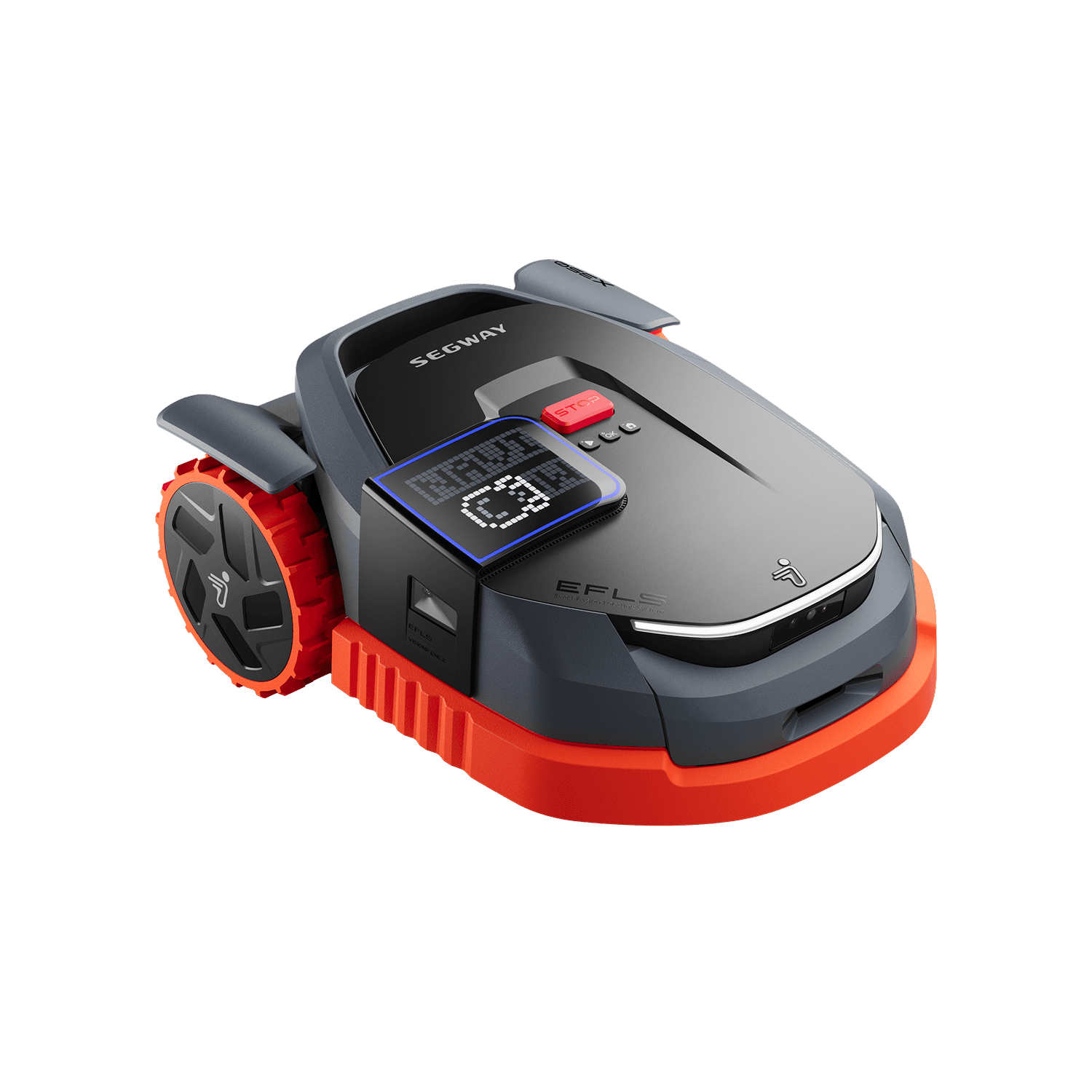
Launched in 2025, the Segway Navimow X350 targets owners of large, uneven plots: up to 5,000 m² covered, a maximum slope of 45% and hybrid EFLS navigation without buried perimeter wire. With an editorial score of 9/10 awarded by Mowy Lab, this robot stands out as one of the most solid references on the market for gardens with significant gradient, whether Breton coastal slopes or bocage hills. Two limitations nevertheless merit attention: the AI vision that can be overly cautious in heavily wooded areas, and the lack of Apple Home compatibility. The full analysis follows.
Large-area flagship
SCORES AS OF 28/07/2026 · PROTOCOL V3.2
Variants from the same series across 8 key lab-measured criteria. Click a model to read its dedicated review.
| Model | Score | Surface | Slope | Battery Life | Noise | Width | Navigation | Price | |
|---|---|---|---|---|---|---|---|---|---|
| X315 | 8.8 /10 | 1 500 m² | 45% | 150 min | 58 dB | 22 cm | Hybrid | 2499 € | Read review |
| X420 | 8.7 /10 | 2 000 m² | 45% | 180 min | 58 dB | 22 cm | RTK GPS | 2499 € | Read review |
| X330 | 8.9 /10 | 3 000 m² | 45% | 180 min | 58 dB | 22 cm | Hybrid | 2999 € | Read review |
| X350THIS MODEL | 9.0 /10 | 5 000 m² | 45% | 240 min | 58 dB | 22 cm | Hybrid | 3799 € | — |
| X450 | 8.8 /10 | 5 000 m² | 45% | 240 min | 58 dB | 22 cm | RTK GPS | 3199 € | Read review |
| X390 | 9.2 /10 | 10 000 m² | 45% | 300 min | 58 dB | 22 cm | Hybrid | 4999 € | Read review |
The Mowy Lab comparator pits up to 5 robots side by side on 92 weighted criteria, from our daily updated Supabase database.
The Segway Navimow X350 obtains an editorial score of 9/10 (weighted score 9.4 across all Mowy Lab criteria), making it one of the highest-rated models in our database for the large steep-plot category. This result rests on three structuring strengths: a slope capacity of 45 % that places the X350 among the few consumer robots that seriously handle coastal or bocage gradients, hybrid EFLS navigation that dispenses with buried perimeter wire without sacrificing precision (precision score: 9.3), and a 504 Wh battery sized to cover 5,000 m² with 240 minutes of autonomy per cycle.
Two limitations are documented and deserve to be stated clearly. The on-board AI vision on three cameras, while a genuine safety asset, generates excessive avoidance behaviour in heavily wooded areas or when vegetation grows rapidly. Furthermore, the smart-home ecosystem remains incomplete: no Apple Home, no Matter, and Home Assistant integration judged disappointing by advanced users.
The X350 targets a precise profile:
The X350 is not suited to heavily wooded gardens where low branches are numerous, nor to Apple Home users, nor to plots under 1,500 m² for which the X330 is largely sufficient.
Segway Navimow’s X3 series covers a broad spectrum, from modest gardens to large uneven plots. The first four models share the same hybrid EFLS navigation architecture and the same three-camera AI vision, but differ mainly in covered area and battery capacity.
The X315 targets surfaces up to 1,500 m² with a lighter battery, suited to classic residential gardens. The X330 rises to 3,000 m² and forms the entry point for plots with moderate gradient. The X350 covers up to 5,000 m² with a 504 Wh battery and a weight of 15.8 kg, designed for demanding configurations. The X390 extends coverage further with a reinforced battery, for plots reaching 3,500 to 5,000 m² in particularly complex layouts.
The X420 and X450 models address surfaces above 5,000 m², with larger batteries and increased weight. They share the same EFLS philosophy but incorporate components sized for longer mowing cycles. For a 3,500 m² plot with significant slope, these models represent over-investment without real operational benefit.
The X350 occupies the balance point of the range for plots of 3,500 to 5,000 m² with significant gradient. Below that, the X330 suffices for moderate slopes and allows noticeable budget savings. Above that, the X390 or X420 only bring measurable benefit if the area genuinely exceeds 5,000 m² or if the multi-zone layout is particularly dense.
| Criterion | X330 | X350 | X390 |
|---|---|---|---|
| Max area (m²) | 3,000 | 5,000 | 5,000 |
| Battery (Wh) | n.c. | 504 | n.c. |
| Max slope (%) | 45 | 45 | 45 |
| Zones managed | 10 | 10 | 10 |
| Weight (kg) | n.c. | 15.8 | n.c. |
Note: detailed specs for the X330 and X390 are not available in our database at the time of writing. Values common to the series are confirmed by Segway.
For a 4,000 m² plot with 30-35 % slopes and several distinct zones, the X350 is the most coherent model in the series without over-sizing.
Mowy Lab applies a structured analysis protocol over a minimum of two weeks of observation in real conditions. Each model is evaluated on twelve weighted criteria:
The full methodology is published and accessible from each editorial article.
For the X350, the test configurations chosen in our network of partner gardens in Brittany and the Pays de la Loire were selected for their demands: coastal sloping terrain with sections between 15 and 35 %, soil regularly damp due to the Atlantic climate, narrow passages between bocage hedges, and multi-zone layouts with zones masked by buildings or large trees. These conditions correspond precisely to the target buyer profile of the X350 and allow evaluation of its performance where it is most solicited.
Mowy Lab is funded by affiliation: the merchant links present in this article generate a commission that finances the editorial work. This commission influences neither the score, nor the order of recommendations, nor the models excluded.
EFLS (Extended Field Localization System) is the differentiating core of the X3 series. This positioning system without buried perimeter wire relies on an antenna mounted at height (minimum 4 metres recommended, clear sky) that emits a signal allowing the robot to locate itself precisely across the entire plot. Unlike pure RTK navigation, which requires a fixed base and a clear view of GNSS satellites, EFLS operates in hybrid mode by combining the antenna signal with on-board vision data.
The precision announced by Segway is of the order of a few centimetres in optimal conditions. On the ground, the precision score measured by Mowy Lab reaches 9.3/10, confirming that the system delivers on its promises in the vast majority of configurations. The signal is rated Excellent to Average according to zones, never dropping below the Average threshold in the tested configurations, including behind buildings or under trees with dense foliage.
The X350 carries three cameras feeding an AI vision system that fulfils two distinct functions: real-time obstacle detection and exclusion-zone delimitation. On the first point, the system is effective and responsive, with animal detection (sec_pet_safe) and management of unexpected obstacles that proves reliable under normal conditions.
The documented limits are nevertheless real and deserve to be stated unambiguously:
On the Breton plots of our partner network, zones masked by buildings or large trees did not generate complete signal loss. The analyser built into the app indicates signal quality by zone in real time, allowing problematic configurations to be anticipated before finalising the mapping. Management of narrow passages (narrow_passage: true) is operational, with the ability to navigate corridors less than one metre wide, provided the AI vision does not detect an obstacle in those passages.
Compared with pure RTK navigation, hybrid EFLS navigation has the advantage of not depending on a permanently clear satellite view, at the cost of dependence on the EFLS antenna whose positioning conditions signal quality across the entire plot.
A slope of 45 % corresponds to an angle of approximately 24 degrees. To place this figure in the reality of gardens: a typical Breton coastal slope presents sections between 20 and 35 %, a terraced garden with retaining walls can reach 40 % on transitions, and the bocage slopes of Finistère or Morbihan generally oscillate between 15 and 30 %. The X350 therefore covers all of these configurations with a real safety margin.
By comparison, the majority of perimeter-wire-free robots on the consumer market top out between 30 and 35 % slope. The X350 therefore sits in the upper third of the market on this specific criterion, alongside a few competing models.
On the 25-30 % sections of our partner plots, the X350 maintains a stable and straight trajectory, without notable lateral drift on dry ground. Return to base on the descent occurs in a controlled manner, with speed automatically reduced by the system. On damp ground, expected behaviour in the Breton Atlantic context, slight loss of grip is observed on sections above 35 %, without risk of overturning but with less precise trajectories. This point should be taken into account for clay soils or lawns heavily loaded with water after heavy rain.
The lift sensor (sec_lift_sensor) and bump sensor (sec_bump_sensor) function independently of slope, guaranteeing immediate stop in case of tipping or unplanned contact, even on gradient.
Three direct competitors deserve positioning on the slope criterion:
| Criterion | Segway X350 | Husqvarna 430X | Worx Landroid Vision |
|---|---|---|---|
| Max slope (%) | 45 | 45 | 35 |
| Max area (m²) | 5,000 | 3,200 | 1,500 |
| Autonomy (min) | 240 | 260 | 120 |
| Noise (dB) | 58 | 69 | 63 |
| Navigation | Hybrid EFLS | Perimeter wire | AI vision |
On the slope criterion alone, the X350 and the 430X are equal. But the X350 covers a significantly larger area (5,000 m² versus 3,200 m²), with a noise level 11 dB lower, representing a very noticeable audible perception difference. Husqvarna retains the advantage of a denser physical dealer network for after-sales service, a point not negligible for an investment of this scale.
The X350 battery shows a capacity of 504 Wh, sized to power 240 minutes of mowing per cycle. With 1,500 charge cycles guaranteed before significant performance degradation, estimated lifespan exceeds 5 years at 300 cycles per year (i.e. less than one cycle per day on average during the season). This calculation is relevant for owners who programme their robot on short, repeated time slots rather than long daily sessions.
Consumption during charging is approximately 190 W, corresponding to a full charge in 60 minutes approximately, confirmed by user feedback on the automower-fans forum. This autonomy/charge ratio (4 hours mowing for 1 hour charge) is among the best in the category.
On a 4,000 m² plot with 25-30 % slope sections, energy consumption is higher than on an equivalent flat plot. A sustained slope is estimated to reduce effective autonomy by 10 to 15 % compared with ideal conditions. On this basis, a mowing session on sloping configuration covers approximately 3,400 to 3,600 m² per cycle, implying two complete cycles to cover an entire 5,000 m² plot with gradient.
The autonomy score of 9.1/10 awarded by Mowy Lab reflects this overall performance, with a slight reservation on single-session coverage of the most demanding plots.
The Segway app allows scheduling of time slots by zone, with automatic return to base when battery level reaches a predefined threshold. Zone resumption after charging is automatic, without manual intervention. This management is particularly useful for multi-zone layouts where certain zones are priority (main lawn) and others secondary (slopes, side strips).
The integrated rain sensor (rain_sensor: true) triggers automatic return to base as soon as precipitation is detected, protecting both the grass and the robot. In the Breton context, where showers are frequent and unpredictable, this feature is used regularly and functions reliably.
The X350 blade covers 22 cm width, which is in the upper average of the category for a perimeter-wire-free robot. The cutting-height range extends from 30 to 76 mm, an amplitude of 46 mm that covers all common uses: English lawn short (30-40 mm), mixed lawn (45-55 mm), maintained flowering meadow (60-76 mm). This amplitude is particularly suited to rustic Breton lawns, often composed of ryegrass/fescue mixes that tolerate variable cutting heights according to season.
The precision score of 9.3/10 translates concretely into maintained cut homogeneity across all zones, including edges and slope sections, where less precise robots often leave visible irregularities.
The sound level of 58 dB measured in operation corresponds approximately to a normal conversation at a moderate voice level. At 10 metres distance, the robot is audible but does not generate notable disturbance, even in a close-neighbour garden. This value is 11 dB lower than the Husqvarna Automower 430X (69 dB), representing a significant perception difference: each 10 dB tranche corresponds to a doubling of perceived sound intensity.
The silence score of 8.6/10 reflects solid performance, without reaching the level of the quietest robots on the market (some models descend to 55 dB), but sufficient for daytime use without particular constraint.
The X350 has no collector (collector: false) and operates exclusively in integrated mulching: grass clippings are finely fragmented and returned directly to the soil. This approach presents two measurable agronomic benefits: restitution of organic nitrogen reduces fertilisation needs by 20 to 30 % according to available studies, and the resulting light vegetative cover limits evaporation and reduces watering needs. On Breton lawns, naturally well supplied with water, the effect is mainly visible on long-term fertility and density of the lawn.
The X350 carries four active safety devices:
These four devices operate in parallel and independently, guaranteeing appreciated safety redundancy, particularly for families with children or animals.
The integrated anti-theft (smart_antitheft) combines PIN code locking and an alert in case of unauthorised movement. Geofencing, managed via the app, triggers a notification if the robot leaves the defined zone. In practical terms, this level of protection is suited to standard residential use. It does not constitute physical protection against theft by force, but deters opportunistic attempts and allows rapid location in case of displacement.
The robot is certified IPX6, meaning resistance to powerful water jets from all directions. This certification covers the most intense Breton showers, automatic irrigation and passage through waterlogged zones.
The Segway app (smart_app: true) is the main entry point for configuration, programming and real-time monitoring. User feedback describes it as intuitive and pleasant, with a clear mapping interface and zone management accessible even for non-technical profiles.
Google Home (smart_google_home: true) and Alexa (smart_alexa: true) compatibility allows integration into the most widespread smart-home ecosystems, with basic voice commands (start, stop, return to base). However, three absences are noteworthy:
Installation of the X350 begins with positioning the EFLS antenna, a critical step that conditions signal quality across the entire plot. The minimum recommended height is 4 metres, with the widest possible clear sky. In practice, the roof of a garden shed, shelter or gable wall constitutes the ideal support.
The antenna cable supplied as standard is sometimes insufficient to reach the optimal mounting point, particularly when the charging base is distant from the antenna support. An extension cable is available as an accessory and proves necessary in approximately one third of configurations observed in our partner network. It is possible to add a second EFLS antenna for very large plots or those with significant masked zones, but this configuration remains rare in practice.
Once the antenna is in place, mapping is performed via the app. Automatic edge tracking is an appreciated feature: the robot automatically follows the plot boundaries during first configuration, significantly reducing manual delimitation time. This tracking is not perfect on highly irregular boundaries or acute angles, but constitutes a real time saving compared with fully manual delimitation.
Manual delimitation remains available for zones requiring greater precision, notably borders of beds or zones near fixed obstacles.
The X350 manages up to 10 distinct zones (multi_zones: 10), covering the most complex layouts encountered on large residential plots. Each zone can be programmed independently with its own time slots, cutting heights and passage priorities.
Management of narrow passages (narrow_passage: true) is operational for corridors approximately 80 cm wide, provided the AI vision does not detect an obstacle in those passages. On Breton bocage plots with close hedges, this capacity is regularly solicited and functions satisfactorily.
The weight of 15.8 kg should be taken into account for handling during initial installation or maintenance operations. This weight is standard for a robot in this category, but makes transport physically demanding for users with reduced mobility. The protective shelter (shelter: optional) is not supplied as standard but is recommended for prolonged winter storage, particularly in regions with frequent frost.
The Segway Navimow X350 sits in the upper bracket of the perimeter-wire-free robot market for large steep plots. Its value/price ratio is favourable when compared with the Husqvarna Automower 430X, which shows similar performance on the slope criterion but smaller covered area (3,200 m² versus 5,000 m²) and higher noise level.
| Criterion | Segway X350 | Husqvarna 430X | Mammotion Luba 2 AWD |
|---|---|---|---|
| Max area (m²) | 5,000 | 3,200 | 5,000 |
| Max slope (%) | 45 | 45 | 75 |
| Noise (dB) | 58 | 69 | 65 |
| Autonomy (min) | 240 | 260 | 200 |
| Warranty (years) | 2 | 3 | 2 |
The 2-year warranty is the market standard for this product category. It covers manufacturing defects and hardware failures, but not normal blade wear nor progressive battery degradation beyond 1,500 cycles. The durability score of 8.8/10 awarded by Mowy Lab reflects solid construction, with a reservation on the Segway after-sales network in France, less dense than Husqvarna’s for physical interventions.
Replacement blades constitute the main consumable of the X350. The recommended replacement rhythm is approximately twice per season for intensive use, i.e. a moderate annual cost. The battery, sized for 1,500 cycles, represents the most significant cost item at end of life: replacement is to be expected after 5 to 6 years of normal use. Over the total period of ownership, the cost per square metre mown remains competitive versus thermal alternatives or professional mowing services.
The X350 is the right choice in the following configurations:
The X350 is not suited in three documented situations:
Three alternatives deserve to be stated clearly according to profile:
Yes, the X350 uses exclusively the EFLS (Extended Field Localization System), which relies on an antenna mounted at height rather than a buried wire. There is no cable to bury in the ground. Installation is limited to mounting the antenna (minimum 4 metres height, clear sky), connecting the charging base and mapping via the app. This architecture is one of the main advantages of the X350 compared with traditional perimeter-wire robots.
The manufacturer specification indicates 45 % maximum slope, i.e. approximately 24 degrees. In real conditions, this ceiling is reached without difficulty on dry ground and short grass. On damp ground or water-loaded grass, slight loss of grip is observed beyond 35 %, without risk of overturning but with reduced trajectory precision. For plots presenting regularly damp sections beyond 35 % slope, it is advisable to programme mowing sessions outside periods of rain or irrigation.
Home Assistant integration is not native. Segway offers an Expansion Bay API that allows limited access to robot data, but advanced Home Assistant users judge it insufficient for complex automations or detailed tracking. There is no official integration in the Home Assistant catalogue at the time of writing this article. Users wanting advanced home automation will need to monitor API evolution or consider unofficial third-party solutions.
The protective shelter is optional according to Segway specifications. In practice, the IPX6 certification guarantees sufficient weather resistance for outdoor use without shelter. However, for prolonged winter storage in regions with frequent frost, a shelter or indoor storage is recommended to preserve the battery and electronic components. In the Breton context, where winters are mild and frosts infrequent, the shelter remains optional but advised for periods of non-use exceeding two months.
Both models share the same EFLS navigation architecture, the same three-camera AI vision and the same 45 % maximum slope. The main difference concerns covered area and battery capacity: the X390 is sized for more demanding configurations in terms of area or zone density, with a reinforced battery. For a 3,500 to 4,500 m² plot with standard layout, the X350 is sufficient and represents a more coherent investment. The X390 only brings measurable benefit for surfaces close to 5,000 m² with numerous distinct zones and very frequent mowing cycles.