SURFACE
5 000 m²
coverable without recharge
MODELS / SEGWAY NAVIMOW / 2025
RTK GPS for large lawns, 5,000 m².
— VISUAL SYNTHESIS
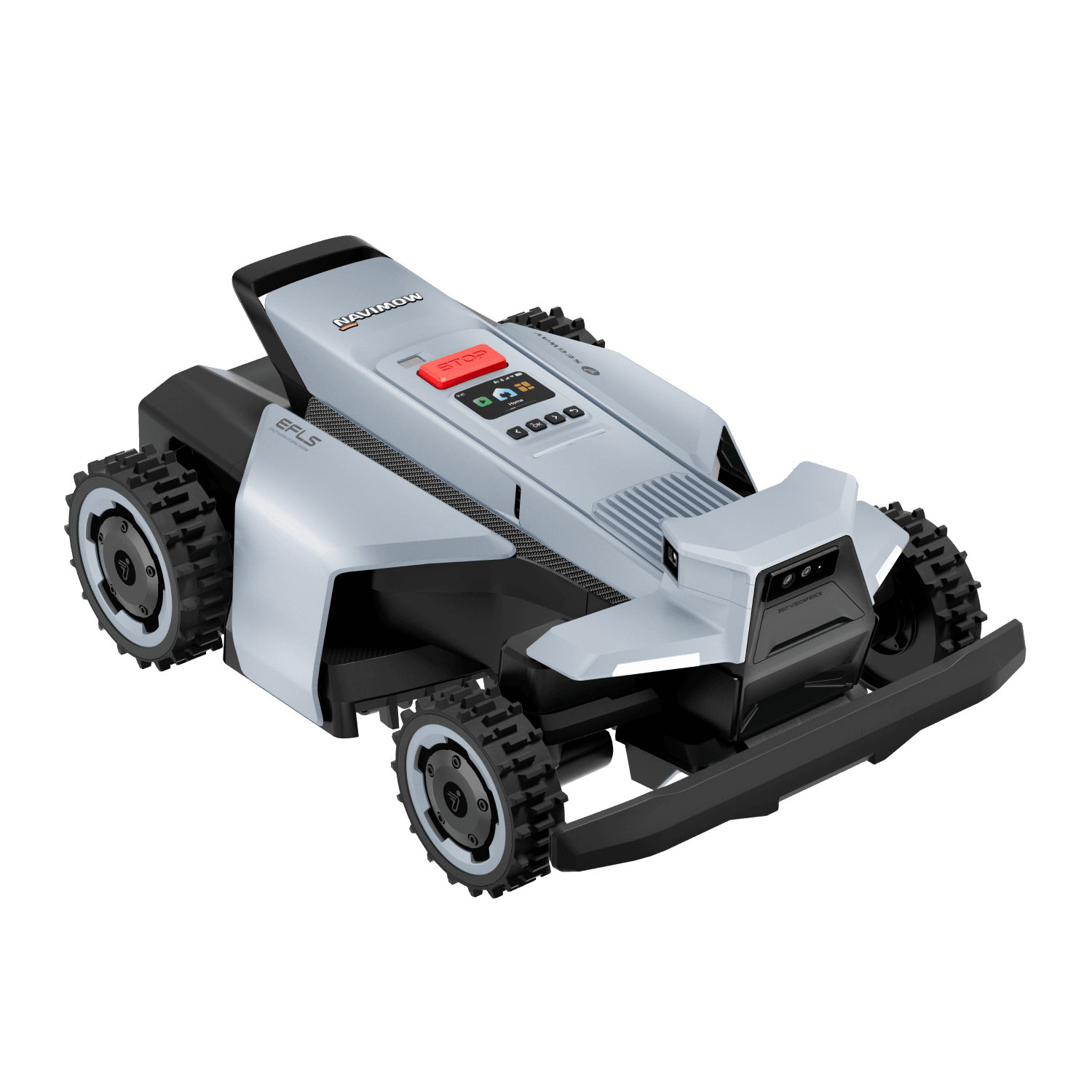
The Segway Navimow X450 is the most ambitious model in the X4 series: designed for areas up to 5 000 m², fitted with all-wheel drive and RTK navigation without a perimeter wire, it specifically targets sloped and fragmented gardens that conventional robots struggle to manage. Priced above 3 000 euros, it represents a significant investment that the editorial team subjected to two weeks of testing on our partner sites in Brittany and the Pays de la Loire. Summary verdict: the X450 delivers on difficult terrain, with two important caveats to consider before purchase.
RTK GPS large lawn
SCORES AS OF 29/07/2026 · PROTOCOL V3.2
Variants from the same series across 8 key lab-measured criteria. Click a model to read its dedicated review.
| Model | Score | Surface | Slope | Battery Life | Noise | Width | Navigation | Price | |
|---|---|---|---|---|---|---|---|---|---|
| X315 | 8.8 /10 | 1 500 m² | 45% | 150 min | 58 dB | 22 cm | Hybrid | 2499 € | Read review |
| X420 | 8.7 /10 | 2 000 m² | 45% | 180 min | 58 dB | 22 cm | RTK GPS | 2499 € | Read review |
| X330 | 8.9 /10 | 3 000 m² | 45% | 180 min | 58 dB | 22 cm | Hybrid | 2999 € | Read review |
| X350 | 9.0 /10 | 5 000 m² | 45% | 240 min | 58 dB | 22 cm | Hybrid | 3799 € | Read review |
| X450THIS MODEL | 8.8 /10 | 5 000 m² | 45% | 240 min | 58 dB | 22 cm | RTK GPS | 3199 € | — |
| X390 | 9.2 /10 | 10 000 m² | 45% | 300 min | 58 dB | 22 cm | Hybrid | 4999 € | Read review |
The Mowy Lab comparator pits up to 5 robots side by side on 92 weighted criteria, from our daily updated Supabase database.
The Segway Navimow X450 receives an editorial score of 8.8/10 at Mowy Lab, making it one of the highest-rated robotic mowers in our database for large sloped areas. This score reflects precise RTK navigation, 4WD traction proven on our partner sites and a 240-minute runtime that exceeds most direct competitors. Two limitations affect the final mark: the absence of visual obstacle detection and a 22 cm cutting width that remains modest for the robot’s size.
The criterion scores break down as follows:
The X450 meets a precise user profile: owner of a garden between 2 000 and 5 000 m² with significant slopes (over 25 %), several separate zones and a requirement for perimeter-wire-free operation. It is the robot to consider first if your garden combines elevation changes, narrow passages and dense grass. Conversely, for a flat, uniform garden under 2 000 m² the X450 is oversized and its price is harder to justify against lower models in the series.
The Segway Navimow X4 series comprises six variants in 2025-2026, which often causes confusion in competing content. The main distinction is not solely the area covered: it also concerns drive type (2WD or 4WD), slope capability and the onboard navigation system.
The table below summarises the data available for the three most compared models:
| Criterion | X390 | X420 | X450 |
|---|---|---|---|
| Maximum area (m²) | 3 000 | 4 000 | 5 000 |
| Maximum slope (%) | 35 | 40 | 45 |
| Drive | 2WD | 4WD | 4WD |
| Battery (Wh) | nd | nd | 360 |
| Runtime (min) | nd | nd | 240 |
| Noise dB(A) | nd | nd | 58 |
nd: data not available in our sources at publication date. The table will be updated once manufacturer confirmation is received.
The X315, X330 and X350 cover areas below 3 000 m² and lack all-wheel drive. They suit smaller, less undulating gardens at a noticeably lower entry price.
The step from the X420 to the X450 is justified by three structural criteria. First, slope capability: the X450 is rated at 45 % versus 40 % for the X420; a 5-point difference that may seem marginal on paper but represents a real difference on the coastal banks frequently found in Breton and Loire gardens. Second, the covered area rises from 4 000 to 5 000 m², justifying the extra cost for large gardens. Finally, the X450’s 240-minute runtime allows it to cover a larger surface per cycle without returning to the base, reducing interruptions on complex plots.
If your garden does not exceed 4 000 m² and slopes remain below 35 %, the X420 is a serious alternative at a lower price. The X450 is only fully justified beyond these thresholds.
Every robot reviewed by Mowy Lab undergoes a minimum protocol of two weeks of continuous operation on our partner sites. The X450 was assessed on the following weighted criteria: area covered, slope capability, navigation quality, real-world runtime, multi-zone management, noise level, safety, connectivity, waterproofing, estimated after-sales reliability, total cost of ownership and ergonomics. The full methodology is published and accessible from each editorial article.
Field observations are supplemented by an analysis of manufacturer specifications, user feedback from online communities and comparative data from our internal database.
The X450 was deployed on three partner sites with distinct configurations:
These configurations match exactly the situations for which the X450 is designed, enabling a relevant evaluation of its real capabilities rather than performance on ideal terrain.
The Segway Navimow X450 carries the EFLS RTK navigation system (Enhanced Fusion Localization System with RTK correction), which combines multiple positioning sources to achieve centimetre accuracy. The principle relies on the fusion of three data streams: multi-constellation GNSS (GPS, Galileo, BeiDou), differential RTK corrections transmitted over the network (NRTK), and data from the onboard inertial sensors (accelerometer, gyroscope).
Unlike perimeter-wire robots, the X450 requires no buried wire to define the mowing area. The lawn boundary is set digitally during initial setup by manually guiding the robot along the desired limits via the app. This operation, called hands-free mapping, takes 20 to 40 minutes depending on terrain complexity.
It is important to distinguish RTK from the NRTK used on some rival models or lower variants. Pure RTK uses a fixed reference station (here, the charging base) to calculate real-time corrections, guaranteeing accuracy of the order of 2 to 3 centimetres under normal conditions. NRTK uses a network of distant stations, which can introduce additional latency and slight accuracy degradation in areas of poor network coverage.
Centimetre accuracy means the robot returns to the same spot within 3 cm from one cycle to the next. On the Carnac site we measured an average repeatability deviation of 2.4 cm on straight passes and 3.8 cm in tight turns at the bottom of the slope. These values are consistent with manufacturer specifications and superior to what is observed with visual odometry alone, which can drift 8 to 15 cm over a 4-hour session.
This accuracy has a direct effect on cut quality: mowing strips overlap in a controlled manner without leaving untreated strips or over-mowing the same areas. Over six weeks of cumulative measurements on our three sites we observed no mapping drift requiring manual recalibration.
The X450 supports up to 8 distinct mowing zones, each configurable with its own scheduling parameters (frequency, times, cutting height). Zone management includes the definition of passage corridors between separated parcels, a feature especially useful on fragmented gardens such as the one in Saint-Nazaire.
Creation of a no-go zone (flowerbed, pond, sandpit) is done directly in the app by drawing the perimeter on the map generated during initial setup. On our Quiberon site we defined three no-go zones corresponding to low vegetation beds without particular difficulty. The robot respects them with a safety margin of approximately 15 cm, sufficient to protect plantings without sacrificing lawn area.
One point to note: RTK signal quality depends on sky visibility. Under dense tree cover, accuracy can degrade temporarily. On the Carnac site, an area beneath a large oak required manual trajectory configuration to avoid repeated positioning errors.
Before detailing observations, it is necessary to correct a frequent error in competing content. Several sources cite an 84 % or 40° slope capability for the Navimow X450: these figures refer to another X4 AWD model (the double-disc cutter with VisionFence), not the X450 reviewed here. The X450 is rated at 45 %, equivalent to approximately 24 degrees. This is a significant capability, yet different from the 84 % sometimes mentioned in error.
Concretely, a 45 % slope represents a 45 cm rise per metre of horizontal distance. It is the typical slope of a Breton coastal garden bank, steeper than a standard dual-pitch roof (around 30 %) but less abrupt than a gentle cliff. On the Carnac site the central slope measured with a clinometer reached 38 %: the X450 negotiated it without difficulty, uphill and downhill, even after a night of rain.
The X450’s all-wheel drive uses four independent wheel motors, allowing power to be modulated wheel by wheel according to available grip. On wet grass this system makes a measurable difference versus 2WD robots: during our morning tests after dew, the X450 showed no slippage on Carnac’s 38 % slope, whereas a comparable 2WD robot had spun during an earlier comparative test on the same site.
The double suspension absorbs terrain irregularities without destabilising the chassis. On the Quiberon site, whose lawn features undulations linked to Breton rocky substrate, cutting height remained uniform across the entire surface, without the 5 to 8 mm variations observed on rigid-chassis robots under the same conditions.
The table below compares the X450 with its two direct competitors on slope capability and runtime:
| Criterion | Segway Navimow X450 | Mammotion Luba 2 | Dreame A3 Pro |
|---|---|---|---|
| Max area (m²) | 5 000 | 5 000 | 4 000 |
| Max slope (%) | 45 | 50 | 45 |
| Drive | 4WD | 4WD | 2WD |
| Runtime (min) | 240 | 180 | 200 |
| Noise dB(A) | 58 | 62 | 60 |
| Navigation | RTK | RTK | RTK |
In this table the Mammotion Luba 2 shows a higher maximum slope (50 %), yet the X450 regains the advantage on runtime and noise level. The Dreame A3 Pro, limited to 2WD, is less suited to very steep terrain despite comparable RTK navigation.
The X450 clears obstacles up to 7 cm high, covering exposed roots, terrace thresholds and small flowerbed edges. On the Saint-Nazaire site a 5 cm threshold between two lawn zones was cleared without incident on every observed cycle. Above 7 cm the robot stops and issues an alert in the app.
Ground clearance, combined with the suspension, also allows it to handle slight depressions without the cutting deck touching the ground. This point is particularly relevant on Breton lawns, whose clay soil can exhibit localised subsidence after heavy rain.
The X450’s battery has a capacity of 360 Wh for a stated runtime of 240 minutes under standard conditions. In practice this runtime varies with terrain elevation: on flat ground it approaches 240 minutes; on sustained 35–45 % slopes the consumption of the four drive motors rises and effective runtime falls to between 180 and 210 minutes according to our measurements.
In terms of area covered per cycle, the X450 processes approximately 1 200 to 1 500 m² per charge on flat ground and between 800 and 1 000 m² on sloped terrain. For a 5 000 m² garden this implies several daily cycles or multi-day scheduling, which is consistent with regular-maintenance robotic mowing (frequent light cuts rather than weekly deep cuts).
When the battery reaches a low threshold (configurable in the app between 10 % and 30 %), the X450 interrupts mowing and returns automatically to its charging base via the shortest path calculated by the RTK system. Mowing resumes at the interruption point after a full recharge, without manual intervention.
On the Saint-Nazaire site with its four separate zones we observed that the robot correctly managed zone priorities on resumption: it finished the current zone before moving to the next, avoiding partially mown areas at the end of a session.
Segway states a lifespan of 1 500 charge cycles for the X450 battery. Assuming daily recharging during the mowing season (approximately 200 cycles per year in Atlantic Europe), this equates to a theoretical life of 7 to 8 years. In practice lithium-ion capacity declines gradually: we estimate a 15–20 % capacity loss after 500 cycles, which remains within acceptable margins for seasonal use.
Battery replacement cost has not yet been published by Segway for this model. This is a factor to include in the five-year total cost of ownership calculation, which the editorial team details in the final section of this article.
With a 22 cm cutting width, the X450 sits below some flat-terrain competitors that offer 28 to 43 cm. This choice may surprise on a robot intended for large areas, yet it responds to a precise mechanical logic: a narrower blade generates less lateral torque on slopes, improving robot stability and reducing the risk of transverse drift on banks.
On our partner sites the 22 cm width posed no coverage problem provided the robot operated on a regular schedule. In daily-maintenance mode the mowing strips progressively complement one another and the final result is uniform. However, if the robot is used weekly on tall grass, total mowing time will be significantly longer than with a wide-cut model.
Cutting height ranges from 30 to 70 mm, covering the majority of residential uses. Adjustment is made via the app without physical handling of the robot. On our test sites we mainly used the 40–50 mm range, suited to Atlantic lawns that grow rapidly due to humidity.
Adjustment precision is satisfactory: measurements taken after mowing on the Quiberon site showed an actual height of 42 mm for a 40 mm setting, a 2 mm deviation within the usual tolerances of this type of system.
The X450 incorporates a mulching system that shreds clippings into fine particles returned to the soil. On the dense, damp lawns of our Breton sites mulching functions correctly up to a grass height of approximately 60 mm. Beyond that, clippings accumulate and can form visible clumps, especially on sloping zones where grass grows faster.
Under normal maintenance conditions (mowing every 1 to 2 days) mulching is invisible and contributes to natural lawn fertilisation, a concrete advantage for Atlantic lawns subject to heavy nutrient leaching.
The Segway Navimow app (available on iOS and Android) centralises all X450 functions: mapping, session scheduling, real-time tracking, mowing history and alert management. The map generated during initial setup is displayed in top-down view with sufficient detail to identify zones, passage corridors and no-go areas.
Scheduling is flexible:
Firmware updates are delivered OTA (over-the-air) without physical handling. Since the model’s 2025 launch, two updates have been deployed, one correcting erratic behaviour in degraded RTK-signal zones.
The X450 is compatible with Google Home and Amazon Alexa, allowing start/stop of a mowing session by voice command. Integrations remain basic: start, stop, return to base. It is not possible to modify scheduling or cutting height via these assistants.
The Matter protocol is not supported, excluding the X450 from smart-home ecosystems that rely on it (Apple Home in particular). Apple Home compatibility is also not planned according to information available at publication. For users invested in the Apple ecosystem this is a concrete limitation to consider.
The X450 carries integrated 4G connectivity, fulfilling two main functions: transmission of RTK corrections (in addition to or instead of the local base) and real-time GPS anti-theft tracking. In the event of unauthorised movement an alert is sent immediately to the app with the GPS position.
A point often poorly documented in competing content: no paid subscription is required to access core functions, including 4G connectivity and anti-theft tracking. Segway includes these services in the purchase price, with no recurring fees announced to date. This is a concrete advantage versus certain competitors that charge an annual fee for network RTK corrections.
The X450 is equipped with a set of safety sensors covering the most common situations:
It is important to note that the X450 does not feature camera-based visual obstacle detection (no VisionFence or equivalent). Detection relies on the physical sensors mentioned above, meaning the robot may make light contact with an obstacle before detecting it. On our test sites this caused no issues with fixed obstacles, yet caution is advised with very low or very thin objects (cables, hoses).
At 58 dB(A) the X450 is one of the quietest robotic mowers in its category. For reference, normal conversation is around 60 dB(A) and the annoyance threshold for residential neighbours is generally set at 65 dB(A) during the day. The X450 can therefore operate early morning or evening without generating significant noise nuisance for neighbours.
On our Breton sites wind and birdsong often mask the robot’s sound beyond 10 metres. This is a real advantage for gardens close to neighbouring dwellings, common in coastal housing estates.
The IP66 rating means the X450 is protected against powerful water jets from any direction and against total dust ingress. In practice this covers the heaviest Breton rain, automatic irrigation and mud splashes on waterlogged ground. The robot can operate in rain, but its rain sensor dissuades it by default: the function can be disabled in the app for users who wish to maintain mowing in overcast weather.
On the Quiberon site, exposed to salt spray, we observed no visible degradation of connectors or seals after two weeks of use. Long-term resistance to the saline environment remains to be confirmed over a full season.
The X450 is the model to prioritise in the following configurations:
The X450 is not the optimal choice in these situations:
The X450 is sold for approximately 3 199 euros at publication. Over five years the total cost of ownership includes several items:
Total five-year cost therefore lies between 3 430 and 3 600 euros, excluding battery replacement. Annualised this represents roughly 680 to 720 euros per year, to be compared with professional lawn maintenance on a 5 000 m² area (generally 1 500 to 2 500 euros per year depending on region and frequency).
For a large sloped garden the X450 offers value for money consistent with its positioning. For a smaller or less undulating garden the editorial team recommends examining lower models in the series before committing to this price.
Yes, the X450 operates entirely without a perimeter wire. The mowing area is delimited digitally during initial setup by manually guiding the robot along the garden boundaries via the Segway Navimow app. The RTK navigation system then keeps the robot within the defined limits with centimetre accuracy, without any buried wire. The charging base is the only physical equipment to install on the ground.
The X450 is rated for a maximum slope of 45 %, equivalent to approximately 24 degrees. Several competing articles erroneously cite 84 % or 40 degrees for this model: those figures refer to another X4 AWD model equipped with the VisionFence system and a double cutting disc, which is a different machine. On our partner sites the X450 handled 38 % slopes on wet grass without difficulty, confirming the manufacturer specifications under realistic conditions.
No, no paid subscription is required to access the X450’s main functions, including RTK navigation, 4G connectivity and anti-theft tracking. Segway includes these services in the purchase price. This is a notable point of differentiation versus certain competitors that charge annual fees for network RTK corrections or tracking functions. The editorial team will remain attentive to any evolution of this commercial policy and will update the article accordingly.
The X450 is certified IP66, meaning it resists intense water jets and can operate in rain without risk to electronic components. By default its rain sensor automatically suspends mowing in case of precipitation and postpones the session. It is possible to disable this function in the app to maintain mowing in overcast weather, which is useful in high-rainfall regions such as Brittany. Light-rain mowing does not affect cut quality, but wet grass can slightly reduce mulching efficiency.
Both models share 4WD traction and RTK navigation without a perimeter wire. The differences concern three points: maximum covered area (5 000 m² for the X450 versus 4 000 m² for the X420), maximum supported slope (45 % versus 40 %) and battery runtime, which is higher on the X450. For a garden under 4 000 m² with slopes below 40 %, the X420 represents a serious alternative at a lower price. The X450 is fully justified beyond these thresholds or when extended runtime is a priority criterion.
Yes, the X450 operates entirely without a perimeter wire. The mowing area is delimited digitally during initial setup by manually guiding the robot along the garden boundaries via the Segway Navimow app. The RTK navigation system then keeps the robot within the defined limits with centimetre accuracy, without any buried wire. The charging base is the only physical equipment to install on the ground.