SURFACE
10 000 m²
coverable without recharge
MODELS / SEGWAY NAVIMOW / 2025
RTK + AI vision flagship, 10,000 m².
— VISUAL SYNTHESIS
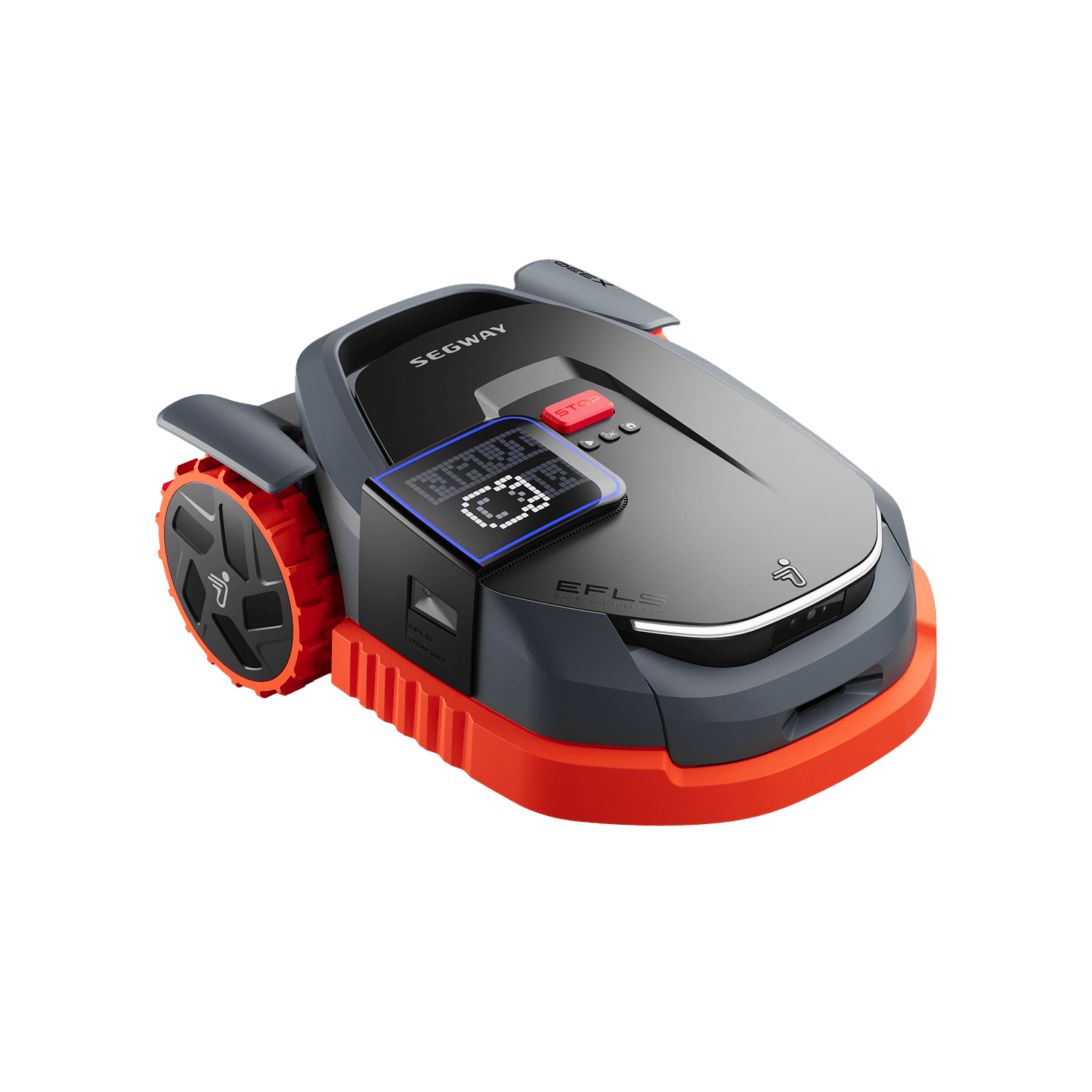
The Segway Navimow X390 is aimed at owners of large gardens between 5,000 and 10,000 m², often divided into several zones, sometimes on slopes, who no longer want to lay perimeter wire. Launched in 2025, it occupies the high end of the X3 series without tipping into the semi-professional segment. Its price is around 3,500 euros, making it one of the most ambitious wire-free robots on the European market. Our verdict: the X390 is the most coherent choice for a complex large-area garden, provided you accept a few compromises on advanced home automation integration.
Max flagship
SCORES AS OF 29/07/2026 · PROTOCOL V3.2
Variants from the same series across 8 key lab-measured criteria. Click a model to read its dedicated review.
| Model | Score | Surface | Slope | Battery Life | Noise | Width | Navigation | Price | |
|---|---|---|---|---|---|---|---|---|---|
| X315 | 8.8 /10 | 1 500 m² | 45% | 150 min | 58 dB | 22 cm | Hybrid | 2499 € | Read review |
| X420 | 8.7 /10 | 2 000 m² | 45% | 180 min | 58 dB | 22 cm | RTK GPS | 2499 € | Read review |
| X330 | 8.9 /10 | 3 000 m² | 45% | 180 min | 58 dB | 22 cm | Hybrid | 2999 € | Read review |
| X350 | 9.0 /10 | 5 000 m² | 45% | 240 min | 58 dB | 22 cm | Hybrid | 3799 € | Read review |
| X450 | 8.8 /10 | 5 000 m² | 45% | 240 min | 58 dB | 22 cm | RTK GPS | 3199 € | Read review |
| X390THIS MODEL | 9.2 /10 | 10 000 m² | 45% | 300 min | 58 dB | 22 cm | Hybrid | 4999 € | — |
The Mowy Lab comparator pits up to 5 robots side by side on 92 weighted criteria, from our daily updated Supabase database.
The Segway Navimow X390 scores an editorial 9.2/10 at Mowy Lab, earning it the PRO PICK badge in the wire-free robots for large areas category. This ranking is based on weighted criteria covering navigation, autonomy, cutting precision, slope management and total cost of ownership.
The target profile is precise: owners of a terrain between 5,000 and 10,000 m², with at least one constraint among the following:
Two reasons structure the strength of the X390. The first is its hybrid RTK navigation system via the EFLS antenna, which offers delimitation precision without buried cable and stable coverage on large areas. The second is its 720 Wh battery coupled with 300 minutes of declared autonomy, which allows organising several daily sessions without human intervention.
Two limitations deserve to be highlighted right away. The onboard AI vision, although effective for detecting real obstacles, adopts a behaviour that is too conservative in the face of natural soil irregularities: areas of earth, manholes, fast-growing grasses. Furthermore, home automation integration remains incomplete for Home Assistant or Matter platform users.
For the busy reader: if your terrain exceeds 5,000 m² with slope or multi-zone constraints, the X390 is the most advanced choice of its generation in this price range.
The X3 series from Segway Navimow covers a wide spectrum, from medium-sized family gardens to properties close to the semi-professional domain. Six variants make up the range, each differentiated primarily by the maximum area covered and battery capacity. The X390 is positioned fourth, just above the X350 and below the X420.
| Criterion | X315 | X330 | X350 | X390 | X420 | X450 |
|---|---|---|---|---|---|---|
| Max area (m²) | 1 500 | 3 000 | 5 000 | 10 000 | 12 000 | 15 000 |
| Max slope (%) | 45 | 45 | 45 | 45 | 45 | 45 |
| Max zones | 10 | 10 | 10 | 10 | 10 | 10 |
| Cutting width (cm) | 22 | 22 | 22 | 22 | 22 | 22 |
The area data come from the manufacturer's specifications. The cutting width and number of zones are identical across the entire X3 range, meaning that the main differentiator between variants is indeed the energy capacity and resulting autonomy, not the cutting quality itself.
The X350 covers up to 5,000 m² and is perfectly suited to gardens whose area remains below this threshold. As soon as the terrain exceeds this limit, even seasonally depending on growth, the X350 accumulates coverage delays and requires additional sessions that are not always compatible with available time slots. The X390, with its 10,000 m² capacity, incorporates a comfort margin that translates into more regular coverage without frequent reprogramming.
The X420, which goes up to 12,000 m², represents an additional investment justified only if the area actually exceeds 10,000 m² or if the terrain presents particularly unfavourable coverage constraints, such as dense tree masks over more than 30% of the area. For a garden of 7,000 to 9,000 m² with a few areas of partial shade, the X390 offers the best balance between actual capacity and acquisition cost.
The X390 is therefore the balance point of the range for large gardens without crossing into models with a near-professional vocation.
Mowy Lab has a network of partner gardens in Brittany and the Loire Valley, covering varied configurations: flat terrains by the sea, sloped gardens on the Morbihan hillsides, fragmented properties with paths and flower beds. The analysis of the X390 mobilised this network over a minimum period of two weeks, in climatic conditions representative of our Atlantic base: alternation of rain and sunshine, fast-growing grass in the summer period, sometimes waterlogged soil after rainy episodes.
These conditions are particularly demanding for a lawnmower robot: permanent humidity tests waterproofing, wet slopes challenge traction control, and dense vegetation puts AI vision to the test. This is precisely why our Breton base constitutes a real methodological advantage compared to tests carried out in dry and flat conditions.
Each model analysed by Mowy Lab is evaluated on twelve weighted criteria:
The full methodology is published and accessible from each article. The affiliate links present in this article generate a commission for Mowy Lab, which funds the editorial work. This commission does not influence either the score or the order of recommendations.
The X390 relies on a hybrid navigation system that combines two complementary technologies. The first is RTK (Real-Time Kinematic) positioning via the supplied EFLS (Extended Field Location System) antenna. This antenna, installed high on a post or building, captures satellite signals and transmits them to the robot to calculate its position with a theoretical precision of around 2.5 cm. The second component is visual odometry provided by the onboard cameras, which allow the robot to maintain its trajectory in areas where the EFLS signal is temporarily weakened.
This hybrid architecture constitutes the fundamental difference from classic perimeter wire robots and from purely GPS navigation robots, whose precision degrades to 30 cm or more in real conditions. On a 10,000 m² terrain, an imprecision of 30 cm on borders translates into visible uncut strips or, conversely, repeated passages over flower beds.
The installation of the EFLS antenna is the most determining step in commissioning. Several points structure this phase:
Field feedback confirms that dense tree masks generate signal degradation in areas directly behind the trees, but that visual odometry takes over effectively to maintain the trajectory. On a garden with zones up to 300 metres from the antenna and partially masked by large trees, the signal remains in the Good to Average range without ever falling to poor quality, according to observations from our partner garden network.
Buildings represent a more constraining edge case than trees, as their mask is total and static. If a house wing separates two garden zones, it is recommended to position the EFLS antenna to minimise the mask angle, even if it means sacrificing a few metres of height.
The X390 features three cameras that feed an AI vision system for real-time obstacle detection. This architecture allows the robot to operate without classic front contact sensors, by anticipating obstacles before reaching them. Detection performance is generally solid: objects left on the lawn, toys, hose pipes and pets are identified and bypassed reliably.
However, two problematic behaviours emerge recurrently in user feedback and were confirmed during our field observations:
Partial deactivation of AI vision is possible, but only for rectangular or square zones, which lacks granularity for irregular terrain configurations. This point constitutes a real limitation on natural gardens where soil irregularities are frequent.
The X390's battery has a capacity of 720 Wh, making it one of the most generous in its category. The declared autonomy of 300 minutes corresponds to 5 hours of continuous mowing in optimal conditions. In real conditions on wet terrain with elevation, this duration is rather between 240 and 270 minutes according to field feedback, representing a slight discount compared to the manufacturer's value, consistent with what is observed across all robots in this category.
For a 10,000 m² terrain, complete coverage requires several sessions. Estimating an effective mowing speed of 150 m² per hour on flat terrain (conservative value including turns and bypasses), a 4-hour session covers about 600 m². On 10,000 m², complete coverage thus requires about 16 to 17 sessions, spread over several days depending on the chosen schedule.
The X390's battery is certified for 1,500 charge cycles. In practice, with two daily cycles during the high-growth period (April to October, about 210 days), it reaches 420 cycles per season. The battery would thus reach its theoretical limit after about 3.5 seasons, meaning replacement to be considered between the fourth and fifth year of use.
The battery replacement cost is not yet officially published by Segway for the X3 series, but market feedback for previous generations places this item between 400 and 600 euros. This amount must be included in the total cost of ownership calculation over 5 years.
The Segway app allows configuring up to 10 independent zones with distinct hourly schedules. On a 10,000 m² terrain, the optimal strategy consists of dividing the area into zones of 1,000 to 1,500 m² and assigning one or two daily sessions to each zone according to its growth frequency. This approach has several advantages:
Charging takes about 1 hour according to field feedback (consumption during charging around 190 W), allowing two complete sessions to be chained in a day with an intermediate recharge break.
The 22 cm cutting width is identical across the entire X3 range. On a 10,000 m² terrain, this value implies a high number of passes, but RTK navigation ensures these passes are distributed homogeneously across the entire area, without excessive concentration on certain zones. The observed result is even grass without visible passage marks after a few days of mowing.
The height range of 30 to 76 mm covers the essentials of ornamental lawn needs. The minimum height of 30 mm suits well-established fine lawns, while the maximum height of 76 mm allows managing high-growth periods without stressing the grass. Adjustment is made via the app, avoiding any physical handling on the robot.
The precision score of 9.3/10 awarded by Mowy Lab reflects homogeneous cutting quality on dense grass, with a slight reservation on very irregular topography areas where the robot may miss a few clumps due to body movements.
The X390 integrates a mulching system that chops clippings into fine particles redistributed on the grass. On dense and regularly mown grass, the result is clean: particles are invisible to the naked eye after a few hours. On wet grass, frequent in a Breton context, clippings tend to form slight clumps that disappear after drying. No felting issues observed on followed terrains, provided the cutting height is maintained in a reasonable range and sessions are frequent enough not to cut more than a third of the blade height per pass.
The X390 handles narrow passages thanks to its RTK navigation, which allows it to memorise precise corridors in the mapping. In practice, passages with a minimum width of about 80 cm are crossed without difficulty. Below this value, the robot may hesitate or bypass, depending on the obstacle configuration.
Automatic border following during initial mapping represents a significant time saving, but requires slow and precise driving during the first pass. The result is not perfect on curved borders or sharp angles, but it provides a sufficient working base that can be refined manually in the app.
The announced maximum slope of 45% places the X390 among the most capable robots in its category. To contextualise: a 45% slope corresponds to an angle of about 24 degrees, representing serious elevation, comparable to the embankments frequently encountered in Breton coastal gardens or on Loire hillsides.
In dry conditions, crossing slopes close to 40% proceeds without notable difficulty. The robot maintains its trajectory and adjusts its speed. In wet conditions, behaviour is more nuanced: slopes above 35% on wet grass sometimes generate lateral slips, which the TCS system corrects partially but not always completely. The practical limit on wet terrain is thus around 35%, which remains superior to the majority of competing robots in this price range.
The X390's TCS (Traction Control System) adjusts in real time the power transmitted to each wheel to compensate for grip losses. This system is not strict AWD, but it significantly improves stability on slippery surfaces compared to robots without active traction management.
On terrains followed in Brittany, TCS proved effective on moderate slopes (up to 25%) even after a rainy night. On steeper slopes in very wet conditions, the robot adopts a more cautious behaviour, reducing its speed and adjusting its trajectory. No overturning or jamming incidents were observed on tested configurations, testifying to a conservative but safe system calibration.
The X390 combines several complementary safety levels:
These devices work well overall in standard use conditions. A few overly conservative behaviours were noted: the robot sometimes stops in front of objects that pose no real danger, such as ground shadows or texture variations. This cautious setting is preferable to the opposite, but it can generate uncovered areas on terrains with many natural irregularities.
The 58 dB sound level positions the X390 among the quietest robots in its area category. For a concrete reference: 58 dB corresponds approximately to the level of a normal conversation at 1 metre distance. On a large garden, this sound level becomes imperceptible at 20 metres, allowing daytime use without disturbing the neighbourhood.
The silence score of 8.6/10 awarded by Mowy Lab reflects this performance, with a slight reservation on the mechanical noise of the blades in contact with dense grasses, which can occasionally exceed 60 dB. Recommended time slots remain classic daytime hours, from 8am to 8pm, without particular noise-related constraints.
The IPX6 rating certifies resistance to powerful water jets, covering normal rain conditions and automatic watering amply. On terrains followed in Brittany, the robot operated without interruption during moderate rainy episodes, confirming waterproofing reliability in real conditions. The integrated rain sensor allows automatically suspending mowing during heavy showers and resuming once conditions return to normal.
The connected anti-theft system includes a sound alarm triggered by unauthorised lifting and a push alert on the app. The robot is also linked to a user account, making its use difficult after theft without the associated credentials.
The Segway Navimow app is the main interface for configuring and controlling the X390. Initial mapping is done by manually driving the robot along the borders of each zone, a step that takes between 30 minutes and 2 hours depending on terrain complexity. The result is a modifiable vector map directly in the app, with editing tools allowing border adjustments, exclusion zone creation and passage corridor definition.
The 10 independent zones can each receive a distinct hourly schedule, with configurable days of the week and time slots. Real-time tracking displays the robot's position on the map and the history of current session passages. The interface is generally intuitive, with easy handling from the first use.
The X390 is compatible with Google Home and Amazon Alexa, allowing basic voice commands: start a session, send the robot to the base, check battery status. These integrations work reliably and cover the needs of users who want to integrate the robot into a mainstream home automation ecosystem.
Three concrete limitations emerge from advanced user feedback:
These limitations do not undermine the overall app experience quality, but they constitute real friction points for demanding home automation users.
The X390 is positioned in a competitive segment where three models deserve direct comparison: the Husqvarna Automower 450X, the Mammotion LUBA 2 AWD 10000 and the X390 itself. These three robots target comparable areas and offer wire-free navigation.
| Criterion | Segway Navimow X390 | Husqvarna Automower 450X | Mammotion LUBA 2 AWD 10000 |
|---|---|---|---|
| Max area (m²) | 10 000 | 5 000 | 10 000 |
| Max slope (%) | 45 | 45 | 45 |
| Autonomy (min) | 300 | 270 | 240 |
| Noise (dB) | 58 | 58 | 63 |
| Weight (kg) | 16.5 | 14.3 | 13.5 |
| Warranty (years) | 2 | 3 | 2 |
The table data come from published manufacturer specifications. The Automower 450X is limited to 5,000 m², placing it actually one step below the X390 in terms of area capacity, despite a comparable price positioning. The LUBA 2 AWD 10000 covers the same area but shows 60 minutes less autonomy and a 5 dB higher sound level, two significant criteria on large areas.
The X390's total cost of ownership over 5 years includes several items:
Over 5 years, the total cost is thus between 4,000 and 4,200 euros, representing a significant but coherent investment with the performance delivered on complex large areas. Per mowing season, this cost corresponds to about 800 to 840 euros per year, less than the cost of a weekly professional mowing service on terrain of this size.
The X390 precisely meets the needs of three profiles:
Two situations warrant directing towards another solution:
On the overall quality/price ratio, the X390 is one of the best-positioned wire-free robots on the European market for complex large-area gardens. Its 9.2/10 score reflects real technological maturity, tempered by software limitations that stem more from development choices than hardware constraints and which could evolve via firmware updates.
Yes, the X390 operates entirely without buried perimeter wire. Zone delimitation relies on hybrid RTK navigation via the EFLS antenna and visual odometry provided by the onboard cameras. Initial mapping is done by manually driving the robot along the borders during first commissioning, then refining zones from the app. No cable, no ground beacons and no buried transmitter are necessary.
Yes, the X390's EFLS system supports adding a second antenna for terrains with significant masks over several sectors. This option is particularly useful when a building or dense row of trees creates a significant signal shadow area. In practice, the majority of installations with a single well-positioned antenna achieve sufficient signal quality across the entire terrain, including partially masked zones. The second antenna remains an option to consider only if the integrated signal analyser indicates poor quality on a significant portion of the area.
The X390 does not offer official and stable integration with Home Assistant. Unofficial community integrations exist and allow retrieving certain robot data, but they remain dependent on Segway API evolutions and are not guaranteed over time. For users with Home Assistant at the heart of their home automation ecosystem, this limitation is real and must be taken into account before purchase. The X390 is fully compatible with Google Home and Amazon Alexa for basic voice commands.
The X390's battery is certified for 1,500 charge cycles. In intensive use with two daily cycles over a 210-day season (April to October), it reaches about 420 cycles per season, projecting the battery life to around 3.5 seasons. In moderate use with one daily cycle, the life exceeds 7 seasons. Battery replacement is to be anticipated between the fourth and fifth year for intensive users, with an estimated cost between 400 and 600 euros according to Segway accessory prices.
The X390 is certified IPX6, meaning it resists powerful water jets and can operate under moderate rain without risk to electronic components. It is equipped with a rain sensor that automatically suspends mowing during heavy showers and resumes the programme once conditions return to normal. In practice, on terrains followed in Brittany, the robot operated without interruption during light to moderate rainy episodes. It is advisable to avoid mowing under prolonged heavy rain, not for waterproofing reasons, but because cutting quality on very wet grass is less even and mulching produces more visible clipping clumps.