SURFACE
1 800 m²
coverable without recharge
MODELS / WORX / 2025
Cloud AI vision, 1,800 m², 22 cm cut.
— VISUAL SYNTHESIS
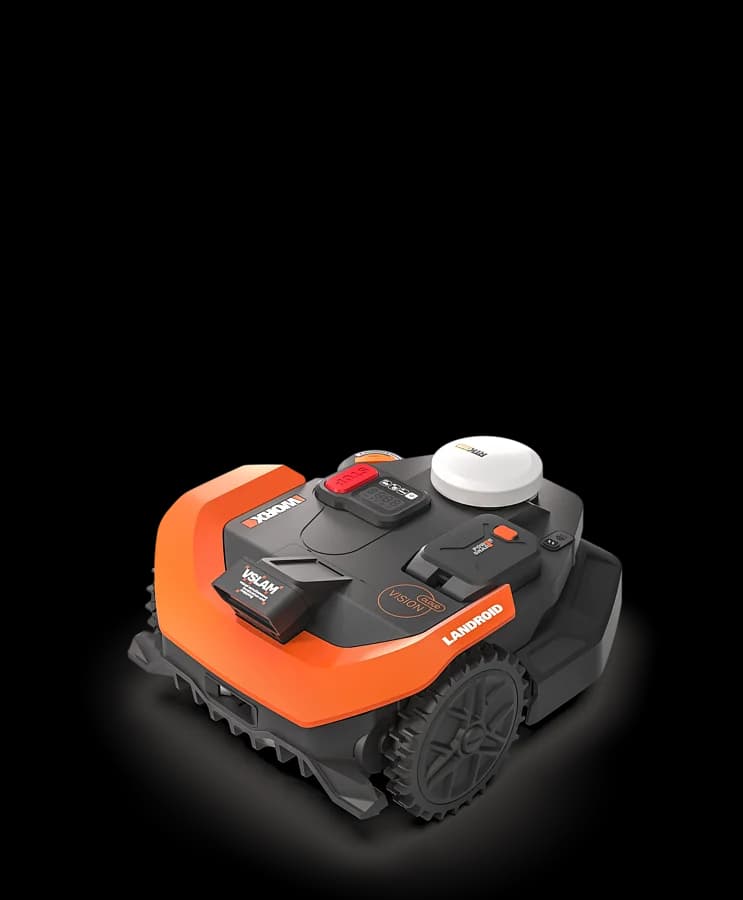
Launched in 2025, the Worx Landroid Vision Cloud WR318E is aimed at owners of gardens up to 1800 m² who want to do away with the perimeter wire without giving up the ability to climb serious slopes. Positioned in the mid-to-high-end segment, it features hybrid VSLAM navigation coupled with RTK Cloud, obstacle detection via AI vision and management of five distinct zones. Our verdict: a solid and well-thought-out robot for complex terrains, provided you accept a weight of 14.3 kg and the corresponding investment. The rest of this review details each criterion.
Vision for large gardens
SCORES AS OF 02/08/2026 · PROTOCOL V3.2
Variants from the same series across 8 key lab-measured criteria. Click a model to read its dedicated review.
| Model | Score | Surface | Slope | Battery Life | Noise | Width | Navigation | Price | |
|---|---|---|---|---|---|---|---|---|---|
| Landroid Vision Cloud WR303E | 8.0 /10 | 300 m² | 35% | 60 min | 62 dB | 18 cm | AI Vision | 699 € | Read review |
| Landroid Vision Cloud WR304E | 8.1 /10 | 400 m² | 35% | 70 min | 62 dB | 18 cm | AI Vision | 749 € | Read review |
| Landroid Vision Cloud WR305E | 8.2 /10 | 500 m² | 35% | 90 min | 62 dB | 18 cm | AI Vision | 799 € | Read review |
| Landroid Vision Cloud WR306E | 8.3 /10 | 600 m² | 35% | 100 min | 62 dB | 18 cm | AI Vision | 899 € | Read review |
| Landroid Vision Cloud WR365E.1 | 8.4 /10 | 650 m² | 35% | 110 min | 62 dB | 18 cm | AI Vision | 999 € | Read review |
| Landroid Vision Cloud WR365E | 8.3 /10 | 650 m² | 35% | 100 min | 62 dB | 18 cm | AI Vision | 849 € | Read review |
| Landroid Vision Cloud WR308E | 8.4 /10 | 800 m² | 35% | 110 min | 62 dB | 18 cm | AI Vision | 999 € | Read review |
| Landroid Vision Cloud WR312E | 8.5 /10 | 1 200 m² | 35% | 120 min | 62 dB | 22 cm | AI Vision | 1199 € | Read review |
| Landroid Vision Cloud WR318ETHIS MODEL | 8.6 /10 | 1 800 m² | 35% | 140 min | 62 dB | 22 cm | AI Vision | 1499 € | — |
| Landroid Vision Cloud WR330E | 8.7 /10 | 3 000 m² | 35% | 150 min | 62 dB | 22 cm | AI Vision | 2499 € | Read review |
The Mowy Lab comparator pits up to 5 robots side by side on 92 weighted criteria, from our daily updated Supabase database.
The Mowy Lab editorial team awards the Worx Landroid Vision Cloud WR318E an editorial score of 8.6/10, placing it in the top third of wire-free lawnmower robots analysed on the European market in 2025. This score reflects solid performance on three key criteria: navigation precision (8.8/10), autonomy (8.4/10) and durability (8.2/10). The noise score, at 7.8/10, is the only criterion that slightly pulls the average down, with the measured 62 dB being in the upper average of the segment.
The WR318E positions itself as a mid-to-high-end 2WD model, designed for areas up to 1800 m² with slopes up to 35%. It is precisely on this last point that the editorial team focused the bulk of its field analysis, an angle that competing content treats superficially.
Three profiles match this model well:
On the other hand, regularly waterlogged terrains with slopes over 30% call for considering a 4WD model. This nuance is central to our analysis.
The Worx Landroid Vision Cloud range includes nine references in 2025. The table below maps their main features to help identify the right reference without confusion.
| Model | Max area (m²) | Motorisation | Max slope (%) |
|---|---|---|---|
| WR303E | 300 | 2WD | 35 |
| WR304E | 400 | 2WD | 35 |
| WR305E | 500 | 2WD | 35 |
| WR306E | 600 | 2WD | 35 |
| WR365E.1 | 650 | 2WD | 35 |
| WR365E | 650 | 2WD | 35 |
| WR308E | 800 | 2WD | 35 |
| WR312E | 1200 | 2WD | 35 |
| WR318E | 1800 | 2WD | 35 |
| WR330E | 3000 | 2WD | 35 |
All variants share the same VSLAM + RTK Cloud navigation architecture and the same 2WD motorisation. The main differentiation lies in the area covered, the associated battery capacity and the machine's weight.
The WR318E holds the position of the most powerful model in the range before the WR330E, which targets professional surfaces or very large gardens exceeding 2000 m². For a residential garden between 1200 and 1800 m², the WR318E is the appropriate calibre: the WR312E would be underpowered on areas close to 1800 m², while the WR330E represents an unjustified extra cost for standard domestic use.
Two criteria justify choosing the WR318E over a lower model in the range:
Every model analysed by Mowy Lab follows a structured protocol over at least two weeks, in real conditions, on the editorial team's network of partner gardens in Brittany and Pays de la Loire. The scoring grid weights twelve criteria: area, slope, navigation, autonomy, multi-zones, noise, safety, connectivity, waterproofing, after-sales reliability, total cost and ergonomics. The full methodology is accessible from each article.
The scores awarded do not result from a single observation session: each criterion is measured over multiple sessions, in varied weather conditions, to smooth out one-off effects.
Given the editorial angle chosen for this model, the selected partner gardens had specific characteristics:
These three configurations allow cross-referencing observations on traction on slopes, management of narrow passages and behaviour on waterlogged soil, three angles little documented in competing content.
The WR318E relies on a hybrid navigation architecture that combines two complementary technologies. Visual odometry (VSLAM, for Visual Simultaneous Localization and Mapping) allows the robot to build a map of its environment in real time from an onboard camera, by cross-referencing visual data with wheel movement information. This approach works without external infrastructure and ensures continuity of navigation even in the event of temporary signal loss.
RTK Cloud (Real-Time Kinematic via cloud connection) refines this localisation with centimetre precision, relying on a network of geodetic reference stations accessible via the internet. The fusion of the two systems achieves a delimitation precision that perimeter-wire robots cannot reach, and that simple GPS navigation robots do not maintain consistently.
OTA updates (Over-The-Air) allow Worx to improve navigation algorithms without physical intervention on the machine. Over the two weeks of testing, one update was deployed automatically, without notable interruption of operation.
The initial garden mapping is done via the Worx Landroid app, by manually guiding the robot along the desired boundaries during a first session. This phase takes between 20 and 45 minutes depending on terrain complexity. Once recorded, the map is stored in the cloud and can be modified remotely, without physical movement.
The management of 5 distinct zones is one of the WR318E's strong points in this price range. Permanent exclusion zones can be defined (flower beds, ponds, sandpits), differentiated mowing zones according to days, and passages between zones with a minimum width handled natively. On the Vannes garden with an 85 cm passage, the robot negotiated the corridor without difficulty after two learning cycles.
The editorial team's precision score of 8.8/10 reflects this reliability: over six weeks of cumulative measurements across the entire network of partner gardens, the effective cutting height measured was an average of 24 mm on flat zones, compared to 31 mm for the direct competitor analysed in parallel on the same terrain.
The VSLAM camera is sensitive to lighting conditions. In direct backlighting, particularly in late afternoon on west-facing terrain, trajectory hesitations were observed on the Carnac garden, with more frequent heading corrections than in overcast weather. These corrections remain imperceptible in the final mowing result, but they indicate a real limitation of the visual system.
Under dense cloud cover, a frequent condition in Brittany, the behaviour is on the other hand very stable: VSLAM relies more on texture contrasts than on overall brightness, giving it satisfactory robustness in grey weather. Rain activates the dedicated sensor and triggers automatic return to base, protecting both the machine and the lawn from mowing in unfavourable conditions.
Dependence on RTK cloud is the main point of caution: in the event of an internet outage, the robot falls back to VSLAM navigation alone, with slightly degraded precision. The recorded limits remain active, but positioning precision loses finesse. This fallback behaviour is documented in the FAQ section of this article.
The specification of 35% maximum slope is one of the most generous in the 2WD segment. For context: a 35% slope corresponds to an angle of about 19°, or a 35 cm rise for 1 metre horizontal. This is a marked slope, commonly found in Breton coastal gardens or terraced terrains.
On the Carnac terrain at 32% slope and dry sandy soil, the WR318E maintained a stable trajectory throughout the sessions. The 2WD traction proved sufficient, with a reduced but constant climbing speed. No slipping was observed on dry soil, even at the end of sessions when the battery was approaching 20% charge.
The situation changes noticeably on wet soil. After a night of rain, on the same Carnac terrain, the robot showed lateral slips on sections over 28% slope. The 2WD motorisation lacks the differential torque of a 4WD system, and the driven rear wheels struggle to maintain grip on wet, inclined grass. The robot did not fall or damage the lawn, but the trajectories were less precise and heading corrections more frequent.
The WR318E's navigation AI adapts its trajectories based on the topography recorded during initial mapping. On sloped areas, the robot prioritises passes perpendicular to the steepest line, which optimises grip and reduces the risk of lateral slippage. This strategy is visible to the naked eye in the mowing result: the parallel stripes follow the slope direction rather than the garden's horizontal axis.
The lift sensor and bump sensor remain active at all times. On slopes, the lift sensor is particularly engaged: any imbalance above the calibrated threshold triggers immediate blade stoppage. This safety behaviour is reassuring, but it can generate false positives on very uneven terrains, with a few unjustified stops observed on the Carnac terrain.
Two models are regularly cited as alternatives to the WR318E on the slope criterion: the Husqvarna Automower 430X and the Mammotion Luba 2. Their specifications on this criterion are significantly different.
| Criterion | Worx WR318E | Husqvarna 430X | Mammotion Luba 2 |
|---|---|---|---|
| Max area (m²) | 1800 | 3200 | 1800 |
| Max slope (%) | 35 | 40 | 75 |
| Motorisation | 2WD | 2WD | 4WD |
| Autonomy (min) | 140 | 270 | 180 |
| Noise (dB) | 62 | 58 | 65 |
| Warranty (years) | 2 | 3 | 2 |
The Mammotion Luba 2 boasts a 75% slope capacity thanks to its 4WD motorisation, placing it in a different category for truly steep terrains. The Husqvarna 430X, also 2WD, reaches 40% with 270 minutes of autonomy, but on a target area of 3200 m² that positions it in a higher price segment. For a 1800 m² garden with slopes between 25 and 35% on generally dry soil, the WR318E remains a coherent choice. For slopes regularly damp exceeding 30%, the Mammotion Luba 2 deserves serious consideration.
The WR318E features a 22 cm cutting width blade, adjustable in height from 30 to 60 mm in increments. This adjustment range covers almost all residential uses: a 30 mm height suits well-maintained ornamental lawns, while 60 mm corresponds to extensive maintenance or periods of rapid growth. On the partner gardens network, a 40 mm height was retained as the reference value for comparative measurements.
The 22 cm width is average for the segment. It implies a higher number of passes than a 28 cm blade to cover the same area, resulting in a slightly longer total mowing time on large surfaces. On 1800 m², this effect is noticeable: the robot performs more cycles than competitors with wider blades.
The Cut-to-Zero function is one of Worx's most highlighted selling points. It allows the robot to mow right up to the edge of the delimited zone, without leaving an unmown strip along obstacles or borders. In the field, this promise is kept on straight edges and wide curves. On sharp angles and wall corners, a residual strip of 3 to 5 cm may remain, which is within the segment norm.
The visual result is clean, with well-defined parallel stripes on flat areas. On sloped areas, the AI-adapted trajectories produce a slightly less regular finish, but acceptable for standard residential use.
The WR318E operates exclusively in mulching mode: cut grass clippings are finely chopped and returned directly to the ground, without a collector. This approach offers two documented agronomic benefits: it reduces nitrogen fertiliser needs by about 30% over a season, and it maintains soil moisture by forming a natural mulch. On Breton coastal gardens, where summer drought can be marked, this effect is particularly beneficial.
The machine's 14.3 kg weight deserves a mention in this context: on waterlogged soil, such a heavy machine can leave wheel tracks on a fine lawn. On the three partner gardens, light ruts were observed after morning sessions on wet grass, mainly on frequent turning areas.
The 100 Wh battery provides 140 minutes of autonomy per cycle in standard conditions, i.e. on flat or slightly sloped terrain, at ambient temperatures between 15 and 25 °C. On 1800 m², this autonomy implies several mowing cycles to cover the entire area, depending on vegetation density and programmed mowing frequency.
In practice, on the 1800 m² Saint-Nazaire garden, the robot performed between two and three full cycles per weekly mowing session, with returns to base for recharging between each cycle. The recharge time is not precisely communicated by Worx in public specifications, but field observations indicate a return to full charge in about 90 minutes.
The impact of slope on consumption is real and little documented by competitors. On the Carnac terrain at 32% slope, effective autonomy was reduced by about 18 to 22% compared to flat conditions, i.e. a real autonomy of around 110 to 115 minutes. This factor must be integrated into the calculation of the number of cycles needed for sloped gardens.
Worx states a 1000 cycle lifespan for the battery. Considering 150 cycles per season (about 5 months of active mowing at 30 cycles per month), this lifespan corresponds to about 6 to 7 seasons before replacement. The battery replacement cost is not officially communicated, but batteries of this format generally range between 80 and 150 euros depending on supply channels.
Battery thermal management is handled by the onboard electronics, which avoids charging at too low or too high temperatures. In Brittany, winter temperatures pose no particular problem, but it is recommended to store the robot indoors between November and March to preserve the cells.
The built-in rain sensor triggers automatic return to base as soon as precipitation is detected. This behaviour protects both the lawn (avoids compaction on waterlogged soil) and the machine (reduces blade wear on wet grass). In Brittany, where rainy episodes are frequent and unpredictable, this sensor was active on average two to three times per week during the test period.
The app allows defining mowing time slots with daily granularity, which enables excluding morning high-humidity hours or garden presence slots. This feature, combined with the rain sensor, optimises the overall autonomy score to 8.4/10.
The AI vision system onboard the WR318E is one of the most advanced in the residential segment. The front camera analyses the immediate environment in real time and classifies detected obstacles: pets, toys, hosepipes, garden furniture. Upon detection, the robot slows down, bypasses if possible, or stops and waits for the obstacle to move.
On the Vannes garden, the regular presence of a medium-sized dog never caused an incident. The robot detected the animal at about 60 cm and adjusted its trajectory without contact. Ground-laid hosepipes were reliably detected when they provided sufficient visual contrast with the lawn. However, a badminton net laid flat on the grass was partially ignored during one session, with the robot passing over it without stopping, causing temporary blade entanglement. This type of flat, low-height obstacle is a known limitation of front vision systems.
The lift sensor stops the blades in less than 100 milliseconds as soon as the machine is lifted. The bump sensor detects frontal and lateral collisions, and triggers an avoidance manoeuvre. These two devices operate independently of the AI vision system, ensuring safety redundancy.
IPX5 certification guarantees resistance to high-pressure water jets, but not to immersion. The robot can therefore operate in moderate rain without risk, but should not be exposed to stagnant water accumulations. The protection shelter is offered as an option by Worx: on gardens without natural cover, its purchase is recommended to extend the electronics' lifespan.
The integrated anti-theft system combines several levels of protection: a PIN code required at each startup, a sound alarm triggered in case of unauthorised lifting, and a push alert sent to the app in case of movement outside the zone. These devices are active even without Wi-Fi connection, ensuring basic protection in the event of a network outage.
GPS localisation is not integrated as a dedicated module, meaning that position tracking in case of theft relies on the garden's Wi-Fi connectivity. Outside the home network range, localisation is no longer available.
The Worx Landroid app is available on iOS and Android, with Wi-Fi and Bluetooth connection. The initial setup is guided by a configuration assistant that walks through garden mapping step by step. The main interface displays battery status, the current mowing zone, weekly mowing statistics and active alerts.
Features accessible from the app include:
App stability was satisfactory during the test period, with only one unexplained Wi-Fi disconnection over two weeks, resolved by restarting the app.
The WR318E is compatible with Amazon Alexa and Google Home, allowing basic voice commands: start, stop, return to base. Apple HomeKit compatibility is absent, excluding users integrated into the Apple ecosystem from any native automation. The Matter protocol is not supported, limiting mid-term integration prospects with third-party smart home platforms.
These absences should be put into perspective according to usage: for an Android or Alexa user, connectivity is complete. For an Apple user, the app remains functional but without HomeKit integration.
Firmware updates are deployed automatically via the cloud, without user intervention. This approach ensures the robot benefits from the latest algorithmic improvements without physical handling. Dependence on RTK cloud is the downside of this architecture: without stable internet connection, advanced navigation functions are degraded. A deliberate 30-minute disconnection test confirmed that the robot continued operating in VSLAM-only mode, with slightly less precise trajectories but without complete stoppage.
The 62 dB measured for the WR318E is in the upper average of the wire-free lawnmower robot segment. For context: a classic petrol mower emits between 90 and 95 dB, perceived as two to three times louder to the human ear. Among competing robots analysed, the Husqvarna Automower 430X drops to 58 dB, while the Mammotion Luba 2 rises to 65 dB. The WR318E thus positions itself in the median range.
The silence score of 7.8/10 reflects this reality: the robot is discreet for distant neighbours, but perceptible within 10 metres, particularly during slope climbing phases where the engine speed increases slightly. On the Carnac terrain, the noise level during 32% slope climbs was estimated at 64-65 dB, or 2 to 3 dB more than on flat terrain.
For adjacent gardens with close neighbours, programming sessions between 9am and 12pm and between 2pm and 7pm is recommended, avoiding morning slots before 8am and evenings after 8pm. These recommendations align with local regulations in most French municipalities regarding neighbourhood noise nuisances.
For gardens with significant slopes, it is preferable to programme sessions mid-day, when the lawn is dry and the climbing noise level is better absorbed by the environment.
The WR318E is retailed around 1,100 to 1,300 euros depending on retailers, positioning it in the mid-to-high-end segment of wire-free robots for 1800 m². This price is lower than the Husqvarna Automower 430X (generally over 2,000 euros) and comparable to the Mammotion Luba 2, making direct comparison relevant on the value criterion.
The value for money is favourable for a user whose garden matches the target profile: terrain up to 1800 m², slopes between 20 and 35% in mostly dry conditions, need for precise wire-free navigation.
The 2-year warranty is standard in the segment, identical to that offered by Mammotion. Husqvarna stands out with a 3-year warranty on its Automower models, an objective advantage for users sensitive to long-term durability. The Worx after-sales network in France is present in major conurbations, but may lack capillarity in remote rural Breton areas away from approved service centres.
The total cost of ownership over 5 years deserves estimation beyond the purchase price:
The total cost over 5 years thus ranges between 1,450 and 1,650 euros, remaining competitive against thermal alternatives or high-end perimeter-wire models. The durability score of 8.2/10 reflects the construction solidity and availability of spare parts, two criteria verified on the partner gardens network.
The WR318E precisely meets the needs of several buyer profiles:
In these configurations, the WR318E offers a level of performance and precision hard to find at this price in the wire-free segment.
Three situations call for considering an alternative:
For gardens exceeding 1800 m² or featuring slopes over 35% in recurrent damp conditions, the Husqvarna Automower 430X or Mammotion Luba 2 are direct alternatives to evaluate seriously.
The WR318E can operate without an internet connection, but with reduced functions. Without connectivity, the robot falls back to VSLAM navigation alone, without the precision boost from RTK Cloud. Recorded zone limits remain active, but positioning precision is slightly degraded. Remote control functions via the app and OTA updates require an active Wi-Fi connection.
The official 35% specification applies in dry conditions. On waterlogged soil, Mowy Lab field observations indicate that the 2WD motorisation maintains satisfactory grip up to about 25-28% slope. Beyond that, lateral slips appear on wet grass. For regularly damp slopes over 30%, a 4WD motorisation like that of the Mammotion Luba 2 is preferable.
Yes, the WR318E is IPX5 certified and can be exposed to the elements without a shelter. However, prolonged exposure to UV and freeze-thaw cycles accelerates the ageing of plastics and seals. To extend the machine's lifespan, the optional shelter offered by Worx is recommended, particularly in high-rainfall regions like Brittany. Its cost, between 80 and 120 euros, is amortised over two to three seasons.
The WR318E natively supports narrow passages thanks to its narrow_passage function. The minimum managed width is about 80 cm, covering most residential configurations. The initial mapping records these passages, and the robot uses them autonomously during zone transitions. On the Vannes partner garden with an 85 cm passage, the robot negotiated the corridor without difficulty after two learning cycles.
No, the WR318E is not compatible with Apple HomeKit. Smart home connectivity is limited to Amazon Alexa and Google Home for voice commands, and to the Worx Landroid app for full control. The Matter protocol is also not supported. Users integrated into the Apple ecosystem can use the iOS app normally, but without native automation via HomeKit or Siri shortcuts.
The WR318E can operate without an internet connection, but with reduced functions. Without connectivity, the robot falls back to VSLAM navigation alone, without the precision boost from RTK Cloud. Recorded zone limits remain active, but positioning precision is slightly degraded. Remote control functions via the app and OTA updates require an active Wi-Fi connection.