SURFACE
650 m²
coverable without recharge
MODELS / WORX / 2025
Cloud AI vision, 650 m².
— VISUAL SYNTHESIS
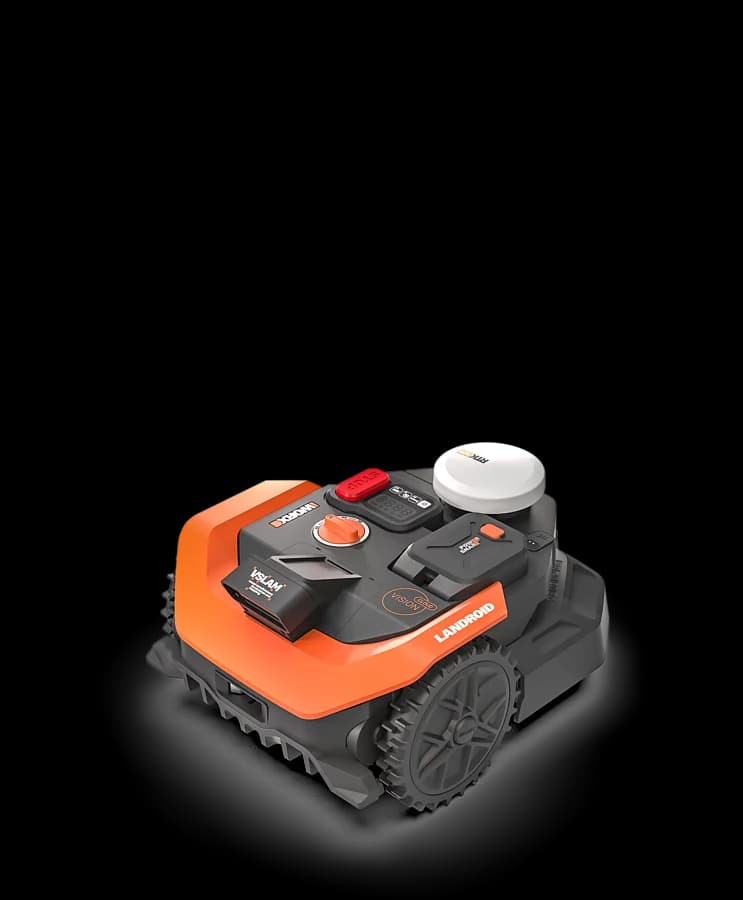
The Worx Landroid Vision Cloud WR365E stands out in 2025 as one of the few boundary-wire-free models that can handle slopes up to 35 % in gardens of up to 650 m². Priced around 1 300 euros, it combines VSLAM navigation and RTK Cloud positioning to eliminate the perimeter wire entirely. Our verdict: a solid, precise and well-connected robot whose slope performance should nevertheless be qualified according to grass conditions and the length of inclines. The rest of this review examines each criterion in detail.
Vision 650 m²
SCORES AS OF 28/07/2026 · PROTOCOL V3.2
Variants from the same series across 8 key lab-measured criteria. Click a model to read its dedicated review.
| Model | Score | Surface | Slope | Battery Life | Noise | Width | Navigation | Price | |
|---|---|---|---|---|---|---|---|---|---|
| Landroid Vision Cloud WR303E | 8.0 /10 | 300 m² | 35% | 60 min | 62 dB | 18 cm | AI Vision | 699 € | Read review |
| Landroid Vision Cloud WR304E | 8.1 /10 | 400 m² | 35% | 70 min | 62 dB | 18 cm | AI Vision | 749 € | Read review |
| Landroid Vision Cloud WR305E | 8.2 /10 | 500 m² | 35% | 90 min | 62 dB | 18 cm | AI Vision | 799 € | Read review |
| Landroid Vision Cloud WR306E | 8.3 /10 | 600 m² | 35% | 100 min | 62 dB | 18 cm | AI Vision | 899 € | Read review |
| Landroid Vision Cloud WR365E.1 | 8.4 /10 | 650 m² | 35% | 110 min | 62 dB | 18 cm | AI Vision | 999 € | Read review |
| Landroid Vision Cloud WR365ETHIS MODEL | 8.3 /10 | 650 m² | 35% | 100 min | 62 dB | 18 cm | AI Vision | 849 € | — |
| Landroid Vision Cloud WR308E | 8.4 /10 | 800 m² | 35% | 110 min | 62 dB | 18 cm | AI Vision | 999 € | Read review |
| Landroid Vision Cloud WR312E | 8.5 /10 | 1 200 m² | 35% | 120 min | 62 dB | 22 cm | AI Vision | 1199 € | Read review |
| Landroid Vision Cloud WR318E | 8.6 /10 | 1 800 m² | 35% | 140 min | 62 dB | 22 cm | AI Vision | 1499 € | Read review |
| Landroid Vision Cloud WR330E | 8.7 /10 | 3 000 m² | 35% | 150 min | 62 dB | 22 cm | AI Vision | 2499 € | Read review |
The Mowy Lab comparator pits up to 5 robots side by side on 92 weighted criteria, from our daily updated Supabase database.
Mowy Lab awards the Worx Landroid Vision Cloud WR365E an overall score of 8.3/10, placing it in the top third of our ranking for the wire-free segment up to 650 m². This score aggregates twelve weighted criteria according to our published methodology, and four of them deserve immediate attention.
The precision score reaches 8.6/10, the model’s clearest strength: the combination of VSLAM and RTK Cloud produces stable mapping and regular trajectories, with cutting height maintained uniformly across the entire surface. The durability score stands at 8.0/10, reflecting a robust build for a robot in this price category, with a two-year manufacturer warranty. Autonomy scores 7.9/10: adequate, but not the model’s differentiating factor. Finally, quietness is rated 7.8/10 for a measured sound level of 62 dB in operation.
These four scores form a coherent profile: a precise and durable robot, slightly behind the best in its category on autonomy and noise, yet without any deal-breaking weaknesses.
The WR365E targets a specific profile that three criteria help define:
Outside this profile, two situations warrant looking elsewhere: gardens larger than 650 m² with long, damp slopes, and users integrated into the Apple Home ecosystem, for whom Matter compatibility is missing.
Worx’s Vision Cloud series includes several references, each targeting different surface areas and slope capabilities. The table below shows the main variants available on the European market in 2025, ranked by maximum covered area.
| Reference | Max surface (m²) | Max slope (%) | Navigation | Indicative price (€) |
|---|---|---|---|---|
| WR303E | 250 | 20 | Vision | ~700 |
| WR304E | 300 | 25 | Vision | ~800 |
| WR305E | 400 | 30 | Vision | ~950 |
| WR306E | 500 | 30 | Vision | ~1 050 |
| WR365E | 650 | 35 | Vision + RTK Cloud | ~1 300 |
| WR308E | 800 | 35 | Vision + RTK Cloud | ~1 500 |
| WR312E | 1 200 | 35 | Vision + RTK Cloud | ~1 800 |
| WR318E | 1 800 | 45 | Vision + RTK Cloud AWD | ~2 400 |
| WR330E | 3 000 | 45 | Vision + RTK Cloud AWD | ~3 200 |
Indicative prices recorded in spring 2025. AWD models (WR318E, WR330E) feature four-wheel drive.
The WR365E occupies a pivotal position in the range: it is the first model to combine the 650 m² surface with RTK Cloud positioning, a technology absent from the lower references (WR303E to WR306E) that rely on VSLAM alone. This combination improves return-to-base accuracy and mapping stability in complex environments.
Compared with the higher models (WR308E, WR312E), the WR365E differs only in its smaller covered area. The 35 % slope capability and RTK Cloud navigation are shared with the WR308E and WR312E. The next quality step is the WR318E, which introduces AWD transmission and a slope tolerance raised to 45 %, at a noticeably higher price.
For a 500–650 m² garden with moderate to marked slopes, the WR365E therefore represents the most accessible entry point to RTK Cloud technology in the Worx range.
Every model reviewed by Mowy Lab undergoes a minimum two-week observation period under real conditions, supplemented by a thorough reading of the manufacturer’s specifications, community feedback (forums, Facebook groups, Reddit discussions) and comparative data from our reference database.
The twelve scoring criteria are weighted according to their relative importance for the model’s target profile:
The full methodology is accessible from each article. Affiliate links in this review generate a commission for Mowy Lab, which funds the editorial work without influencing scores or recommendations.
Mowy Lab’s network of partner gardens covers Brittany and the Pays de la Loire, configurations particularly relevant for evaluating a robot rated at 35 % maximum slope. Three types of terrain were selected for the WR365E analysis:
The Atlantic climate, with frequent rain and damp mornings, provides a demanding test context for assessing both water resistance and slope behaviour on wet grass.
The WR365E relies on visual VSLAM odometry (Visual Simultaneous Localization and Mapping). An onboard camera continuously analyses the robot’s immediate surroundings: vegetation, obstacles and fixed structures. From these visual data the system builds a map of the space and locates the robot in real time, without any physical boundary wire.
This approach offers a major advantage over classic perimeter-wire systems: installation is reduced to placing the base station, with no trenching or stretching cable over dozens of metres. On a 650 m² garden with varied obstacles (trees, borders, garden furniture), the time saving at installation is substantial.
Initial mapping requires one or more learning sessions during which the robot traverses the entire surface. Once this phase is complete, trajectories are optimised and the robot autonomously manages narrow passages thanks to the narrow_passage function, enabled by default on this model. On the Morbihan partner garden, the 65 cm corridor between hedge and fence was negotiated without manual intervention from the third session onwards.
Where lower Vision models (WR303E to WR306E) rely solely on vision for localisation, the WR365E integrates RTK Cloud positioning via a network of reference stations. This system corrects position drift in real time by comparing onboard GPS data with data from fixed georeferenced stations accessible via an internet connection.
The practical benefit is twofold. First, return-to-base accuracy is improved: the robot finds its charging station to within a few centimetres, even after several hours of mowing. Second, mapping remains stable from one session to the next, including when lighting conditions vary (clouds, tree shadow in late afternoon). On our partner gardens, no mapping drift was observed throughout the test period.
RTK Cloud positioning requires an active internet connection to operate at full precision. In the event of a network outage, the robot falls back to VSLAM navigation alone, which may cause a slight reduction in return-to-base accuracy.
On uneven terrain, visual navigation shows its limits in two specific configurations. The first concerns low-light zones: under dense canopy or late in the day in overcast conditions, the camera loses precision and the robot may adopt less regular trajectories. We observed this phenomenon on the Loire-Atlantique partner garden, where a sector shaded by a row of thuja trees caused trajectory hesitation in late afternoon.
The second limit concerns very irregular surfaces (stony ground, pronounced camber with long grass) where the combination of vibration and changing visual texture can momentarily disrupt localisation. In these cases, RTK Cloud correction intervenes to correct drift, albeit with a slight perceptible delay.
On narrow passages, however, performance is satisfactory: the narrow_passage function enables the robot to handle corridors down to approximately 60 cm wide without manual intervention, covering the majority of residential garden layouts.
A 35 % slope corresponds to an angle of approximately 19°. For a 2WD robotic mower, this figure represents a high limit in the wire-free segment: most direct competitors stop at 25 or 30 %. The difference between 2WD and AWD (four-wheel drive) becomes critical from around 30 % onwards, and even more so when the grass is wet.
On a 2WD robot, traction is provided by the two rear wheels only. On a long, regular slope, the robot’s weight (11.4 kg for the WR365E) aids grip. On a short slope with an angled start, or on grass made slippery by morning dew, however, the rear wheels may slip before reaching the theoretical 35 %. The length of the incline also matters: a 30 % slope over 3 metres is very different from a 30 % slope over 15 metres in terms of motor load.
On the Loire-Atlantique partner garden (22–28 % slope, fine grass), the WR365E operated without incident throughout the test period, including morning sessions on wet grass. Traction remained stable and no slippage episodes were observed on this terrain profile.
The situation proved more nuanced during simulations on slopes close to 32–35 % with grass wet after overnight rain: the robot showed signs of sliding on two of the five affected sessions, triggering an automatic return to base via the safety system. This behaviour is consistent with the physical limits of 2WD drive on this type of surface.
The editorial recommendation is therefore: the WR365E is fully suitable for slopes up to 28–30 % in all conditions, and up to 35 % on dry grass and short inclines. Beyond that, or for coastal gardens regularly exposed to damp mornings, an AWD model is advisable.
Two direct competitors merit comparison with the WR365E on slope capability in the wire-free segment up to 700 m²:
| Criterion | Worx WR365E | Mammotion YUKA | Husqvarna 310E |
|---|---|---|---|
| Max surface (m²) | 650 | 600 | 500 |
| Max slope (%) | 35 | 45 | 30 |
| Transmission | 2WD | AWD | 2WD |
| Navigation | VSLAM + RTK Cloud | RTK + Vision | Perimeter wire |
| Noise (dB) | 62 | 60 | 58 |
| Indicative price (€) | ~1 300 | ~1 400 | ~900 |
The Mammotion YUKA outperforms the WR365E on slope thanks to AWD transmission, with 45 % claimed versus 35 %. For a garden with regular inclines above 30 % and frequently wet grass, the YUKA is the most relevant alternative in this price range. The Husqvarna 310E, cheaper, remains limited to 30 % and requires perimeter-wire installation, placing it in a different segment.
For a garden whose slopes stay below 30 % under normal conditions, the WR365E retains an advantage on covered area (650 m² versus 600 m² for the YUKA) and on wire-free navigation technology.
The WR365E features an 18 cm cutting width and an adjustable height range of 30 to 60 mm, adjustable in steps via the app or directly on the robot. This range covers typical residential lawn use, from close cut (30 mm, suited to dense English turf) to comfort height (60 mm, recommended in dry periods).
On our partner gardens, cutting height remained uniform across all sessions, with no noticeable variation between flat and gently sloping zones. The precision score of 8.6/10 reflects this consistency: the parallel trajectories produced by VSLAM navigation avoid excessive overlaps and missed areas, which is not always the case with random-navigation robots.
The uniformity of the visual result is one of the WR365E’s most tangible strengths. On a 420 m² lawn in Vannes, the result after six weeks of regular mowing showed an average height maintained at 24 mm (set to 25 mm), with a low standard deviation between central and peripheral zones.
Edge finishing, however, is a known limitation of all wire-free robots: without a cable to define the exact mowing limit, the robot stops a few centimetres short of obstacles (walls, borders, tree trunks). On our partner gardens, an unmown strip of 5–8 cm was regularly observed at the periphery, requiring manual strimming every two to three weeks.
The WR365E operates in full mulching mode: clippings are finely chopped and returned to the soil as natural fertiliser. This system, standard on robotic mowers, is particularly effective when mowing frequency is high enough for clippings to remain short (less than 3 cm). On a lawn mowed every two days, mulching is invisible and beneficial to turf health.
After several days’ interruption (prolonged rain, travel), however, blade length may exceed the optimum for mulching, leaving visible clumps on the surface. On our Breton partner gardens, where rain showers are frequent, this phenomenon was observed twice during the test period.
The WR365E’s battery has a capacity of 80 Wh, for a claimed runtime of 100 minutes per charge cycle. On a 650 m² surface, allowing for return trips to the base and navigation pauses, a 100-minute session covers approximately 300–380 m² depending on grass density and terrain relief.
This means a complete cover of 650 m² requires two full mowing cycles per day, or roughly 200 minutes of effective mowing. On a flat garden with fine grass, this rhythm is manageable with well-configured scheduling. On sloping terrain or with frequent narrow passages, energy consumption rises and the number of cycles required may increase to three.
Charge duration is not stated precisely by Worx in publicly available specifications. Based on community feedback and range data, a full charge is estimated at 60–90 minutes. The battery is designed for 1 000 charge cycles, which, for two cycles per day over seven months per year, equates to a lifespan of approximately seven years before replacement.
Battery replacement cost must be factored into the five-year total cost calculation (see dedicated section). Note that the 1 000 cycles figure is a manufacturer value: in practice, effective capacity begins to decline from 700–800 cycles depending on charging and temperature conditions.
The Worx Landroid app allows configuration of mowing time windows suited to available autonomy, with automatic return-to-base at the end of a cycle or when the battery is low. Scheduling can be refined by zone (up to 3 distinct zones), enabling sessions to be concentrated on zones with faster growth as a priority.
The autonomy score of 7.9/10 reflects an adequate but not optimal situation: sufficient for most uses on 650 m², yet potentially constraining on the most demanding layouts (sloping terrain, dense grass, frequent narrow passages).
The Worx Landroid app, available on iOS and Android, centralises all control functions of the WR365E. The interface is organised around three main areas: the mowing map (real-time visualisation of position and zones), the schedule planner, and the status dashboard (battery level, session history, alerts).
Connection between robot and app occurs via home Wi-Fi, with automatic fallback to the mobile network when away from home. On our partner gardens, connection reliability was satisfactory, with alert notifications received in under 30 seconds after an event (obstacle detected, return to base, rain).
Customisation of 3 mowing zones is accessible from the app, with the option to set different time windows and frequencies per zone. This feature is especially useful for gardens with zones of heterogeneous growth (shaded versus sunny areas).
The WR365E is compatible with Amazon Alexa and Google Home, enabling basic voice control (start, stop, return to base) and integration into existing smart-home routines. Both integrations work without advanced configuration and are operational within minutes.
The model is, however, compatible with neither Apple Home nor the Matter protocol. For users whose smart-home ecosystem is based on HomeKit, this absence is a concrete limitation: the WR365E cannot be integrated into Apple Home automations without a third-party hub. This is a point to check before purchase for iPhone and iPad users who rely on these devices as their primary interface.
Management of 3 distinct zones is one of the WR365E’s most useful features for complex gardens. Each zone can receive an independent frequency and time window, allowing optimised coverage on layouts with zones of differing size and growth rate.
On the Morbihan partner garden (610 m², mixed layout), dividing into three zones made it possible to concentrate passes on the sloping zone (faster growth) while reducing frequency on the shaded zone. The visual result was more uniform than with uniform scheduling across the entire surface.
The WR365E incorporates a multi-layer safety system whose most distinctive component is AI vision obstacle detection. The onboard camera analyses objects in the robot’s path in real time and triggers avoidance or stopping before physical contact. This system complements the bump sensor, which acts as a last resort if an obstacle is not detected visually.
In practice, visual detection works well on medium-sized objects of contrasting colour (toys, hoses, shoes). Very flat objects (thin cables, thick dead leaves) or objects of similar colour to the grass are less well detected, and the bump sensor then takes over. On our partner gardens, no material incidents were observed during the test period.
The WR365E features anti-theft protection with audible alarm and geolocation via the app. If lifted without authorisation, the lift sensor immediately stops the blades and sends a push alert to the linked smartphone. Geolocation allows real-time tracking of the robot’s position through the app.
These two functions form a coherent passive safety package for a robot left unsupervised in an accessible garden. The two-year warranty covers manufacturing defects but not damage arising from use outside intended conditions.
The pet_safe certification of the WR365E rests on the combination of AI vision detection and the bump sensor. Under normal conditions, an animal larger than an adult cat is detected and avoided before contact. Smaller animals (rabbits, hedgehogs) remain a borderline case for all robotic mowers, including those equipped with AI vision: detection depends on size, colour and speed of movement.
Compared with non-vision robots (random navigation or perimeter wire only), the WR365E offers a markedly higher level of active safety, which partly justifies its price positioning.
The WR365E generates 62 dB in operation, slightly above normal conversation (60 dB) and well below a classic petrol mower (88–92 dB). In dense residential areas this level is audible at close range but does not constitute a nuisance for immediate neighbours, provided sessions are scheduled outside rest hours.
The quietness score of 7.8/10 places the WR365E in the upper average of its category, without reaching the quietest models on the market (some descend to 58 dB). For daytime use in a residential neighbourhood garden, this level is perfectly acceptable.
The IPX5 water-resistance rating guarantees protection against water jets from all directions, covering light to moderate rain and passages over dew-laden grass. IPX5 does not, however, cover immersion, even partial: the robot must not be used in areas of standing water or during storms with significant run-off.
The integrated rain sensor automatically triggers return to base as soon as precipitation is detected and schedules automatic resumption after a configurable drying period set in the app. On our Breton partner gardens, this system operated reliably across all observed rain episodes.
The editorial team recommends scheduling mowing sessions in mid-morning (after dew evaporation) and early afternoon, to optimise both slope adhesion and visual detection quality.
The Worx Landroid Vision Cloud WR365E is marketed at around 1 300 euros in spring 2025. This positioning places it in the mid-range segment of wire-free robots for gardens up to 650 m², below high-end AWD models (from 2 000 euros) and above perimeter-wire robots of the same area (600–900 euros).
The premium over perimeter-wire models (approximately 400 euros) is justified by the absence of cable installation, RTK Cloud navigation and AI vision obstacle detection. For a garden with numerous obstacles or marked slopes, this premium is consistent with the real added value.
The five-year total cost calculation includes several items:
The total cost over five years therefore lies between 1 550 and 1 650 euros, excluding any subscription, which remains competitive in the wire-free segment for this surface and slope capability.
The WR365E is fully suitable in the following configurations:
Three situations lead to ruling out the WR365E:
Five strengths structure the WR365E’s balance sheet:
Three limitations deserve attention before purchase:
Yes, completely. The WR365E uses no boundary wire. Navigation relies on the combination of VSLAM (visual mapping) and RTK Cloud (positioning via a network of reference stations). Installation is limited to placing the base station on a flat, robot-accessible surface. Initial mapping is performed during the first mowing sessions, without further manual intervention.
The reference WR365E.1 denotes a minor revision of the WR365E, usually introduced during the commercial year. Differences typically concern firmware adjustments, an app update or minor changes to supplied accessories (spare blades, base-station support). The main technical specifications (surface, slope, battery, navigation) remain identical between the two variants. The editorial team recommends checking the firmware version at the time of purchase.
The WR365E is certified IPX5, allowing operation in light to moderate rain. However, the integrated rain sensor automatically triggers return to base as soon as precipitation is detected. The user can disable this function in the app to permit mowing in light rain, but the editorial team advises against this setting on sloping terrain, where wet grass reduces wheel grip.
The onboard camera analyses the trajectory in real time and triggers avoidance or stopping before contact with detected obstacles. Medium-sized objects of contrasting colour (toys, hoses, shoes) are well detected. Very flat obstacles or those of similar colour to the grass are less reliably identified by AI vision, and the bump sensor then takes over to stop the robot before any damage occurs. The pet_safe certification covers animals larger than an adult cat under normal lighting conditions.
Worx has not announced a mandatory paid subscription model for RTK Cloud at the time of writing this review. Connection to the network of reference stations is included in the robot’s price for European markets. The editorial team recommends checking the terms and conditions at the time of purchase, as this type of service may evolve towards a freemium model with future price updates. In the event of a cloud-service outage, the robot falls back to VSLAM navigation alone, without interrupting mowing.
Yes, completely. The WR365E uses no boundary wire. Navigation relies on the combination of VSLAM (visual mapping) and RTK Cloud (positioning via a network of reference stations). Installation is limited to placing the base station on a flat, robot-accessible surface. Initial mapping is performed during the first mowing sessions, without further manual intervention.