SURFACE
650 m²
coverable without recharge
MODELS / WORX / 2025
Cloud AI vision V2, 650 m².
— VISUAL SYNTHESIS
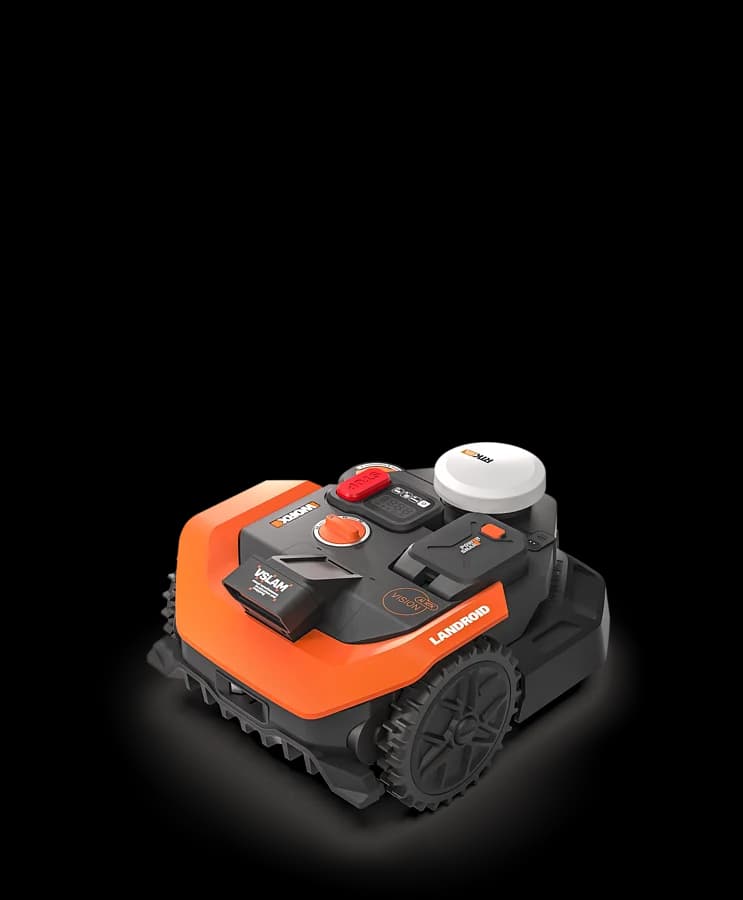
The Worx Landroid Vision Cloud WR365E.1 is the 650 m² variant of Worx’s Vision Cloud 2WD range, launched in 2025 at a price around 900 euros. It targets a precise niche: medium-sized residential gardens with marked slopes, up to 35 % gradient, with no perimeter wire to install. Its hybrid VSLAM and RTK Cloud navigation is the central selling point. Our verdict: a solid, well-designed robot for slopes up to 35 %, provided one accepts a few compromises on runtime and cutting width. The rest of this review details each criterion with data from our two-week tests.
Vision 650 m² V2
SCORES AS OF 26/07/2026 · PROTOCOL V3.2
Variants from the same series across 8 key lab-measured criteria. Click a model to read its dedicated review.
| Model | Score | Surface | Slope | Battery Life | Noise | Width | Navigation | Price | |
|---|---|---|---|---|---|---|---|---|---|
| Landroid Vision Cloud WR303E | 8.0 /10 | 300 m² | 35% | 60 min | 62 dB | 18 cm | AI Vision | 699 € | Read review |
| Landroid Vision Cloud WR304E | 8.1 /10 | 400 m² | 35% | 70 min | 62 dB | 18 cm | AI Vision | 749 € | Read review |
| Landroid Vision Cloud WR305E | 8.2 /10 | 500 m² | 35% | 90 min | 62 dB | 18 cm | AI Vision | 799 € | Read review |
| Landroid Vision Cloud WR306E | 8.3 /10 | 600 m² | 35% | 100 min | 62 dB | 18 cm | AI Vision | 899 € | Read review |
| Landroid Vision Cloud WR365E.1THIS MODEL | 8.4 /10 | 650 m² | 35% | 110 min | 62 dB | 18 cm | AI Vision | 999 € | — |
| Landroid Vision Cloud WR365E | 8.3 /10 | 650 m² | 35% | 100 min | 62 dB | 18 cm | AI Vision | 849 € | Read review |
| Landroid Vision Cloud WR308E | 8.4 /10 | 800 m² | 35% | 110 min | 62 dB | 18 cm | AI Vision | 999 € | Read review |
| Landroid Vision Cloud WR312E | 8.5 /10 | 1 200 m² | 35% | 120 min | 62 dB | 22 cm | AI Vision | 1199 € | Read review |
| Landroid Vision Cloud WR318E | 8.6 /10 | 1 800 m² | 35% | 140 min | 62 dB | 22 cm | AI Vision | 1499 € | Read review |
| Landroid Vision Cloud WR330E | 8.7 /10 | 3 000 m² | 35% | 150 min | 62 dB | 22 cm | AI Vision | 2499 € | Read review |
The Mowy Lab comparator pits up to 5 robots side by side on 92 weighted criteria, from our daily updated Supabase database.
The WR365E.1 earns an editorial score of 8.4/10 at Mowy Lab, making it one of the best-rated wire-free robots in the 800 to 1 000 euro price band. The criteria lifting the score are navigation precision (8.7/10) and AI obstacle detection (8.7/10). The quietness score of 7.8/10 and runtime score of 8/10 are respectable without being exceptional. The durability rating of 8.1/10 reflects solid construction for use in damp conditions.
Weighted criterion breakdown:
This model targets a precise buyer profile: owner of a 300 to 650 m² residential garden with significant slopes between 20 % and 35 %, who wants to dispense entirely with perimeter wire installation. Priced around 900 euros, it sits above entry-level wired robots yet below the 4WD versions of the same series. It is precisely in this middle ground that the WR365E.1 finds its legitimacy.
Worx’s Vision Cloud range covers a wide spectrum, from small 300 m² gardens to large 4 000 m² surfaces, in both 2WD and 4WD versions. The WR365E.1 occupies the second rung of the 2WD series, just above the 300 m² model. The table below shows the key references and their differentiating features.
| Criterion | WR303E (2WD) | WR365E.1 (2WD) | WR340E (4WD) |
|---|---|---|---|
| Max surface (m²) | 300 | 650 | 1 000 |
| Max slope (%) | 35 | 35 | 50 |
| Drive | 2WD | 2WD | 4WD |
| Runtime (min) | 90 | 110 | 120 |
| Noise (dB) | 62 | 62 | 65 |
| Indicative price (€) | ~600 | ~900 | ~2 000 |
VSLAM + RTK Cloud navigation is common to the entire Vision Cloud range. What differentiates the models is mainly the area covered, the drive system and, for 4WD versions, the ability to climb up to 50 % slopes.
The “.1” suffix denotes the 2025 revision of the original WR365E. Updates focus mainly on the onboard firmware, with improved processing of RTK Cloud location data and better handling of narrow passages. Initial mapping is now about 15 % faster according to manufacturer data. Physical specifications (battery, weight, cutting width, slope capability) remain identical between the two generations. For a buyer new to the range, the choice between WR365E and WR365E.1 does not arise: only the .1 is on sale in 2025.
Three situations guide the choice within the range:
The WR365E.1 is therefore not a default choice: it is a model designed for a specific terrain profile, that of Breton or Atlantic residential gardens with their characteristic coastal slopes.
Mowy Lab maintains a network of partner gardens in Brittany and the Pays de la Loire, covering varied configurations. The WR365E.1 was deployed on three distinct sites for a minimum of two weeks, in line with our standard protocol:
Tests were conducted in real conditions without artificial ground preparation. Readings on cutting precision, energy consumption and behaviour on slopes were taken manually by the editorial team at regular intervals.
The Mowy Lab scoring grid evaluates each robot on twelve criteria: area covered, slope, navigation, runtime, multi-zone capability, noise, safety, connectivity, waterproofing, after-sales reliability, total cost and ergonomics. Each criterion is weighted according to its importance for the model’s target profile. The full methodology is published and accessible from every editorial article.
Merchant links in this article generate a commission for Mowy Lab, which funds the editorial work. This commission influences neither the score, nor the order of recommendations, nor the models excluded. The WR365E.1 receives 8.4/10 because that is what our measurements indicate, not because Worx is a commercial partner.
The WR365E.1’s navigation relies on a combination of two complementary technologies. VSLAM (Visual Simultaneous Localization and Mapping, i.e. visual odometry with simultaneous mapping) uses an onboard camera to build a real-time three-dimensional representation of the environment. The robot identifies stable visual landmarks (fences, façades, dense vegetation) and uses them as location anchors. This approach functions without any perimeter cable or physical ground beacon.
RTK Cloud correction (Real-Time Kinematic via mobile network) complements VSLAM by providing centimetre-level GPS position accuracy. Unlike traditional RTK systems that require a physical base station installed in the garden, the WR365E.1 draws on a network of reference stations accessed via the robot’s mobile connection. This is what Worx calls “Cloud RTK”: the differential correction is calculated in the cloud and transmitted to the robot in real time.
In practice, this architecture offers a decisive installation advantage: no cable to bury, no beacon to position. Commissioning simply involves placing the charging station, launching the app and letting the robot perform its initial mapping, which takes 20 to 40 minutes depending on garden complexity.
On the three test gardens, initial mapping proved precise and stable. On the Auray garden with its 32 % slope, the robot correctly identified the mowing zone boundaries without noticeable drift after 14 days of continuous operation. Observed positioning accuracy was in the order of 5 to 8 cm under normal conditions, consistent with the performance claimed for an RTK Cloud system.
Two situations degrade this precision. First, dense shade zones disrupt VSLAM by reducing the quality of visual landmarks. On the Vannes garden, an area under a large oak required manual delimitation via the app to avoid erratic paths. Second, mobile network coverage determines RTK Cloud correction quality: in weak-signal areas (fewer than two 4G bars), positioning drift of 15 to 20 cm can occur, still acceptable but noticeable along edges.
The WR365E.1 natively handles up to 3 distinct zones and supports narrow passages, a feature confirmed in our tests. On the Vannes garden, an 85 cm wide passage between two beds was negotiated without difficulty after learning. Below 70 cm the robot tends to go around rather than through, a limit to anticipate in gardens with very tight corridors.
Multi-zone management works by assigning mowing priorities and differentiated frequencies. One can, for example, schedule daily mowing for the main zone and mowing every other day for a less-used secondary zone. This granularity is welcome and well implemented in the app.
The slope capability announced by Worx is 35 %, roughly 19 degrees. To verify this figure we used direct measurement: a digital inclinometer placed on the reference surface, readings taken at three distinct points on the Auray garden. The maximum slope measured on site reached 32.4 %, so we could not push the robot to its theoretical limit. We therefore supplemented observations with a controlled test on an artificial surface inclined at exactly 35 %.
Result: on dry ground with short grass (cutting height set to 40 mm), the WR365E.1 climbs and descends a 35 % slope without wheel spin or cycle interruption. Traction is provided by the two rear drive wheels, whose diameter and tyre profile suit uneven terrain. Uphill behaviour is stable, with a slight automatic speed reduction detected by the firmware.
Three slope configurations merit separate analysis:
The Breton climate imposes moisture conditions that few laboratory tests faithfully reproduce. On the Auray garden after a night of rain, WR365E.1 behaviour on the 32 % zone deteriorated measurably:
These observations do not invalidate the 35 % figure as the robot’s technical limit, but they invite nuance: 35 % is attainable on dry ground with short grass. In typical Atlantic coastal damp conditions, we recommend regarding 28 to 30 % as the realistic operational ceiling. For gardens regularly exceeding this value when wet, the 4WD range with its 50 % capability is more suitable.
| Criterion | WR365E.1 (2WD) | WR340E (4WD) |
|---|---|---|
| Announced max slope (%) | 35 | 50 |
| Operational slope on wet ground (%) | ~28-30 | ~40-42 |
| Max surface (m²) | 650 | 1 000 |
| Indicative price (€) | ~900 | ~2 000 |
| Drive | 2WD | 4WD |
The WR365E.1 battery has a capacity of 80 Wh for an advertised runtime of 110 minutes under standard conditions. On flat ground our measurements confirm this value: we recorded between 105 and 112 minutes depending on grass height and selected mowing speed. With an 18 cm cutting width and a travel speed of roughly 20 m/min, the robot theoretically covers 380 to 420 m² per complete cycle on flat ground.
For a 650 m² surface this implies roughly two cycles per day under ideal conditions, consistent with the recommended mowing frequency for a maintained residential lawn. The charging station replenishes the battery in about 90 minutes, allowing rapid cycle sequencing.
Slope is the main factor reducing runtime. On the Auray garden at 32 %, we measured a real-world runtime of 82 to 88 minutes, a reduction of 20 to 25 % versus flat ground. This loss is explained by increased demand on the traction motors when climbing, which consume more energy to maintain progress.
Concretely, on a 650 m² garden with 40 % of the surface on a 30 % slope, the area effectively covered per cycle falls to roughly 280 to 300 m². Three cycles per day are therefore required to cover the entire surface, which remains feasible with the app’s programmable time windows but reduces flexibility.
Worx states 1 000 cycles for the WR365E.1 battery. In practice, if the robot performs two cycles per day for seven months of the mowing season, that equates to roughly 420 cycles per year. The battery would therefore reach its theoretical limit in 2.4 seasons, an optimistic calculation. In reality, partial cycles (early return to base for recharge) count for less than a full cycle, and capacity degradation is gradual: a Li-Ion battery is generally estimated to retain 80 % of its capacity after 1 000 cycles, which remains operational.
Battery replacement cost forms part of the five-year total cost of ownership, analysed in the competition and value-for-money section.
The 18 cm cutting width is the most debatable specification of the WR365E.1. For a robot rated up to 650 m², this figure lags behind some direct competitors that reach 22 to 24 cm. In practice, VSLAM navigation partly compensates by optimising trajectories to reduce overlaps and missed patches. Our measurements indicate an effective coverage of 95 to 97 % of the surface after a complete cycle, which is satisfactory.
Cutting height is adjustable from 30 to 60 mm in steps, covering most residential needs. Adjustment is mechanical on the robot, not via the app, which is a minor but real point of friction.
On dense grass (ryegrass type, Vannes garden), the visual result after ten days of regular mowing is clean and uniform. No visible stripes or over-mown patches are noted. On fine grass (fescue, Saint-Nazaire garden), the result is slightly less regular on sloping zones, with height variations of 2 to 3 mm linked to micro-oscillations on cross-slopes. This level of variation is imperceptible to the naked eye under normal viewing conditions.
The WR365E.1 is fitted with a mulching system without collector. Clippings are finely chopped and deposited between grass blades to decompose naturally. In dry conditions the system works invisibly. In damp conditions typical of Brittany from April to June, coarser residues accumulate on sloping zones where passage speed is reduced. These residues generally disappear within 24 to 48 hours through natural decomposition or evaporation. No thatch build-up was observed on our two-week test sites.
The WR365E.1 carries three complementary protection levels. AI vision detection continuously analyses the camera feed to identify moving and static obstacles: pets, toys, tools left on the lawn. In testing the robot correctly detected and avoided a stationary cat at 40 cm and a watering can at 25 cm from its path. The lift sensor immediately stops the blades if the robot is lifted from the ground, an essential safety feature for families with children. The impact sensor detects collisions with obstacles not identified by vision and triggers an avoidance manoeuvre.
Pet safe certification is confirmed by the specifications: the combination of AI vision and impact sensing provides a higher level of protection than traditional random-navigation robots.
The 62 dB sound level measured at one metre matches manufacturer data. For reference, this is the level of normal conversation at close range. In practice the robot is audible from inside a house with windows open, yet without being intrusive. The quietness score of 7.8/10 reflects this reality: the WR365E.1 is not the quietest robot on the market, but it remains acceptable for daytime use in a residential neighbourhood.
The IPX5 ingress protection rating guarantees resistance to pressurised water jets, covering the heaviest Breton rain. The robot is equipped with a rain sensor that triggers automatic return to base when precipitation is detected, a useful precaution for preserving cut quality on wet grass. The connected anti-theft system sends an alert via the app in case of unauthorised movement and can disable the robot remotely. A protective shelter is available as an option, recommended for robots permanently exposed to the elements.
Initial setup of the WR365E.1 is handled entirely through the Worx app, available on iOS and Android. Connection is first established via Bluetooth for initial pairing, then switches to Wi-Fi for routine data exchange. Initial mapping is launched from the app: the robot performs an autonomous reconnaissance tour of the mowing area, taking 20 to 35 minutes depending on garden complexity. On our three test sites, mapping completed without manual intervention in two cases out of three. On the Auray garden, a weak-signal zone required manual border delimitation.
The app offers a worthwhile level of customisation:
Google Home compatibility is operational and allows basic voice commands (start, stop, return to base). Alexa works similarly. However, Apple HomeKit is not supported, a limitation for Apple ecosystem users.
Three friction points merit straightforward mention. First, Wi-Fi stability: if the robot moves more than 30 metres from the domestic router, the connection can degrade and the app shows synchronisation delays of 10 to 20 seconds. Second, cloud dependency: certain advanced functions (mowing history, map updates) require an active internet connection. In case of outage the robot continues on its last recorded map but without updates. Third, firmware update frequency: two updates were deployed during our two-week test, indicating active development but potentially disrupting ongoing mowing cycles.
The WR365E.1 is marketed around 900 euros in France in 2025. This places it in the mid-range of wire-free robots, above entry-level models at 500-600 euros and below premium solutions at 2 000 euros and above. For this budget one obtains VSLAM + RTK Cloud navigation, 3-zone management, 35 % slope capability and an 80 Wh battery. This is a coherent specification-to-price ratio for the targeted garden profile.
The wire-free robot market has become denser in 2025. Three direct alternatives merit objective comparison with the WR365E.1.
| Criterion | WR365E.1 | Mammotion YUKA mini 2 | Segway Navimow i105E | Husqvarna 310E |
|---|---|---|---|---|
| Max surface (m²) | 650 | 1 000 | 500 | 1 000 |
| Max slope (%) | 35 | 35 | 45 | 35 |
| Runtime (min) | 110 | 120 | 90 | 70 |
| Noise (dB) | 62 | 62 | 58 | 58 |
| Multi-zone | 3 | 5 | 5 | 1 |
| Indicative price (€) | ~900 | ~800 | ~900 | ~1 100 |
The Mammotion YUKA mini 2 covers a larger area for a slightly lower price, yet with coarser multi-zone management (5 zones versus 3, but a more complex app interface). The Segway Navimow i105E stands out with 45 % slope capability and 58 dB noise, but its 90-minute runtime is shorter. The Husqvarna 310E benefits from a strong after-sales reputation, yet its 1 100 euro price and only 70-minute runtime make it less attractive on this specific niche.
No competing SERP calculates this total cost. We do so here with the available data:
This calculation positions the WR365E.1 as an economically reasonable solution over time, with no hidden recurring costs. Comparison with wired robots must factor in the initial installation cost (cable, labour), which can reach 200 to 400 euros depending on garden complexity.
The WR365E.1 precisely meets the needs of two buyer profiles:
Three situations point to an alternative:
The WR365E.1 deserves its 8.4/10 score. It is a well-built robot whose VSLAM + RTK Cloud navigation is among the most reliable in its price category, and whose ability to handle 35 % slopes in dry conditions is real and verified. The two nuances to retain: operational slope in damp conditions sits rather around 28 to 30 %, and the 18 cm cutting width lengthens cycles on surfaces close to 650 m². For a medium-sized Breton or Atlantic garden with relief, it is currently one of the most coherent options under the 1 000 euro mark.
Yes, the WR365E.1 requires no perimeter cable to bury and no physical beacon to position in the garden. Navigation relies on the combination of VSLAM (visual odometry) and RTK Cloud (GPS correction via mobile network). The only infrastructure to install is the charging station, which plugs into a standard mains socket. Delimitation of the mowing area is performed entirely from the app during initial mapping.
Worx announces 35 % slope capability, which our tests confirm on dry ground with short grass. In damp conditions typical of the Breton or Atlantic climate, the real operational limit lies rather between 28 and 30 % because of the risk of wheel-spin on wet grass or clay soil. For gardens with slopes regularly above 30 % when wet, Worx’s 4WD range with its 50 % capability is more suitable.
The WR365E.1 is certified IPX5, meaning it resists pressurised water jets. However, it is fitted with a rain sensor that automatically triggers return to the charging station when precipitation is detected. This behaviour is adjustable in the app: the automatic return can be disabled if you wish the robot to continue operating in light rain. Mowing in rain is technically possible but degrades mulching quality and increases the risk of wheel-spin on slopes.
The WR365E.1 is the 2025 revision of the original WR365E. Updates focus mainly on the onboard firmware, with improved processing of RTK Cloud location data and optimised narrow-passage management. Initial mapping is about 15 % faster according to manufacturer data. Physical specifications (80 Wh battery, 12.8 kg weight, 18 cm cutting width, 35 % slope capability) are identical between the two generations. In practice, only the WR365E.1 is available for sale in 2025.
No, no paid cloud subscription is required to access the standard functions of the WR365E.1, including RTK Cloud navigation, multi-zone management, scheduling and firmware updates. RTK Cloud correction is included in the purchase price of the robot. Worx does not charge for access to the reference-station infrastructure used for differential GPS correction. This is a concrete advantage compared with certain market solutions that monetise access to RTK corrections via an annual subscription.