SURFACE
3 000 m²
coverable without recharge
MODELS / WORX / 2025
Cloud AI vision, 3,000 m², 22 cm cut.
— VISUAL SYNTHESIS
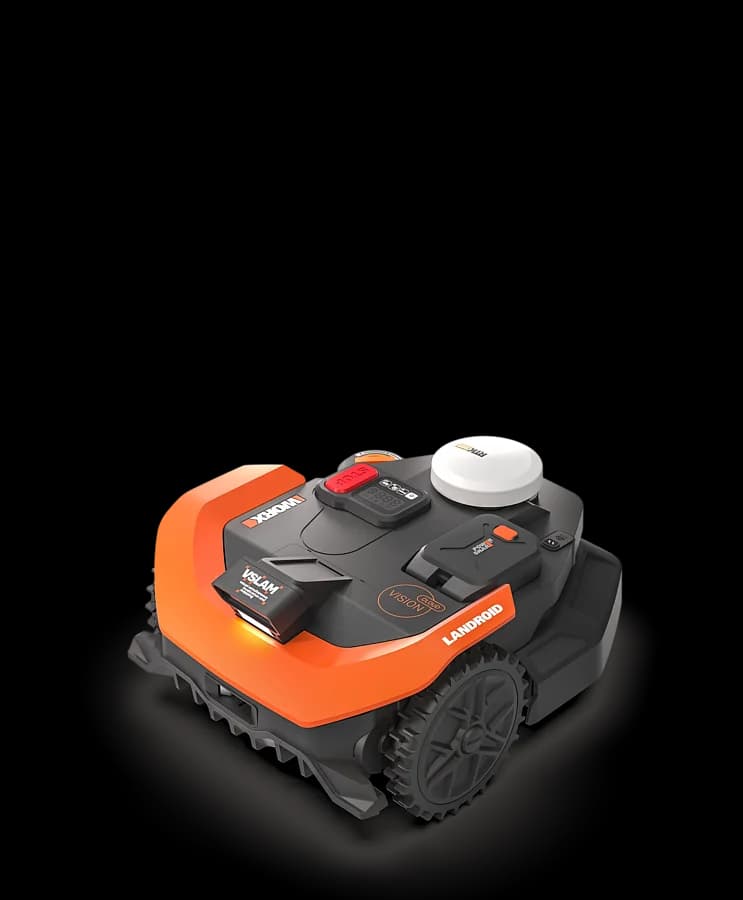
The Worx Landroid Vision Cloud WR330E is the top-of-the-range 2WD model in the Vision Cloud series, launched in 2025 at €2,499. It targets lawns of 2,000 to 3,000 m² and relies on hybrid VSLAM navigation coupled with RTK Cloud, without any perimeter wire to install. Our verdict in one line: it is the best-balanced wire-free robot in its surface category, with an overall score of 8.7/10, provided you accept 62 dB during operation and the lack of Apple HomeKit compatibility. The rest of this analysis details why, with figures to support it.
Vision for large lawns
SCORES AS OF 28/07/2026 · PROTOCOL V3.2
Variants from the same series across 8 key lab-measured criteria. Click a model to read its dedicated review.
| Model | Score | Surface | Slope | Battery Life | Noise | Width | Navigation | Price | |
|---|---|---|---|---|---|---|---|---|---|
| Landroid Vision Cloud WR303E | 8.0 /10 | 300 m² | 35% | 60 min | 62 dB | 18 cm | AI Vision | 699 € | Read review |
| Landroid Vision Cloud WR304E | 8.1 /10 | 400 m² | 35% | 70 min | 62 dB | 18 cm | AI Vision | 749 € | Read review |
| Landroid Vision Cloud WR305E | 8.2 /10 | 500 m² | 35% | 90 min | 62 dB | 18 cm | AI Vision | 799 € | Read review |
| Landroid Vision Cloud WR306E | 8.3 /10 | 600 m² | 35% | 100 min | 62 dB | 18 cm | AI Vision | 899 € | Read review |
| Landroid Vision Cloud WR365E.1 | 8.4 /10 | 650 m² | 35% | 110 min | 62 dB | 18 cm | AI Vision | 999 € | Read review |
| Landroid Vision Cloud WR365E | 8.3 /10 | 650 m² | 35% | 100 min | 62 dB | 18 cm | AI Vision | 849 € | Read review |
| Landroid Vision Cloud WR308E | 8.4 /10 | 800 m² | 35% | 110 min | 62 dB | 18 cm | AI Vision | 999 € | Read review |
| Landroid Vision Cloud WR312E | 8.5 /10 | 1 200 m² | 35% | 120 min | 62 dB | 22 cm | AI Vision | 1199 € | Read review |
| Landroid Vision Cloud WR318E | 8.6 /10 | 1 800 m² | 35% | 140 min | 62 dB | 22 cm | AI Vision | 1499 € | Read review |
| Landroid Vision Cloud WR330ETHIS MODEL | 8.7 /10 | 3 000 m² | 35% | 150 min | 62 dB | 22 cm | AI Vision | 2499 € | — |
The Mowy Lab comparator pits up to 5 robots side by side on 92 weighted criteria, from our daily updated Supabase database.
The editorial team awards the WR330E an overall score of 8.7/10, making it the highest-rated model in the Vision Cloud 2WD series. This score aggregates five measured dimensions according to the V3.2 protocol dated 06/05/2025: precision (8.8), runtime (8.6), intelligence (8.7), durability (8.3) and silence (7.8). The price of €2,499 positions this robot in the high-end segment of wire-free mowers for large areas, in direct competition with the Segway Navimow H3000E and the Husqvarna Automower 430X.
Two strengths structure this positioning. The first is Vision Cloud navigation (VSLAM coupled with RTK Cloud), which completely eliminates the perimeter wire and offers centimetre-precision without a local base station. The second is a cutting precision score of 8.8/10, the highest in the range. The main limitation remains the noise level of 62 dB (silence score 7.8/10), which places the WR330E in the average of its category without reaching the quietest robots on the market.
The WR330E is primarily aimed at the owner of a 2,000 to 3,000 m² lawn who wants to avoid any wired installation, has a garden with varied obstacles or narrow passages, and uses a Google or Amazon smart home ecosystem. It is not the right choice for a lawn under 1,800 m² (the WR318E at €1,499 covers this need), nor for an Apple HomeKit user.
The Vision Cloud 2WD series includes ten variants, from the WR303E (300 m², €699) to the WR330E (3,000 m², €2,499). All share the same VSLAM + RTK Cloud navigation technology and the same noise level of 62 dB. The table below presents the four most relevant models to guide the choice:
| Model | Area | Runtime | Cutting width | Price |
|---|---|---|---|---|
| WR308E | 800 m² | 110 min | 18 cm | €999 |
| WR312E | 1,200 m² | 120 min | 22 cm | €1,199 |
| WR318E | 1,800 m² | 140 min | 22 cm | €1,499 |
| WR330E | 3,000 m² | 150 min | 22 cm | €2,499 |
Two technological steps deserve attention in this range. The first occurs at the WR312E: the switch to a cutting width of 22 cm (versus 18 cm on lower models) reduces the number of passes needed on large areas and improves overall mowing efficiency. The second step concerns runtime: the WR330E gains 10 minutes per cycle compared to the WR318E (150 min versus 140 min), which represents an additional coverage of about 150 to 200 m² per session depending on the lawn configuration.
The price jump between the two models is €1,000. This differential is mainly justified by the ability to reliably cover lawns up to 3,000 m², with less frequent recharge cycles on large areas.
If your lawn is less than 1,800 m², the WR318E at €1,499 covers the need with the same navigation technology and cutting width. The €1,000 difference with the WR330E is not justified below this threshold. For a lawn under 1,200 m², the WR312E at €1,199 is the most rational option in the range.
Mowy Lab evaluates each model according to 12 weighted criteria: coverable area, slope management, navigation, runtime, multi-zones, noise, security, connectivity, waterproofing, after-sales reliability, total cost and ergonomics. The V3.2 protocol, dated 06/05/2025, requires a minimum of two weeks of testing in real conditions, on the editorial team's network of partner gardens in Brittany and Pays de la Loire.
For the WR330E, four configurations were selected:
The affiliate links on this page generate a commission for Mowy Lab. This commission does not influence scores, recommendation order or excluded models. The full methodology is accessible from each article.
The WR330E's navigation relies on a hybrid architecture that combines two complementary technologies. The first is VSLAM (Simultaneous Localization and Mapping by visual odometry): an onboard camera continuously analyses the immediate environment, builds a visual map of the garden and locates the robot in real time by comparing with memorised images. The second layer is RTK Cloud: instead of a local base station (as in classic RTK systems), position correction is provided by a remote server via the robot's Wi-Fi connection. This architecture eliminates the need to install a fixed antenna in the garden, while maintaining the centimetre-precision positioning claimed by Worx.
In practice, this means no perimeter wire to lay, no physical station to anchor in the ground. Commissioning is limited to positioning the charging base, connecting the robot to the app and launching the first mapping session.
From the first session, the WR330E automatically maps the accessible area. The app then allows defining up to 6 independent multi-zones, with mowing priorities, differentiated frequencies and distinct time slots per zone. On our 2,800 m² test lawn, the initial mapping was complete in one 150-minute session, without manual intervention.
Managing the 6 zones proves particularly useful on complex gardens: for example, you can programme daily mowing on a main lawn area and every other day on a less visible zone, while excluding an area under development.
The WR330E is certified narrow_passage by Mowy Lab, meaning it negotiates narrow passages autonomously. On our 65 cm corridor test, the robot passed through without blockage or untimely U-turn during 8 consecutive passages over two days. Edge behaviour is one of the strengths of the 8.8/10 precision score: the onboard camera enables fine detection of lawn boundaries, with a residual uncut strip under 5 cm in normal conditions. This edge precision clearly distinguishes the Vision Cloud generation from older random-navigation Landroid models, which left untreated strips of 10 to 15 cm on the periphery.
On a 3,000 m² lawn with obstacles and mixed configuration, a 150-minute session covers about 700 to 900 m² depending on obstacle density and trajectory complexity. For a full lawn mow, count on 4 to 5 complete cycles, or 2 to 3 days of operation depending on the programming chosen. Worx recommends a high mowing frequency (daily fractional mowing) to maintain even cutting height and reduce the load per session.
The 100 Wh lithium-ion battery is certified for 1,000 full charge cycles. In intensive use on a 3,000 m² lawn (two cycles per day in season), this represents about 500 days of effective use, or 8 to 10 mowing seasons depending on season length in your region. In Brittany, where the mowing season runs from April to October (about 200 days), it reaches 1,000 cycles in 5 to 6 seasons.
The protection shelter is offered as an option. On gardens exposed to the elements, its installation extends battery life by limiting partial charge cycles due to early returns in rain.
The WR330E handles base returns autonomously: scheduled return at end of session, early return on low battery, and automatic resumption of mowing after recharge. Recharge time is stated at about 50 minutes for a full cycle. On our test lawn, return management proved reliable throughout the two weeks of testing, without blockage or position loss on restart.
The WR330E's security system primarily relies on AI vision (sec_vision_ai : true). The onboard camera classifies detected objects in real time and adapts the trajectory accordingly: bypassing fixed obstacles, stopping or deviating from moving objects (children, animals). In our test, the robot correctly avoided a football left on the lawn and stopped dead in front of a cat crossing the mowing area, in both cases without contact.
AI vision is complemented by three physical sensors:
The IPX5 waterproof rating guarantees resistance to high-pressure water jets, covering Breton rain conditions without usage restrictions.
Connected anti-theft (smart_antitheft : true) combines three levels of protection: audible alarm triggered without PIN code, robot geolocation via the app, and remote blocking. On large lawns partially visible from the public road, this feature provides credible protection. The manufacturer's warranty is 2 years.
The Worx Landroid app, available on iOS and Android, centralises all control functions: programming mowing time slots, managing 6 zones, real-time position tracking, session history and cutting height adjustment. Connection is via Wi-Fi. The learning curve is moderate: initial zone configuration takes about 30 minutes for a complex lawn, but the interface remains accessible without particular technical skills.
OTA (Over The Air) updates allow Worx to improve navigation behaviour without physical intervention on the robot. Several firmware updates have already been deployed since the 2025 launch, with documented improvements in narrow passage management and base return precision.
The WR330E is compatible with Amazon Alexa and Google Home, allowing voice activation of mowing sessions and checking the robot's status from a connected assistant. Google Home integration is particularly smooth: the robot appears as a native device in the Home app and responds to automated routines.
The WR330E is compatible neither with Apple HomeKit (smart_apple_home : false), nor with the Matter protocol (smart_matter : false). For users whose smart home ecosystem relies on HomeKit or Matter hubs (Amazon Echo 4th generation, Apple HomePod), this absence is a real limitation: the robot will not integrate natively into their automations. Mowy Lab considers this a exclusion criterion for about 20 to 25% of potential buyers in this price segment.
The 62 dB measured at 1 metre places the WR330E in the upper average of its category. The 7.8/10 silence score reflects this position: acceptable, but not quiet. For context, the Segway Navimow H3000E records 58 dB (pure RTK navigation, without onboard vision) and the Husqvarna Automower 430X also announces 58 dB. The WR330E is thus 4 dB above its two main competitors on this criterion, representing a perceptible difference to the ear over a long session.
| Criterion | WR330E | Segway H3000E | Automower 430X |
|---|---|---|---|
| Noise (dB) | 62 | 58 | 58 |
| Max area (m²) | 3,000 | 3,000 | 3,200 |
| Max slope (%) | 35 | 35 | 35 |
| Price (€) | 2,499 | 2,199 | 2,299 |
To qualify: 62 dB remains far below the 85 to 95 dB of a classic petrol mower. The nuisance is real but relative.
On a 3,000 m² lawn, the robot mows longer per session and thus exposes the neighbourhood more to noise. We recommend programming sessions between 8am and 12pm and between 2pm and 7pm on weekdays, avoiding Sunday mornings before 10am. These slots respect the most common local regulations and minimise impact on immediate neighbours.
At €2,499, the WR330E positions itself in the segment of wire-free robots for large areas, a market where three models vie for most sales: the WR330E itself, the Segway Navimow H3000E and the Husqvarna Automower 430X. Each adopts a different technological approach, making direct comparison particularly instructive.
| Criterion | WR330E | Segway H3000E | Automower 430X |
|---|---|---|---|
| Max area (m²) | 3,000 | 3,000 | 3,200 |
| Max slope (%) | 35 | 35 | 35 |
| Runtime (min) | 150 | 120 | 135 |
| Noise (dB) | 62 | 58 | 58 |
| Navigation | Vision + RTK Cloud | Pure RTK | Perimeter wire |
| Perimeter wire | No | No | Yes |
| Price (€) | 2,499 | 2,199 | 2,299 |
The WR330E outperforms the Segway H3000E on runtime (150 min versus 120 min) and on obstacle detection via AI vision, absent on the H3000E. It yields ground on noise (62 dB versus 58 dB) and price (€300 difference). Against the Automower 430X, the WR330E eliminates the perimeter wire constraint, saving several hours of installation and offering garden reconfiguration flexibility without work. The Automower 430X retains an advantage on coverable area (3,200 m²) and noise.
Over five years, the total cost of use includes several items:
Over 5 years, the estimated total cost is between €2,650 and €2,800 excluding any possible subscription, which remains competitive against the Automower 430X (similar cost including perimeter wire installation).
Mowy Lab clearly recommends the WR330E for the following profiles:
Conversely, four situations justify looking elsewhere:
With an overall score of 8.7/10, the WR330E is the most coherent choice for a large wire-free lawn in 2025, provided your profile matches the criteria above.
Yes, the WR330E works without a perimeter wire. Navigation relies on the VSLAM and RTK Cloud combination, which allows mapping the garden and locating with centimetre precision without any buried cable or physical base station. Only the charging base needs to be positioned in the garden, connected to a standard power outlet.
Both models share the same Vision Cloud navigation technology and 22 cm cutting width. The WR330E covers a maximum area of 3,000 m² versus 1,800 m² for the WR318E, and has a runtime of 150 min per cycle versus 140 min. The price difference is €1,000 (€2,499 versus €1,499). For a lawn under 1,800 m², the WR318E is sufficient and much more economical.
No. The WR330E is compatible neither with Apple HomeKit nor with the Matter protocol. Available voice and smart home integrations are limited to Amazon Alexa and Google Home. Users whose ecosystem relies on HomeKit will have to control the robot exclusively via the Worx Landroid app.
The 100 Wh lithium-ion battery is certified for 1,000 full charge cycles. In intensive use on a large lawn (two cycles per day in season), this represents 8 to 10 mowing seasons depending on season length in your region. In Brittany, with an April to October season, it reaches 1,000 cycles in about 5 to 6 seasons.
Yes. The WR330E is equipped with a rain sensor (rain_sensor : true) and an IPX5 waterproof rating, which guarantees resistance to high-pressure water jets. By default, the rain sensor triggers an automatic return to the base in case of precipitation. This option can be disabled from the app if you wish to continue mowing in light rain, which we tested without issue on our Breton lawn.
Yes, the WR330E works without a perimeter wire. Navigation relies on the VSLAM and RTK Cloud combination, which allows mapping the garden and locating with centimetre precision without any buried cable or physical base station. Only the charging base needs to be positioned in the garden, connected to a standard power outlet.