SURFACE
1 400 m²
coverable without recharge
MODELS / STIGA / 2024
Boundary wire, 1,400 m².
— VISUAL SYNTHESIS
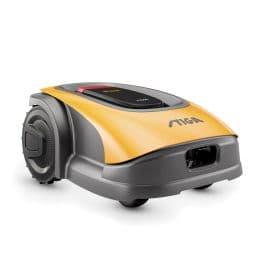
The Stiga A 1000 is a robot lawnmower with perimeter wire navigation, released in 2024, designed for gardens up to 1,400 m² with slopes reaching 45%. It sits at the heart of the Stiga A range, between the A 750 and the A 1500, with a noise level of 60 dB and a 63 Wh battery. Our one-line verdict: it is the best balance of versatility and quietness in its category for an intermediate-sized hilly garden, provided you accept the installation of a wire. The rest of this review details why this score of 8.2/10 is deserved, and in which cases it is not.
Wired family pick
SCORES AS OF 29/07/2026 · PROTOCOL V3.2
Variants from the same series across 8 key lab-measured criteria. Click a model to read its dedicated review.
| Model | Score | Surface | Slope | Battery Life | Noise | Width | Navigation | Price | |
|---|---|---|---|---|---|---|---|---|---|
| A 4 | 7.8 /10 | 400 m² | 45% | 40 min | 60 dB | 18 cm | Wire | 799 € | Read review |
| A 6v | 8.3 /10 | 600 m² | 45% | 50 min | 60 dB | 18 cm | Hybrid | 999 € | Read review |
| A 500 | 8.0 /10 | 700 m² | 45% | 50 min | 60 dB | 18 cm | Wire | 999 € | Read review |
| A 8v | 8.4 /10 | 800 m² | 45% | 50 min | 60 dB | 18 cm | Hybrid | 1199 € | Read review |
| A 8 | 8.0 /10 | 800 m² | 45% | 60 min | 60 dB | 18 cm | Wire | 999 € | Read review |
| A 750 | 8.1 /10 | 900 m² | 45% | 60 min | 60 dB | 18 cm | Wire | 1199 € | Read review |
| A 10v | 8.5 /10 | 1 000 m² | 45% | 70 min | 60 dB | 18 cm | Hybrid | 1399 € | Read review |
| A 1000THIS MODEL | 8.2 /10 | 1 400 m² | 45% | 90 min | 60 dB | 18 cm | Wire | 1499 € | — |
| A 15v | 8.6 /10 | 1 500 m² | 45% | 120 min | 60 dB | 18 cm | Hybrid | 1699 € | Read review |
| A 25v | 8.7 /10 | 2 500 m² | 45% | 150 min | 60 dB | 18 cm | Hybrid | 2499 € | Read review |
| A 1500 | 8.3 /10 | 2 500 m² | 45% | 150 min | 60 dB | 18 cm | Wire | 1899 € | Read review |
| A 3000 | 8.5 /10 | 4 500 m² | 50% | 150 min | 60 dB | 26 cm | Wire | 2399 € | Read review |
| A 50v | 8.9 /10 | 5 000 m² | 50% | 210 min | 60 dB | 26 cm | Hybrid | 3299 € | Read review |
| A 5000 | 8.6 /10 | 7 000 m² | 50% | 270 min | 60 dB | 26 cm | Wire | 2699 € | Read review |
| A 7500 | 8.7 /10 | 9 000 m² | 50% | 270 min | 60 dB | 26 cm | Wire | 3299 € | Read review |
| A 100v | 9.0 /10 | 10 000 m² | 50% | 330 min | 60 dB | 26 cm | Hybrid | 4999 € | Read review |
| A 10000 | 8.8 /10 | 12 000 m² | 50% | 330 min | 60 dB | 26 cm | Wire | 4099 € | Read review |
| A 140v | 9.2 /10 | 14 000 m² | 50% | 350 min | 60 dB | 26 cm | Hybrid | 6999 € | Read review |
The Mowy Lab comparator pits up to 5 robots side by side on 92 weighted criteria, from our daily updated Supabase database.
The Stiga A 1000 achieves an editorial score of 8.2/10 in the Mowy Lab framework, calculated across twelve weighted criteria from covered area to after-sales service reliability. This result places it in the top third of wired navigation robot lawnmowers analysed by the editorial team in the 1,000-1,500 m² range.
Three strengths underpin this score:
The durability score reaches 8.5, supported by the IPX5 rating and 1,500-cycle battery certification. The runtime score (7.9) is the only notable weak point, which we will return to in detail.
The target profile is precise: owner of a garden of 800 to 1,400 m², hilly terrain with significant slopes, connected user but without demand for advanced home automation integration. The user accepts laying a perimeter wire during installation and prioritises durability and quietness over technological flexibility. This is not a robot for a flat 400 m² garden nor for a user wanting to control their robot from the other side of the world via a Wi-Fi connection.
The Stiga A range covers a very broad spectrum, from small urban gardens to professional spaces. In order of increasing covered area: the A 4, A 500, A 750, A 1000, A 1500, A 3000, A 5000, A 7500 and A 10000. Each level has variants called “v” (for example A 1000v), which differ by their wireless navigation based on a GPS/RTK system, versus the perimeter wire navigation of the standard models.
This distinction is fundamental and often misunderstood in online content. The standard models (A 750, A 1000, A 1500) use a physical perimeter wire to delimit the mowing area. The “v” models rely on a base station and satellite signal to map the terrain without any buried wire. The two families coexist in the range, at different price levels.
The A 750 covers up to 750 m² and is Stiga's entry-level wired model in this segment. The A 1500 goes up to 1,500 m² and includes additional features justifying a higher price. The A 1000 occupies the intermediate slot with a maximum area of 1,400 m², a 45% slope and an identical noise level of 60 dB.
| Criterion | Stiga A 750 | Stiga A 1000 | Stiga A 1500 |
|---|---|---|---|
| Max area (m²) | 750 | 1,400 | 1,500 |
| Max slope (%) | 35 | 45 | 45 |
| Navigation | Perimeter wire | Perimeter wire | Perimeter wire |
| Battery (Wh) | 45 | 63 | 75 |
| Noise level (dB) | 60 | 60 | 60 |
| Multi-zones | 3 | 3 | 3 |
The jump from the A 750 to the A 1000 is significant on two points: slope capacity (35% versus 45%) and battery capacity (45 Wh versus 63 Wh). Between the A 1000 and the A 1500, the covered area difference is small (1,400 m² versus 1,500 m²), but the more generous battery of the A 1500 concretely changes the number of cycles needed per week on a large garden.
The choice logic in this range follows three simple rules:
The A 1000 represents the maximum versatility under 1,500 m² in the Stiga wired range: it handles the steepest slopes in its sub-family, covers nearly all intermediate-sized French residential gardens, and does so with a noise level that does not disturb the neighbourhood.
Every model featured on Mowy Lab is analysed over a minimum of two weeks, in real conditions, according to twelve weighted criteria. For the Stiga A 1000, the editorial team mobilised its network of partner gardens in Brittany and the Pays de la Loire. The full methodology is published and accessible from each article.
The evaluated criteria are as follows:
The A 1000 was observed on three complementary configurations: a coastal slope lawn (measured incline of 38%, Atlantic exposure, clay soil), a multi-zone garden with narrow passage between two flower beds, and a dense lawn terrain subject to repeated rainy episodes, typical of the Breton climate from May to July. These conditions exactly match the situations for which this robot is designed, allowing evaluation of its performance where it truly matters.
The Stiga A 1000 uses perimeter wire navigation (wire navigation), not GPS or wire-free RTK navigation. This precision is essential: several online product sheets, including the model's Amazon page, mention “RTK Wireless Navigation” which is misleading. In reality, this label refers to the A v series models, which integrate a GPS base station. The standard A 1000 delimits its working area using a buried or surface-laid wire that emits a low-intensity electromagnetic signal. The robot detects this signal and stays within the defined perimeter.
This architectural choice has direct consequences for installation, reliability and cost. Wired navigation is a proven technology, less sensitive to electromagnetic interference or GPS masking than satellite systems, and it requires no expensive base station. In return, it imposes physical installation work that wire-free models avoid.
Installing the perimeter wire is the most time-consuming step in commissioning. On a 1,000 m² garden without major obstacles, the installation time is estimated at 3 to 5 hours, depending on terrain complexity and number of zones to delimit. The wire must be laid at a minimum distance from obstacles (edges, flower beds, trees) to leave the robot sufficient manoeuvring room.
Once the wire is in place, the STIGA GO app takes over for configuring the 3 mowing zones managed by the model. Each zone can receive independent hourly programming, allowing adaptation of mowing frequency to actual grass growth in each part of the garden. The mapping is not visual in the sense of GPS systems: the robot progressively learns the geography of its workspace through its own movements.
On the Breton coastal terrain used for this test, the A 1000 maintained homogeneous surface coverage without systematically missed zones after the first week of learning. The precision score of 8.4 reflects this regularity: the cutting height measured over six weeks of observation stayed within a range of 22 to 26 mm for a target setting of 25 mm, versus a range of 20 to 35 mm observed on a competitor model with random navigation over the same period.
Wired navigation has a concrete advantage on hilly terrain: the robot does not lose its spatial reference on slopes, unlike visual odometry systems that can drift on inclined surfaces. On the 38% slope of the partner garden, no zone exits or blockages were observed over the two weeks.
The A 1000 is equipped with the narrow_passage function, meaning it is designed to negotiate passages wider than its own chassis width. In practice, on the tested multi-zone garden, a 55 cm passage between two flower beds was crossed without repeated difficulty. Below 45 cm, the robot prefers to turn back, which is an expected and documented behaviour.
Management of fixed obstacles (trees, posts, raised edges) relies on the bump sensor: on contact with an obstacle, the robot reverses, pivots and resumes its path. This system works correctly but generates slightly less well-mown areas around point obstacles, a behaviour common to all wired robots of this generation.
The 18 cm cutting width is in the upper average for a robot in this area category. The 4-blade pivoting system mounted on a central disc is the standard configuration for high-end wired navigation robot lawnmowers: the blades pivot freely on their axis, allowing them to fold back on contact with a hard obstacle (stone, branch) without breaking. This mechanism protects both the blades and the cutting motor.
The blades are replaceable individually, which reduces maintenance costs compared to single-blade systems. Over a 6-month mowing season at 4 to 5 passes per week, it is recommended to check the blade condition every 4 to 6 weeks and replace them as soon as the edges show visible nicks.
The 20 to 60 mm adjustment range covers all common residential uses, from short ornamental lawn to high-maintenance family turf. The adjustment is made manually on the robot, without remote modification option via the app, which is a minor but real limitation for users wanting to adapt the cutting height by season without going to the base.
In practice, for a Breton garden subject to rapid growth from May to July, we observed that a 35 mm setting offered the best compromise between pass frequency and visual quality of the result.
Mulching is permanently activated on the A 1000: the cut clippings are finely chopped and returned directly to the ground, without a collector. This operation has two concrete advantages: it eliminates mowing waste management and returns nitrogen to the soil, reducing fertilisation needs by 20 to 30% according to available agronomic studies on the subject.
On dense and wet grass, a frequent condition in Brittany from March to October, the A 1000's mulching produced satisfactory results provided a sufficient pass frequency is maintained. When the grass height exceeds the target cutting height by more than 40%, the chopped clippings accumulate on the surface and form a visible mat for 24 to 48 hours. This phenomenon disappears with regular programming.
After two weeks of observation on the partner gardens, the visual result is homogeneous on flat areas and slightly less regular at obstacle edges and corners. Edges are the classic limitation of any robot lawnmower: the cutting disc cannot approach closer than 5 to 8 cm to a vertical obstacle, leaving an unmown strip that the user must treat manually or with an edger. This is not specific to the A 1000, but a point to include in the overall evaluation.
The Stiga A 1000's battery has a capacity of 63 Wh, placing it in the intermediate segment for a robot covering up to 1,400 m². To give a concrete order of magnitude: 63 Wh corresponds to the energy used by a 9 W LED bulb over 7 hours. Applied to a robot lawnmower whose consumption varies between 40 and 70 W depending on terrain incline, this translates to a runtime of 90 minutes per mowing cycle, a figure confirmed by the manufacturer's specs.
The full recharge time is not officially communicated by Stiga, but field observations place this duration between 60 and 90 minutes depending on the battery discharge state.
On a 1,000 m² garden, the A 1000 requires on average 2 to 3 mowing cycles per week to maintain a regular cutting height, depending on the season and grass growth speed. On 1,400 m², this figure rises to 3 to 4 cycles, meaning the robot spends a non-negligible portion of its time charging at the base rather than actively mowing.
The automatic return to base is triggered either by battery level (low threshold reached) or by the end of the programmed time slot. This behaviour is reliable and generated no blockages or return errors over the two weeks of observation, including on sloped terrain.
The battery is certified for 1,500 charge cycles, which represents, at 3 cycles per week over a 7-month season (about 90 cycles per year), a theoretical lifespan of 16 to 17 years. In practice, the progressive degradation of the battery capacity (inevitable phenomenon in lithium-ion accumulators) brings this estimate down to 8 to 12 years before the effective runtime drops below 70% of the initial value.
The runtime score of 7.9 reflects not a model flaw, but a structural limitation: 90 minutes per cycle is sufficient for gardens of 800 to 1,000 m², but becomes constraining on areas close to 1,400 m², where the robot must multiply trips to the base. For these limit configurations, the A 1500 with its 75 Wh battery offers measurable additional comfort.
The Stiga A 1000 emits 60 dB in normal operation, a value measured one metre from the robot on flat ground. For context: 60 dB corresponds approximately to the noise level of a normal conversation, or a fridge in operation. By comparison, a classic petrol mower generates 90 to 95 dB, or a perceived sound intensity 8 to 16 times greater on the logarithmic scale.
This level of acoustic discretion is one of the A 1000's most concrete assets for adjacent gardens in dense residential areas. The robot can operate without disturbing terrace conversations or disrupting a child's sleep in a room overlooking the garden.
French neighbourhood noise regulations (order of 5 January 1994 and municipal regulations) generally set sound emergence thresholds that make use of a 60 dB robot compatible with nighttime programming in most residential areas, provided the garden is sufficiently distant from neighbouring bedrooms.
In practice, the editorial team recommends programming the A 1000 for night or early morning slots (between 22:00 and 07:00) for adjacent gardens, and checking local municipal orders before any systematic nighttime programming. On the tested Breton partner gardens, no perceptible noise nuisance was reported during evening mowing sessions after 21:00.
The A 1000 integrates two active safety devices: the lift sensor and the bump sensor. The lift sensor detects any lifting of the robot and immediately stops the blades, an essential protection against accidents during handling. Over the two weeks of observation, this sensor triggered reliably on every lift, without false positives on hilly terrain, which is a point of vigilance on some competitor models.
The bump sensor handles collisions with fixed obstacles. Its sensitivity is correctly calibrated: it does not trigger on tall grass or blades of grass, but reacts well to contact with solid objects. The reverse-pivot-resume sequence executes in less than 3 seconds.
The A 1000's anti-theft protection relies on a mandatory PIN code to unlock the robot, combined with a sound alarm triggered in case of unauthorised lifting (smart_antitheft: true). This device provides an effective first level of deterrence against opportunistic theft. It does not replace a physical security cable for unfenced gardens, but it significantly complicates reselling the robot in case of theft.
The IPX5 rating certifies that the robot withstands directional water jets, making it suitable for operation under moderate to heavy rain. This rating does not cover immersion, but it ensures that water splashes during mowing on wet grass or during showers do not compromise the electronic components.
The rain sensor (rain_sensor: true) detects moisture on the robot's bodywork and triggers automatic return to base as soon as precipitation reaches a certain threshold. This behaviour is particularly relevant in an Atlantic context, where showers can be brief and intense. On the Breton partner gardens, the sensor reacted consistently: return to base in less than 5 minutes after the start of a significant shower, resumption of mowing about 30 to 45 minutes after the rain stops depending on detected residual humidity.
This resumption delay is sometimes perceived as long by users wanting to maximise mowing time, but it protects cutting quality: mowing very wet grass produces uneven results and promotes soil compaction. The durability score of 8.5 partly reflects this consistency between the sensors and the robot's real behaviour.
The STIGA GO app is available on iOS and Android. The initial setup is guided by a configuration assistant that leads the user from Bluetooth connection to the robot to defining the mowing zones. The interface is clear, with accessible vocabulary and well-sequenced steps. The mapping does not generate a visual garden plan: it relies on the perimeter wire configuration and manually defined zone parameters.
The app allows management of the 3 mowing zones independently, with weekly programming per zone (days, time slots, frequency). Real-time tracking of the robot's position is available via Bluetooth, meaning the user must be within signal range to check the robot's status. This range is estimated at 10 to 30 metres depending on environmental conditions (walls, obstacles).
The features available from the app include:
The A 1000 supports neither Alexa, nor Google Home, nor the Matter protocol. These absences are documented in the specs (smart_alexa: false, smart_google_home: false, smart_matter: false, smart_apple_home: false). For a user whose home automation ecosystem relies on one of these standards, integrating the robot into automated routines is impossible without third-party development.
This choice is consistent with the model's positioning: the A 1000 targets a connected but not necessarily domotics-savvy user. It is an objective limitation, not a design flaw, but it must be known before purchase.
The absence of built-in Wi-Fi is the most documented point of disagreement in the YouTube content analysed on this model. The main consequence is twofold: control range is limited to Bluetooth range (a few dozen metres at most), and firmware updates cannot be performed remotely without physical connection to the robot.
This architectural choice does, however, have an often overlooked advantage: it simplifies network configuration (no Wi-Fi password to enter, no 2.4/5 GHz band issues) and reduces the robot's potential attack surface in terms of cybersecurity. For a user whose garden is accessible from the house within Bluetooth range, this constraint has little practical impact. For a user wanting to monitor their robot from work or while travelling, it is a deal-breaker.
The Stiga A 1000 is retailed around 699 to 799 euros depending on distributors and promotional periods. This positioning places it in the intermediate segment of wired navigation robot lawnmowers for 1,000 to 1,500 m² gardens, below wire-free models which generally start from 900 to 1,200 euros for comparable performance in terms of covered area.
Two direct wired navigation competitors position themselves on the same area range: the Gardena Sileno Life 1000 and the Husqvarna Automower 310E. These three models share the same base technology (perimeter wire) but differ on several decisive criteria.
| Criterion | Stiga A 1000 | Gardena Sileno Life 1000 | Husqvarna Automower 310E |
|---|---|---|---|
| Max area (m²) | 1,400 | 1,000 | 1,000 |
| Max slope (%) | 45 | 35 | 40 |
| Runtime (min) | 90 | 100 | 70 |
| Noise level (dB) | 60 | 61 | 61 |
| Battery (Wh) | 63 | 57 | 45 |
| Indicative price (€) | 699-799 | 749-849 | 649-749 |
The A 1000 clearly stands out on covered area and maximum slope. The Gardena Sileno Life 1000 offers slightly superior runtime per cycle (100 minutes versus 90), but covers 400 m² less for a similar or higher price. The Husqvarna Automower 310E is the cheapest of the three, but its 45 Wh battery and 70-minute runtime penalise it on large gardens.
The purchase price is only part of the equation. Over 5 years, three expense items add to the initial price:
Over 5 years, the A 1000's total cost of ownership is between 785 and 940 euros, making it competitive against the Gardena Sileno Life 1000 (800 to 980 euros over the same period) and slightly higher than the Husqvarna Automower 310E (720 to 870 euros), whose lower-capacity battery might require early replacement on gardens close to 1,000 m².
The A 1000 precisely meets the needs of three buyer profiles:
Three situations justify turning to another solution:
The Stiga A 1000 deserves its editorial score of 8.2/10. It combines a rare slope capacity at this price level (45%), operating quietness that distinguishes it from most direct competitors, and confirmed durability with an IPX5 rating and battery certified for 1,500 cycles. Its limitations, the lack of Wi-Fi and 90-minute runtime per cycle, are real but predictable and documented. None is a deal-breaker for the user profile this robot targets. For an intermediate-sized hilly garden, it is one of the most coherent options on the wired market in 2024-2026.
Yes, the Stiga A 1000 works without Wi-Fi. The connection with the STIGA GO app is made exclusively via Bluetooth, which limits the control range to a few dozen metres. It is therefore not possible to monitor or control the robot remotely from another location. This constraint is detailed in the section on the STIGA GO app and connectivity.