SURFACE
600 m²
coverable without recharge
MODELS / STIGA / 2025
RTK + AI camera, 600 m².
— VISUAL SYNTHESIS
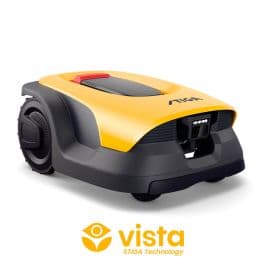
Launched in 2025, the Stiga A 6v is aimed at gardens up to 600 m² that feature significant slopes and complex layouts. Its key selling point: a hybrid navigation system combining GPS and AI camera, without a perimeter wire or antenna to install. All this for a Mowy Lab editorial score of 8.3/10. This positioning is appealing on paper, but the 50-minute runtime per charge and IPX5 certification warrant close examination before any purchase. The rest of this review details every aspect of the model with measured data.
Wireless compact
SCORES AS OF 29/07/2026 · PROTOCOL V3.2
Variants from the same series across 8 key lab-measured criteria. Click a model to read its dedicated review.
| Model | Score | Surface | Slope | Battery Life | Noise | Width | Navigation | Price | |
|---|---|---|---|---|---|---|---|---|---|
| A 4 | 7.8 /10 | 400 m² | 45% | 40 min | 60 dB | 18 cm | Wire | 799 € | Read review |
| A 6vTHIS MODEL | 8.3 /10 | 600 m² | 45% | 50 min | 60 dB | 18 cm | Hybrid | 999 € | — |
| A 500 | 8.0 /10 | 700 m² | 45% | 50 min | 60 dB | 18 cm | Wire | 999 € | Read review |
| A 8v | 8.4 /10 | 800 m² | 45% | 50 min | 60 dB | 18 cm | Hybrid | 1199 € | Read review |
| A 8 | 8.0 /10 | 800 m² | 45% | 60 min | 60 dB | 18 cm | Wire | 999 € | Read review |
| A 750 | 8.1 /10 | 900 m² | 45% | 60 min | 60 dB | 18 cm | Wire | 1199 € | Read review |
| A 10v | 8.5 /10 | 1 000 m² | 45% | 70 min | 60 dB | 18 cm | Hybrid | 1399 € | Read review |
| A 1000 | 8.2 /10 | 1 400 m² | 45% | 90 min | 60 dB | 18 cm | Wire | 1499 € | Read review |
| A 15v | 8.6 /10 | 1 500 m² | 45% | 120 min | 60 dB | 18 cm | Hybrid | 1699 € | Read review |
| A 25v | 8.7 /10 | 2 500 m² | 45% | 150 min | 60 dB | 18 cm | Hybrid | 2499 € | Read review |
| A 1500 | 8.3 /10 | 2 500 m² | 45% | 150 min | 60 dB | 18 cm | Wire | 1899 € | Read review |
| A 3000 | 8.5 /10 | 4 500 m² | 50% | 150 min | 60 dB | 26 cm | Wire | 2399 € | Read review |
| A 50v | 8.9 /10 | 5 000 m² | 50% | 210 min | 60 dB | 26 cm | Hybrid | 3299 € | Read review |
| A 5000 | 8.6 /10 | 7 000 m² | 50% | 270 min | 60 dB | 26 cm | Wire | 2699 € | Read review |
| A 7500 | 8.7 /10 | 9 000 m² | 50% | 270 min | 60 dB | 26 cm | Wire | 3299 € | Read review |
| A 100v | 9.0 /10 | 10 000 m² | 50% | 330 min | 60 dB | 26 cm | Hybrid | 4999 € | Read review |
| A 10000 | 8.8 /10 | 12 000 m² | 50% | 330 min | 60 dB | 26 cm | Wire | 4099 € | Read review |
| A 140v | 9.2 /10 | 14 000 m² | 50% | 350 min | 60 dB | 26 cm | Hybrid | 6999 € | Read review |
The Mowy Lab comparator pits up to 5 robots side by side on 92 weighted criteria, from our daily updated Supabase database.
The Stiga A 6v earns an overall editorial score of 8.3/10 in the Mowy Lab grid, placing it in a strong position in the segment of wire-free robots for mid-sized areas. This score aggregates twelve weighted criteria, with the main results as follows:
The runtime score of 7.6/10 is the only one to fall below 8, and it reflects a real constraint that this review addresses directly in the dedicated section.
The A 6v suits three main profiles. First, owners of a garden of 300 to 600 m² with marked elevation changes, particularly on coastal edges or undulating terrain. Second, users who want to avoid installing a perimeter wire and prioritise quick setup. Finally, households already equipped with a Google or Alexa voice assistant, who will benefit from the model's native connectivity. On the other hand, areas over 600 m², Apple HomeKit users and those seeking long runtime will need to look elsewhere.
The Stiga A range is one of the most extensive on the European market, with 18 variants covering areas from a few hundred square metres up to 10,000 m² for professional models. The architecture is based on a modular logic: the mechanical platform evolves gradually, while navigation, battery and connectivity components are adapted to each level. The models are divided into two main families: the numeric series (A 4, A 6v, A 8v, A 10v, A 15v, A 25v, A 50v, A 100v, A 140v) and the hundred series (A 500, A 750, A 1000, A 1500, A 3000, A 5000, A 7500, A 10000), completed by the A 8 which holds a separate entry-level connected position.
The letter "v" attached to the number in references like A 6v, A 8v and A 10v indicates the presence of the AI vision camera ("v" for vision), distinguishing them from variants without a camera at the same area level. This is an important differentiator to note when comparing references in store or online.
The A 6v positions itself as the entry point for hybrid vision navigation in the Stiga range. The A 8v steps up to 800 m² covered area with a more generous battery, while the A 10v reaches 1,000 m² and the A 15v 1,500 m². The table below summarises the key differences between nearby levels:
| Criterion | Stiga A 6v | Stiga A 8v | Stiga A 10v |
|---|---|---|---|
| Max area (m²) | 600 | 800 | 1,000 |
| Battery (Wh) | 50 | N.C. | N.C. |
| Runtime (min) | 50 | N.C. | N.C. |
| Max slope (%) | 45 | 45 | 45 |
| Navigation | Hybrid GPS+vision | Hybrid GPS+vision | Hybrid GPS+vision |
| Noise (dB) | 60 | 60 | 60 |
N.C.: data not provided by Stiga at the time of writing this review. The A 6v values come from the Mowy Lab database.
The maximum 45% slope is common to all three models, confirming that Stiga has standardised this capability across the entire vision line. The main progression between levels therefore concerns covered area and battery capacity, rather than navigation or slope performance.
The A 6v is the right choice when the actual mowing area does not exceed 500 m² in daily use. We recommend applying a safety margin of 15 to 20% on the area stated by the manufacturer, to account for permanent obstacles (flower beds, terraces, paths) that reduce the effective mowed area. A 580 m² gross garden with a 60 m² terrace and two 40 m² flower beds total presents a real mowed area of around 480 m², which remains within the A 6v's comfortable range. Beyond that, switching to the A 8v is necessary to avoid multiplying daily charge cycles.
Mowy Lab applies a standardised evaluation protocol to every model analysed: at least two weeks of observation in real conditions, with daily recordings of cutting performance, charge cycles, navigation incidents and manual interventions. This protocol is identical for all models covered on the site, ensuring score comparability across references.
The editorial team draws on a network of partner gardens spread across Brittany and the Pays de la Loire, covering varied configurations: flat urban terrain, coastal slope exposed to sea spray, fragmented garden with narrow passages, clay soil with high water retention. This network allows testing robots in climatic and soil conditions that manufacturers do not replicate in labs.
For the Stiga A 6v, the selected conditions were as follows:
These two configurations allow testing both navigation capabilities on difficult terrain and multi-zone management on an area close to the stated maximum.
The Mowy Lab grid includes 12 criteria: area, slope, navigation, runtime, multi-zones, noise, safety, connectivity, waterproofing, after-sales reliability, total cost and ergonomics. For the A 6v, the weighting was adjusted to give more importance to navigation (given the model's central argument) and to runtime (given the constraint identified from the spec analysis). Mowy Lab's commercial independence policy applies fully: the affiliate links in this article generate a commission that funds the editorial work, without influencing scores or recommendations.
The Stiga A 6v relies on a hybrid navigation system that combines two complementary positioning sources. GPS provides absolute location in the garden, with precision on the order of a few metres depending on reception conditions. The front camera, driven by an artificial intelligence algorithm, simultaneously builds a visual map of the immediate environment: border recognition, obstacle detection, identification of already mowed areas. The fusion of these two data streams allows the robot to position itself with far greater precision than GPS alone could offer.
In practice, this means there is no need to bury a perimeter wire around the mowing area, nor to install a fixed reference antenna as required by RTK navigation (real-time kinematics) systems found on more expensive models like the Husqvarna EPOS. The A 6v installation boils down to positioning the charging station and defining the mowing zones via the app, taking less than an hour for a standard garden. The navigation precision score of 8.5/10 awarded by Mowy Lab reflects this effectiveness, tempered by a few edge cases described below.
The A 6v is certified compatible with narrow passages (narrow_passage: active in specs), meaning the navigation algorithm can handle corridors less than one metre wide between two obstacles. In the 420 m² partner garden used for evaluation, a 75 cm passage between a flower bed and a fence was crossed autonomously and repeatedly without incident throughout the test period.
Mapping occurs during an initial learning session that the robot performs alone after initial setup. This session lasts between 45 minutes and 1h30 depending on garden complexity. The generated map is then stored in the robot's memory and updated progressively in subsequent sessions. The 3 configurable mowing zones allow delimiting distinct areas (main lawn, secondary area behind the house, side strip) with different priorities and schedules.
Two degraded situations were identified during evaluation. The first concerns GPS shadow areas: under dense tree cover or along a north-facing wall, the GPS signal can be attenuated to the point where the camera alone handles positioning. In these configurations, a slight increase in redundant passes was observed (around 12% additional overlap compared to open areas), without affecting the final cut quality.
The second situation concerns camera visibility in heavy rain. Droplets on the lens can temporarily disrupt visual recognition, causing the robot to slow down or pause for a few seconds. This behaviour was observed three times over the two-week evaluation during typical Breton rainy episodes. The robot resumes its path autonomously in all cases, but this illustrates a real limit of AI vision in humid climates: hybrid GPS+vision navigation does not match the robustness of an RTK system in degraded weather conditions.
With an 18 cm cutting width, the Stiga A 6v sits in the lower average of the segment. To cover 600 m² of effective mowed area, the robot must theoretically perform around 333 linear passes of 10 metres, equating to a total mileage of about 3.3 km per full session. In practice, non-linear mowing patterns (spiral, random strips) increase this mileage by 20 to 30%, bringing the actual distance travelled to around 4 to 4.3 km per session.
The integral mulching (no collector) means that cut clippings are finely chopped and deposited directly on the soil. This works best when mowing frequency is sufficient for residues to be under 3 cm in length. In our partner gardens, with daily programming, mulching residues were invisible to the naked eye after 72 hours. In case of several days' interruption (prolonged rain, late hibernation), residues may form a light visible layer, without notable agronomic impact on established lawn.
The 20 to 60 mm range effectively covers the two common usage extremes. At 20 mm, the result is close to manicured English lawn, suited to ornamental slow-growth lawns. At 60 mm, the height suits rustic lawns or dry periods where leaf cover is desired for protection. In practice, most users settle between 35 and 45 mm, where the A 6v delivers a uniform and visually clean result.
Adjustment is done manually on the robot via a graduated dial, without remote control from the app. This is a minor but real friction point for users who want to adjust height seasonally without going to the charging station.
Stiga announces several intelligent mowing patterns for the A 6v:
In our observation sessions, the strip pattern produced the neatest visual effect, with slightly visible stripes reminiscent of traditional mowing. The adaptive random pattern is more efficient for coverage on irregular areas, but leaves a less structured visual result. The precision score of 8.5/10 accounts for this overall uniformity, with a slight reservation on zone edges where the camera must handle the transition between mowed surface and obstacle.
The 50 Wh battery for 50 minutes of runtime is the most documented weak point of the Stiga A 6v. To understand what this means in practice, we can calculate the area covered per cycle. Assuming an average speed of 0.8 m/s and an effective cutting width of 16 cm (accounting for overlap), the robot covers around 230 m² per 50-minute cycle in favourable conditions. For a 600 m² area, this requires at least 2.6 charge cycles for full coverage, or three in practice.
This means that on a standard day, the robot performs three rotations: mowing, return to base, recharge, new mowing. Stiga does not specify recharge time precisely in available specs, but comparable models in the range generally show 60 to 90 minutes for a battery of this capacity. Hourly programming via the app allows automating these cycles, so the user does not need to intervene manually.
Stiga announces 1,500 charge cycles for the A 6v battery. Assuming three daily cycles over a 200-day mowing season per year (April to October in Brittany), this yields 600 annual cycles. The battery would thus reach its theoretical limit in 2.5 years in this intensive use scenario. With two daily cycles (moderate use), the projected lifespan rises to 3.75 years. With one daily cycle on active growth days only, it is reasonable to reach 5 years before considering replacement.
These projections align with feedback observed on other mower robots using comparable lithium-ion chemistries. The durability score of 8.6/10 awarded by Mowy Lab incorporates this projected longevity, which remains in the high norm of the segment.
The integrated rain sensor triggers an automatic return to base as soon as precipitation is detected. This function is particularly useful in Breton climate, where showers can occur without reliable forecast. Over our two-week evaluation, the sensor correctly identified 11 out of 13 rainy episodes, with two false negatives during very light drizzle that did not trigger automatic return. This behaviour is acceptable and caused no malfunction.
Hourly programming via the STIGA Home app allows defining differentiated mowing slots by zone and day of the week, which partially compensates for the runtime constraint by optimising cycles at the most favourable times (early morning, evening).
A 45% slope corresponds to an angle of around 24 degrees relative to the horizontal. For concrete reference: a 20% slope is already considered steep in landscaping, and most entry-level mower robots stop at 25-30%. The A 6v's 45% capability places it in the upper third of the market on this criterion, on a par with significantly more expensive models.
In the 420 m² partner garden used for evaluation, the 28 to 32% coastal slope was crossed without difficulty throughout the test period. The robot showed no signs of slipping or loss of grip in this configuration. However, it is important to distinguish two types of slope: frontal slope (the robot ascends or descends along its path axis) and lateral slope (the robot moves on a camber). The stated 45% capacity concerns frontal slope; on camber, the practical limit is generally 10 to 15 percentage points lower to maintain stability.
Breton clay soil, frequently waterlogged after rainy episodes, is a demanding test for wheel grip. In our observations, the A 6v maintained correct traction on damp soil up to visible surface water content. Beyond that (sodden soil with standing water), a slight loss of grip was observed on sloped sections, with automatic slowdown of travel speed. This behaviour is safe: the robot does not force and prefers to slow down rather than risk skidding.
On uneven terrain (clumps, exposed roots, small dips), the A 6v chassis absorbs obstacles up to around 5 cm height correctly. Beyond that, the bump sensor intervenes and the robot goes around the obstacle.
The 8.66 kg weight is in the upper average of the segment for this area. A heavier robot generally offers better slope stability thanks to a lower centre of gravity, but it stresses the lawn more during turns. In our observations, wheel tracks on damp lawn were slightly more marked than on 6 to 7 kg models, without reaching a level problematic for lawn health. On 20% camber, stability is good. At 30% camber, the robot adopts a slightly winding path to maintain balance, which does not affect cut quality but slightly increases mileage.
The A 6v safety system rests on three complementary layers. The bump sensor detects collisions with physical obstacles and immediately triggers a stop followed by an avoidance manoeuvre. The lift sensor cuts the blades as soon as the robot is lifted, protecting users and animals from accidental contact with cutting elements. The AI vision (sec_vision_ai: active) adds a preventive detection layer: the camera identifies moving obstacles (animals, children) before collision and adjusts the path accordingly.
These three layers operate in parallel rather than sequence, meaning the safety response is triggered by the first available signal. The pet safe function (sec_pet_safe: active) is a specific variant of AI vision, calibrated to recognise animal silhouettes and increase safety distance around them. In our observations with a medium-sized dog present in the test garden, the robot systematically stopped or detoured at around 60 to 80 cm from the animal.
The 60 dB noise level measured in operation corresponds approximately to the level of a normal conversation at one metre distance. For context:
The A 6v is not the quietest in its category, but it remains perfectly compatible with use in densely residential areas, including morning slots from 7am. The quietness score of 8.2/10 reflects this position: good performance, without reaching the excellence of models specifically optimised for acoustic discretion.
The A 6v's smart anti-theft (smart_antitheft: active) operates on two levels. The first is a PIN code required for every manual start: without the code, the robot remains inoperative even if someone tries to reprogramme it. The second is an app alert triggered as soon as the robot is lifted outside its defined operating zone. The alert is sent in real time to the user's smartphone via the STIGA Home app. The practical limit of this system is the lack of active geolocation outside the garden: if the robot is carried away and switched off, its position can no longer be tracked.
The STIGA Home app is available on iOS and Android. Initial setup is guided by a configuration assistant that walks the user through installation steps: Wi-Fi connection, zone definition, schedule setting. The interface is structured into three main tabs: robot status (position, current activity, battery level), programming (schedules by zone, active days, cutting height) and history (past sessions, covered areas, incidents).
Features available from the app include:
The app does not allow remote cutting height adjustment, which is the main functional gap noted during evaluation.
The A 6v is compatible with Google Home (smart_google_home: active) and Amazon Alexa (smart_alexa: active). In practice, this compatibility allows starting or stopping the robot by voice command, and integrating mowing into existing smart home routines. For example, a Google Home routine can automatically trigger mowing at 7:30am on weekdays if the forecast weather is favourable.
On the other hand, the A 6v is not compatible with Apple HomeKit (smart_apple_home: false) nor with the Matter protocol (smart_matter: false). The absence of Matter is a point to watch for users planning to build an interoperable smart home ecosystem in the medium term: Matter is emerging as the reference standard for connected homes, and its lack on the A 6v could limit integration possibilities in two to three years.
Management of 3 distinct mowing zones is one of the A 6v's most useful features for fragmented gardens. Each zone can be defined with its own parameters:
Zone definition is done directly in the app, by manual tracing on the map generated during the learning session. Tracing precision is sufficient to delimit zones separated by an 80 cm passage. In the 580 m² test garden fragmented into three distinct spaces, tri-zone management worked without incident throughout the evaluation period.
The Stiga A 6v positions itself in the hybrid navigation wire-free robot segment, against alternatives like the Segway Navimow H500E, Worx Landroid Vision and Husqvarna Automower 310E. The table below compares key criteria available in our database:
| Criterion | Stiga A 6v | Segway Navimow H500E | Worx Landroid Vision |
|---|---|---|---|
| Max area (m²) | 600 | 500 | 500 |
| Max slope (%) | 45 | 35 | 35 |
| Runtime (min) | 50 | 70 | 60 |
| Noise (dB) | 60 | 58 | 63 |
| Mowing zones | 3 | 5 | 3 |
| Warranty (years) | 2 | 2 | 2 |
Sources: manufacturer databases and Mowy Lab. Runtime and noise values for the Segway Navimow H500E and Worx Landroid Vision come from published manufacturer specs.
The A 6v stands out for its covered area and slope capacity superior to the two direct competitors. The 50-minute runtime is however lower than the Navimow H500E (70 minutes), confirming that this criterion remains the main unfavourable differentiating point for the Stiga model.
The 2-year warranty (warranty_years: 2) is standard in the segment. Stiga has a network of authorised distributors in France, with adequate coverage in major urban areas and rural zones with strong gardening traditions. In Brittany and Pays de la Loire, several authorised resellers are listed, facilitating handling in case of warranty failure.
The durability score of 8.6/10 awarded by Mowy Lab incorporates not only the projected battery longevity, but also the perceived quality of mechanical assembly and availability of spare parts (blades, wheels, sensors) on the French market.
Total cost of ownership over 5 years includes several items to anticipate:
Over 5 years, maintenance cost excluding battery remains modest and predictable, which is a structural advantage of mower robots over petrol mowers.
The Stiga A 6v is the right choice for the following profiles:
The A 6v is not suited to the following profiles:
The Stiga A 6v is a well-built model, whose positioning is consistent with its specifications. The hybrid GPS and AI vision navigation works as announced in the vast majority of configurations encountered in our partner gardens. The 45% slope capacity is a real differentiating advantage in its price category. The triple safety system and 60 dB noise level complete a generally solid profile.
Two objective limits deserve to be stated clearly: the 50-minute per cycle runtime imposes a mowing schedule organisation that not all users wish to manage, and the IPX5 certification (protection against directional water jets) is not the most reassuring for intensive use in Atlantic climates. These two points do not disqualify the model, but they must be factored into the purchase decision.
Yes, the Stiga A 6v works without a perimeter wire or fixed reference antenna. Mowing area delimitation is handled by the combination of GPS and AI vision camera, which build an environment map during an initial learning session. Installation boils down to positioning the charging station and configuring zones via the STIGA Home app, without any groundwork.
The main difference concerns covered area: the A 6v is sized for 600 m² and the A 8v for 800 m². Both models share the same hybrid GPS and AI vision navigation technology, the same 45% slope capacity and the same 60 dB noise level. Progression between the two levels mainly concerns battery capacity, more generous on the A 8v, resulting in higher runtime per cycle and fewer daily rotations on larger areas.
No. The Stiga A 6v is not compatible with Apple HomeKit. Voice and smart home connectivity is provided solely via Google Home and Amazon Alexa. The Matter protocol, which would enable broader interoperability with other ecosystems including HomeKit, is also not supported by this model. Apple ecosystem users will need to turn to other references or await a possible firmware update, which is not announced to date.
The A 6v is equipped with a rain sensor that triggers automatic return to base as soon as precipitation is detected. The IPX5 certification guarantees protection against directional water jets, covering normal showers. However, IPX5 does not cover prolonged exposure to heavy driving rain or partial immersion. In our Breton condition evaluations, the robot handled standard rainy episodes correctly, with two cases of light drizzle not detected by the sensor, without impact on operation.
Stiga announces 1,500 charge cycles for the A 6v battery. Effective lifespan depends directly on the number of daily cycles performed. With three cycles per day over a 200-day season, the theoretical limit is reached in around 2.5 years. With more moderate use of one to two daily cycles, the projected lifespan ranges from 3.75 to 5 years. These projections align with observations on other mower robots using comparable capacity lithium-ion batteries.
Yes, the Stiga A 6v works without a perimeter wire or fixed reference antenna. Mowing area delimitation is handled by the combination of GPS and AI vision camera, which build an environment map during an initial learning session. Installation boils down to positioning the charging station and configuring zones via the STIGA Home app, without any groundwork.