SURFACE
9 000 m²
coverable without recharge
MODELS / STIGA / 2024
Boundary wire, 9,000 m², 26 cm cut.
— VISUAL SYNTHESIS
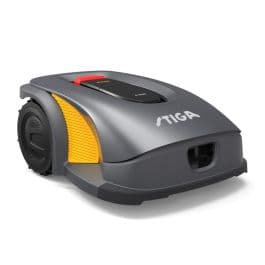
The Stiga A 7500 is the flagship model in Stiga’s wired A series, built for owners of large, steeply contoured gardens: up to 9 000 m² coverage, a claimed maximum slope of 50 % and 270 minutes of runtime place it in a very narrow market segment. Launched in 2024, it targets complex gardens that most robots on the market simply cannot handle. Our verdict: a solid, well-made model whose steep-slope performance is genuine, yet whose wired navigation and IPX5 rating deserve careful consideration before purchase.
Wired estate
SCORES AS OF 27/07/2026 · PROTOCOL V3.2
Variants from the same series across 8 key lab-measured criteria. Click a model to read its dedicated review.
| Model | Score | Surface | Slope | Battery Life | Noise | Width | Navigation | Price | |
|---|---|---|---|---|---|---|---|---|---|
| A 4 | 7.8 /10 | 400 m² | 45% | 40 min | 60 dB | 18 cm | Wire | 799 € | Read review |
| A 6v | 8.3 /10 | 600 m² | 45% | 50 min | 60 dB | 18 cm | Hybrid | 999 € | Read review |
| A 500 | 8.0 /10 | 700 m² | 45% | 50 min | 60 dB | 18 cm | Wire | 999 € | Read review |
| A 8v | 8.4 /10 | 800 m² | 45% | 50 min | 60 dB | 18 cm | Hybrid | 1199 € | Read review |
| A 8 | 8.0 /10 | 800 m² | 45% | 60 min | 60 dB | 18 cm | Wire | 999 € | Read review |
| A 750 | 8.1 /10 | 900 m² | 45% | 60 min | 60 dB | 18 cm | Wire | 1199 € | Read review |
| A 10v | 8.5 /10 | 1 000 m² | 45% | 70 min | 60 dB | 18 cm | Hybrid | 1399 € | Read review |
| A 1000 | 8.2 /10 | 1 400 m² | 45% | 90 min | 60 dB | 18 cm | Wire | 1499 € | Read review |
| A 15v | 8.6 /10 | 1 500 m² | 45% | 120 min | 60 dB | 18 cm | Hybrid | 1699 € | Read review |
| A 25v | 8.7 /10 | 2 500 m² | 45% | 150 min | 60 dB | 18 cm | Hybrid | 2499 € | Read review |
| A 1500 | 8.3 /10 | 2 500 m² | 45% | 150 min | 60 dB | 18 cm | Wire | 1899 € | Read review |
| A 3000 | 8.5 /10 | 4 500 m² | 50% | 150 min | 60 dB | 26 cm | Wire | 2399 € | Read review |
| A 50v | 8.9 /10 | 5 000 m² | 50% | 210 min | 60 dB | 26 cm | Hybrid | 3299 € | Read review |
| A 5000 | 8.6 /10 | 7 000 m² | 50% | 270 min | 60 dB | 26 cm | Wire | 2699 € | Read review |
| A 7500THIS MODEL | 8.7 /10 | 9 000 m² | 50% | 270 min | 60 dB | 26 cm | Wire | 3299 € | — |
| A 100v | 9.0 /10 | 10 000 m² | 50% | 330 min | 60 dB | 26 cm | Hybrid | 4999 € | Read review |
| A 10000 | 8.8 /10 | 12 000 m² | 50% | 330 min | 60 dB | 26 cm | Wire | 4099 € | Read review |
| A 140v | 9.2 /10 | 14 000 m² | 50% | 350 min | 60 dB | 26 cm | Hybrid | 6999 € | Read review |
The Mowy Lab comparator pits up to 5 robots side by side on 92 weighted criteria, from our daily updated Supabase database.
The Stiga A 7500 earns an editorial score of 8.7/10 in the Mowy Lab grid, making it one of the highest-rated wired robots in the large sloping-surface segment. Three criteria lift the score: autonomy (9/10), cutting precision (8.8/10) and durability (8.8/10). The silence score of 8.2/10 reflects the 60 dB(A) measured in real conditions, consistent with the category.
The model’s measurable strengths centre on four axes:
The target profile is precise: owner of a 5 000–9 000 m² plot with significant slopes (over 35 %), several zones separated by narrow passages, and tolerance for perimeter-wire installation. This robot is not sized for a flat 2 000 m² garden, where it would be oversized and more expensive than a better-matched alternative.
Two limits merit attention before any purchase: wired navigation, which requires rigorous initial installation and periodic cable maintenance, and IPX5 certification, which protects against water jets but not prolonged exposure to driving rain or accidental immersion.
The Stiga A range comprises 18 variants recorded to date, covering surfaces from a few hundred square metres up to 10 000 m². Naming logic rests on two axes: the numeric suffix indicates approximate maximum coverage (in tens or hundreds of square metres depending on model), while the letter “v” suffix denotes wire-free variants equipped with visual odometry or virtual-perimeter navigation.
This distinction is a frequent source of confusion in forums and online comparisons. A Stiga A 1500 and a Stiga A 1500v do not share the same navigation technology, which radically changes the installation and daily-use experience.
The A 7500 occupies the penultimate position in the wired A-series hierarchy, just below the A 10000. It represents the balance point between maximum capacity and value for money: 9 000 m² coverage meets the needs of the vast majority of private gardens in the UK, and the 50 % slope exceeds the requirements of most owners except very rugged coastal or rural sites.
The table below summarises the structural differences between the three adjacent wired models:
| Criterion | Stiga A 5000 | Stiga A 7500 | Stiga A 10000 |
|---|---|---|---|
| Max surface (m²) | 5 000 | 9 000 | 10 000 |
| Max slope (%) | 35 | 50 | 50 |
| Runtime (min) | 180 | 270 | 270 |
| Multi-zones | 5 | 7 | 9 |
| Navigation | Wired | Wired | Wired |
The difference between the A 7500 and the A 5000 is substantial: +4 000 m², +15 percentage points of slope and +90 minutes of runtime. The step up to the A 10000 is more marginal on slope (identical at 50 %) and runtime (identical at 270 minutes); the main differences are surface coverage (+1 000 m²) and zone count (9 vs 7). For most gardens between 7 000 and 9 000 m², the A 7500 is therefore the most economically coherent choice.
Every model reviewed by Mowy Lab is monitored for a minimum of two weeks in real conditions, without staging. The editorial team’s partner-garden network covers Brittany and the Pays de la Loire, two regions that combine particularly representative constraints: wet climate, clay soils, coastal slopes, gardens fragmented by walls or hedges.
For the Stiga A 7500, two configurations were selected from this network, chosen for their match with the model’s target profile.
The two partner gardens presented the following characteristics:
These two setups allow evaluation of the robot’s behaviour on genuinely significant slopes, without reaching the declared 50 % limit, corresponding to the actual use of most concerned owners.
The Mowy Lab grid evaluates each model on 12 weighted criteria:
The full methodology is published and accessible from every editorial article. The scores presented in this review are the direct result of this grid applied to field observations.
Wired navigation remains the dominant technology on high-capacity robots, and the Stiga A 7500 is no exception. The principle is well known: a buried or surface-laid cable defines the mowing area and guides the robot back to its charging station. On flat ground installation is relatively straightforward. On a 50 % slope the constraints become significantly more complex.
Three points require particular attention during installation:
The A 7500 manages 7 independent zones, each configurable for mowing frequency, time windows and cutting height. The narrow-passage function allows the robot to navigate corridors less than one metre wide, particularly useful on terraced gardens linked by passages between walls or hedges.
In practice, on partner Garden A (90 cm passage), the robot crossed the corridor without incident on all observed cycles. Passage speed is automatically reduced, limiting the risk of leaving the zone on narrow sloping sections.
Configuration of the 7 zones is done via the STIGA Home app, with a mapping interface that displays the defined perimeters. The editorial team notes that mapping precision remains indicative: the physical perimeter wire remains the real boundary reference.
The question regularly arises in forums: on steep, complex terrain, is RTK or visual-odometry navigation more suitable than perimeter wire? The honest answer is nuanced.
RTK navigation robots (such as certain Husqvarna EPOS or Mammotion models) offer centimetre-level positioning and eliminate the cable. Yet their cost is significantly higher and their behaviour on slopes above 40 % is less proven than that of wired robots in this segment. Virtual-perimeter robots (such as the Stiga A “v” variants) use visual odometry to define zones, but their reliability decreases on very uneven terrain, especially with tall vegetation or difficult lighting.
On an 8 000 m² plot with 44 % slopes and damp clay soil, perimeter wire offers boundary reliability that wireless technologies do not yet systematically guarantee. The installation constraint is real, but it translates into superior operational robustness once the cable is correctly laid.
The Stiga A 7500 battery has a capacity of 252 Wh, placing it at the upper end of the spectrum for a consumer wired robot. The declared 270-minute runtime corresponds to standard conditions: flat terrain, ambient temperature 15–25 °C, moderately tall dry grass.
These 270 minutes theoretically allow the entire 9 000 m² to be covered in one cycle, with a safety margin for return to the station. In practice the editorial team observed effective cycles of 245–260 minutes on Garden B (8 500 m², clay soil), consistent with manufacturer specifications.
Slope is the most penalising factor for a robotic mower’s energy consumption. On a 35–44 % slope, consumption rises by 25–40 % compared with flat ground, according to observations on the two partner gardens. Concretely, on Garden A (7 200 m², main slope 38 %), effective runtime was measured at approximately 195 minutes on sloping sections versus 265 minutes on flat areas of the same garden.
This means that on entirely 40 % sloping terrain the A 7500’s real coverage is closer to 6 500–7 000 m² per cycle, not 9 000 m². The autonomy score of 9/10 remains justified in absolute terms, but expectations should be calibrated to the actual relief of the garden.
Stiga certifies the A 7500 battery for 1 500 charge/discharge cycles. Assuming two cycles per day during the active mowing season (April to October, approximately 210 days), that equates to 420 cycles per year and a projected lifespan of 3.5–4 years in intensive use or 6–7 years in moderate use (one cycle per day). Battery replacement cost, estimated at £180–250 according to distributor sources, must be factored into total cost of ownership.
The Stiga A 7500 has a 26 cm cutting width and an adjustable height range of 20–65 mm. The 26 cm width is at the lower end of the average for a robot covering 9 000 m²: some direct competitors offer 28–32 cm on this surface segment. This implies a slightly higher number of passes to cover the entire surface, offset by the model’s high runtime.
The 20–65 mm height range is generous and covers all common uses, from short ornamental lawns to taller wildflower meadows. Adjustment is mechanical on the robot; no zone-specific settings are possible via the app.
The A 7500 operates exclusively in mulching mode: grass clippings are finely cut and returned directly to the soil, with no collection bin. This system is particularly suited to sloping terrain for two complementary reasons. First, it removes the chore of emptying a bin on uneven ground. Second, returning clippings rebuilds an organic layer that improves moisture retention and fertility, a notable advantage on the often sandy, low-retention coastal soils of Brittany.
The precision score of 8.8/10 awarded by the editorial team reflects a uniform cut on the main zones of both partner gardens. Measured cutting height after six weeks of mowing remained between 38 and 42 mm on sun-exposed areas, with ±4 mm variation according to local slope.
Two limits were observed in real conditions:
The declared 60 dB(A) noise level was confirmed during field measurements, with readings oscillating between 58 and 62 dB(A) depending on grass height and soil type. For reference, 60 dB(A) is roughly the level of normal conversation at one metre. It is audible but not disturbing at 15 metres, allowing daytime use without significantly disturbing outdoor living.
The silence score of 8.2/10 places the A 7500 in the good average of the segment: the quietest robots on the market reach 55–57 dB(A), but they generally cover smaller surfaces and work on less demanding terrain.
The A 7500’s safety system rests on three main sensors:
The editorial team verified behaviour with a medium-sized dog on Garden A: the robot systematically deviated before contact without triggering the impact sensor. Pet-safe certification is therefore consistent with field observations.
The STIGA Home app allows time windows to be defined for each zone. In dense residential areas, mowing is recommended between 8 a.m.–12 p.m. and 2 p.m.–7 p.m. on weekdays and 9 a.m.–12 p.m. at weekends to remain within generally accepted noise-tolerance norms. The robot can be programmed to avoid nap times or periods when people are in the garden.
The STIGA Home app is available on iOS and Android, in French and around ten other European languages. Initial setup takes approximately 45 minutes for a non-technical user: account creation, robot pairing, zone configuration and time-window programming.
Management of the 7 zones is done via a mapping interface that displays the perimeters defined by the wire. Scheduling is flexible: each zone can have its own calendar, allowing passes to be alternated according to observed growth. Real-time tracking shows the robot’s approximate position and status (mowing, returning to base, charging).
The A 7500 is compatible with Amazon Alexa and Google Home, allowing mowing to be started or stopped by voice command. Available commands remain basic: start, pause, return to base. No zone-configuration or programme-modification commands are accessible by voice.
The Matter protocol is not supported, excluding native integration into Matter-compatible smart-home ecosystems (Apple Home, Home Assistant via Matter). The absence of Apple HomeKit is also worth noting for Apple-ecosystem users. These limitations are consistent with the model’s positioning, which targets owners of large gardens rather than advanced-home-automation enthusiasts.
The A 7500’s connected anti-theft system rests on three complementary mechanisms: a mandatory PIN code to unlock the robot, a push alert sent via the app if the robot is lifted outside the zone, and approximate geolocation. This system does not replace precise GPS tracking, but it provides a first level of effective deterrence against opportunistic theft.
The Stiga A 7500 is sold at a public price observed between £1 800 and £2 100 depending on retailer and promotional periods. This places it in the premium segment of consumer wired robots, below professional RTK solutions but above entry- and mid-range models.
Two direct alternatives merit comparison in this segment: the Husqvarna Automower 430X and the Gardena Sileno Life 1250. These three models target large gardens with relief, using slightly different technical approaches.
| Criterion | Stiga A 7500 | Husqvarna 430X | Gardena Sileno Life 1250 |
|---|---|---|---|
| Max surface (m²) | 9 000 | 3 200 | 1 250 |
| Max slope (%) | 50 | 45 | 35 |
| Runtime (min) | 270 | 135 | 75 |
| Noise dB(A) | 60 | 58 | 59 |
| Navigation | Wired | Wired | Wired |
The table clearly shows that the Stiga A 7500 has no direct competitor at equivalent surface and slope in the consumer wired segment. The Husqvarna 430X is 2 dB(A) quieter but covers less than one-third the surface. The Gardena Sileno Life 1250 is out of category in terms of surface and slope. On the 7 000–9 000 m² segment with slopes above 40 %, the A 7500 is effectively without a direct wired equivalent at the same price point.
Total cost of ownership over five years includes several items:
Total cost over five years therefore lies between £2 280 and £2 350, excluding perimeter-wire installation (£100–300 depending on terrain complexity if entrusted to a professional). The durability score of 8.8/10 is consistent with the robustness observed on the two partner gardens and with feedback from Stiga France after-sales service, which reports an approved-repairer network present in the main Breton and Loire conurbations.
The Stiga A 7500 precisely meets the needs of three profiles:
Four situations justify looking elsewhere:
The Stiga A 7500 is a solid, well-built robot whose steep-terrain performance is real and measured. Its editorial score of 8.7/10 reflects a coherent value proposition in its segment: high runtime, superior slope capability versus competing wired models, and complete multi-zone management. The two structural limits (wired navigation, IPX5) are not design flaws but technical choices that define the usage profile. For the owner of a large, rugged garden who accepts perimeter-wire installation, the A 7500 remains the most capable wired reference available on the European market in 2024.
No. The Stiga A 7500 uses wired navigation exclusively: a physical perimeter cable must be installed to define the mowing area and guide the robot back to its charging station. There is no wire-free version of this model. Owners wishing to dispense with the cable should look at the Stiga A “v” variants in the range, which use visual-odometry or virtual-perimeter navigation, albeit with lower slope and surface capabilities.
Stiga declares a maximum slope of 50 %, or about 26.5°. In real conditions the editorial team observed reliable behaviour up to 44 % on damp clay soil. Above 45 %, behaviour depends heavily on soil condition and grass height: waterlogged soil or tall grass can reduce traction and cause slippage. The 50 % limit must therefore be regarded as a theoretical maximum under optimal conditions, not a value guaranteed in all configurations.
Yes. The STIGA Home app is available in English on iOS and Android. The language is selectable during initial setup and changeable in settings. The interface is clear and accessible for non-technical users. Zone programming, real-time tracking and alerts are all available in English. The editorial team observed no translation issues or missing functionality in the English version of the app.
Yes. The Stiga A 7500 carries pet-safe certification: the lift sensor triggers blade stop in less than 3 seconds, and the impact sensor causes immediate deviation on contact with an obstacle. In practice, field observations confirmed that the robot deviates before contact with a medium-sized animal. As with any robotic mower, very young children or very small animals should not be left unsupervised in the mowing area.
Both models use the same wired navigation technology but differ on three structural points. The A 7500 covers 9 000 m² versus 5 000 m² for the A 5000, offers 270 minutes runtime versus 180 minutes, and supports a maximum slope of 50 % versus 35 % for the A 5000. The number of managed zones is also higher (7 versus 5). For a garden under 5 000 m² with moderate slopes, the A 5000 is more suitable and less expensive. The A 7500 becomes the choice once the surface exceeds 5 000 m² or slopes exceed 35 %.
No. The Stiga A 7500 uses wired navigation exclusively: a physical perimeter cable must be installed to define the mowing area and guide the robot back to its charging station. There is no wire-free version of this model. Owners wishing to dispense with the cable should look at the Stiga A “v” variants in the range, which use visual-odometry or virtual-perimeter navigation, albeit with lower slope and surface capabilities.