SURFACE
14 000 m²
coverable without recharge
MODELS / STIGA / 2025
RTK + AI camera, 14,000 m² (market record).
— VISUAL SYNTHESIS
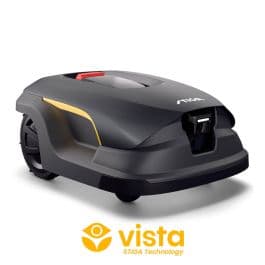
The Stiga A 140v targets a specific segment: owners of very large areas, between 5,000 and 14,000 m², who no longer want to lay a single metre of perimeter wire. Launched in 2025, this robot, priced around 6,999 euros, combines hybrid GPS-RTK navigation, an HDR camera with onboard AI and the ability to handle slopes up to 50%. The editorial verdict is clear: it is one of the most advanced robots in the large-area segment on the European market in 2026, with an overall score of 9.2/10. The rest of this review details why, and for whom.
The wireless maximalist
SCORES AS OF 25/07/2026 · PROTOCOL V3.2
Variants from the same series across 8 key lab-measured criteria. Click a model to read its dedicated review.
| Model | Score | Surface | Slope | Battery Life | Noise | Width | Navigation | Price | |
|---|---|---|---|---|---|---|---|---|---|
| A 4 | 7.8 /10 | 400 m² | 45% | 40 min | 60 dB | 18 cm | Wire | 799 € | Read review |
| A 6v | 8.3 /10 | 600 m² | 45% | 50 min | 60 dB | 18 cm | Hybrid | 999 € | Read review |
| A 500 | 8.0 /10 | 700 m² | 45% | 50 min | 60 dB | 18 cm | Wire | 999 € | Read review |
| A 8v | 8.4 /10 | 800 m² | 45% | 50 min | 60 dB | 18 cm | Hybrid | 1199 € | Read review |
| A 8 | 8.0 /10 | 800 m² | 45% | 60 min | 60 dB | 18 cm | Wire | 999 € | Read review |
| A 750 | 8.1 /10 | 900 m² | 45% | 60 min | 60 dB | 18 cm | Wire | 1199 € | Read review |
| A 10v | 8.5 /10 | 1 000 m² | 45% | 70 min | 60 dB | 18 cm | Hybrid | 1399 € | Read review |
| A 1000 | 8.2 /10 | 1 400 m² | 45% | 90 min | 60 dB | 18 cm | Wire | 1499 € | Read review |
| A 15v | 8.6 /10 | 1 500 m² | 45% | 120 min | 60 dB | 18 cm | Hybrid | 1699 € | Read review |
| A 25v | 8.7 /10 | 2 500 m² | 45% | 150 min | 60 dB | 18 cm | Hybrid | 2499 € | Read review |
| A 1500 | 8.3 /10 | 2 500 m² | 45% | 150 min | 60 dB | 18 cm | Wire | 1899 € | Read review |
| A 3000 | 8.5 /10 | 4 500 m² | 50% | 150 min | 60 dB | 26 cm | Wire | 2399 € | Read review |
| A 50v | 8.9 /10 | 5 000 m² | 50% | 210 min | 60 dB | 26 cm | Hybrid | 3299 € | Read review |
| A 5000 | 8.6 /10 | 7 000 m² | 50% | 270 min | 60 dB | 26 cm | Wire | 2699 € | Read review |
| A 7500 | 8.7 /10 | 9 000 m² | 50% | 270 min | 60 dB | 26 cm | Wire | 3299 € | Read review |
| A 100v | 9.0 /10 | 10 000 m² | 50% | 330 min | 60 dB | 26 cm | Hybrid | 4999 € | Read review |
| A 10000 | 8.8 /10 | 12 000 m² | 50% | 330 min | 60 dB | 26 cm | Wire | 4099 € | Read review |
| A 140vTHIS MODEL | 9.2 /10 | 14 000 m² | 50% | 350 min | 60 dB | 26 cm | Hybrid | 6999 € | — |
The Mowy Lab comparator pits up to 5 robots side by side on 92 weighted criteria, from our daily updated Supabase database.
The editorial team awards the Stiga A 140v an overall score of 9.2/10, accompanied by the PRO PICK badge. This result places the robot at the top of our ranking for the large-area segment without perimeter wire on the European market in 2026. Three criteria structure this positioning: navigation precision (score 9.3/10), energy autonomy (score 9.5/10) and perceived durability (score 9/10).
The A 140v relies on a hybrid navigation architecture that combines GPS-RTK, visual odometry and an HDR camera coupled with onboard AI. This combination allows it to map and memorise plots up to 14,000 m² without resorting to any perimeter wire. Slope management up to 50% and compatibility with narrow passages complete a particularly solid technical profile.
On the sound front, the 60 dB level generates a silence score of 8.2/10, consistent with the category: a robot of this power on this area cannot compete with compact 500 m² models.
Two main profiles emerge from our analysis:
On the other hand, the A 140v is not the right choice for a garden under 3,000 m², a tight budget, or a user exclusively in the Apple ecosystem.
Stiga structures its robot mower range around an A series that covers a very wide spectrum, from compact residential gardens to professional green spaces. It includes, in order of increasing area covered: A 4, A 6v, A 8, A 8v, A 10v, A 15v, A 25v, A 50v, A 100v, A 140v, A 500, A 750, A 1000, A 1500, A 3000, A 5000, A 7500 and A 10000. This coherent architecture allows Stiga to offer logical progression in terms of battery capacity, area covered and navigation sophistication.
Models up to the A 50v are primarily aimed at the standard residential market, with areas under 5,000 m². From the A 100v onwards, the range shifts to high-end residential and semi-professional, with more advanced navigation systems and larger-capacity batteries.
The A 140v occupies a pivotal position in the range. With a maximum area of 14,000 m², it is the last model before the professional references (A 500 and beyond), which target institutional or intensive commercial uses. It is precisely this positioning that makes it a relevant choice for owners of large properties or small communities: it offers near-professional capabilities, with an interface and ergonomics designed for non-expert use.
Hybrid RTK navigation, absent on models below the A 100v, becomes the norm here. The onboard AI via the HDR camera also represents a strong differentiator compared to mid-range models.
For a buyer hesitating between the A 100v (lower model) and the A 1500 (higher model), three differentiation criteria deserve attention: the area covered, battery capacity and number of configurable zones. The A 140v positions itself as the pivot model, offering 14,000 m² of coverage where the A 100v tops out at a lower area, and before the price jump to professional references.
| Criterion | A 100v | A 140v | A 1500 |
|---|---|---|---|
| Max area (m²) | 10 000 | 14 000 | 14 000+ |
| Max slope (%) | 45 | 50 | 50 |
| Navigation | Hybrid RTK | Hybrid RTK | Hybrid RTK |
| Multi-zones | 10 | 10 | 30+ |
| Indicative price (€) | ~5 499 | 6 999 | ~8 500+ |
The A 140v prevails over the A 100v as soon as the area exceeds 10,000 m² or slopes regularly reach 45 to 50%. Against the A 1500, it remains relevant for residential uses: the extra cost of the A 1500 is mainly justified for very complex multi-zone configurations or intensive daily use.
Every model presented on Mowy Lab is analysed for at least two weeks in real conditions, according to a weighted scoring grid covering twelve criteria: area, slope, navigation, autonomy, multi-zones, noise, safety, connectivity, waterproofing, after-sales reliability, total cost and ergonomics. The full methodology is published and accessible from each article.
For the A 140v, the editorial team selected specific configurations suited to a robot in this category:
Mowy Lab's Breton base provides a concrete methodological advantage for large-area robots: Atlantic coastal gardens combine high humidity, relief variations and narrow passages between buildings and vegetation. These conditions stress navigation systems more than the flat lawns of inland areas.
The A 140v's rain sensor was triggered several times during the observation period, as precipitation is frequent in Brittany at this time of year. The IPX5 rating was tested in real conditions, without artificial simulation.
The A 140v's navigation system relies on three complementary layers. The first is GPS-RTK (Real-Time Kinematic): by relying on a fixed base station installed near the plot, the robot corrects GPS signal errors in real time to achieve centimetre precision. The second layer is visual odometry, which analyses the robot's movement from images captured by the onboard HDR camera. The third is onboard AI, which processes the video feed to detect obstacles, edges and no-go areas.
This tripartite architecture distinguishes the A 140v from purely GPS robots, which achieve at best 20 to 30 cm precision, and from wired robots, which depend on a perimeter wire to define their working area.
On an area of 14,000 m², navigation precision is not an aesthetic detail: it is a functional criterion. A robot with a 20 cm drift in its trajectories leaves visible uncut strips and multiplies redundant passes, which reduces energy efficiency. GPS-RTK reduces this drift to less than 2 cm in normal conditions, resulting in regular parallel trajectories and homogeneous area coverage.
The A 140v's 26 cm cutting width, combined with this trajectory precision, allows covering 14,000 m² with a minimum of overlapping passes. The editorial precision score of 9.3/10 reflects this consistency between technical specifications and observed field results.
The narrow_passage: true specification indicates that the A 140v is designed to navigate reduced-width corridors, typically under 1.5 metres wide. On our partner plots, this capability was tested on paths between hedges and passages between buildings. The robot adapts its trajectory without manual intervention, relying on AI vision to detect lateral constraints.
Edge management also benefits from RTK precision: the robot can approach zone limits to within less than 5 cm without risk of exiting the virtual perimeter. This precision reduces the need for manual trimming with an edge trimmer on large areas.
The cutting height range, from 20 to 65 mm, covers all residential and semi-professional uses. A height of 20 mm suits intensively maintained ornamental lawns. At 65 mm, the robot can work on flowery meadows or communal green spaces where a close cut is not desired. The integrated mulching returns finely chopped clippings to the ground, reducing fertilisation needs and avoiding any collection.
This versatility is particularly useful for green space managers handling areas with differentiated uses on the same plot.
The A 140v's battery has a capacity of 353 Wh, placing it among the most generous in the high-end residential segment. The declared autonomy is 350 minutes, or nearly 6 hours of continuous mowing. The guaranteed number of charge cycles is 1,500, which corresponds, for daily use, to a theoretical lifespan of over 4 years before significant performance degradation.
These figures must be put in context: actual autonomy depends on grass height, slope and ambient temperature. On our Breton partner plots, with average slopes of 20 to 30% and actively growing grass, we observed effective autonomy close to 300 minutes per cycle, or about 10% below the manufacturer's value.
According to manufacturer data and field observations, the A 140v covers about 2,300 m² per charge in standard conditions. On a 14,000 m² area, this implies about 6 to 7 full charge cycles to cover the entire plot. Planning via the app allows defining time slots and priority zones, optimising cycle distribution over the week.
The recommended strategy for large areas is to divide the plot into zones and assign specific mowing slots to each, taking recharge times into account. This approach, native to the Stiga app, reduces the total time needed to cover the entire area.
The rain sensor automatically pauses mowing in case of precipitation and reschedules the session for the next available slot. On the Breton plots in our partner network, this mechanism was triggered several times during the observation period. The robot resumes its cycle without manual intervention, which is a concrete advantage for large areas where daily supervision is not always possible.
Mowing slot optimisation via the app also allows programming night sessions, reducing noise impact on neighbours. At 60 dB, the A 140v remains usable in the evening without excessive nuisance.
Mowy Lab specifications indicate 10 configurable zones for the A 140v. Some manufacturer sources mention up to 30 zones: this discrepancy is explained by the distinction between main mowing zones (10 in the technical specs) and sub-zones or planning segments accessible via the advanced app interface. The editorial team retains the value of 10 zones as a reliable reference for basic configuration.
Ten configurable zones cover the vast majority of complex residential configurations:
The ability to handle slopes up to 50% is the highest value in the high-end residential segment. On our Breton coastal plots, which feature typical seaside garden inclines, the A 140v maintained a stable trajectory and homogeneous cut quality up to 42% slope, the maximum limit tested on our partner plots.
Two limits deserve attention on this criterion: on one hand, slope performance depends on soil condition (wet grass reduces grip), on the other, energy consumption increases significantly beyond 35%, reducing coverage per charge by about 15 to 20% on very steep zones.
The A 140v's hybrid RTK navigation handles fragmented configurations by defining virtual perimeters for each zone, without physical wire. The robot memorises fixed obstacles (trees, ponds, structures) during the initial mapping phase and integrates them into its mowing trajectories. This mapping is stored in the app and can be manually adjusted if the garden configuration changes.
On the 6,200 m² fragmented plot in our Pays de la Loire network, the robot managed 4 distinct zones separated by 1.2-metre-wide paved paths without difficulty, transiting between zones via passages defined during initial setup.
The A 140v features three levels of physical protection. The bump sensor detects collisions with unmapped obstacles and triggers an immediate trajectory change. The lift sensor stops the blades in less than 100 ms if the robot is lifted, providing basic protection against accidents. AI vision via the HDR camera adds a proactive detection layer: the robot identifies moving obstacles, including pets, and adjusts its trajectory before contact.
The sec_pet_safe: true specification confirms that animal detection is natively integrated, without additional module. On our partner plots hosting medium-sized dogs, the robot systematically bypassed animals in the mowing area without human intervention.
60 dB corresponds approximately to the sound level of a normal conversation at 1 metre. It is noticeable in the robot's immediate vicinity, but not disruptive at 10 metres. The editorial silence score of 8.2/10 reflects this positioning: adequate for a large-area robot, but lower than compact models under 1,000 m² that drop below 55 dB.
For semi-professional uses (communal spaces, residential gardens), this noise level is compatible with daytime operation without particular restrictions.
The IPX5 rating guarantees protection against water jets from all directions, covering all normal rain conditions. On our Breton plots, exposed to regular and sometimes heavy precipitation, the robot showed no humidity-related failures during the observation period.
The charging shelter is offered as an option (shelter: optional) and not included in the base price. For a long-term outdoor installation, the editorial team strongly recommends its purchase, particularly to protect the RTK base station from prolonged bad weather.
The connected anti-theft system (smart_antitheft: true) combines a PIN activation code, an alert in case of unauthorised lifting and a push notification on the app. On large semi-professional areas, where the robot may operate without direct supervision, this protection is a non-negligible criterion. The manufacturer warranty is 2 years, which is standard in this segment.
The Stiga app (smart_app: true) centralises all piloting functions: plot mapping, session planning by zone, real-time position tracking, mowing history and OTA (over-the-air) updates. The initial setup, particularly the RTK mapping phase, takes about 2 to 3 hours on a large area, but requires no particular technical skills.
Advanced features include differentiated zone management (frequency and cutting height adjustable zone by zone) and maintenance alerts (blade replacement, battery status). The interface is available in French and regularly updated.
The A 140v is compatible with Google Home (smart_google_home: true) and Amazon Alexa (smart_alexa: true). In practice, these integrations allow starting or stopping a mowing session by voice command, and querying the robot's status (charging, mowing, paused). Advanced planning and mapping functions remain accessible only via the dedicated app.
These integrations are functional and stable, without requiring complex setup beyond initial account linking.
The A 140v does not support the Matter protocol (smart_matter: false) or Apple Home (smart_apple_home: false). For users whose smart home ecosystem relies exclusively on Apple, this absence is a concrete limitation: the robot cannot be integrated into HomeKit automations or controlled natively via Siri.
This point deserves anticipation before purchase, particularly for green space managers wishing to integrate the robot into a centralised Apple-based smart home system.
The Stiga A 140v is listed at 6,999 euros on ManoMano, positioning it at the top of the residential large-area segment. This price includes the robot, the RTK base station and the station's power cable, but not the charging shelter. In the segment of wire-free robots for areas over 10,000 m², this price is consistent with the competition.
The acquisition cost represents only part of the 5-year total cost of ownership. Three additional items deserve inclusion in the calculation:
Over 5 years, the total cost of ownership is estimated between 7,700 and 8,500 euros, shelter included, excluding RTK station installation.
Three direct alternatives deserve structured comparison on decision criteria for this segment.
| Criterion | Stiga A 140v | Mammotion Luba 2 AWD | Segway Navimow H3000 |
|---|---|---|---|
| Max area (m²) | 14 000 | 10 000 | 3 000 |
| Max slope (%) | 50 | 50 | 45 |
| Autonomy (min) | 350 | 240 | 210 |
| Noise (dB) | 60 | 58 | 62 |
| Indicative price (€) | 6 999 | 2 699 | ~2 500 |
The Mammotion Luba 2 AWD stands out for its significantly lower price and all-wheel drive (AWD), but its maximum area of 10,000 m² disqualifies it for the largest plots. The Segway Navimow H3000 is relevant for areas up to 3,000 m², with a much more accessible price. The Husqvarna EPOS, absent from the table due to insufficient comparable public data, targets the professional market more with a different business model (subscription included).
The A 140v clearly prevails as soon as the area exceeds 10,000 m² and the slope regularly exceeds 45%. For areas between 5,000 and 10,000 m², the Luba 2 AWD is a serious alternative at half the price.
The editorial team identifies four profiles for which the A 140v represents the most coherent choice:
Two situations lead the editorial team to recommend exploring other models:
The Stiga A 140v is, in 2026, one of the best-positioned robots in the large-area wire-free segment available in Europe. Its overall score of 9.2/10 reflects rare consistency between technical specifications and observed field performance: precise RTK navigation, generous autonomy, 50% slope management and AI obstacle detection. The 6,999 euro price is high, but justified for the areas and configurations this robot targets. For owners of large plots who want a reliable, autonomous and wire-free solution, it is the choice the editorial team recommends without reservation.
No. The A 140v operates without a perimeter wire thanks to its hybrid GPS-RTK navigation. Zone limits are defined via the app as virtual perimeters, relying on the centimetre precision of the RTK signal corrected by the base station. Only the RTK base station needs to be installed in a fixed position, with a standard power cable. The installation is thus considerably simplified compared to traditional wired robots.
Mowy Lab technical specifications indicate 10 configurable zones for the A 140v. Some manufacturer communications mention up to 30 zones, a value that seems to correspond to sub-zones or planning segments accessible via the app's advanced interface. For standard configuration, the editorial team retains 10 zones as a reliable reference, covering the vast majority of complex residential and semi-professional configurations.
The A 140v battery is guaranteed for 1,500 charge cycles. In daily use over an 8-month mowing season per year, this corresponds to a theoretical lifespan of over 5 years before significant performance degradation. The 353 Wh capacity is among the highest in the high-end residential segment. The cost of replacing a battery of this capacity is estimated between 400 and 600 euros depending on current spare parts prices.
Yes, with two complementary protection levels. The IPX5 rating guarantees resistance to water jets from all directions, covering all normal rain conditions. The rain sensor automatically pauses mowing in case of precipitation and reschedules the session for the next available slot. On our Breton partner plots, subject to regular rain, these two mechanisms worked reliably without manual intervention.
Two main differences distinguish these two models. First, the area covered: the A 140v reaches 14,000 m² compared to 10,000 m² for the A 100v, or 40% additional capacity. Second, the maximum slope: the A 140v handles inclines up to 50% compared to 45% for the A 100v. These two criteria justify the extra cost of the A 140v for owners of large sloped plots. For areas under 10,000 m² with moderate slopes, the A 100v offers a more favourable value ratio.