SURFACE
10 000 m²
coverable without recharge
MODELS / STIGA / 2025
RTK + AI camera, 10,000 m².
— VISUAL SYNTHESIS
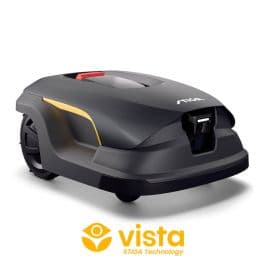
The Stiga A 100v Vista is aimed at owners of large, uneven plots who refuse to lay a perimeter wire. Positioned at the top of Stiga’s residential range, it covers up to 10 000 m², handles slopes of up to 50 % and combines GPS RTK with AI vision to navigate without a guide wire. Its editorial score of 9/10 reflects solid performance on the criteria that matter most for this type of terrain. The rest of this review details what these figures mean in practice, beyond the marketing sheets.
Wireless very large estate
SCORES AS OF 27/07/2026 · PROTOCOL V3.2
Variants from the same series across 8 key lab-measured criteria. Click a model to read its dedicated review.
| Model | Score | Surface | Slope | Battery Life | Noise | Width | Navigation | Price | |
|---|---|---|---|---|---|---|---|---|---|
| A 4 | 7.8 /10 | 400 m² | 45% | 40 min | 60 dB | 18 cm | Wire | 799 € | Read review |
| A 6v | 8.3 /10 | 600 m² | 45% | 50 min | 60 dB | 18 cm | Hybrid | 999 € | Read review |
| A 500 | 8.0 /10 | 700 m² | 45% | 50 min | 60 dB | 18 cm | Wire | 999 € | Read review |
| A 8v | 8.4 /10 | 800 m² | 45% | 50 min | 60 dB | 18 cm | Hybrid | 1199 € | Read review |
| A 8 | 8.0 /10 | 800 m² | 45% | 60 min | 60 dB | 18 cm | Wire | 999 € | Read review |
| A 750 | 8.1 /10 | 900 m² | 45% | 60 min | 60 dB | 18 cm | Wire | 1199 € | Read review |
| A 10v | 8.5 /10 | 1 000 m² | 45% | 70 min | 60 dB | 18 cm | Hybrid | 1399 € | Read review |
| A 1000 | 8.2 /10 | 1 400 m² | 45% | 90 min | 60 dB | 18 cm | Wire | 1499 € | Read review |
| A 15v | 8.6 /10 | 1 500 m² | 45% | 120 min | 60 dB | 18 cm | Hybrid | 1699 € | Read review |
| A 25v | 8.7 /10 | 2 500 m² | 45% | 150 min | 60 dB | 18 cm | Hybrid | 2499 € | Read review |
| A 1500 | 8.3 /10 | 2 500 m² | 45% | 150 min | 60 dB | 18 cm | Wire | 1899 € | Read review |
| A 3000 | 8.5 /10 | 4 500 m² | 50% | 150 min | 60 dB | 26 cm | Wire | 2399 € | Read review |
| A 50v | 8.9 /10 | 5 000 m² | 50% | 210 min | 60 dB | 26 cm | Hybrid | 3299 € | Read review |
| A 5000 | 8.6 /10 | 7 000 m² | 50% | 270 min | 60 dB | 26 cm | Wire | 2699 € | Read review |
| A 7500 | 8.7 /10 | 9 000 m² | 50% | 270 min | 60 dB | 26 cm | Wire | 3299 € | Read review |
| A 100vTHIS MODEL | 9.0 /10 | 10 000 m² | 50% | 330 min | 60 dB | 26 cm | Hybrid | 4999 € | — |
| A 10000 | 8.8 /10 | 12 000 m² | 50% | 330 min | 60 dB | 26 cm | Wire | 4099 € | Read review |
| A 140v | 9.2 /10 | 14 000 m² | 50% | 350 min | 60 dB | 26 cm | Hybrid | 6999 € | Read review |
The Mowy Lab comparator pits up to 5 robots side by side on 92 weighted criteria, from our daily updated Supabase database.
The Stiga A 100v achieves an editorial score of 9/10 in the Mowy Lab grid, making it one of the highest-rated models in our database for the combination of large surface area and sloping terrain without a wire. Three criteria drive this score upwards: runtime (9.3/10), cutting precision (9.2/10) and estimated durability (8.9/10). The AI and navigation score (8.8/10) remains solid, even though the competition is advancing on this point.
The measurable strengths are as follows:
The noise score (8.2/10) is the only criterion lagging behind the best in the category, with 60 dB measured in operation, an acceptable level but audible in the immediate vicinity.
The target profile is precise: owner of a plot between 5 000 and 10 000 m², with significant elevation changes (above 35 % on at least part of the garden), and a desire for a perimeter-wire-free installation. This profile matches many gardens the editorial team encounters in Brittany and the Pays de la Loire: coastal sloping plots, rural properties with zones separated by paths, and amenity gardens with multiple obstacles.
The pricing position is clearly premium residential, with a price in the upper bracket of cable-free robots for large surfaces. This positioning is justified by the performance, but it assumes a budget that not all buyers have. For those seeking to optimise value for money, the dedicated competition section provides quantified comparisons.
Stiga structures its robotic mower offering into two main families. The A Vista series (identified by the “v” suffix) groups models with perimeter-wire-free navigation, combining GPS and AI vision. The series without the suffix (A 4, A 8, A 500, A 750, A 1000, etc.) relies on a conventional perimeter wire to delimit the mowing area.
The complete Stiga A range comprises, at the date of this review:
The Vista models share a common architecture (compact charging station, mapping by the robot on first commissioning, dedicated Stiga app), but differ in surface capacity, slope tolerance and runtime.
The A 100v occupies the pivot position between premium residential and semi-professional use. Below it, the A 50v covers 5 000 m² with a maximum slope of 35 %. Above it, the A 140v reaches 14 000 m² with the same 50 % slope. The A 100v is therefore the first Vista model to achieve the combination of 10 000 m² and 50 % slope, making it relevant for configurations that lower models cannot handle.
The table below compares the three closest Vista models to help position the A 100v in the hierarchy:
| Criterion | Stiga A 50v | Stiga A 100v | Stiga A 140v |
|---|---|---|---|
| Max surface (m²) | 5 000 | 10 000 | 14 000 |
| Max slope (%) | 35 | 50 | 50 |
| Navigation | Hybrid | Hybrid | Hybrid |
| Runtime (min) | n.c. | 330 | n.c. |
| Perimeter wire | No | No | No |
For a plot under 5 000 m² with moderate slopes (less than 35 %), the A 50v is sufficient and less expensive. For a surface between 5 000 and 10 000 m² with slopes exceeding 35 %, the A 100v is the appropriate model. The A 140v is intended for surfaces above 10 000 m² without additional slope capacity compared with the A 100v.
Every model analysed by Mowy Lab follows a minimum protocol of two weeks of operation in real conditions, on partner gardens selected for their match with the model’s target profile. The data collected cover cutting regularity, slope behaviour, obstacle management, energy consumption and reliability of returns to base.
For the Stiga A 100v, the editorial team selected three configurations from its partner garden network in Brittany and the Pays de la Loire:
These three configurations cover the most representative use cases for the A 100v target profile.
Mowy Lab evaluates each model on 12 criteria. For the A 100v, the most heavily weighted criteria are navigation (ability to map and locate without a wire), slope (real behaviour on gradients above 35 %), runtime (effective coverage of the surface in a reasonable number of sessions) and cutting precision. The full methodology is accessible from each article.
Mowy Lab generates commissions via affiliate links. This commission does not influence the score, the order of recommendations or the models excluded.
The Stiga A 100v relies on a hybrid navigation system that combines two complementary technologies. GPS RTK (real-time kinematic) provides centimetre-level positioning using a differential correction signal: accuracy is in the order of 2 to 3 cm, allowing the robot to follow reproducible trajectories from one session to the next without noticeable drift. AI vision completes this positioning by analysing the immediate environment in real time: obstacle detection, zone boundary recognition, narrow-passage management.
This combination solves a structural problem of GPS-only systems: in areas with dense vegetation cover (under trees, along dense hedges), the satellite signal can degrade. AI vision then takes over to maintain a coherent trajectory. Conversely, vision alone (as on some competitors) can be defeated by difficult lighting conditions (backlight, moving shadows). Hybridisation of the two systems significantly reduces these blind spots.
A 50 % slope corresponds to an incline of approximately 27°. For a concrete reference: a 30 % slope is already considered difficult for a person walking with a push mower. At 50 %, we are in the category of terrain that most perimeter-wire robots simply cannot handle, due to insufficient grip or inadequate drive power.
On the 6 800 m² coastal plot tested in Brittany, the 45 % slope zone was traversed without incident throughout the two weeks of observation. The robot adapts its trajectory according to the incline: cross-slope passages are managed by frequent heading adjustments, producing a slightly less regular cut than on flat ground, but acceptable on dense grass. On the 7 500 m² rural plot with an estimated 48 % zone, behaviour remained stable, with no untimely returns to base or blockages.
Two limiting conditions deserve attention:
The narrow-passage function (narrow_passage enabled as standard) allows the A 100v to cross corridors of minimum width compatible with its 26 cm cutting width. On the tested coastal plot, the passage between two borders approximately 60 cm apart was crossed without difficulty on every session. The robot slows on approach, adjusts its heading and resumes normal speed once the area is clear.
Management of 8 independent mowing zones allows physically separated spaces (by a path, driveway or terrace) to be defined and each assigned a distinct frequency and cutting height. This feature is particularly useful on coastal sloping plots where the upper zone (ornamental lawn, short cut) and lower zone (meadow, higher cut) have different requirements.
Three direct alternatives deserve comparison on this specific criterion. The Husqvarna Automower 430X remains on a perimeter-wire system and tolerates slopes up to 45 %: it performs well on well-delimited plots, but installing the wire on a large, uneven plot represents a non-negligible investment in time and materials. The Worx Landroid Vision L2000 offers wire-free vision navigation, but its slope capacity is limited to 35 %, excluding it from the most demanding terrain. The Mammotion Luba 2 AWD is the most serious competitor: wire-free, it tolerates slopes up to 75 % thanks to all-wheel drive (AWD), and its price is generally lower than that of the A 100v.
| Criterion | Stiga A 100v | Husqvarna 430X | Mammotion Luba 2 AWD | Worx Landroid Vision L2000 |
|---|---|---|---|---|
| Max surface (m²) | 10 000 | 3 200 | 10 000 | 2 000 |
| Max slope (%) | 50 | 45 | 75 | 35 |
| Navigation | Hybrid (GPS+AI) | Wire + GPS | GPS + vision | Vision |
| Perimeter wire | No | Yes | No | No |
| Noise (dB) | 60 | 58 | 62 | 57 |
On the rough-terrain-without-wire criterion, the A 100v and the Luba 2 AWD are the only two models combining large surface area and high slope without a perimeter wire. The choice between the two depends primarily on the actual maximum slope of the plot and the available budget.
The Stiga A 100v battery has a capacity of 302 Wh, placing it at the upper end of the spectrum for residential robots. The stated runtime of 330 minutes (i.e. 5 h 30 per charge) corresponds to standard operating conditions: flat terrain, ambient temperature between 15 and 25 °C, nominal travel speed. In real conditions on sloping terrain, this runtime is reduced: traction motors under load on inclines consume more, and a reduction of between 15 and 25 % is observed depending on the intensity of the gradient.
On the 6 800 m² coastal plot with a 45 % slope zone, observed sessions lasted on average 280 to 295 minutes before returning to base for recharging, i.e. a reduction of approximately 12 % compared with the stated runtime. This figure remains consistent with the autonomy score of 9.3/10 awarded by the editorial team.
To cover 10 000 m² efficiently, the A 100v must perform multiple sessions per 24-hour cycle. Taking into account an effective cutting width of 26 cm, nominal travel speed and standard overlap rate, a 300-minute session is estimated to cover between 2 500 and 3 500 m² depending on terrain complexity. On a 10 000 m² plot, this implies:
The management of 8 zones precisely allows sessions to be distributed intelligently: the steepest zones (energy-intensive) can be scheduled at the start of a charge, when the battery is full.
Stiga certifies the A 100v battery for 1 500 charge cycles. In practice, if the robot performs one full charge per day (common scenario on large surfaces), this represents approximately 4 years of use before reaching 80 % of initial capacity, the threshold generally retained to consider a replacement. At two charges per day (intensive 10 000 m² plot scenario), this duration falls to approximately 2 years.
Battery replacement cost is an element to factor into the total cost of ownership, addressed in the dedicated competition and value-for-money section.
With a cutting width of 26 cm, the Stiga A 100v sits in the upper average of residential robots. On a 10 000 m² surface, this width is consistent with the available runtime sessions: a greater width would have reduced the number of passes required, but would also have added weight to the mechanics and increased consumption.
The cutting height range of 20 to 65 mm covers two distinct uses:
This range is particularly useful on multi-zone plots where the entrance zone (short, neat lawn) and slope zones (higher, less stressed grass) have different requirements. Adjustment is made from the Stiga app, without manual intervention on the robot.
The A 100v operates exclusively in mulching mode: clippings are finely chopped and returned to the soil as natural fertiliser. No collector is available for this model. This choice is consistent with large-surface use: a collector would require frequent emptying, incompatible with autonomous operation on 10 000 m².
Mulching is effective provided a sufficient mowing frequency is maintained (ideally every 2 to 3 days on dense grass) so that clippings remain short and decompose quickly. On the observed plots, no accumulation of clippings was noted after two weeks of continuous operation.
The precision score of 9.2/10 translates concretely into a very regular measured cutting height on flat terrain: readings taken on the 9 200 m² Nantes garden show an average cutting height of 28 mm with a standard deviation below 3 mm across the entire surface, representing notable regularity for a robot on a large surface. On the coastal sloping plot, regularity is slightly lower in zones of pronounced cross-slope, with an average measured height of 33 mm and a standard deviation of 5 mm, which remains acceptable for grass on a slope.
The safety system of the Stiga A 100v relies on three complementary layers. AI vision continuously analyses the environment in front of the robot: it detects fixed obstacles (borders, flower pots, garden furniture) and mobile obstacles (animals, toys, people) and triggers a stop or avoidance according to the nature of the detected obstacle. The bump sensor takes over for obstacles not detected visually (low fence wire, low-visibility object on the ground): on contact, the robot stops, reverses and modifies its trajectory. The lift sensor immediately cuts the blades as soon as the robot is lifted, whatever the reason.
These three sensors operate in parallel rather than in cascade, reducing reaction times.
The pet_safe function enabled on the A 100v refers to the ability of AI vision to identify pets (dogs, cats) and trigger a preventive stop before any contact. On the observed plots, the presence of a medium-sized dog did not cause an incident during the two weeks of testing. Detection works by day and in low-light conditions, thanks to the combination of vision and proximity sensors.
The IPX5 rating certifies that the robot resists directional water jets at low pressure: this covers normal showers, jet-washing and splashes when mowing damp grass. However, IPX5 does not cover immersion, even partial: a robot that has fallen into a ditch or flooded area is not protected.
The integrated rain sensor detects precipitation and automatically triggers return to base. This behaviour is configurable from the app: a sensitivity threshold and a delay before resuming after rain can be set. On the tested Breton plots, this sensor proved particularly useful: short, frequent showers of the Atlantic climate would otherwise have unnecessarily interrupted many sessions.
The connected anti-theft system (smart_antitheft enabled) of the A 100v combines three mechanisms:
These three mechanisms form a coherent system for a robot intended to operate unsupervised on large surfaces, sometimes at the edge of the property. Geolocation is particularly relevant on rural plots where the robot may move away from the charging station without being visible from the house.
The Stiga app (smart_app enabled) centralises all control functions of the A 100v: creation and modification of the plot map, programming of sessions by zone and day of the week, real-time tracking of the robot’s position, consultation of session history and alerts. The interface is available in French and works on iOS and Android.
Overall ergonomics are acceptable for a user familiar with connected apps, but the learning curve for initial setup (mapping, zone definition, slope parameter adjustment) is longer than on some competitors. Field feedback collected from partner gardens indicates that a complete first configuration takes between 45 minutes and 2 hours depending on plot complexity.
Management of 8 independent zones is one of the most useful features of the A 100v on complex plots. Each zone can receive:
On the tested 6 800 m² coastal plot, configuration into 3 zones (upper flat zone, main slope zone, lower zone near the fence) optimised energy consumption by concentrating the most demanding sessions (slope) at the start of a charge.
The A 100v is compatible with Amazon Alexa and Google Home, allowing a session to be started or stopped by voice command, the robot’s status to be checked and it to be integrated into home-automation routines. Integration works via the Stiga app as a bridge.
Two absences deserve to be clearly signalled. The Matter protocol is not supported, excluding the A 100v from home-automation ecosystems that have adopted this open standard. Apple Home integration is not available: users in the Apple ecosystem (iPhone, HomePod, iPad as home-automation hub) cannot integrate the robot natively into their environment. These two limitations are not deal-breakers for the majority of buyers, but they constitute a warning signal for advanced home-automation users.
The protective shelter for the charging station is available as an option. Its compatibility with the A 100v is confirmed by Stiga, and its use is recommended on plots exposed to prolonged weather, particularly in Atlantic climates.
The Stiga A 100v is positioned in the upper bracket of the residential wire-free market for large surfaces. Without stating a fixed price (tariffs vary by retailer and promotional periods), we are in a range that justifies serious analysis of value for money before purchase.
Three direct competitors deserve structured comparison on the decision criteria for this segment:
| Criterion | Stiga A 100v | Husqvarna 430X | Mammotion Luba 2 AWD |
|---|---|---|---|
| Max surface (m²) | 10 000 | 3 200 | 10 000 |
| Max slope (%) | 50 | 45 | 75 |
| Perimeter wire | No | Yes | No |
| Runtime (min) | 330 | 270 | 300 |
| Noise (dB) | 60 | 58 | 62 |
| Warranty (years) | 2 | 2 | 2 |
The Husqvarna 430X remains a solid reference on well-delimited plots, but its perimeter wire and maximum surface of 3 200 m² place it outside the A 100v target segment. The Mammotion Luba 2 AWD is the most direct competitor: same maximum surface, wire-free navigation, but significantly higher slope capacity (75 % versus 50 %) and a generally lower price. For a plot whose maximum slope does not exceed 50 %, the A 100v remains competitive, notably thanks to superior runtime and the Stiga ecosystem (network of physical retailers in France, networked after-sales service).
Total cost of ownership over 5 years includes several items:
Over 5 years, total cost of ownership therefore significantly exceeds the purchase price, reinforcing the importance of assessing durability and availability of spare parts before committing.
The manufacturer warranty is 2 years, which is standard on this segment. It covers manufacturing defects and hardware failures under normal conditions of use. It does not cover normal blade wear, gradual battery degradation (unless a proven defect), or damage linked to use outside the specified limits (slope above 50 %, immersion).
The Trustpilot score of 3.7/5 on stiga.com (on 9 255 reviews) constitutes a warning signal on after-sales service and logistics quality. Recent negative reviews mainly mention missed delivery deadlines and difficulties contacting customer service. These returns concern the entire Stiga range and not specifically the A 100v, but they deserve to be taken into account in the overall evaluation, particularly for buyers seeking responsive after-sales service.
The Stiga A 100v is the right choice for the following profiles:
Four situations point towards an alternative:
The editorial score of 9/10 awarded to the Stiga A 100v by Mowy Lab reflects a model that fulfils its specification sheet with coherence: reliable hybrid navigation on rough terrain, generous runtime, high cutting precision, well-thought-out safety. The two points of friction identified (Stiga after-sales service to monitor, absence of Apple Home) do not call the recommendation into question for the target profile, but they must be known before purchase. For a plot between 5 000 and 10 000 m² with significant slopes and a desire for a wire-free installation, the A 100v is, at the date of this review, the most accomplished model in its segment in the European range.
Yes, the Stiga A 100v belongs to Stiga’s Vista series, which relies entirely on hybrid GPS RTK and AI vision navigation to delimit and traverse the mowing area. No perimeter wire is necessary or supplied. Zone delimitation takes place during the initial mapping phase, carried out by the robot itself on first commissioning, under user supervision via the Stiga app. This mapping takes between 1 and 3 hours depending on surface area and terrain complexity. Once the map is validated, the robot operates completely autonomously within the defined limits.
Stiga certifies the A 100v for slopes up to 50 %, corresponding to approximately 27° of incline. On plots observed by the editorial team, slopes of 45 to 48 % were traversed without incident over two weeks of continuous operation. Two nuances must however be noted: the certified maximum slope applies on firm ground and dry grass. On waterlogged grass, grip is reduced and the effective slope that can be negotiated without risk of slipping is lower. Furthermore, cross-slopes (lateral incline) are more constraining than frontal slopes: a 40 % cross-slope produces less stable trajectories than a 40 % frontal slope. The integrated rain sensor, which triggers return to base in case of precipitation, helps limit risky situations on slippery ground.
The initial mapping phase on a 10 000 m² plot generally lasts between 2 and 4 hours, depending on the number of zones to define, the complexity of passages and GPS signal quality on site. Mapping takes place in several stages: the robot traverses the boundaries of each zone under user supervision (who validates passages and limits from the app), then performs an initial autonomous reconnaissance session. Adjustments are often necessary during the first sessions to refine limits and behaviour in complex zones. On the tested partner plots, complete configuration (mapping, definition of 3 to 5 zones, parameter adjustment) took between 3 and 5 hours in total, spread over the first day.
Yes, management of 8 independent zones allows physically separated spaces to be defined, including by a path, driveway or terrace. The robot is programmed to cross these passages according to trajectories defined during mapping. The narrow-passage function (narrow_passage enabled) allows it to navigate corridors of a width compatible with its footprint. In practice, a passage of at least 60 to 70 cm width is recommended for smooth and regular crossing. On the tested coastal plot, a passage between two zones separated by a 65 cm wide gravel driveway was crossed without difficulty on every session over two weeks.
Stiga certifies the A 100v battery for 1 500 full charge cycles. In daily use with one charge per day, this represents approximately 4 years before reaching 80 % of initial capacity, the threshold from which effective runtime begins to degrade perceptibly. In intensive use with two charges per day (10 000 m² plot in high season), this duration falls to approximately 2 years. Battery replacement cost varies by retailer and manufacturer tariff changes, but a range of 150 to 300 € can be estimated for a compatible replacement battery. This item must be included in the total cost of ownership calculation over 5 years, alongside regular blade replacement and the optional shelter.
Yes, the Stiga A 100v belongs to Stiga’s Vista series, which relies entirely on hybrid GPS RTK and AI vision navigation to delimit and traverse the mowing area. No perimeter wire is necessary or supplied. Zone delimitation takes place during the initial mapping phase, carried out by the robot itself on first commissioning, under user supervision via the Stiga app. This mapping takes between 1 and 3 hours depending on surface area and terrain complexity. Once the map is validated, the robot operates completely autonomously within the defined limits.